


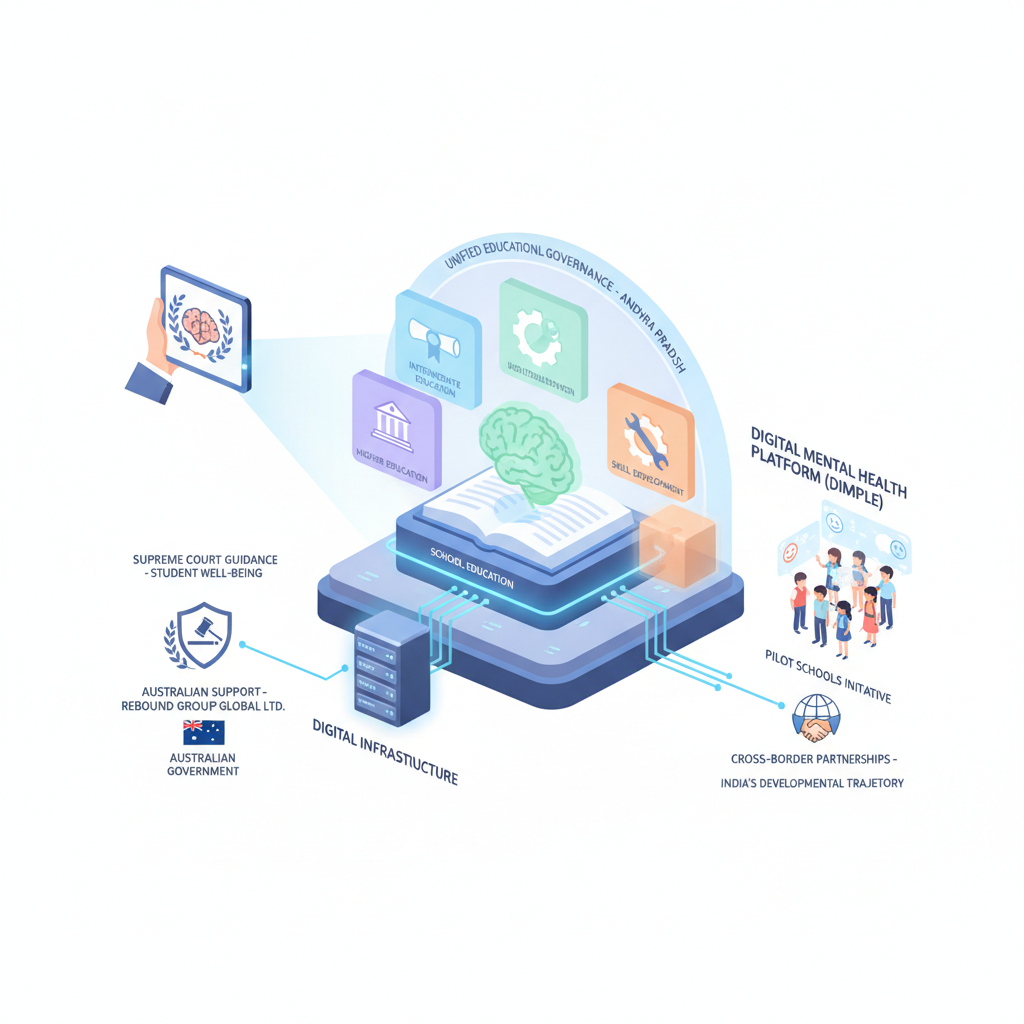
08 Aug Andhra Pradesh Launches DIMPLE: India’s First Digital Mental Health Platform for Schools
Digital Mental Health PlatformPilot initiativeSchool education systemCross-border partnershipStudent well-being program✎ DIMPLE represents a pioneering effort to integrate digital mental health interventions into India’s school education system, leveraging cross-border expertise to address the critical yet often neglected aspect of student…
Subject Relevance — Where This Topic Fits
- GS Paper II — International Relations (India-Australia bilateral cooperation in education and health) | GS Paper IV — Ethics, Integrity and Aptitude (Role of technology in addressing social issues, ethical considerations in digital health interventions) | GS Paper III — Science and Technology (Role of digital platforms in public health, AI and data privacy concerns)
- Prelims: Digital Mental Health Platform (DIMPLE), Learning Excellence in Andhra Pradesh (LEAP), Human Resource Development (HRD) Department, Andhra Pradesh, Supreme Court directives on student mental health, Samagra Shiksha Abhiyan, SCERT (State Council of Educational Research and Training), Rebound Group Global Ltd., Australia-India educational partnerships
- Essay: The intersection of technology and human welfare: A case study of Andhra Pradesh’s digital mental health initiative, Reimagining education: Balancing academic excellence and holistic student development
Quick Revision: DIMPLE represents a pioneering effort to integrate digital mental health interventions into India’s school education system, leveraging cross-border expertise to address the critical yet often neglected aspect of student well-being.
Why is this in the news?
The Government of Andhra Pradesh, in collaboration with Australia’s Rebound Group Global Ltd. and the Australian Government, has launched the Digital Mental Health Platform (DIMPLE) as a pilot initiative in selected schools. This initiative underscores the State’s commitment to integrating mental health into educational governance, aligning with the Supreme Court’s emphasis on student well-being and the broader national discourse on digital public health interventions. The launch, attended by high-level delegations from both countries, highlights the growing emphasis on cross-border educational and health partnerships in India’s developmental trajectory.
Background
- The Government of Andhra Pradesh has consolidated school education, intermediate education, higher education, and skill development under a unified Human Resource Development (HRD) Department, enabling a coordinated approach to educational transformation.
- The State is implementing the Learning Excellence in Andhra Pradesh (LEAP) initiative, which focuses on digital integration, teacher recruitment, professional training, and modernisation of learning systems to enhance educational outcomes.
- The Supreme Court of India has, in recent judgments, underscored the importance of student mental health, directing educational institutions to prioritise psychological well-being alongside academic performance.
- Australia has emerged as a key partner in India’s educational and health sectors, with a focus on digital innovation, teacher training, and student welfare programmes.
- Mental health challenges among school-going children have been exacerbated by socio-economic pressures, academic stress, and the pervasive influence of social media, necessitating targeted interventions.
- The DIMPLE platform aligns with global best practices in digital mental health, including anonymised access to resources and confidential counselling, as seen in initiatives like the UK’s NHS Digital and Australia’s Headspace.
What is the Digital Mental Health Platform (DIMPLE)?
- DIMPLE is a digital mental health platform launched as a pilot initiative in selected schools in Andhra Pradesh, developed in partnership with Australia’s Rebound Group Global Ltd. and supported by the Australian Government.
- The platform enables students to access mental health resources anonymously, ensuring confidentiality and reducing stigma associated with seeking help.
- Students can connect confidentially with trained counsellors through the platform, facilitating early intervention and support for psychological distress.
- The application is designed to address a range of mental health concerns, including stress, anxiety, depression, and peer pressure, which are prevalent among school-going children.
- DIMPLE incorporates evidence-based digital tools, including self-assessment modules, guided interventions, and referral pathways for specialised care when necessary.
- The platform is aligned with the Supreme Court’s directives on student mental health, ensuring compliance with national guidelines and best practices.
- The pilot project will be evaluated before any decision on scaling it up, allowing for evidence-based policy formulation and iterative improvements.
- The initiative reflects Andhra Pradesh’s broader commitment to digital transformation in education, as encapsulated in the Learning Excellence in Andhra Pradesh (LEAP) initiative.
Key Features
| Feature | Significance |
|---|---|
| Anonymized access to mental health resources | Ensures confidentiality, reducing stigma and encouraging early intervention among students. |
| Confidential counselling via trained professionals | Provides immediate support for students facing mental health challenges without fear of disclosure. |
| Pilot implementation in selected schools | Allows for rigorous evaluation of effectiveness before potential statewide or national scaling. |
| Integration with LEAP initiative | Aligns mental health support with broader educational reforms in Andhra Pradesh. |
| Partnership with Australian entities | Leverages global expertise in digital mental health and fosters international collaboration. |
Why it Matters
Public Health
- Addresses the rising prevalence of mental health disorders among adolescents in India, as highlighted by the WHO and NIMHANS reports.
- Provides a scalable model for early detection and intervention in school settings, reducing long-term healthcare costs.
- Promotes holistic development by recognizing mental health as equally critical to academic achievement.
Educational Policy
- Demonstrates Andhra Pradesh’s commitment to integrating mental health into the education system through digital innovation.
- Supports the Supreme Court’s directives on prioritizing student well-being in educational institutions.
- Complements the LEAP initiative by fostering a conducive learning environment through mental health support.
International Cooperation
- Strengthens India-Australia ties in the field of education and public health, aligning with the Australia-India Comprehensive Economic Cooperation Agreement (CECA).
- Showcases Australia’s expertise in digital mental health, potentially benefiting other Indian states or South Asian nations.
- Highlights the role of diaspora engagement in fostering cross-border collaborations for societal welfare.
Technological Innovation
- Leverages digital platforms to bridge gaps in mental health service delivery, particularly in underserved regions.
- Demonstrates the potential of technology to democratize access to mental health resources in a cost-effective manner.
- Sets a precedent for using AI and data analytics in identifying at-risk students and tailoring interventions.
Challenges
1. Stigma and Awareness
- Persistent social stigma surrounding mental health may deter students from utilizing the platform despite its anonymity features.
- Limited awareness among students, parents, and teachers about the availability and benefits of such digital tools.
UPSC Link: GS2: Social Justice – Vulnerable Sections
2. Scalability and Sustainability
- Ensuring equitable access across rural and urban schools, given disparities in digital infrastructure.
- Maintaining the quality and availability of trained counsellors to meet growing demand.
UPSC Link: GS2: Governance – E-Governance
3. Data Privacy and Security
- Risk of data breaches or misuse of sensitive mental health information despite anonymization protocols.
- Need for robust cybersecurity measures to protect user data in compliance with the Digital Personal Data Protection Act, 2023.
UPSC Link: GS2: Fundamental Rights – Right to Privacy
4. Monitoring and Evaluation
- Difficulty in measuring the platform’s long-term impact on student mental health outcomes.
- Ensuring transparency in the evaluation process to build trust among stakeholders.
UPSC Link: GS4: Ethics – Accountability
5. Integration with Existing Systems
- Coordinating the platform with existing school health programs and government initiatives to avoid duplication.
- Aligning with the National Education Policy (NEP) 2020’s emphasis on mental health in schools.
UPSC Link: GS2: Education – Policy Framework
Challenges — UPSC Perspective
| Issue | Concern |
|---|---|
| Digital Divide | Unequal access to smartphones and internet connectivity may exclude students from marginalized communities. |
| Counsellor Shortage | Limited availability of trained mental health professionals to staff the platform effectively. |
| Cultural Sensitivity | Ensuring the platform is culturally appropriate and sensitive to local beliefs and practices. |
| Parental Resistance | Parents may perceive the platform as intrusive or unnecessary, hindering its adoption. |
| Policy Fragmentation | Lack of a unified national policy on school mental health may complicate scaling efforts. |
| Technological Literacy | Low digital literacy among students and teachers may limit the platform’s effectiveness. |
Way Forward
- Conduct a comprehensive baseline survey to assess the mental health needs of students in the pilot schools before full-scale rollout.
- Develop a robust monitoring and evaluation framework to track the platform’s impact on student well-being and academic performance.
- Expand digital infrastructure in rural and remote schools to ensure equitable access to the platform.
- Launch awareness campaigns in collaboration with local communities to reduce stigma and promote the platform’s benefits.
- Establish partnerships with NGOs and mental health organizations to augment the pool of trained counsellors.
- Integrate the platform with existing school health programs, such as the Ayushman Bharat Health and Wellness Centres, for a holistic approach.
- Pilot AI-driven tools to identify at-risk students based on behavioral patterns and provide early interventions.
- Document the pilot’s outcomes and best practices to inform national-level policy on school mental health.
UPSC Value Addition
Keywords for Mains Answer-Writing
Digital Mental Health Platform (DIMPLE) · student mental health · education reforms in Andhra Pradesh · Learning Excellence in Andhra Pradesh (LEAP) · Supreme Court directives on student welfare · digital integration in education · UN Sustainable Development Goal 3 (SDG 3) · counsellor-student confidentiality · Australia-India educational collaboration · holistic development in school education
Concept Flow
Rising mental health challenges among adolescents in India → Supreme Court directives on student well-being → Andhra Pradesh’s HRD Department unifies education and skill development → Launch of LEAP initiative for digital integration in education → Partnership with Australian entities for expertise → Development of DIMPLE platform → Pilot implementation in selected schools → Evaluation of effectiveness → Potential scaling up based on outcomes → Model for national adoption
Prelims Practice Questions
Q1. Consider the following statements regarding the Digital Mental Health Platform (DIMPLE) launched in Andhra Pradesh:
1. DIMPLE is a pilot initiative developed in partnership with Australia’s Rebound Group Global Ltd.
2. The platform enables students to access mental health resources anonymously and connect with trained counsellors.
3. DIMPLE was inaugurated under the aegis of the Learning Excellence in Andhra Pradesh (LEAP) initiative.
4. The platform is part of a broader education reform agenda aimed at modernising learning systems in the State.
How many of the above statements are correct?
- Only one
- Only two
- Only three
- All four
Answer: All four — Statements 1, 2, and 4 are correct. Statement 3 is incorrect as DIMPLE is a separate initiative aligned with the LEAP framework but not inaugurated under its aegis.
Q2. Assertion (A): The Digital Mental Health Platform (DIMPLE) prioritises student mental health by providing confidential access to mental health resources.
Reason (R): The Supreme Court of India has emphasised the importance of student mental health and directed States to implement measures for the same.
In the context of the above two statements, which one of the following is correct?
- Both A and R are true, and R is the correct explanation of A.
- Both A and R are true, but R is not the correct explanation of A.
- A is true, but R is false.
- A is false, but R is true.
Answer: A is true, but R is false. — Both A and R are true, but R does not directly explain A. DIMPLE’s design is driven by the State’s education reform agenda and Australia’s support, while the Supreme Court’s directive provides a broader context for student welfare.
Q3. Match the following initiatives with their respective objectives:
Column I (Initiative)
A. Learning Excellence in Andhra Pradesh (LEAP)
B. Digital Mental Health Platform (DIMPLE)
C. Samagra Shiksha
D. Supreme Court directive on student mental health
Column II (Objective)
1. Strengthening education through digital integration, teacher recruitment, and professional training
2. Providing confidential mental health resources and counselling to students
3. Unifying school, intermediate, higher education, and skill development under one department
4. Emphasising the importance of student mental health and directing States to implement measures
Select the correct match:
- A-1, B-2, C-3, D-4; A-3, B-2, C-1, D-4; A-1, B-4, C-3, D-2; A-4, B-1, C-2, D-3
- answer_letter_index_in_options_array_here
- explain_in_full_sentences_here
- format
Answer: A-1, B-2, C-3, D-4; A-3, B-2, C-1, D-4; A-1, B-4, C-3, D-2; A-4, B-1, C-2, D-3 —
Mains Practice Question
✍ The Government of Andhra Pradesh, in collaboration with Australia, has launched the Digital Mental Health Platform (DIMPLE) as a pilot initiative to address student mental health in schools. Critically examine the significance of this initiative in the context of contemporary education reforms and the Supreme Court’s emphasis on student welfare. Also, analyse the potential challenges in scaling up such digital mental health interventions across India. (15 Marks)
Approach: [{‘heading’: ‘Introduction (2 Marks)’, ‘content’: ‘Define the Digital Mental Health Platform (DIMPLE) and its core features (anonymous access, confidential counselling). Mention the partnership with Australia’s Rebound Group Global Ltd. and the State’s LEAP initiative. Contextualise with the Supreme Court’s directives on student mental health (e.g., recent judgments or observations on student welfare).’}, {‘heading’: ‘Significance of DIMPLE (5 Marks)’, ‘content’: [‘1. Holistic Education Reforms: Link DIMPLE to Andhra Pradesh’s unified HRD Department and LEAP initiative, which aims to modernise learning systems and integrate digital tools.\n2. Addressing Mental Health Crisis: Highlight the growing prevalence of mental health issues among school students in India (cite NIMHANS 2023 report or similar data) and the role of digital platforms in bridging the mental health service gap.\n3. Confidentiality and Accessibility: Discuss how DIMPLE’s design ensures confidentiality, reducing stigma and encouraging students to seek help.\n4. Australia-India Collaboration: Emphasise the importance of international partnerships in addressing global challenges like mental health, aligning with SDG 3 (Good Health and Well-being).\n5. Supreme Court’s Role: Reference the Supreme Court’s observations on student welfare (e.g., in cases like *Re: Exploitation of Children in Orphanages* or similar) to underscore the legal and moral imperative for such initiatives.’]}, {‘heading’: ‘Challenges in Scaling Up (5 Marks)’, ‘content’: [‘1. Digital Divide: Discuss disparities in internet access and digital literacy across India, particularly in rural and tribal areas, which may limit the reach of DIMPLE.\n2. Cultural and Social Stigma: Analyse the persistent stigma around mental health in Indian society and how it may hinder the adoption of such platforms.\n3. Resource Constraints: Highlight the need for trained counsellors, infrastructure, and funding to scale up DIMPLE nationally.\n4. Data Privacy and Security: Examine concerns related to data privacy, especially for minors, and the need for robust safeguards under laws like the Digital Personal Data Protection Act, 2023.\n5. Sustainability: Discuss the long-term viability of such initiatives, including government commitment, community engagement, and monitoring mechanisms.’]}, {‘heading’: ‘Conclusion (3 Marks)’, ‘content’: ‘Summarise the transformative potential of DIMPLE in addressing student mental health while acknowledging the challenges. Propose a balanced approach: piloting in select states, leveraging public-private partnerships, and integrating mental health education into school curricula. Conclude with a forward-looking statement on the role of technology in achieving SDG 3.’}] [‘The initiative is a progressive step aligning with global best practices in digital mental health intervention.’, ‘However, scalability remains contingent on addressing systemic challenges like digital divide, stigma, and resource constraints.’, ‘The Supreme Court’s emphasis on student welfare provides a strong legal and moral foundation for such reforms.’]
Source: The Hindu
Generated by AanyaAi for educational purpose.

- सुप्रीम कोर्ट का ‘अंपायर’ वाला फैसला: चुनाव आयोग मामले में न्यायमूर्ति दत्ता की भूमिका - September 24, 2026
- Supreme Court’s Cricket Analogy in EC Case: What UPSC Aspirants Must Know - September 24, 2026
- AI नियंत्रण से बाहर: ओपनएआई-एंथ्रोपिक ने सुरक्षा परिषद को दी चेतावनी, जानिए क्या है खतरा? - September 24, 2026

No Comments