


25 Oct Andhra Pradesh Prepares for Very Severe Cyclone: Key Facts for UPSC & State PCS
✎ Very Severe Cyclonic Storms (VSCS) are classified by the IMD with sustained wind speeds of 118–165 kmph, requiring immediate evacuation, structural reinforcement, and multi-agency coordination for effective disaster mitigation.
Subject Relevance — Where This Topic Fits
- GS Paper III — Disaster Management
- Prelims: Cyclone classification (IMD), National Disaster Response Force (NDRF), State Disaster Response Force (SDRF), Andhra Pradesh State Disaster Management Authority (APSDMA), Very Severe Cyclonic Storm (VSCS), landfall, disaster mitigation, evacuation protocols, IMD cyclone warnings
- Essay: Disaster resilience and sustainable development, Role of technology in disaster management
Quick Revision: Very Severe Cyclonic Storms (VSCS) are classified by the IMD with sustained wind speeds of 118–165 kmph, requiring immediate evacuation, structural reinforcement, and multi-agency coordination for effective disaster mitigation.
Why is this in the news?
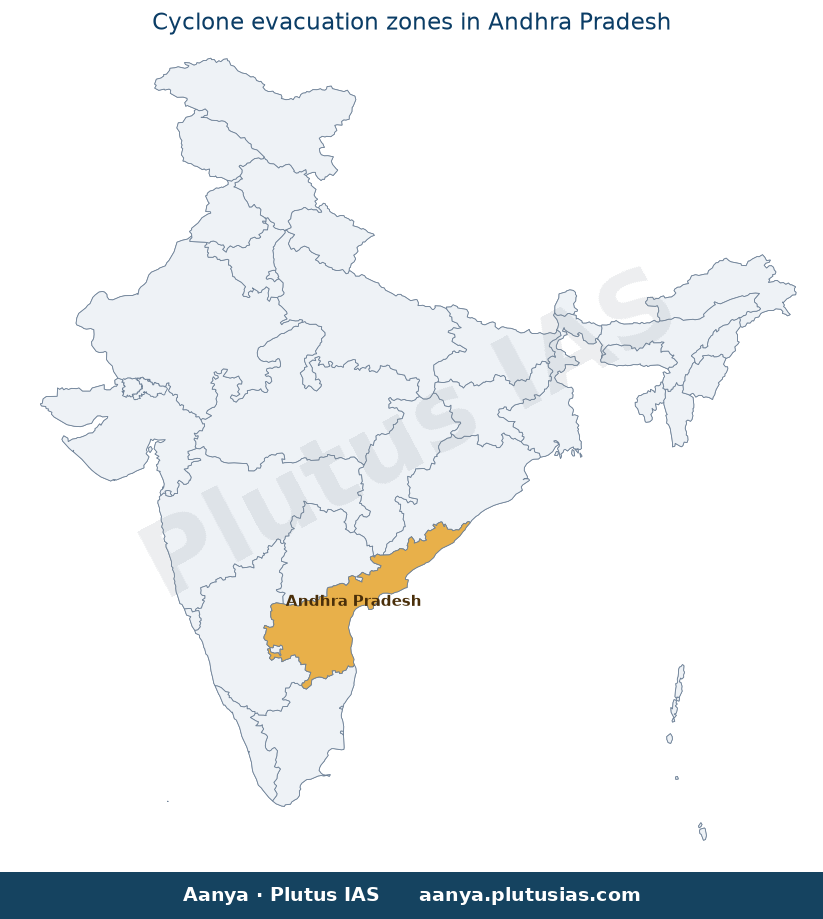
The Andhra Pradesh State Disaster Management Authority (APSDMA) has initiated large-scale evacuation and preparedness measures in coastal districts ahead of the anticipated landfall of a Very Severe Cyclonic Storm (VSCS) between Machilipatnam and Visakhapatnam on October 28, 2026. With wind speeds projected to reach 140 kmph and potential impacts on 8 districts, this event underscores the critical importance of India’s institutional disaster management framework, including the roles of the India Meteorological Department (IMD), NDRF, SDRF, and district-level authorities in mitigating cyclone-related risks.
Background
- The Bay of Bengal is one of the most cyclone-prone regions globally, with an average of 5-6 cyclonic storms forming annually, of which 2-3 typically intensify into severe cyclones.
- Andhra Pradesh’s coastline, spanning approximately 974 km, is highly vulnerable to cyclonic storms due to its geographical exposure and low-lying terrain in deltaic regions.
- Between 1971 and 2026, 61 cyclonic storms have made landfall on the Andhra Pradesh coast, with 10 classified as Very Severe Cyclonic Storms (VSCS), including Hudhud (2014) and Titli (2018).
- The National Disaster Management Authority (NDMA), established under the Disaster Management Act, 2005, provides the legal and institutional framework for disaster management in India, mandating a multi-tiered response system involving central, state, and district agencies.
- The Andhra Pradesh State Disaster Management Authority (APSDMA) functions as the nodal agency for disaster preparedness, response, and recovery, coordinating with the National Disaster Response Force (NDRF) and State Disaster Response Force (SDRF).
- Cyclone classification by the India Meteorological Department (IMD) follows the Saffir-Simpson Hurricane Wind Scale, with categories ranging from Depression to Super Cyclonic Storm based on sustained wind speeds and potential damage.
What is a Very Severe Cyclonic Storm (VSCS)?
- A Very Severe Cyclonic Storm (VSCS) is a meteorological phenomenon classified by the India Meteorological Department (IMD) when sustained wind speeds range between 118 kmph and 165 kmph, accompanied by torrential rainfall and storm surges.
- VSCSs are capable of causing extensive structural damage to kutcha (non-permanent) and semi-permanent structures, uprooting trees, disrupting power and communication networks, and triggering flash floods and landslides in vulnerable regions.
- The IMD uses a five-tier classification system for cyclones: Depression (<63 kmph), Deep Depression (63–87 kmph), Cyclonic Storm (88–117 kmph), Severe Cyclonic Storm (118–165 kmph), and Very Severe Cyclonic Storm (>165 kmph).
- Cyclone formation in the Bay of Bengal is influenced by warm sea surface temperatures (above 26°C), low vertical wind shear, and the presence of a pre-existing low-pressure system, often during the post-monsoon season (October–December).
- The IMD issues colour-coded alerts (Green, Yellow, Orange, Red) to indicate the severity of impending cyclones, with Red alerts signifying the highest risk and prompting large-scale evacuations and emergency responses.
- Storm surges, a rise in seawater level due to low atmospheric pressure and strong winds, are a major hazard during cyclones, particularly in low-lying coastal districts like those in Andhra Pradesh.
- The National Disaster Response Force (NDRF) and State Disaster Response Forces (SDRF) are deployed for search and rescue, relief operations, and restoration of critical infrastructure during and after cyclones.
- Post-cyclone recovery involves damage assessment, restoration of utilities, provision of relief materials, and psychological support to affected communities, coordinated by district disaster management authorities.
Key Features
| Feature | Significance |
|---|---|
| Forecasted landfall zone | Determines the spatial distribution of impact, guiding evacuation and resource allocation in districts such as Krishna, West Godavari, and Visakhapatnam. |
| Wind speed projections (140 kmph) | Indicates the potential for structural damage to infrastructure, particularly to kuchha houses and standing vegetation, necessitating preemptive reinforcement measures. |
| Evacuation protocols | Ensures systematic relocation of vulnerable populations to cyclone shelters, reducing human casualties and facilitating post-disaster relief operations. |
| State Disaster Response Force (SDRF) and National Disaster Response Force (NDRF) deployment | Enhances the State’s capacity for rapid response, search-and-rescue, and medical aid during the cyclone’s landfall and aftermath. |
| Cyclone shelter preparedness | Involves sanitation, stocking of essential commodities, and crowd management, ensuring habitability and reducing disease outbreaks post-landfall. |
Why it Matters
Disaster Risk Reduction
- Andhra Pradesh’s proactive measures align with the Sendai Framework for Disaster Risk Reduction (2015–2030), emphasizing early warning systems and community preparedness to mitigate cyclone impacts.
- The deployment of SDRF and NDRF battalions reflects India’s institutional framework for disaster management under the Disaster Management Act, 2005.
- Evacuation protocols demonstrate adherence to the National Disaster Management Plan (NDMP), which prioritizes life-saving interventions during cyclonic events.
Climate Resilience
- The increasing frequency of cyclonic storms in the Bay of Bengal underscores the need for climate-resilient infrastructure and urban planning in coastal districts.
- Historical data (61 cyclones since 1971) highlights the vulnerability of Andhra Pradesh’s coastline, necessitating long-term adaptation strategies such as mangrove restoration and coastal zone regulation.
Institutional Coordination
- The role of the India Meteorological Department (IMD) in forecasting and the APSDMA in coordination exemplifies multi-agency collaboration in disaster management.
- The requisitioning of additional NDRF battalions demonstrates inter-state resource sharing, a critical component of the NDMP’s collaborative approach.
Humanitarian Impact
- The cyclone’s potential to disrupt livelihoods in fishing and agriculture sectors necessitates post-disaster economic rehabilitation measures under the Pradhan Mantri Fasal Bima Yojana (PMFBY) and other welfare schemes.
- Evacuation and shelter management address the immediate humanitarian needs of displaced populations, including women, children, and the elderly.
Challenges
1. Predictability of Cyclone Intensity
- Rapid intensification of cyclones challenges early warning systems, requiring real-time monitoring and adaptive response strategies.
- The transition from a deep depression to a cyclonic storm within hours necessitates agile decision-making by disaster management authorities.
UPSC Link: Geography: Tropical Cyclones, IMD forecasting
2. Logistical Constraints in Evacuation
- High population density in coastal districts complicates the evacuation process, particularly in urban areas like Visakhapatnam and Machilipatnam.
- Transportation and communication disruptions during landfall may hinder the movement of relief teams and supplies.
UPSC Link: Disaster Management: Evacuation planning
3. Infrastructure Vulnerability
- Kuchha houses and informal settlements are highly susceptible to damage, exacerbating post-disaster displacement and homelessness.
- Critical infrastructure such as power lines, water supply systems, and healthcare facilities may face operational disruptions.
UPSC Link: Disaster Management: Structural resilience
4. Post-Disaster Health Risks
- Flooding and waterlogging increase the risk of waterborne diseases, requiring immediate sanitation and medical interventions in shelters.
- Mental health support for affected populations, particularly children and trauma survivors, is often overlooked in emergency responses.
UPSC Link: Disaster Management: Public health
5. Resource Allocation Under Uncertainty
- The need for additional NDRF battalions and cyclone shelters strains State resources, particularly in fiscally constrained scenarios.
- Balancing immediate relief with long-term recovery planning requires careful prioritization of funds and materials.
UPSC Link: Disaster Management: Fiscal planning
Challenges — UPSC Perspective
| Issue | Concern |
|---|---|
| Rapid intensification of cyclones | Limits the time available for evacuation and resource mobilization, increasing the risk of casualties. |
| Urban evacuation bottlenecks | High-density coastal cities face challenges in managing large-scale evacuations due to limited shelter capacity and traffic congestion. |
| Damage to critical infrastructure | Disruptions to power, water, and healthcare services can prolong recovery and exacerbate humanitarian crises. |
| Post-disaster disease outbreaks | Flooding and poor sanitation in shelters create conditions for epidemics, particularly in densely populated areas. |
| Inter-agency coordination gaps | Delays in decision-making or resource sharing between State and Central agencies can undermine response effectiveness. |
Government Initiatives — Must-Memorise for Prelims
- National Disaster Management Plan (NDMP)
- Pradhan Mantri Fasal Bima Yojana (PMFBY)
- State Disaster Response Fund (SDRF)
- National Disaster Response Fund (NDRF)
Way Forward
- Conduct pre-emptive mock drills in high-risk districts to test evacuation protocols and shelter management systems.
- Strengthen real-time data sharing between IMD, APSDMA, and local authorities to refine forecasting and response timelines.
- Pre-position relief materials, including food, water, and medical supplies, in cyclone shelters and strategic locations.
- Enhance public awareness campaigns using multi-media platforms to disseminate early warnings and safety instructions.
- Establish rapid assessment teams to evaluate infrastructure damage and prioritize restoration of critical services post-landfall.
- Collaborate with NGOs and civil society organizations to support vulnerable groups, including women, children, and the elderly, during evacuation and recovery.
- Integrate climate-resilient urban planning in coastal cities, including green belts and flood-resistant construction standards.
- Review and update the State Disaster Management Plan (SDMP) to incorporate lessons from past cyclones, such as Hudhud and Titli.
UPSC Value Addition
Keywords for Mains Answer-Writing
Disaster Management Act, 2005 · National Disaster Response Force (NDRF) · State Disaster Response Force (SDRF) · Cyclone preparedness · Andhra Pradesh State Disaster Management Authority (APSDMA) · Cyclone shelters · Very Severe Cyclonic Storm (VSCS) · Cyclone landfall · IMD classification of cyclones · Disaster risk reduction · Evacuation protocols · Cyclone Titli · Cyclone Hudhud · Cyclone Michaung · Cyclone Montha · Coastal vulnerability · Disaster management governance · Early warning systems · Evacuation and relief operations
Concept Flow
Deep depression over Bay of Bengal intensifies → IMD issues cyclone warnings → APSDMA activates disaster management protocols → NDRF and SDRF deploy to high-risk districts → Evacuation orders issued to coastal populations → Cyclone makes landfall with sustained winds of 140 kmph → Structural damage occurs in vulnerable areas → Relief and rehabilitation operations commence under NDMP → Post-disaster assessment informs long-term resilience planning.
Prelims Practice Questions
Q1. Consider the following statements regarding the classification of cyclones by the India Meteorological Department (IMD):
1. A ‘Very Severe Cyclonic Storm’ (VSCS) is defined by sustained wind speeds of 118–165 km/h.
2. Cyclone ‘Titli’ (2018) was classified as a ‘Very Severe Cyclonic Storm’ by the IMD.
3. Cyclone ‘Hudhud’ (2014) was classified as a ‘Severe Cyclonic Storm’ by the IMD.
4. The IMD classifies cyclones into five categories based on wind speed and potential damage.
How many of the above statements are correct?
- Only one
- Only two
- Only three
- All four
Answer: Only three — Statements 1 and 2 are correct. Statement 3 is incorrect (Hudhud was a VSCS). Statement 4 is incorrect (IMD classifies cyclones into seven categories: Low Pressure Area, Depression, Deep Depression, Cyclonic Storm, Severe Cyclonic Storm, Very Severe Cyclonic Storm, and Super Cyclonic Storm).
Q2. Assertion (A): The National Disaster Response Force (NDRF) is a statutory body under the Disaster Management Act, 2005.
Reason (R): The NDRF is constituted to provide a specialized response to natural and man-made disasters and is funded by the National Disaster Response Fund (NDRF).
- Both A and R are true, and R is the correct explanation of A.
- Both A and R are true, but R is not the correct explanation of A.
- A is true, but R is false.
- A is false, but R is true.
Answer: A is false, but R is true. — Assertion (A) is true: NDRF is a statutory body under the Disaster Management Act, 2005. Reason (R) is false: The NDRF is funded by the National Disaster Response Fund, but it is not a fund itself; the NDRF is a force under the Ministry of Home Affairs.
Q3. Match the following cyclones with their respective IMD classifications:
Column I (Cyclone) Column II (Classification)
A. Cyclone Hudhud 1. Severe Cyclonic Storm
B. Cyclone Titli 2. Very Severe Cyclonic Storm
C. Cyclone Michaung 3. Super Cyclonic Storm
D. Cyclone Montha 4. Severe Cyclonic Storm
- A-2, B-2, C-1, D-4
- A-2, B-2, C-4, D-1
- A-3, B-2, C-4, D-1
- A-2, B-3, C-1, D-4
Answer: A-2, B-2, C-4, D-1 — Cyclone Hudhud (2014) and Cyclone Titli (2018) were classified as Very Severe Cyclonic Storms. Cyclone Michaung (2023) and Cyclone Montha (2025) were classified as Severe Cyclonic Storms.
Mains Practice Question
✍ Critically examine the institutional framework for cyclone preparedness and response in India, with particular reference to the role of the National Disaster Response Force (NDRF), State Disaster Response Force (SDRF), and the Andhra Pradesh State Disaster Management Authority (APSDMA). Also, analyse the efficacy of evacuation protocols and cyclone shelter management in mitigating disaster risks. (15 Marks)
Approach: MODEL-ANSWER SKELETON:
1. **Institutional Framework**:
– Disaster Management Act, 2005: Legal basis for disaster management in India; establishment of National Disaster Management Authority (NDMA), State Disaster Management Authorities (SDMAs), and District Disaster Management Authorities (DDMAs).
– NDRF: Role under Section 44 of the Act; composition, training, and deployment; integration with SDRFs.
– SDRF: State-level rapid response force; coordination with NDRF and local authorities.
– APSDMA: Institutional mechanism in Andhra Pradesh; preparedness measures for Very Severe Cyclonic Storms (VSCS).
2. **Cyclone Preparedness and Response**:
– Early Warning Systems: Role of India Meteorological Department (IMD) in cyclone forecasting; classification of cyclones (e.g., VSCS with wind speeds 118–165 km/h).
– Evacuation Protocols: Pre-emptive evacuation in coastal districts (e.g., Andhra Pradesh); coordination between district collectors, SDRF, and local communities.
– Cyclone Shelters: Standards for cyclone shelters; sanitation, essential commodity stocking, and accessibility.
3. **Efficacy and Challenges**:
– Successes: Case studies of cyclones like Hudhud (2014) and Titli (2018) where institutional frameworks mitigated damage.
– Challenges: Coordination gaps, resource constraints, and community awareness; lessons from recent cyclones like Michaung (2023) and Montha (2025).
– Way Forward: Strengthening inter-agency coordination, community-based disaster risk reduction (CBDRR), and technological integration (e.g., GIS mapping, mobile alerts).
4. **Conclusion**:
– Balanced assessment of institutional strengths and gaps; emphasis on proactive governance and community participation in disaster risk reduction.
Source: The Hindu
Generated by AanyaAi for educational purpose.
Related guides on our sites
- How to prepare for GS paper 1 for UPSC CSE mains exam
- Best UPSC coaching for IFOS exam
- Best geography optional coaching
- Best geography optional coaching

- Andhra Pradesh Prepares for Very Severe Cyclone: Key Facts for UPSC & State PCS - October 25, 2026
- टीजी-आईपास पोर्टल दो दिन में बहाल: साइबर हमले के बाद सुरक्षा बढ़ाई गई - October 25, 2026
- नीति आयोग ने बताया: सशक्त शहरी सरकारें ही देश को बना सकती हैं विकसित - October 25, 2026

No Comments