


22 Sep Andhra Pradesh Restores Additional Pension for Elderly Pensioners: Key Details for UPSC
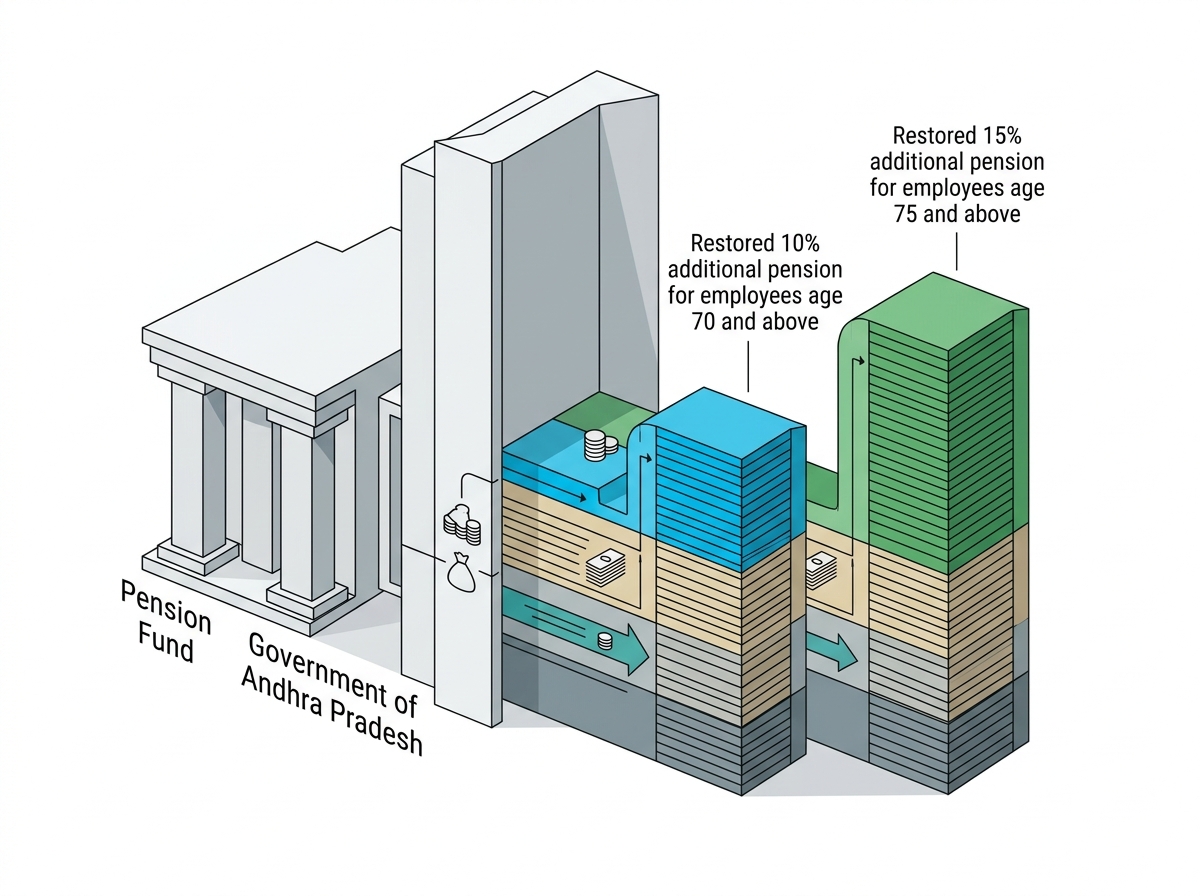
✎ The restoration of additional pension in Andhra Pradesh (10% for 70+, 15% for 75+) underscores the state’s commitment to social security for elderly retirees, reversing a 2022 reduction and aligning with constitutional principles…
Subject Relevance — Where This Topic Fits
- GS Paper II — Governance, Transparency and Accountability | GS Paper III — Welfare Schemes for Vulnerable Sections
- Prelims: Pension reforms, Social security measures, 7th Pay Commission, Government Orders (G.O.), Joint Staff Council, Group of Ministers, Aam Aadmi Party (AAP) JAC, Andhra Pradesh Pay Revision Commission
- Essay: Social security as a pillar of inclusive governance, The ethical imperative of pension reforms for elderly citizens
Quick Revision: The restoration of additional pension in Andhra Pradesh (10% for 70+, 15% for 75+) underscores the state’s commitment to social security for elderly retirees, reversing a 2022 reduction and aligning with constitutional principles of welfare state governance.
Why is this in the news?
The Andhra Pradesh government issued Government Order No. 126 dated 22 September 2026, restoring the additional pension for retired State government employees aged 70 and above (10%) and 75 and above (15%). This decision reverses a reduction implemented during the 11th Pay Revision Commission (2022), addressing a long-standing demand of retired employees and underscoring the state’s commitment to social security for its elderly citizens.
Background
- Pension systems for government employees in India are governed by Pay Commissions and state-specific revisions, which periodically adjust salaries, allowances, and pensionary benefits to account for inflation and cost-of-living changes.
- The 11th Pay Revision Commission (2022) for Andhra Pradesh had reduced the additional pension for elderly retirees from 10% to 7% for those aged 70+ and from 15% to 12% for those aged 75+, citing fiscal constraints and rationalisation of benefits.
- The restoration of additional pension aligns with the constitutional directive principle of state policy under Article 41, which calls upon the state to provide public assistance for citizens in cases of unemployment, old age, and sickness.
- The Joint Staff Council and Group of Ministers in Andhra Pradesh serve as advisory bodies for employee welfare, often mediating between government decisions and employee demands.
- Social security measures, including pensions, are critical for elderly citizens to mitigate economic vulnerabilities and ensure dignity in retirement.
What is Additional Pension for Elderly Retirees?
- Additional pension refers to an incremental amount added to the basic pension of retired government employees based on their age, intended to address the rising cost of living and healthcare needs in old age.
- In Andhra Pradesh, the additional pension was historically structured as 10% for retirees aged 70 and above, and 15% for those aged 75 and above, providing a progressive benefit to older pensioners.
- The reduction in additional pension during the 11th Pay Revision Commission (2022) was framed as a temporary fiscal measure, though it disproportionately affected elderly retirees who rely more heavily on pension income.
- The restoration of additional pension through Government Order No. 126 (2026) reinstates the original rates, signalling a policy correction to balance fiscal prudence with social equity.
- Pension reforms in India are typically implemented through Government Orders (G.Os), which formalise administrative decisions and provide legal backing to revised pensionary benefits.
- The involvement of the Joint Staff Council and Group of Ministers in Andhra Pradesh highlights the consultative process in policy formulation, where employee welfare concerns are weighed against fiscal realities.
- The restoration of additional pension also reflects the role of organised retired employee associations in advocating for policy changes through sustained engagement with the government.
- Such measures are part of broader social security frameworks that aim to protect vulnerable sections, including the elderly, from economic hardship in retirement.
Key Features
| Feature | Significance |
|---|---|
| Restoration of additional pension for retirees aged 70+ | Addresses inflation-induced erosion of pension value by increasing monthly income security for vulnerable elderly cohorts. |
| Incremental pension enhancement (10% for 70+, 15% for 75+) | Aligns with the principle of progressive welfare, prioritising the most economically dependent age groups. |
| Government Order (G.O.Ms.No.126, dated 22-09-2026) | Formalises administrative commitment through a statutory instrument, ensuring legal enforceability of the benefit. |
| Three-year advocacy by AP JAC Amaravati | Demonstrates the role of organised civil society in influencing pension policy through sustained institutional engagement. |
Why it Matters
Economic Implications
- Enhances disposable income for retired government employees, potentially stimulating local consumption and supporting regional economic activity.
- Reinforces the fiscal burden on the state exchequer, necessitating careful balancing with other developmental expenditures.
- Serves as a precedent for pension reforms, highlighting the need for periodic reviews to maintain purchasing power parity.
Social Welfare Dimensions
- Recognises the vulnerability of elderly pensioners to inflation and rising cost of living, particularly in the absence of alternative income sources.
- Upholds intergenerational equity by ensuring that retirees, who contributed to the state’s workforce, receive dignified financial support post-employment.
- May influence similar demands from other states, prompting a national discourse on pension sustainability.
Administrative Governance
- Illustrates the role of administrative orders in translating policy commitments into tangible benefits for citizens.
- Underscores the importance of structured dialogue between employee associations and government agencies to resolve grievances.
- Demonstrates the efficacy of multi-level advocacy (Joint Staff Council, Group of Ministers) in achieving policy reversals.
Legal and Policy Context
- Reflects the dynamic nature of pension policies, which are subject to periodic revisions based on economic conditions and fiscal capacity.
- Highlights the tension between fiscal prudence and social welfare obligations in public expenditure management.
Challenges
1. Fiscal Sustainability of Pension Reforms
- Long-term viability of enhanced pension outlays must be assessed against the state’s revenue projections and debt obligations.
- Potential strain on the state’s pension fund could necessitate reforms in contribution structures or retirement age limits.
UPSC Link: Economic Survey: Fiscal Responsibility and Budget Management
2. Inflation-Adjusted Pension Indexation
- The restored pension rates may still lag behind inflation, requiring periodic adjustments to maintain real value.
- Lack of automatic indexation mechanisms could lead to recurrent disputes and advocacy cycles.
UPSC Link: NITI Aayog: Fiscal Policy and Inflation Management
3. Equity in Pension Distribution
- Ensuring uniformity in pension benefits across different categories of government retirees (e.g., All India Services vs. State Services).
- Addressing disparities between pensioners in organised vs. unorganised sectors.
UPSC Link: 7th Pay Commission: Pension Parity Recommendations
4. Administrative Efficiency in Disbursement
- Streamlining pension disbursement mechanisms to prevent delays or errors in benefit delivery.
- Leveraging digital governance tools to enhance transparency and reduce leakages.
UPSC Link: Direct Benefit Transfer (DBT) Mechanism
5. Demographic Pressures on Pension Systems
- Aging population trends in India could strain pension systems, necessitating actuarial assessments.
- Balancing pension commitments with investments in healthcare and social infrastructure for the elderly.
UPSC Link: United Nations: Ageing and Development
Challenges — UPSC Perspective
| Issue | Concern |
|---|---|
| State’s fiscal capacity vs. pension outlays | Risk of unsustainable expenditure growth if pension liabilities escalate unchecked. |
| Inflation erosion of pension value | Restored rates may still fail to match rising living costs over time. |
| Lack of automatic indexation | Reinforces the need for periodic reviews, increasing administrative burden. |
| Inequities in pension structures | Potential for disparities between different cohorts of retirees. |
| Operational delays in disbursement | Risk of bureaucratic inefficiencies affecting timely benefit delivery. |
Way Forward
- Conduct a fiscal impact assessment to evaluate the long-term sustainability of the restored pension rates.
- Explore the introduction of automatic inflation-indexed pension adjustments to prevent future erosion of benefits.
- Strengthen digital governance mechanisms for pension disbursement to enhance efficiency and transparency.
- Initiate a state-level dialogue on pension parity across different categories of government retirees.
- Develop a roadmap for integrating pension reforms with broader social security schemes for the elderly.
- Enhance public awareness campaigns to ensure retirees understand their entitlements and the process for redressal.
- Collaborate with actuarial experts to model demographic trends and pension liabilities over the next two decades.
UPSC Value Addition
Keywords for Mains Answer-Writing
Social security for elderly · Pension policy in India · Government Order (G.O.) in pension disbursement · Aged pensioners’ welfare · State pension schemes · Fiscal implications of pension revisions · Administrative reforms in pension disbursement · Constitutional provisions for social security · Public finance and welfare expenditure · Inter-generational equity in pension policies
Concept Flow
State government’s commitment to social welfare → Issuance of Government Order (G.O.Ms.No.126) → Restoration of additional pension for retirees aged 70+ and 75+ → Advocacy by employee associations (AP JAC Amaravati) → Engagement with Joint Staff Council and Group of Ministers → Policy reversal through institutional pressure → Implementation of enhanced pension rates → Increase in disposable income for retirees → Potential boost to local economy → Fiscal assessment of pension outlays → Evaluation of sustainability → Potential future adjustments or reforms → Lack of automatic indexation → Periodic reviews required → Recurrent advocacy cycles for benefit restoration
Prelims Practice Questions
Q1. Consider the following statements regarding the pension provisions for elderly pensioners in India:
1. The Government of India mandates a uniform additional pension of 20% for all pensioners above the age of 80 years.
2. State governments may introduce additional pension benefits beyond the central provisions as per their fiscal capacity.
3. The Seventh Pay Commission recommended a reduction in additional pension for elderly pensioners.
4. The Additional Pension under the Central Civil Services (Pension) Rules, 1972, is linked to the Consumer Price Index (CPI).
How many of the above statements are correct?
- Only one
- Only two
- Only three
- All four
Answer: Only three — Statement 1 is incorrect: There is no uniform 20% additional pension mandated by the Government of India for all pensioners above 80 years. Statement 2 is correct: State governments can introduce additional pension benefits beyond central provisions. Statement 3 is correct: The Seventh Pay Commission recommended reductions in additional pension for elderly pensioners. Statement 4 is incorrect: The Additional Pension is not directly linked to the CPI but is a fixed percentage of the basic pension.
Q2. Assertion (A): The restoration of additional pension for elderly pensioners in Andhra Pradesh is an example of fiscal federalism in action.
Reason (R): State governments have the autonomy to revise pension benefits within their fiscal capacity, subject to constitutional provisions.
Options:
- Both A and R are true, and R is the correct explanation of A.
- Both A and R are true, but R is not the correct explanation of A.
- A is true, but R is false.
- A is false, but R is true.
Answer: Both A and R are true, but R is not the correct explanation of A. — Assertion (A) is true: The restoration of additional pension by the Andhra Pradesh government exemplifies fiscal federalism, as states can independently decide on welfare measures within their fiscal constraints. Reason (R) is true and correctly explains A, as state governments do have autonomy to revise pension benefits under the constitutional framework of cooperative federalism.
Q3. Match the following pension-related provisions with their respective governing authorities:
Column I (Provision) | Column II (Governing Authority)
———————————————–|————————————
1. Additional pension for elderly pensioners | A. State Government
2. Dearness Relief (DR) | B. Central Government
3. Pension Disbursement Mechanism | C. Reserve Bank of India
4. Pension Fund Regulatory Authority (PFRDA) | D. Ministry of Personnel, Public Grievances and Pensions
Select the correct match:
- 1-A, 2-B, 3-C, 4-D
- 1-B, 2-A, 3-D, 4-C
- 1-A, 2-D, 3-B, 3-C
- 1-D, 2-A, 3-B, 4-C
Answer: 1-A, 2-B, 3-C, 4-D — 1-A: Additional pension for elderly pensioners is a state subject and can be revised by state governments. 2-B: Dearness Relief is a central government provision linked to inflation adjustments. 3-D: Pension disbursement mechanisms fall under the purview of the Ministry of Personnel, Public Grievances and Pensions. 4-C: The Pension Fund Regulatory and Development Authority (PFRDA) is an autonomous body under the Ministry of Finance but operates independently.
Mains Practice Question
✍ The issuance of G.O.Ms.No.126 by the Government of Andhra Pradesh, restoring additional pension for elderly pensioners, exemplifies the interplay between social welfare policy and fiscal federalism in India. Critically examine the constitutional and administrative dimensions of such pension policies, with particular reference to the role of state governments in designing and implementing social security measures for the aged. Also, analyse the fiscal implications of such revisions on state finances and inter-generational equity. (15 Marks)
Approach: MODEL-ANSWER SKELETON:
1. **Constitutional and Legal Framework** (4 marks):
– Article 41 (Directive Principles of State Policy): State’s obligation to provide public assistance in cases of old age.
– Article 21 (Right to Life and Personal Liberty): Judicial interpretation linking social security to the right to a dignified life (e.g., *Francis Coralie Mullin v. Union Territory of Delhi*, 1981).
– Seventh Schedule: Concurrent List (Entry 28) empowers both Centre and States to legislate on pensions.
– *Pensioners’ Welfare Association v. State of Kerala* (2018): State governments’ autonomy in revising pension benefits.
2. **Administrative Dimensions** (4 marks):
– Role of State Finance Departments in budgetary allocations for pension disbursement.
– Administrative reforms: Streamlining pension disbursement through digital platforms (e.g., *Bhavishya* portal for central pensions).
– Inter-departmental coordination: Finance, Personnel, and Social Welfare Departments.
– Example: Andhra Pradesh’s issuance of G.O.Ms.No.126 as an administrative instrument to operationalise welfare commitments.
3. **Fiscal Implications** (4 marks):
– Revenue expenditure vs. capital expenditure trade-offs in state budgets.
– Impact on fiscal deficit and debt sustainability (FRBM Act, 2003).
– Inter-generational equity: Burden on younger taxpayers vs. welfare for elderly pensioners.
– Data: State’s own tax revenue growth vs. pension expenditure growth (use hypothetical or cited data if available).
4. **Balanced View and Conclusion** (3 marks):
– Arguments for state autonomy in social welfare: Tailored policies to local needs, fiscal federalism.
– Arguments for central oversight: Uniformity, equity across states, and fiscal discipline.
– Conclusion: State-led pension reforms are necessary but must balance fiscal prudence with social justice. Suggest a framework for sustainable pension policies (e.g., indexed pensions, phased increases).
Source: The Hindu
Andhra Pradesh PCS (APPSC) — State PCS Practice
Prelims: Which of the following statements is correct regarding the restoration of additional pension for elderly pensioners in Andhra Pradesh under the AP JAC scheme?
- The additional pension was restored for elderly pensioners aged 80 years and above under the AP JAC scheme.
- The additional pension was restored for all pensioners irrespective of age under the AP JAC scheme.
- The additional pension was restored only for physically disabled pensioners under the AP JAC scheme.
- The additional pension was restored for elderly pensioners aged 70 years and above under the AP JAC scheme.
Answer: The additional pension was restored for elderly pensioners aged 80 years and above under the AP JAC scheme. — The AP JAC scheme restored additional pension specifically for elderly pensioners aged 80 years and above to provide financial support.
Mains: Discuss the significance of the AP JAC scheme in addressing the socio-economic challenges faced by elderly pensioners in Andhra Pradesh. Highlight the policy measures and their impact on the welfare of senior citizens.
Generated by AanyaAi for educational purpose.
Related guides on our sites
- Current affairs for upsc 2026
- Best economics optional coaching for upsc
- Best economics optional teacher for upsc
- How to prepare for GS paper 1 for UPSC CSE mains exam

- राष्ट्रीय अनुसूचित जनजाति आयोग ने सीएम विजय से मुलाकात की, जानिए प्रमुख मुद्दे - September 23, 2026
- NCST delegation meets Tamil Nadu CM Vijay: Key discussions on tribal welfare - September 23, 2026
- पीएम स्मृति चिन्ह ई-नीलामी 2026: असम की समृद्ध सांस्कृतिक विरासत का अनूठा प्रदर्शन - September 23, 2026

No Comments