


10 Sep Andhra Pradesh Urged to Fast-Track Reforms for ₹3,525 Crore Central Scheme Funds
✎ The Special Assistance for Capital Investment (SASCI) scheme incentivises States to undertake sector-specific reforms through performance-linked financial assistance, with Andhra Pradesh aiming to unlock ₹3,525 crore in 2026-27…
Subject Relevance — Where This Topic Fits
- GS Paper II — Functions and Responsibilities of the Union and the States | GS Paper III — Indian Economy and issues relating to Planning, Mobilisation of Resources, Growth, Development and Employment | GS Paper III — Government Budgeting and Fiscal Policy
- Prelims: Special Assistance for Capital Investment (SASCI), Centrally Sponsored Schemes (CSS), Public Financial Management System (PFMS), Right of Way (RoW) for telecom infrastructure, AgriStack, SNA-SPARSH system, National Quality Assurance Standards (NQAS), Performance-Based Incentive (PBI) mechanisms
- Essay: Fiscal federalism and cooperative governance in India: Balancing autonomy and accountability in Centre-State financial relations, Digital transformation in public service delivery: Opportunities, challenges, and the role of institutional reforms
Quick Revision: The Special Assistance for Capital Investment (SASCI) scheme incentivises States to undertake sector-specific reforms through performance-linked financial assistance, with Andhra Pradesh aiming to unlock ₹3,525 crore in 2026-27 by accelerating compliance with conditionalities in agriculture, mining, public health, and digital governance.
Why is this in the news?
The Government of Andhra Pradesh has convened a high-level review to accelerate the completion of prescribed reforms across agriculture, livestock, mining, public health, and telecom sectors to unlock over ₹3,525 crore in incentives under the Centre’s Special Assistance for Capital Investment (SASCI) scheme for 2026-27. The urgency stems from a December 1 deadline for reform compliance, with the State having already received ₹3,486 crore under SASCI in the current financial year but facing significant disparities in the utilisation of Central funds across departments and districts.
Background
- The Special Assistance for Capital Investment (SASCI) scheme, launched by the Government of India, provides performance-linked incentives to States for undertaking specified reforms in key sectors, thereby enhancing capital expenditure and improving governance outcomes.
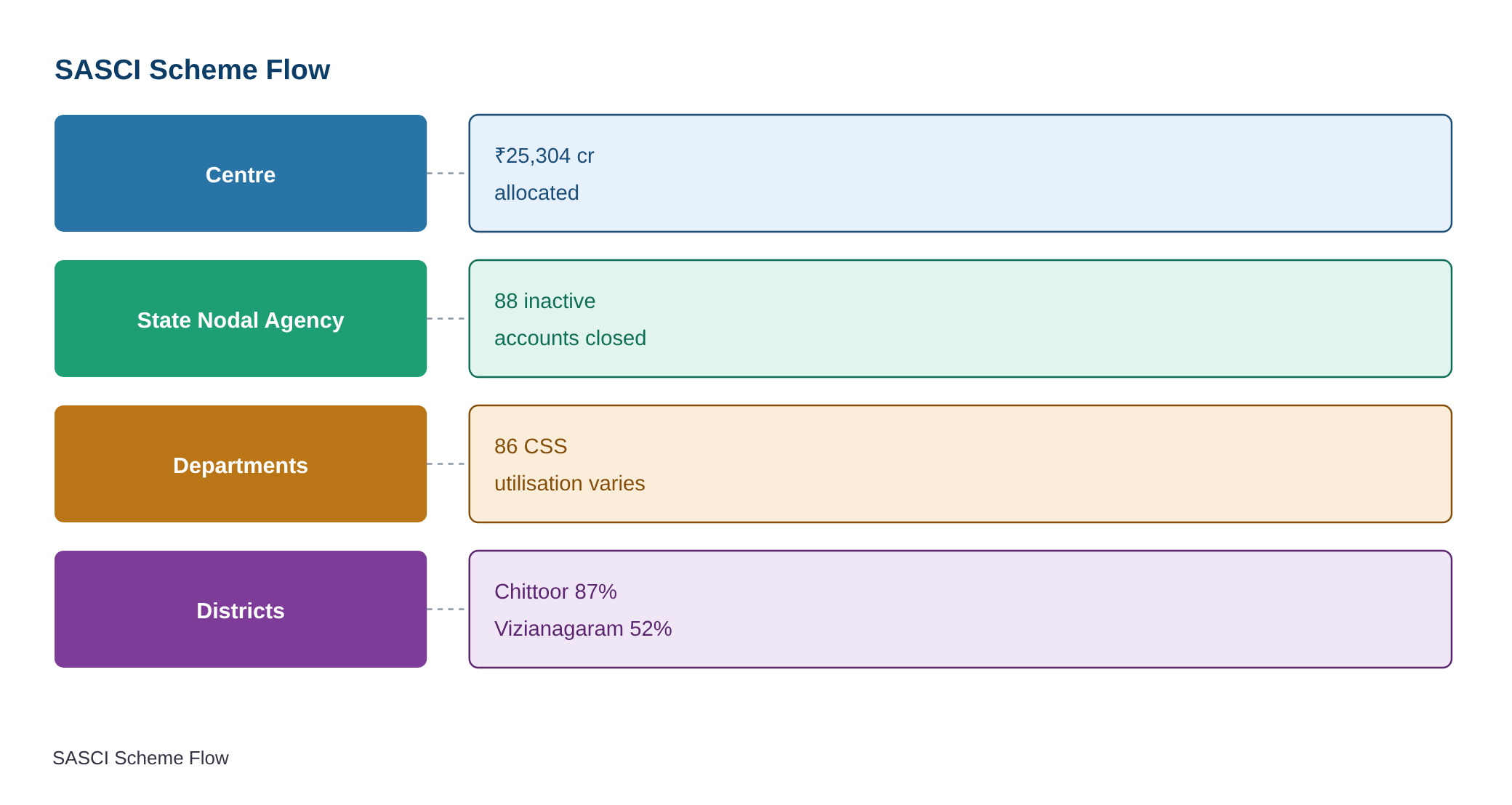
- Andhra Pradesh is implementing 86 Centrally Sponsored Schemes (CSS) in 2026-27, with a total Central allocation of ₹25,304 crore, of which ₹10,552 crore has been released to the State as of September 7, 2026.
- As of September 7, 2026, Andhra Pradesh has utilised ₹8,694 crore (47%) of the received CSS funds, with utilisation rates varying sharply across departments—ranging from 99% in the BC Welfare Department to 6% in the Water Resources Department.
- District-level utilisation disparities are equally pronounced, with Chittoor district utilising 87% of its available funds while Vizianagaram district utilises only 52%.
- The State has identified ₹135 crore lying in State Nodal Agency (SNA) accounts, with directives issued to close 88 inactive SNA accounts across 20 departments to ensure fiscal discipline and transparency.
- The review meeting highlighted the need for systematic reforms in digital governance, inter-departmental coordination, and performance monitoring to align with SASCI’s conditionalities and enhance fund utilisation efficiency.
What is the Special Assistance for Capital Investment (SASCI) Scheme?
- The SASCI scheme, introduced by the Government of India, is a performance-based incentive mechanism designed to reward States for undertaking specified reforms that enhance capital expenditure, improve service delivery, and strengthen governance in key sectors.
- The scheme provides financial incentives in the form of additional central assistance, which is released upon the State’s compliance with pre-defined reform milestones across sectors such as agriculture, livestock, mining, public health, and infrastructure.
- Reforms under SASCI are categorised into sector-specific conditionalities, including digitisation initiatives, institutional restructuring, policy implementation, and performance benchmarking, with incentives disbursed on a milestone-achievement basis.
- The scheme aligns with the broader objective of the Government of India to promote cooperative federalism by incentivising States to undertake reforms that align with national priorities while respecting fiscal autonomy.
- SASCI complements other central schemes such as the PM-KISAN, PM-KVY, and Ayushman Bharat by creating an enabling environment for States to leverage additional resources for capital expenditure and service delivery enhancement.
- The scheme operates within the framework of the Public Financial Management System (PFMS), ensuring real-time tracking of fund utilisation, performance monitoring, and accountability in fund disbursement.
- States are required to submit reform action plans and progress reports to the Ministry of Finance for verification before incentives are released, ensuring transparency and adherence to conditionalities.
Key Features
| Feature | Significance |
|---|---|
| Special Assistance for Capital Investment (SASCI) Scheme | A Central sector incentive scheme providing additional funds to States for undertaking specified reforms in key sectors to augment capital expenditure. |
| Reform-linked incentives under SASCI | Funds are disbursed based on the completion of prescribed reforms in agriculture, livestock, mining, public health, and other sectors, ensuring performance-based fiscal support. |
| Sectoral digitisation initiatives (AgriStack) | Digitisation of agricultural processes such as fertilizer distribution, procurement, and land records to enhance transparency, efficiency, and service delivery. |
| Mining sector reforms | Integration of mining portals, constitution of pre-auction committees, and annual auction calendars to streamline mineral governance and revenue generation. |
| Public health performance incentives | Funds linked to measurable health outcomes such as reducing infant and maternal mortality, NQAS certification, and TB control, aligning fiscal support with health system strengthening. |
Why it Matters
Fiscal Federalism and Centre-State Financial Relations
- Highlights the Centre’s role in incentivising State-level reforms through conditional fiscal transfers, reinforcing cooperative federalism under Article 282 of the Constitution.
- Demonstrates the use of performance-based grants to align State actions with national priorities, such as capital expenditure enhancement and sectoral reforms.
- Exposes disparities in fund utilisation across States and sectors, underscoring the need for robust financial management and monitoring mechanisms at the State level.
Economic Growth and Capital Formation
- Direct linkage between reform completion and unlocking additional capital funds, which can stimulate investment in critical sectors like agriculture, mining, and public health.
- Potential to augment State’s capital expenditure by ₹3,525 crore, contributing to economic growth and infrastructure development.
- Sector-specific reforms (e.g., mining, agriculture) can enhance productivity, revenue generation, and long-term economic sustainability.
Digital Governance and Administrative Efficiency
- Digitisation initiatives under AgriStack and other reforms aim to reduce leakages, improve service delivery, and enhance transparency in public service provision.
- Integration of portals and real-time monitoring systems can streamline administrative processes, reducing delays and improving accountability.
- Adoption of satellite-based mapping and digital land records can resolve disputes and improve land governance.
Public Health System Strengthening
- Incentives tied to health outcomes incentivise States to prioritise maternal and child health, TB control, and hospital certification, aligning fiscal support with health system goals.
- Performance-based funding can drive improvements in health infrastructure, service quality, and health outcomes, particularly in underserved regions.
- Strengthening public health systems can reduce out-of-pocket expenditures and improve health equity.
Challenges
1. Variations in Fund Utilisation Across Sectors and Districts
- Significant disparities in the utilisation of Central scheme funds, with some departments (e.g., BC Welfare) utilising 99% of available funds, while others (e.g., Water Resources at 6%) lag behind.
- District-wise variations, such as Chittoor (87%) and Vizianagaram (52%), indicate uneven administrative capacity and resource deployment across regions.
- Such disparities can lead to inequitable development, inefficient resource allocation, and suboptimal utilisation of available funds.
UPSC Link: GS-II: Centre-State Relations
2. Administrative and Bureaucratic Bottlenecks
- Slow pace of reform implementation, particularly in sectors like mining and agriculture, due to procedural delays, lack of coordination, and bureaucratic inertia.
- Inadequate utilisation of funds in certain departments suggests systemic issues in financial management, monitoring, and accountability mechanisms.
- Need for streamlined processes, capacity building, and performance incentives to overcome administrative hurdles.
UPSC Link: GS-II: Governance
3. Sectoral Reform Compliance and Monitoring
- Complexity of reform-linked incentives requires meticulous planning, inter-departmental coordination, and robust monitoring mechanisms to ensure compliance.
- Challenges in digitisation initiatives, such as AgriStack, include data privacy concerns, technological readiness, and integration with existing systems.
- Ensuring timely completion of reforms by the December 1 deadline demands accelerated decision-making and resource mobilisation.
UPSC Link: GS-III: Economic Reforms
4. Financial Management and SNA Account Closures
- Existence of ₹135 crore in inactive SNA accounts across 20 departments highlights issues in financial management, including poor utilisation, lack of transparency, and weak monitoring.
- Interest earned on Central funds must be remitted to the Centre via PFMS, but delays or non-compliance can strain Centre-State financial relations.
- Need for systematic audits, regular reconciliation, and closure of inactive accounts to optimise fund utilisation and compliance.
UPSC Link: GS-III: Public Finance
5. Sector-Specific Challenges in Mining and Agriculture
- Mining sector reforms require integration of portals, constitution of committees, and annual auction calendars, which may face resistance from vested interests or lack of technical capacity.
- Agricultural reforms under AgriStack involve digitisation of land records, procurement systems, and satellite mapping, which demand significant technological and administrative investments.
- Livestock and public health reforms may face challenges related to stakeholder engagement, resource mobilisation, and inter-departmental coordination.
UPSC Link: GS-III: Sectoral Development
Challenges — UPSC Perspective
| Issue | Concern |
|---|---|
| Sectoral Fund Utilisation Disparities | Uneven deployment of Central funds across departments and districts leads to inequitable development and suboptimal resource utilisation. |
| Administrative Delays in Reform Implementation | Bureaucratic inertia and procedural complexities slow down reform-linked incentives, delaying fund disbursement and economic benefits. |
| Inactive SNA Accounts and Financial Mismanagement | Presence of ₹135 crore in inactive accounts across 20 departments indicates poor financial governance and weak monitoring mechanisms. |
| Sectoral Reform Compliance Challenges | Complexity of reform-linked incentives requires meticulous planning, technological readiness, and inter-departmental coordination to ensure compliance. |
| Public Health Performance Incentives | Achieving health outcome-based incentives demands robust health infrastructure, data systems, and performance monitoring mechanisms. |
| Mining and Agriculture Sector Reforms | Reforms in these sectors face resistance from vested interests, lack of technical capacity, and administrative hurdles. |
Government Initiatives — Must-Memorise for Prelims
- Special Assistance for Capital Investment (SASCI) Scheme
- AgriStack (Agricultural Stack)
- BharatNet (for telecom Right of Way component)
- Compressed Biogas Policy (for incentivising biogas adoption)
Way Forward
- Accelerate reform implementation in high-potential sectors (mining, agriculture, public health) by setting clear timelines, assigning accountability, and conducting weekly reviews.
- Strengthen inter-departmental coordination through cross-sectoral committees to address bottlenecks in reform-linked incentive schemes.
- Conduct capacity-building programmes for officials in departments lagging in fund utilisation, focusing on financial management, monitoring, and compliance.
- Establish a real-time dashboard for tracking reform progress and fund utilisation, integrating data from PFMS, departments, and districts for transparency.
- Prioritise closure of inactive SNA accounts by conducting audits, reconciling balances, and remitting interest earnings to the Centre via PFMS within stipulated timelines.
- Enhance technological readiness for digitisation initiatives under AgriStack by investing in IT infrastructure, training officials, and ensuring data privacy and security.
- Leverage performance-based incentives to drive measurable outcomes in public health, agriculture, and mining, aligning fiscal support with national and State priorities.
- Promote district-level best practices by documenting and replicating successful reform implementation strategies from high-performing districts like Chittoor.
UPSC Value Addition
Keywords for Mains Answer-Writing
Special Assistance for Capital Investment (SASCI) Scheme · Central Sector and Centrally Sponsored Schemes · Andhra Pradesh Finance Department reforms · Capital Expenditure Incentives · Mining Sector Reforms in India · AgriStack and Digital Agriculture · Livestock Sector Development · Public Health Performance-linked Incentives · State Nodal Agency (SNA) and SPARSH System · Compressed Biogas Policy · Performance-based Fund Utilisation · Public Financial Management System (PFMS) · District Collector’s Conference on Finance Restructuring
Concept Flow
Central Sector Scheme (SASCI) → Performance-based Incentives → Sectoral Reforms (Agriculture, Mining, Public Health) → Fund Disbursement → Capital Expenditure Augmentation → Economic Growth and Infrastructure Development → State Government Receives Allocation → Reforms Initiated → Progress Monitored via PFMS and Sectoral Portals → Compliance Verified → Incentive Funds Released → Sectoral Development Outcomes Achieved → Digitisation Initiatives (AgriStack) → Land Records and Procurement Digitised → Transparency and Efficiency Improved → Leakages Reduced → Service Delivery Enhanced → Mining Sector Reforms → Portal Integration and Auction Calendars → Mineral Governance Streamlined → Revenue Generation Increased → Investment Attracted → Public Health Performance Incentives → Health Outcomes Improved (Maternal, Infant, TB) → NQAS Certification Achieved → Funds Released → Health Infrastructure Strengthened
Prelims Practice Questions
Q1. Consider the following statements regarding the Special Assistance for Capital Investment (SASCI) Scheme in India:
1. SASCI provides unconditional capital funds to States.
2. Incentives under SASCI are linked to the State’s performance in increasing capital expenditure.
3. Mining reforms, including portal integration and annual auction calendars, are eligible for incentives under SASCI.
4. The scheme is exclusively for States with a population below 1 crore.
How many of the above statements are correct?
- Only one
- Only two
- Only three
- All four
Answer: Only three — Statements 1, 2, and 3 are correct as per the SASCI framework. Statement 4 is incorrect as the scheme is not restricted by population size.
Q2. Assertion (A): The Public Financial Management System (PFMS) is used to track the utilisation of Central funds by States.
Reason (R): PFMS ensures that interest earned on the Centre’s share of funds is remitted back to the Centre.
Options:
A. Both A and R are true, and R is the correct explanation of A.
B. Both A and R are true, but R is not the correct explanation of A.
C. A is true, but R is false.
D. A is false, but R is true.
- A
- B
- C
- D
Answer: B — PFMS is a digital platform for tracking and managing Central funds, including interest remittances, making both A and R true with R correctly explaining A.
Q3. Match the following sectors with their respective incentive amounts under the SASCI scheme for Andhra Pradesh (2026-27):
Sector : Incentive Amount (₹ crore)
A. Mining Reforms : 1. 1,450
B. AgriStack : 2. 950
C. Public Health : 3. 650
D. Compressed Biogas Policy : 4. 175
Options:
A. A-2, B-1, C-3, D-4
B. A-1, B-2, C-3, D-4
C. A-3, B-4, C-1, D-2
D. A-4, B-3, C-2, D-1
- A
- B
- C
- D
Answer: A — Mining Reforms: ₹950 crore (A-2), AgriStack: ₹1,450 crore (B-1), Public Health: ₹650 crore (C-3), Compressed Biogas Policy: ₹175 crore (D-4).
Mains Practice Question
✍ The utilisation of Central funds by States is often marked by significant disparities across departments and districts. Critically examine the causes and consequences of such disparities, with reference to the performance of Andhra Pradesh in utilising funds under Centrally Sponsored Schemes. Also, outline the institutional mechanisms available to address these disparities. (15 Marks)
Approach: MODEL-ANSWER SKELETON:
1. **Introduction (2 marks)**
– Define Centrally Sponsored Schemes (CSS) and their significance in India’s federal fiscal architecture.
– Highlight the constitutional basis (Article 282) and the role of Finance Commissions in resource allocation.
– Mention Andhra Pradesh’s performance as a case study (utilisation rates: BC Welfare 99%, Water Resources 6%).
2. **Causes of Disparities (5 marks)**
– **Administrative Factors**: Lack of capacity, bureaucratic delays, and poor coordination between departments (e.g., Water Resources Department’s 6% utilisation).
– **Political Economy Factors**: District-level priorities and political pressures influencing fund allocation (e.g., Chittoor vs. Vizianagaram).
– **Structural Factors**: Over-reliance on certain departments for welfare schemes, leading to bottlenecks in others.
– **Technical Factors**: Non-integration of portals (e.g., mining, AgriStack) and delays in approvals (e.g., BharatNet permissions).
– **Incentive Misalignment**: Performance-linked incentives under SASCI may not address systemic inefficiencies.
3. **Consequences of Disparities (4 marks)**
– **Developmental Impact**: Underutilisation of funds in critical sectors (e.g., water resources, rural development) exacerbates regional inequalities.
– **Fiscal Discipline**: Accumulation of idle funds (e.g., ₹135 crore in SNA accounts) undermines fiscal federalism and Centre-State trust.
– **Accountability Gaps**: Lack of performance tracking (PFMS) and delayed remittances of interest to the Centre.
– **Social Outcomes**: Inequitable access to welfare schemes (e.g., BC Welfare Department’s high utilisation vs. Housing’s 26%).
4. **Institutional Mechanisms to Address Disparities (4 marks)**
– **Performance-Based Incentives**: SASCI scheme’s conditional funding (e.g., mining reforms, AgriStack) to align State actions with national priorities.
– **Capacity Building**: Training for district officials and departmental heads on fund utilisation and portal integration.
– **Monitoring and Evaluation**: Strengthening of PFMS and real-time dashboards for tracking utilisation (e.g., SNA-SPARSH system).
– **Constitutional Safeguards**: Role of Finance Commissions (15th FC recommendations) and NITI Aayog in addressing inter-State disparities.
– **Legal Frameworks**: Enforcement of guidelines under the Public Financial Management System (PFMS) Act, 2016.
5. **Conclusion (2 marks)**
– Reiterate the need for a balanced approach combining incentives, accountability, and capacity-building.
– Emphasise the role of States in leveraging Central funds for equitable development while maintaining fiscal discipline.
Source: The Hindu
Generated by AanyaAi for educational purpose.
Related guides on our sites
- Current affairs for upsc 2026
- Best PSIR optional coaching for upsc
- Best PSIR optional teacher for upsc
- Best teacher of PSIR optional for upsc

- मद्रास उच्च न्यायालय में ‘वेट्ट्री पयणम’ योजना को असंवैधानिक घोषित करने की मांग - October 4, 2026
- Gurugram’s groundwater extraction exceeds limit by 212%; HC seeks ban - October 4, 2026
- स्वतंत्रता सेनानी श्यामजी कृष्ण वर्मा की जन्म जयंती पर पीएम का श्रद्धांजलि - October 4, 2026

No Comments