


02 Sep Andhra Pradesh’s Literacy Surge: UPSC Perspective on Akshara Andhra Impact
✎ The 'Akshara Andhra' programme exemplifies a state-driven, multi-sectoral approach to literacy enhancement, integrating adult education, school reintegration, and inclusive learning, with measurable outcomes in teacher attendance…
Subject Relevance — Where This Topic Fits
- GS Paper II — Governance, Administration and Challenges
- Prelims: Literacy Rate, Adult Education, NEP 2020, Sarva Shiksha Abhiyan, National Literacy Mission Authority
- Essay: Role of State-led initiatives in achieving Sustainable Development Goal 4 (Quality Education)
Quick Revision: The ‘Akshara Andhra’ programme exemplifies a state-driven, multi-sectoral approach to literacy enhancement, integrating adult education, school reintegration, and inclusive learning, with measurable outcomes in teacher attendance (98.97%) and student re-enrolment (33,000 in 2026).
Why is this in the news?
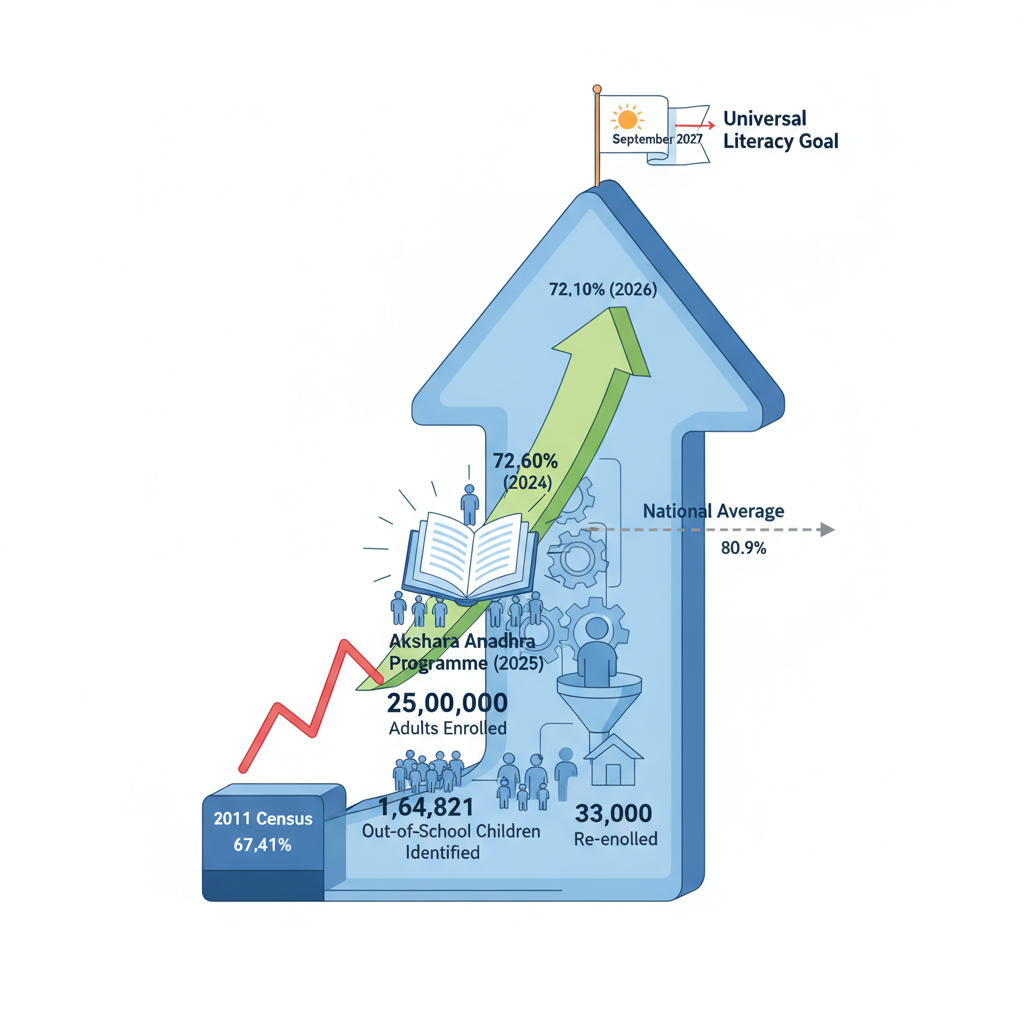
The Andhra Pradesh government’s recent announcement that its literacy rate has surpassed the national average—rising from 72.60% in 2024 to 82.10% in 2026, compared to the national average of 80.9%—highlights a significant governance achievement in adult education and school reintegration. This development is attributed to the ‘Akshara Andhra’ programme, launched in 2025, which has enrolled approximately 25 lakh adults in literacy initiatives and aims to achieve universal literacy by September 2027. The initiative also addresses systemic gaps in school enrolment, with 1,64,821 out-of-school children identified and 33,000 re-enrolled, underscoring the programme’s multi-pronged approach to education reform.
Background
- The 2011 Census of India reported Andhra Pradesh’s literacy rate at 67.41%, lagging behind the national average of 74.04%, reflecting historical disparities in educational attainment.
- The National Literacy Mission (NLM), launched in 1988, aimed to achieve a 75% literacy rate by 2007, but progress remained uneven across states due to implementation challenges.
- The programme’s focus on school reintegration aligns with the Right to Education (RTE) Act, 2009, which mandates free and compulsory education for children aged 6–14 years.
What is the ‘Akshara Andhra’ Programme?
- A state-led adult education initiative launched in 2025 by the Andhra Pradesh government to achieve universal literacy by 2027, targeting an estimated 25 lakh illiterate adults.
- The programme operates through multi-tiered governance, involving local public representatives (MLAs, panchayat leaders) for grassroots mobilisation and awareness campaigns.
- Literacy classes are conducted in community centres, schools, and digital platforms, with a focus on functional literacy (reading, writing, and basic numeracy) tailored to adult learners.
- The programme integrates technology, including the LEAP app, to track out-of-school children, monitor teacher attendance (98.97%), and student attendance (85.41%), ensuring data-driven interventions.
- Special emphasis is placed on marginalised groups, including women, tribal communities, and persons with disabilities, through targeted outreach and inclusive pedagogy.
- The initiative includes a school reintegration component, identifying 1,64,821 out-of-school children and re-enrolling 33,000 in 2026, with the remaining tracked via the LEAP app for follow-up.
- Complementary measures include the establishment of 125 autism centres across the state to support neurodiverse learners, reflecting a holistic approach to inclusive education.
Key Features
| Feature | Significance |
|---|---|
| Literacy Rate Improvement (72.60% in 2024 to 82.10% in 2026) | Demonstrates effective implementation of targeted literacy programmes, narrowing the gap with the national average (80.9%) and positioning Andhra Pradesh as a model for other states. |
| Akshara Andhra Programme | A state-led initiative contributing to the literacy turnaround by enrolling 25 lakh individuals, integrating local governance (MLAs and public representatives) for grassroots mobilisation. |
| Autism Centres (125 locations) | Expansion of special education infrastructure to address neurodiversity, aligning with inclusive education goals under the Rights of Persons with Disabilities Act, 2016. |
| Teacher and Student Attendance Metrics (98.97% and 85.41%) | High teacher attendance reflects administrative efficiency, while student attendance indicates sustained engagement in formal education systems. |
| LEAP App Integration for Out-of-School Children | Digital tracking of 1,64,821 out-of-school children to ensure their re-enrolment, demonstrating the use of technology in education governance. |
Why it Matters
Economic
- Enhanced literacy correlates with improved human capital, potentially boosting productivity and economic growth through a skilled workforce.
- Higher literacy rates may reduce dependency on low-skilled labour, fostering higher-value economic activities in sectors like services and technology.
- Improved educational attainment can attract investment by signalling a capable and trainable labour force to potential investors.
Social
- Reduction in intergenerational poverty by equipping individuals with foundational skills for better livelihood opportunities.
- Strengthened social equity through inclusive education, particularly for marginalised groups historically excluded from formal learning systems.
- Empowerment of women and girls, as literacy often correlates with delayed marriage, improved maternal health, and greater participation in decision-making.
Governance
- Demonstrates the efficacy of state-led, targeted interventions in addressing developmental deficits, setting a precedent for other states.
- Showcases the integration of digital tools (LEAP app) in tracking and addressing systemic gaps in education delivery.
- Highlights the role of local governance (MLAs and public representatives) in mobilising communities for literacy campaigns.
Educational
- Achievement of near-universal primary enrolment (33,000 out-of-school children re-enrolled) reflects progress toward Sustainable Development Goal 4 (Quality Education).
- Focus on stress-free learning and mental development (autism centres) aligns with holistic educational approaches beyond mere literacy metrics.
Challenges
1. Sustainability of Literacy Gains
- Risk of relapse into illiteracy without continuous reinforcement, given that literacy is a perishable skill without periodic practice.
- Dependence on political will and administrative consistency; long-term success requires institutionalisation beyond short-term programmes.
UPSC Link: GS2: Education Policies
2. Digital Divide in Education Delivery
- Uneven access to digital tools (LEAP app) across rural and remote areas may exclude certain populations from literacy tracking and re-enrolment efforts.
- Need for robust digital infrastructure to sustain technology-driven education governance models.
UPSC Link: GS2: E-Governance
3. Inclusion of Marginalised Groups
- Remaining 1,31,821 out-of-school children represent a significant challenge, particularly those from tribal, Dalit, or economically disadvantaged backgrounds.
- Cultural and socio-economic barriers (e.g., child labour, early marriage) may impede full inclusion despite enrolment drives.
UPSC Link: GS1: Social Justice
4. Quality vs. Quantity in Education
- Rapid literacy gains must not compromise foundational learning outcomes (e.g., numeracy, critical thinking) to meet quantitative targets.
- Need for standardised assessment mechanisms to ensure literacy translates into functional skills.
UPSC Link: GS2: Education Quality
5. Resource Allocation for Special Needs
- Establishing 125 autism centres requires sustained funding, trained personnel, and multi-disciplinary collaboration (e.g., psychologists, speech therapists).
- Scalability of such centres across diverse socio-economic contexts remains a logistical challenge.
UPSC Link: GS2: Rights of Persons with Disabilities
Challenges — UPSC Perspective
| Issue | Concern |
|---|---|
| Out-of-School Children (1,64,821) | Systemic barriers to enrolment, including poverty, migration, and social exclusion, require targeted interventions. |
| Teacher Absenteeism (1.03% shortfall) | Even minor absenteeism disrupts learning continuity; solutions include incentivisation and community monitoring. |
| Digital Literacy Gaps | Teachers and students in rural areas may lack proficiency in using digital tools like the LEAP app for education tracking. |
| Language and Curriculum Barriers | Multilingual states face challenges in standardising teaching materials to ensure comprehension across linguistic groups. |
| Funding Sustainability | Long-term financing for programmes like ‘Akshara Andhra’ and autism centres must be secured beyond electoral cycles. |
| Monitoring and Evaluation | Lack of real-time data on learning outcomes may obscure gaps between literacy rates and actual skill acquisition. |
Government Initiatives — Must-Memorise for Prelims
- LEAP App (for tracking out-of-school children)
Way Forward
- Institutionalise the ‘Akshara Andhra’ model by integrating it into the State’s annual budget and education policy frameworks to ensure continuity.
- Expand digital infrastructure in rural areas to bridge the divide in access to tools like the LEAP app, including offline functionality and multilingual support.
- Launch targeted campaigns to re-enrol the remaining 1,31,821 out-of-school children, with incentives for families (e.g., mid-day meals, stipends) to address socio-economic barriers.
- Develop a standardised assessment framework to measure functional literacy (e.g., numeracy, reading comprehension) alongside enrolment metrics.
- Strengthen teacher training programmes to focus on inclusive pedagogy, stress-free learning, and early identification of learning disabilities.
- Scale up autism centres by partnering with NGOs, medical colleges, and corporate CSR initiatives to ensure multi-disciplinary support and resource optimisation.
- Conduct periodic audits of literacy programmes to identify bottlenecks (e.g., teacher absenteeism, curriculum gaps) and rectify them through data-driven interventions.
UPSC Value Addition
Keywords for Mains Answer-Writing
Literacy Rate in India · Akshara Andhra Programme · Sarva Shiksha Abhiyan (SSA) · National Literacy Mission Authority (NLMA) · Right to Education (RTE) Act, 2009 · Adult Education Initiatives · School Education System in India · Literacy Statistics and Trends · State-Specific Education Policies · Universalisation of Elementary Education (UEE)
Constitutional & Policy Linkages
- Article 45 (DPSP: Free and Compulsory Education for Children)
- Article 21A (Right to Education)
Concept Flow
State-led literacy programmes (Akshara Andhra) → Increased enrolment and attendance metrics → Short-term surge in literacy rates → Need for sustained quality and inclusion → Addressing systemic barriers (digital divide, marginalisation) → Long-term human capital development → Contribution to SDG 4 (Quality Education). → High teacher attendance (98.97%) → Improved classroom engagement → Higher student attendance (85.41%) → Reduced dropouts → Enhanced literacy outcomes. → Digital tracking (LEAP app) → Identification of out-of-school children → Targeted re-enrolment drives → Inclusion of marginalised groups → Social equity in education. → Expansion of autism centres → Recognition of neurodiversity in education policy → Inclusive learning environments → Alignment with Rights of Persons with Disabilities Act, 2016. → Literacy gains → Improved human capital → Potential economic growth → Attraction of investment → Sustainable development.
Prelims Practice Questions
Q1. Consider the following statements regarding the literacy rate in India:
1. The literacy rate in India as per the 2011 Census was 74.04%.
2. The National Literacy Mission Authority (NLMA) was launched in 1988 to eradicate illiteracy.
3. The Right to Education (RTE) Act, 2009, mandates free and compulsory education for children aged 6 to 14 years.
4. The Sarva Shiksha Abhiyan (SSA) is a centrally sponsored scheme aimed at universalising elementary education.
How many of the above statements are correct?
- Only one
- Only two
- Only three
- All
Answer: All — Statements 1, 2, 3, and 4 are all correct. The 2011 Census recorded India’s literacy rate at 74.04%. The NLMA was indeed launched in 1988 to promote literacy. The RTE Act, 2009, ensures free and compulsory education for children aged 6 to 14. SSA is a centrally sponsored scheme for universalising elementary education.
Q2. Assertion (A): The Akshara Andhra Programme is a state-specific initiative aimed at enhancing literacy rates in Andhra Pradesh.
Reason (R): The programme targets out-of-school children and adult illiterates, aligning with the objectives of the National Literacy Mission Authority (NLMA).
Options:
A. Both A and R are true, and R is the correct explanation of A.
B. Both A and R are true, but R is not the correct explanation of A.
C. A is true, but R is false.
D. A is false, but R is true.
Answer: ? — The Akshara Andhra Programme is a state-specific initiative to improve literacy in Andhra Pradesh, targeting both out-of-school children and adult illiterates. The programme aligns with the broader objectives of the NLMA, which aims to eradicate illiteracy nationwide. Thus, both the assertion and reason are true, and the reason correctly explains the assertion.
Q3. Match the following initiatives with their respective objectives:
Column I (Initiative) | Column II (Objective)
— | —
A. Sarva Shiksha Abhiyan (SSA) | 1. Eradication of illiteracy among adults
B. National Literacy Mission Authority (NLMA) | 2. Universalisation of elementary education
C. Right to Education (RTE) Act, 2009 | 3. Providing free and compulsory education to children aged 6-14
D. Akshara Andhra Programme | 4. State-specific literacy enhancement in Andhra Pradesh
Options:
A. A-2, B-1, C-3, D-4
B. A-1, B-2, C-3, D-4
C. A-3, B-1, C-2, D-4
D. A-4, B-2, C-1, D-3
Answer: ? — Sarva Shiksha Abhiyan (SSA) aims at the universalisation of elementary education (A-2). The National Literacy Mission Authority (NLMA) focuses on eradicating illiteracy among adults (B-1). The Right to Education (RTE) Act, 2009, provides free and compulsory education to children aged 6-14 (C-3). The Akshara Andhra Programme is a state-specific initiative for literacy enhancement in Andhra Pradesh (D-4).
Mains Practice Question
✍ The literacy rate in Andhra Pradesh has surpassed the national average in the last two years, primarily attributed to the state’s ‘Akshara Andhra’ programme. In this context, critically examine the significance of state-specific literacy initiatives in achieving the goal of universal literacy in India. Also, discuss the role of centrally sponsored schemes such as the Sarva Shiksha Abhiyan (SSA) and the National Literacy Mission Authority (NLMA) in complementing such initiatives. (15 Marks)
Approach: MODEL-ANSWER SKELETON:
1. **Introduction (2 Marks)**: Define literacy and its socio-economic significance. Highlight the current literacy rate in India (74.04% as per 2011 Census) and the national average (80.9% as per the given data).
2. **State-Specific Initiatives (5 Marks)**:
– Explain the ‘Akshara Andhra’ programme: its objectives, target groups (out-of-school children, adult illiterates), and outcomes (e.g., 25 lakh people made literate).
– Discuss the rationale for state-specific initiatives: addressing regional disparities, tailoring solutions to local needs, and leveraging state-level governance.
– Cite examples of other state-specific programmes (e.g., Kerala’s literacy mission, Bihar’s ‘Jagriti Yojana’).
3. **Centrally Sponsored Schemes (5 Marks)**:
– **Sarva Shiksha Abhiyan (SSA)**: Objectives, coverage (6-14 years), and impact on enrolment and retention.
– **National Literacy Mission Authority (NLMA)**: Role in adult education, post-2009 shift to ‘Saakshar Bharat’ (focus on women, minorities, and marginalised groups).
– Complementarity: How state initiatives like ‘Akshara Andhra’ can integrate with SSA and NLMA to achieve universal literacy.
4. **Challenges and Way Forward (3 Marks)**:
– Challenges: Out-of-school children (1,64,821 in Andhra Pradesh), teacher absenteeism, infrastructure gaps, and socio-economic barriers.
– Suggestions: Strengthening multi-stakeholder collaboration (MLAs, local representatives), leveraging technology (e.g., LEAP app for tracking), and ensuring inclusive policies (e.g., autism centres, mental health support).
Balance: Present both the strengths of state-specific initiatives and the limitations of centrally sponsored schemes (e.g., bureaucratic delays, one-size-fits-all approach). Conclude with a balanced view on achieving universal literacy through coordinated efforts.
Source: The Hindu
Andhra Pradesh PCS (APPSC) — State PCS Practice
Prelims: As per the latest data, Andhra Pradesh’s literacy rate has surpassed the national average in the last two years. Which of the following districts in Andhra Pradesh has consistently recorded the highest literacy rate in recent surveys?
- Visakhapatnam
- Krishna
- Chittoor
- East Godavari
Answer: East Godavari — East Godavari district has been consistently reporting the highest literacy rate in Andhra Pradesh, contributing significantly to the state’s overall literacy surpassing the national average.
Mains: Analyze the key factors contributing to Andhra Pradesh’s recent achievement of surpassing the national average in literacy rates. Discuss the role of government initiatives, socio-economic changes, and grassroots efforts in this improvement.
Generated by AanyaAi for educational purpose.
Related guides on our sites
- Current affairs for upsc 2026
- Best sociology optional coaching for upsc
- Which is best sociology optional coaching for upsc
- Best teacher of sociology optional for upsc

- UPSC Alert: 40-Day ‘Khet Bachao Abhiyan’ Launch by Union Minister - October 22, 2026
- भारत ने बताया UN रिपोर्ट में दाऊद इब्राहिम को ‘भारत-आधारित’ बताना ‘गलत’ - October 22, 2026
- GRAP Stage I activated in Delhi-NCR amid rising AQI: Key actions for aspirants - October 22, 2026

No Comments