


23 Apr Anthropology or History: Which Optional Subject is Better for UPSC CSE?
Anthropology or History: Which Optional Subject is Better for UPSC CSE?
The choice of an optional subject for UPSC Civil Services Examination (CSE) plays a crucial role in determining your success in the Mains stage. With 500 marks allocated to the optional papers, selecting the right subject can significantly impact your rank and overall performance.
Among the popular choices for UPSC optionals, Anthropology and History are widely considered by aspirants. Both subjects have produced several toppers and high scorers in recent years. But which one is better for you? Which one offers a higher scoring potential with balanced effort?
In this blog post, we present a detailed comparison between Anthropology and History optional for UPSC CSE based on syllabus structure, scoring trends, overlap with General Studies (GS), time investment, answer writing, and expert guidance.
best Anthropology optional teacher
1. Understanding the Subjects
Anthropology is the scientific study of human evolution, biological diversity, cultural patterns, and tribal communities. It is factual, concise, and diagram-based, making it a favorite for aspirants looking for a scoring optional with a shorter syllabus.
History is the study of past events, civilizations, empires, revolutions, and political movements. It offers a broad and detailed understanding of Indian and world history, cultural heritage, and freedom struggles.
✅ Key Difference: Anthropology focuses on human sciences and tribal studies, while History deals with chronological analysis of human civilization and historical processes.
best Anthropology optional test series
2. Syllabus Structure and Preparation Time
Anthropology Syllabus:
- Paper I: General Anthropology (Physical Anthropology, Socio-cultural Anthropology, Archaeological Anthropology, Linguistics)
- Paper II: Indian Anthropology (Tribal Issues, Development Programs, Constitutional Safeguards for Tribals)
History Syllabus:
- Paper I: Ancient India, Medieval India, and World History
- Paper II: Modern India (Freedom Struggle, Indian National Movement, Post-independence Consolidation)
? Preparation Time:
- Anthropology: 3-4 months with focused diagram practice and revisions.
- History: 5-6 months due to its vast syllabus and extensive content.
3. Scoring Potential and Past Trends
Anthropology is widely regarded as a high-scoring optional. Many toppers, including Anudeep Durishetty (AIR 1, 2017), have chosen Anthropology due to its static syllabus and scoring consistency. Aspirants frequently score above 270+ with structured preparation and good diagram usage.
History has produced several toppers like Gaurav Agarwal (AIR 1, 2013), but the marks trend is often variable depending on the examiner’s evaluation. The vast syllabus sometimes makes complete coverage challenging.
According to the best Anthropology optional coaching, candidates following a structured approach with regular test practice achieve higher scores in Anthropology.
4. Overlap with General Studies (GS) and Essay Paper
Anthropology Overlap:
- GS Paper I: Indian Society, Tribal Issues, Cultural Heritage
- GS Paper II: Welfare Schemes for Tribals
- GS Paper IV: Ethics (Human Values, Social Issues)
- Essay Paper: Topics on human development, tribal welfare, society, and culture
History Overlap:
- GS Paper I: Indian History, Art and Culture, World History
- Essay Paper: Historical perspectives on freedom, democracy, social reforms, etc.
? Verdict: History has strong overlap with GS I and Essay, while Anthropology contributes well to GS I, GS II, GS IV, and Essay, making it useful across multiple papers.
5. Answer Writing Style and Evaluation
Anthropology Answers:
- Structured, factual writing enriched with diagrams, flowcharts, maps, and case studies.
- Diagrams significantly improve presentation and scoring.
History Answers:
- Descriptive, essay-type writing with proper chronology, analysis, and critical perspective.
- Quoting historians, archaeological sources, and facts is essential.
✅ Verdict: Anthropology offers quicker writing with diagram-based answers, while History requires strong narrative and analytical skills.
6. Background Suitability
Anthropology: Suitable for aspirants from science, engineering, humanities, or any background. Biology students may find Paper I easier due to topics like human evolution and genetics.
History: Well-suited for aspirants with a background in history, humanities, or those who have studied Indian history during their graduation.
7. Coaching and Mentorship Availability
For **Anthropology**, guidance from mentors like Dr. Huma Hassan PlutusIAS and structured test series help aspirants achieve high marks through diagram-rich answers and personal feedback.
For **History**, experienced faculty and test series help improve content coverage and writing skills. However, consistent answer writing practice is key to success.
Explore the best History optional coaching for recommended mentors and institutes.
8. Time Management and Revision Strategy
Anthropology: Allows for quick syllabus completion and multiple revisions. Focus on mastering diagrams and answer structuring.
History: Requires more time for comprehensive coverage, note-making, and revisions due to its vast syllabus. Regular practice of mock tests is essential.
9. UPSC Previous Year Question Paper Analysis
Checking previous year papers provides insight into exam trends and expected questions. Visit the UPSC official previous year question paper segment to analyze Anthropology and History papers.
10. Final Verdict: Anthropology vs History – Which is Better?
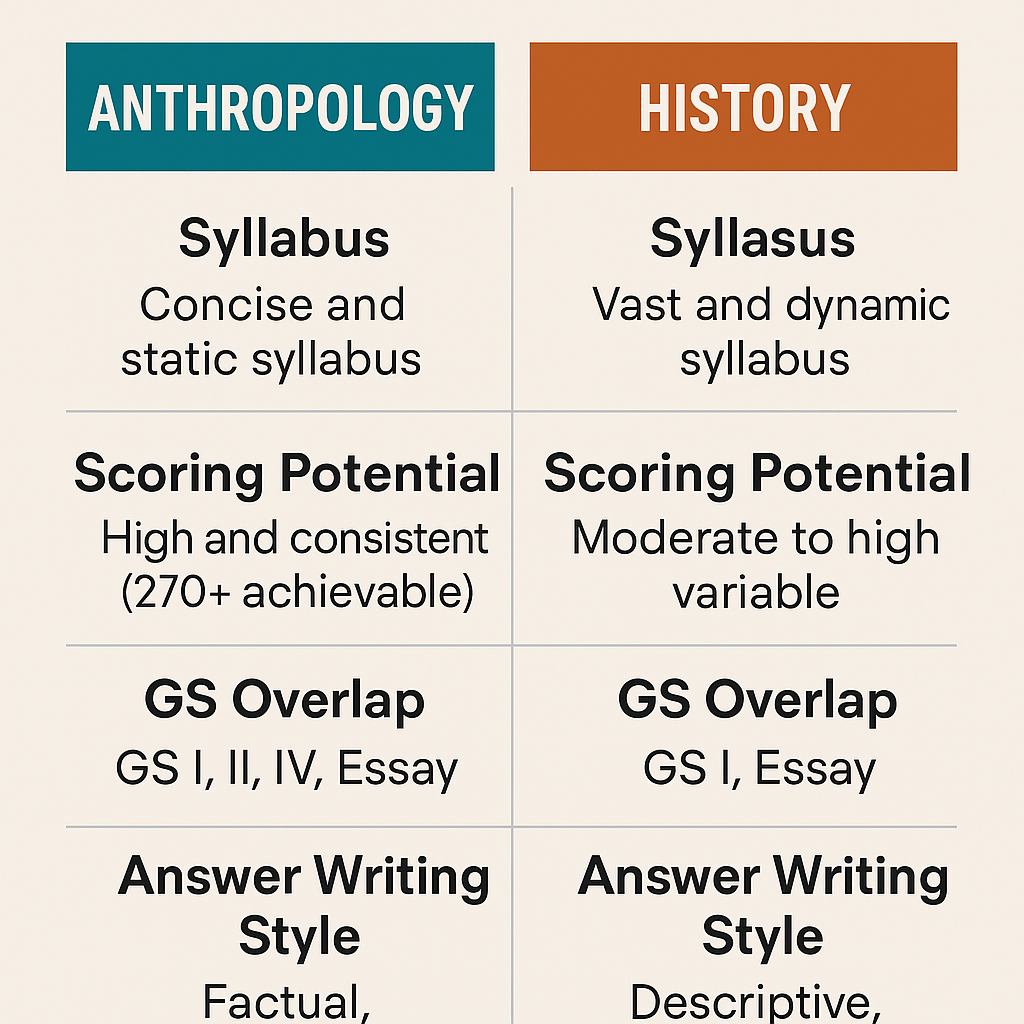
| Criteria | Anthropology | History |
|——————————–|——————————————-|——————————————-|
| Syllabus Size | Concise, static | Vast, theory-based, dynamic |
| Scoring Potential | High, consistent (270+ achievable) | Moderate to high, but variable |
| GS and Essay Overlap | GS I, II, IV, Essay | Strong overlap with GS I, Essay |
| Answer Writing Style | Factual, diagram-based | Descriptive, analytical, essay-oriented |
| Background Suitability | Science, engineering, humanities | Humanities, history, arts |
| Time to Prepare | 3-4 months with revisions | 5-6 months with writing practice |
✅ **Conclusion:**
– Choose **Anthropology** if you prefer a concise syllabus, objective answers, diagram-based writing, and high scoring predictability.
– Choose **History** if you have strong writing skills, a passion for historical events, and are willing to handle a vast syllabus.
Remember, your interest, background, and preparation strategy should drive your decision, not just scoring potential.
Useful Resources:
- Top Anthropology Coaching for UPSC
- Best History Optional Coaching for UPSC
- UPSC Previous Year Papers – Official Website
- Best Mentorship for UPSC Optionals
- Also read Which is better optional: Anthropology or Zoology

- ओडिशा में 870 एकड़ में बनेगा ‘सिलिकॉन वैली’, जानिए क्या होगा फायदा - September 19, 2026
- Odisha’s 870-Acre Silicon Valley Hub: UPSC Exam Focus on Semiconductor Growth - September 19, 2026
- यूपीएससी तैयारी: आरबीआई द्वारा 91, 182 और 364 दिनों के ट्रेजरी बिलों की नीलामी - September 19, 2026

No Comments