


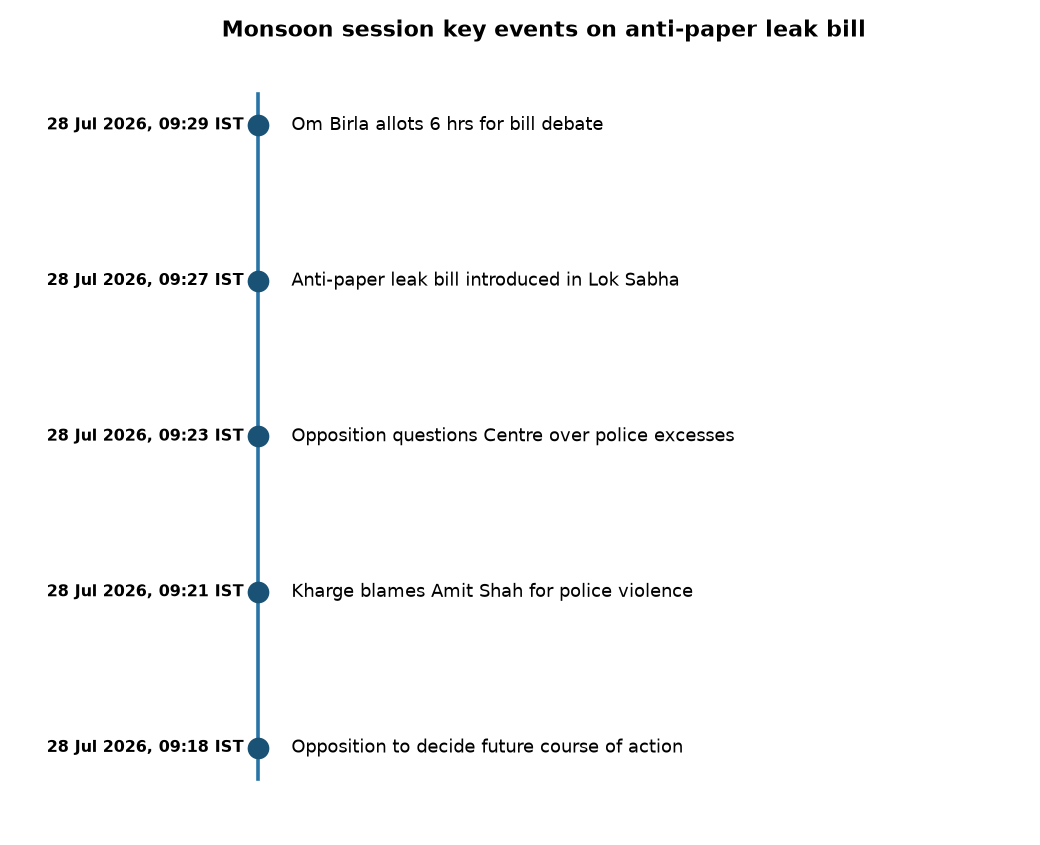
28 Jul Anti-Paper Leak Bill Debate: Key Points for UPSC & State PCS Aspirants
Subject Relevance — Where This Topic Fits
- GS Paper II — Polity and Governance | GS Paper III — Security and Governance | GS Paper IV — Ethics in Governance
- Prelims: Public Examinations (Prevention of Unfair Means) Act, 2024, NEET-UG examination controversy, Lok Sabha Speaker’s discretionary powers under Rule 374, Section 124A of the Indian Penal Code (sedition), Right to Education (RTE) Act, 2009, All India Services (Conduct) Rules, 1968
- Essay: Governance failures and the erosion of public trust in examinations, Balancing accountability and overreach in legislative responses to crises
Quick Revision: The Public Examinations (Prevention of Unfair Means) Amendment Bill, seeks to criminalise organised paper leaks with stringent penalties, strengthen institutional accountability, and introduce technological safeguards to restore public trust in examination governance.
Why is this in the news?
The Parliament’s monsoon session is witnessing intense debate on the Public Examinations (Prevention of Unfair Means) Amendment Bill, introduced in response to widespread allegations of paper leaks in competitive examinations such as NEET-UG. The bill seeks to enhance penalties for examination fraud and address systemic governance failures exposed by recent protests, including allegations of police excesses during crackdowns on student agitations. The legislative move follows the resignation of the Union Education Minister and underscores the intersection of educational integrity, administrative accountability, and constitutional rights.
Background
- The Public Examinations (Prevention of Unfair Means) Act, was enacted to curb malpractices in public examinations conducted by bodies like the National Testing Agency (NTA) and the Union Public Service Commission (UPSC).
- Recent controversies surrounding the NEET-UG 2024 examination, including allegations of paper leaks and irregularities, triggered nationwide protests by students and aspirants, leading to disruptions in major cities.
- The protests escalated into clashes with law enforcement agencies, with allegations of excessive use of force, including the deployment of pellet guns, raising concerns about human rights violations and state response to dissent.
- The resignation of the Union Education Minister, Dharmendra Pradhan, marked a significant political fallout, reflecting the gravity of the crisis and the erosion of public confidence in examination governance.
- The Opposition has accused the central government of failing to prevent malpractices and of resorting to disproportionate measures to suppress dissent, demanding accountability from the Home Ministry and the Prime Minister’s Office.
- The Lok Sabha Speaker allocated six hours for debate on the amendment bill, indicating the government’s intent to address the issue legislatively while acknowledging the Opposition’s demand for a thorough discussion.
What is the Public Examinations (Prevention of Unfair Means) Amendment Bill?
- The bill amends the Public Examinations (Prevention of Unfair Means) Act, to introduce stricter penalties for individuals and organised groups involved in examination paper leaks, including imprisonment terms up to 10 years and fines up to ₹1 crore.
- It expands the definition of ‘unfair means’ to include digital manipulation, impersonation, and collusion with examination authorities, thereby broadening the scope of offences under the Act.
- The amendment empowers the Union Government to notify additional examinations as ‘public examinations’ under the Act, thereby extending its jurisdiction to state-conducted examinations and professional entrance tests.
- It establishes a dedicated ‘High-Level National Technical Committee’ to oversee the integrity of examination processes, including the use of AI-based proctoring and blockchain for secure question paper generation.
- The bill introduces provisions for the confiscation and forfeiture of property acquired through examination fraud, targeting organised syndicates and middlemen involved in paper leaks.
- It mandates the creation of a ‘National Examination Integrity Portal’ for real-time reporting of malpractices, enabling swift action by law enforcement agencies.
- The amendment bill seeks to address governance gaps by imposing liability on examination conducting bodies for lapses in security protocols, including mandatory audits by third-party agencies.
- It includes clauses for the protection of whistle-blowers and informants, ensuring anonymity and safeguards against retaliation for those reporting malpractices.
Key Features
| Feature | Significance |
|---|---|
| Public Examinations (Prevention of Unfair Means) Amendment Bill, 2026 | Proposes stringent penalties, including imprisonment up to 10 years and fines up to ₹1 crore, for examination paper leaks, aiming to restore integrity in competitive examinations such as NEET, JEE, and UPSC. |
| Lok Sabha Speaker’s allocation of 6 hours for debate | Demonstrates procedural fairness and parliamentary accommodation, enabling thorough discussion while balancing legislative urgency and democratic scrutiny. |
| Opposition’s submission of 93 amendments | Reflects democratic engagement and scrutiny of the bill, highlighting concerns over potential overreach, lack of safeguards, and the need for broader consultations with stakeholders. |
| Allegations of police excesses during protests | Underscores the tension between law enforcement and citizens’ rights, raising questions about proportionality in crowd control measures and the impact on public trust. |
| Union Education Minister’s resignation | Signals political accountability in response to systemic failures, particularly the recurrence of examination paper leaks despite existing legal frameworks. |
Why it Matters
Governance and Accountability
- The bill’s introduction underscores the government’s commitment to addressing systemic corruption in competitive examinations, a critical issue affecting lakhs of aspirants annually.
- The resignation of a Union Minister reflects the political cost of perceived inaction, reinforcing the principle of ministerial responsibility in democratic governance.
- Parliamentary debates and Opposition amendments exemplify the system of checks and balances, ensuring legislative proposals undergo rigorous scrutiny before enactment.
Economic Implications
- Examination paper leaks disrupt the merit-based selection process, leading to inefficient allocation of human resources in critical sectors such as healthcare, engineering, and civil services.
- The financial burden of re-conducting examinations, as seen in NEET-UG 2024, imposes significant costs on the exchequer, estimated in crores of rupees.
- Restoring trust in examination systems is essential for maintaining India’s competitive edge in global talent markets, particularly in STEM fields.
Social and Ethical Dimensions
- Paper leaks disproportionately affect marginalised sections of society, exacerbating inequities in access to higher education and professional opportunities.
- The use of pellet guns and police excesses during protests raises ethical concerns about the state’s response to legitimate grievances, potentially eroding public confidence in institutions.
- The bill’s stringent penalties must balance deterrence with proportionality to avoid criminalising unintended or minor infractions.
Legislative and Procedural Aspects
- The amendment bill seeks to amend the Public Examinations (Prevention of Unfair Means) Act, 2024, by introducing stricter provisions and expanding the scope of offences.
- The debate’s allocation of 6 hours reflects the speaker’s role in ensuring meaningful discussion while managing legislative timelines during the monsoon session.
- The Opposition’s amendments highlight the need for pre-legislative consultations with educationists, examination bodies, and student representatives.
Challenges
1. Enforcement and Implementation Gaps
- Existing laws, including the Public Examinations (Prevention of Unfair Means) Act, 2024, have failed to deter paper leaks, indicating systemic weaknesses in enforcement mechanisms.
- The bill’s stringent penalties may face challenges in prosecution and conviction due to the clandestine nature of paper leaks, requiring robust investigative agencies.
- Coordination among central and state agencies, examination bodies (e.g., NTA, UPSC), and law enforcement is critical but often fragmented.
UPSC Link: GS-II: Role of Statutory, Regulatory and various Quasi-judicial bodies
2. Balancing Deterrence and Proportionality
- The bill proposes imprisonment up to 10 years and fines up to ₹1 crore, raising concerns about disproportionate punishment for minor or unintentional offences.
- The definition of ‘unfair means’ must be precise to avoid arbitrary application, particularly in cases involving technical glitches or administrative errors.
- Judicial scrutiny of the bill’s provisions will be essential to ensure compliance with constitutional principles such as Article 21 (right to life and personal liberty).
UPSC Link: GS-II: Fundamental Rights
3. Public Trust and Institutional Credibility
- Repeated paper leaks, despite legislative measures, have eroded public trust in examination systems, necessitating transparent and time-bound investigations.
- The use of force during protests has further damaged the government’s credibility, requiring accountability and corrective measures to restore faith in institutions.
- Stakeholder engagement, including consultations with student bodies, teachers’ unions, and examination authorities, is vital to design effective and acceptable solutions.
UPSC Link: GS-II: Issues relating to development and management of Social Sector/Services relating to Health, Education, Human Resources
4. Operational Challenges for Examination Bodies
- Examination bodies like NTA and UPSC face operational challenges in conducting examinations securely, including technological safeguards, invigilation, and post-exam verification.
- The bill’s provisions may impose additional administrative burdens on these bodies, requiring enhanced infrastructure and personnel.
- Ensuring the integrity of digital examination platforms, including prevention of hacking and data breaches, remains a critical challenge.
UPSC Link: GS-III: Science and Technology- developments and their applications and effects in everyday life
5. Political Polarisation and Legislative Gridlock
- The Opposition’s demand for accountability over police excesses and the resignation of the Education Minister has led to heightened political tensions, risking legislative deadlock.
- The bill’s passage may be delayed due to partisan debates, undermining the urgency of addressing examination malpractices.
- Consensus-building among political parties is essential to ensure the bill’s effectiveness and long-term implementation.
UPSC Link: GS-II: Parliament and State Legislatures—structure, functioning, conduct of business, powers & privileges and issues arising out of these
Challenges — UPSC Perspective
| Issue | Concern |
|---|---|
| Enforcement of new penalties | Risk of low conviction rates due to the clandestine nature of paper leaks and lack of evidence. |
| Definition of ‘unfair means’ | Potential ambiguity leading to arbitrary application and legal challenges. |
| Police response to protests | Use of pellet guns and excessive force raises ethical and legal concerns about state overreach. |
| Stakeholder consultations | Lack of pre-legislative engagement with students, teachers, and examination bodies may result in ineffective provisions. |
| Operational capacity of examination bodies | Inadequate technological and human resources to implement stringent security measures. |
| Political consensus | Opposition’s demands for accountability may delay or dilute the bill’s provisions. |
Way Forward
- Constitute a high-powered committee comprising representatives from NTA, UPSC, CBI, and state police forces to assess enforcement gaps in existing laws and propose corrective measures.
- Introduce mandatory pre-legislative consultations with student bodies, teachers’ associations, and examination authorities to refine the bill’s provisions and ensure stakeholder buy-in.
- Enhance technological safeguards for digital examinations, including AI-based proctoring, blockchain for answer sheets, and real-time monitoring by multiple agencies.
- Establish a dedicated cybersecurity task force to investigate and prevent data breaches in examination systems, with strict penalties for cyber offenders.
- Implement a transparent grievance redressal mechanism for aspirants, including a helpline and online portal to report irregularities anonymously.
- Strengthen coordination between central and state agencies through regular inter-state meetings and joint task forces to track paper leak syndicates.
- Conduct periodic audits of examination centres to identify vulnerabilities and enforce strict compliance with security protocols.
- Launch a public awareness campaign to educate aspirants about legal consequences of paper leaks and the importance of merit-based selection.
UPSC Value Addition
Keywords for Mains Answer-Writing
Public Examinations (Prevention of Unfair Means) Act, 2024 · NEET-UG examination irregularities · Constitutional provisions for conduct of examinations · Parliamentary procedures and debates · Role of Union Education Ministry in examination reforms · Judicial oversight of examination processes · Federal structure and Centre-state coordination in education · Right to Education (RTE) Act, 2009 · Examination malpractices and social justice · Legislative accountability and parliamentary scrutiny
Constitutional & Policy Linkages
- [‘Article 14: Equality before law and equal protection of laws’, ‘Ensures fair treatment of all aspirants and prevents arbitrary application of penalties.’]
- [‘Article 21: Protection of life and personal liberty’, ‘Protects aspirants from disproportionate punishment and police excesses during protests.’]
- [‘Article 19(1)(a): Freedom of speech and expression’, ‘Balances the right to protest against the need for law and order during demonstrations.’]
- [‘Article 38: Directive Principles of State Policy’, ‘Directs the state to promote welfare and reduce inequalities in access to education.’]
Concept Flow
Examination paper leaks → Erosion of public trust in competitive examinations → Public protests and political backlash → Resignation of Union Minister → Introduction of stringent anti-paper leak bill → Protests over police excesses → Allegations of state overreach → Heightened political tensions → Opposition demands for accountability → Delayed legislative process → Bill proposes stringent penalties → Concerns over proportionality and legal ambiguity → Opposition submits 93 amendments → Speaker allocates 6 hours for debate → Risk of legislative gridlock → Lack of stakeholder consultations → Potential operational inefficiencies → Need for technological safeguards → Enhanced cybersecurity measures → Improved examination integrity → Systemic failures in enforcement → Repeated paper leaks despite existing laws → Need for high-powered committee → Coordination among central and state agencies → Strengthened institutional capacity → Public trust in institutions eroded → Loss of faith in meritocracy → Long-term impact on human resource development → Urgency for systemic reforms → Balancing deterrence and fairness
Prelims Practice Questions
Q1. Which of the following provisions is NOT included in the Public Examinations (Prevention of Unfair Means) Act, 2024?
- Imposition of fines up to ₹1 crore for examination malpractices
- Mandatory imprisonment for paper leak offenders
- Establishment of a National Examination Regulatory Authority
- Provision for cancellation of examinations in case of malpractices
Answer: Establishment of a National Examination Regulatory Authority — The Act does not establish a National Examination Regulatory Authority; it primarily focuses on punitive measures and procedural safeguards. The other options are directly referenced in the Act’s provisions.
Q2. The Public Examinations (Prevention of Unfair Means) Amendment Bill, 2026, seeks to amend which of the following Acts?
- Right to Information Act, 2005
- Right to Education Act, 2009
- Public Examinations (Prevention of Unfair Means) Act, 2024
- University Grants Commission Act, 1956
Answer: Public Examinations (Prevention of Unfair Means) Act, 2024 — The Amendment Bill specifically targets the Public Examinations (Prevention of Unfair Means) Act, 2024, to introduce stricter penalties and procedural reforms in response to recent examination irregularities.
Mains Practice Question
✍ Evaluate the constitutional and administrative measures required to ensure transparency and fairness in national-level examinations such as NEET-UG. Critically analyse the role of the Union Government in addressing the challenges posed by examination malpractices.
Approach: Begin by outlining the constitutional provisions relevant to examinations (e.g., Article 29(2) for non-discrimination, Article 30 for minority rights, and the Seventh Schedule’s distribution of powers). Discuss the administrative reforms needed, including the establishment of a statutory body for oversight, digitalisation of examination processes, and stringent penalties for malpractices. Critically assess the Union Government’s role in balancing federal concerns (e.g., state-level education boards) with national standards, and the need for judicial and parliamentary oversight to ensure accountability.
Source: Hindustan Times
Generated by AanyaAi for educational purpose.

- दिल्ली में 99% पीजी में नहीं है फायर एनओसी, 30% को नहीं मिला लेआउट अप्रूवल: एमसीडी सर्वे - September 15, 2026
- महत्वपूर्ण: MSC एल्सा 3 जहाज के डूबने के दीर्घकालिक प्रभावों का आकलन करेगा केंद्र, जानिए पूरा मामला - September 15, 2026
- केरल की इकोसेंस छात्रवृत्तियां: 46,000 छात्रों को अपशिष्ट प्रबंधन में सशक्त बना रही हैं - September 14, 2026

No Comments