


08 Aug APEDA facilitates first GI-tagged Mithila Makhana export to Australia via sea route
✎ Mithila Makhana, a GI-tagged aquatic crop from Bihar, has been exported to Australia via sea route for the first time, demonstrating India’s potential to leverage GI tags and export-oriented value chains for enhancing farmer…
Subject Relevance — Where This Topic Fits
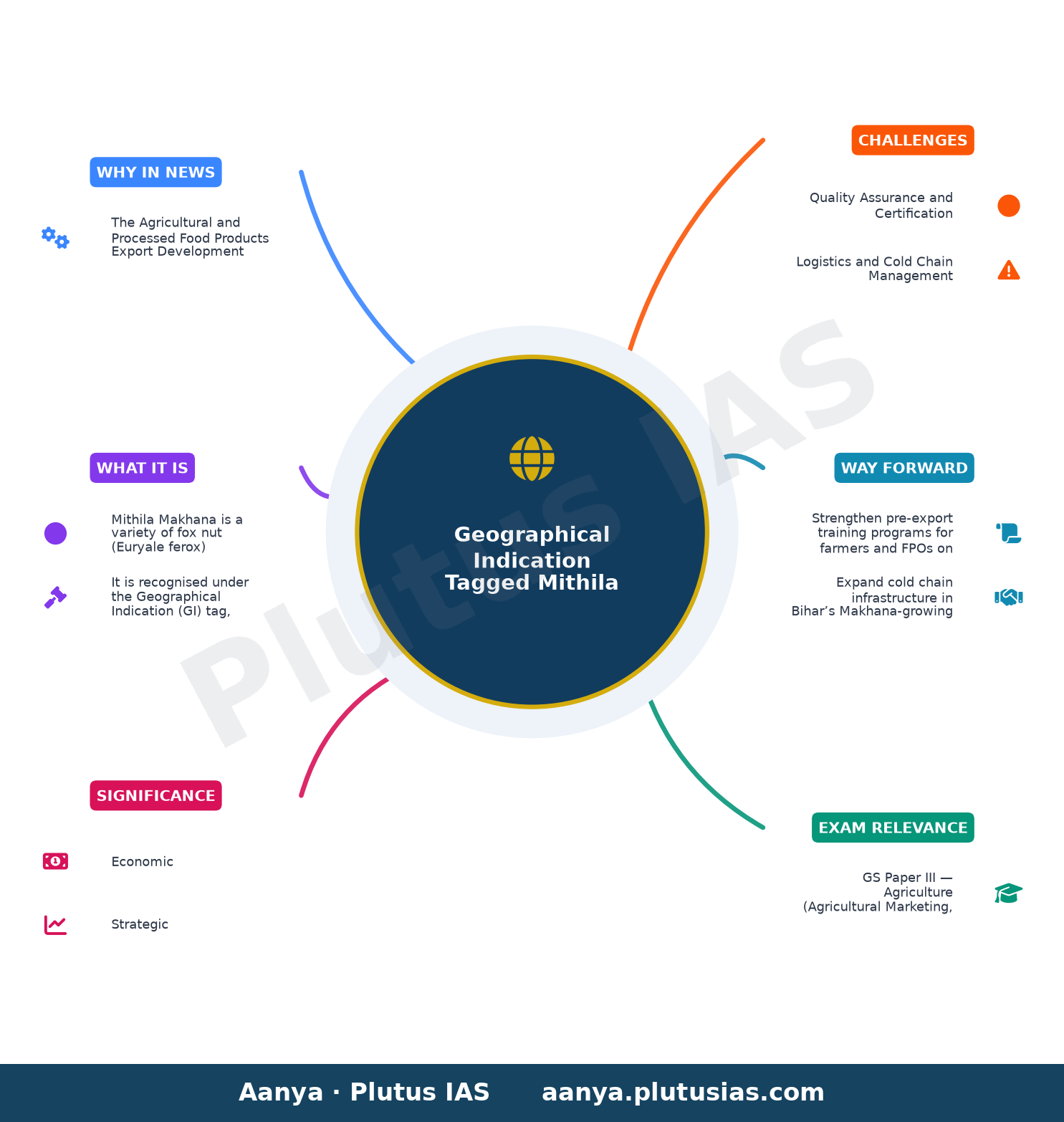
- GS Paper III — Agriculture (Agricultural Marketing, Export Promotion, GI Tags)
- Prelims: Geographical Indication (GI) Tags, APEDA, Mithila Makhana, Sea Route Exports, Farmer Producer Organisations (FPOs), HS Code for Makhana, Bihar’s Agricultural Exports
- Essay: The role of geographical indications in enhancing rural livelihoods and global market integration, Sustainable agricultural export strategies for India’s agro-based economy
Quick Revision: Mithila Makhana, a GI-tagged aquatic crop from Bihar, has been exported to Australia via sea route for the first time, demonstrating India’s potential to leverage GI tags and export-oriented value chains for enhancing farmer incomes and global market integration.
Why is this in the news?
The Agricultural and Processed Food Products Export Development Authority (APEDA) facilitated the first-ever commercial sea shipment of 18 metric tonnes of Geographical Indication (GI)-tagged Mithila Makhana from Bihar, India, to Australia. This initiative underscores the expanding global market for premium-quality Indian agricultural products, the strategic importance of GI tags in value addition, and the potential for export-oriented agricultural value chains to enhance farmer incomes through direct market linkages and premium pricing.
Background
- Mithila Makhana, cultivated primarily in the Mithila region of Bihar, is a premium aquatic crop with high nutritional value and cultural significance, recognised under the Geographical Indication (GI) tag.
- Bihar contributes approximately 85% to India’s total makhana production, making it a critical agricultural commodity for the state’s economy and export potential.
- The Government of India introduced a separate HS Code for makhana in July 2025 under the Finance Bill, 2025, to streamline trade data, facilitate market access, and enhance export competitiveness.
- APEDA, under the Ministry of Commerce and Industry, plays a pivotal role in promoting agricultural exports by providing market development support, capacity building, and export facilitation services, including GI-tagged products.
- The export of GI-tagged agricultural products is part of India’s broader strategy to leverage its rich agro-biodiversity, enhance farmer incomes, and integrate smallholder farmers into global value chains.
- The use of sea routes for agricultural exports is a cost-effective and environmentally sustainable alternative to air freight, particularly for non-perishable and low-weight commodities like makhana.
What is Mithila Makhana?
- Mithila Makhana is a variety of fox nut (Euryale ferox) cultivated in the wetlands of the Mithila region in northern Bihar, primarily in districts such as Darbhanga, Madhubani, and Samastipur.
- It is recognised under the Geographical Indication (GI) tag, which certifies its unique geographical origin, traditional cultivation practices, and quality attributes.
- The crop is grown in shallow water bodies, and its processing involves drying, roasting, and grading to produce the final edible product, which is rich in protein, calcium, magnesium, and antioxidants.
- Mithila Makhana is a traditional food item in the region, consumed during religious ceremonies, festivals, and as a nutritious snack, and is also used in Ayurvedic medicine.
- The GI tag ensures that only products originating from the Mithila region and adhering to traditional methods can be marketed as ‘Mithila Makhana’, thereby protecting the interests of local farmers and processors.
- The export of GI-tagged Mithila Makhana to international markets like Australia signifies the growing demand for premium-quality Indian agricultural products and the potential for value addition through certification and branding.
- The involvement of Farmer Producer Organisations (FPOs) and startups in the export process highlights the role of collective action and innovation in enhancing market access and income for smallholder farmers.
Key Features
| Feature | Significance |
|---|---|
| Geographical Indication (GI) Tag | Ensures authenticity, protects traditional knowledge, and enhances marketability of Mithila Makhana in international trade. |
| Maritime Export Route | Reduces logistics costs, extends shelf life, and aligns with sustainable export practices for perishable agricultural goods. |
| Direct Farmer Procurement | Eliminates middlemen, ensures higher remuneration for farmers, and strengthens backward linkages in the value chain. |
| APEDA Facilitation | Provides end-to-end support including certification, logistics coordination, and market access for GI-tagged agricultural products. |
| Logistics Partnership with Startups | Leverages AgriTech innovation (e.g., Bharti Hub) to optimize cold chain management and reduce transit losses. |
Why it Matters
Economic
- Enhances foreign exchange earnings through high-value agricultural exports, contributing to India’s trade surplus.
- Increases farmer income by 18% via direct market access, reducing dependency on local intermediaries.
- Strengthens Bihar’s agricultural economy, where Mithila Makhana constitutes ~85% of India’s production.
- Creates sustainable export opportunities for allied sectors, including packaging, logistics, and AgriTech.
Strategic
- Expands India’s footprint in niche agricultural markets, particularly in Oceania, diversifying export destinations.
- Demonstrates India’s capability to meet stringent international quality standards (e.g., phytosanitary norms) for perishable goods.
- Positions Mithila Makhana as a premium export product, reinforcing India’s soft power in global agri-commodity trade.
Social
- Preserves traditional knowledge and livelihoods of the Mithila community, who are integral to Makhana processing.
- Promotes gender-inclusive agriculture, as women play a significant role in Makhana farming and processing in Bihar.
- Encourages rural entrepreneurship through FPOs and startups in the export ecosystem.
Environmental
- Maritime transport has a lower carbon footprint compared to air freight, aligning with sustainable export practices.
- Supports conservation of Mithila Makhana’s indigenous varieties through GI tagging and market-driven demand.
Challenges
1. Quality Assurance and Certification
- Meeting international phytosanitary and food safety standards (e.g., EU, Australia) requires rigorous testing and certification.
- Ensuring consistency in GI-tagged product quality across batches to maintain brand reputation.
- High compliance costs for small farmers and FPOs may deter participation in export chains.
UPSC Link: GS-III: Food Processing and Related Industries
2. Logistics and Cold Chain Management
- Perishable nature of Makhana demands uninterrupted cold chain logistics to prevent spoilage during transit.
- Limited infrastructure in rural Bihar for pre-cooling, storage, and refrigerated transport.
- Delays in customs clearance or port handling can compromise product quality.
UPSC Link: GS-III: Infrastructure and Logistics
3. Market Competition and Price Volatility
- Competition from substitute products (e.g., lotus seeds from other regions) may pressure pricing.
- Fluctuations in global demand or trade policies (e.g., tariffs) can impact export viability.
- Need for continuous market intelligence to adapt to consumer preferences in target markets like Australia.
UPSC Link: GS-III: Agricultural Marketing
4. Policy and Regulatory Hurdles
- Complexity in availing export incentives under schemes like RoDTEP or MEIS due to documentation requirements.
- State-level disparities in agricultural policies and export facilitation may create bottlenecks.
- Lack of awareness among farmers about export procedures and benefits.
UPSC Link: GS-II: Government Policies and Interventions
Challenges — UPSC Perspective
| Issue | Concern |
|---|---|
| Phytosanitary Compliance | Risk of rejection at ports due to non-compliance with importing country’s sanitary standards. |
| Cold Chain Gaps | Potential spoilage during transit if refrigeration fails or delays occur in multimodal transport. |
| Smallholder Vulnerability | Limited bargaining power of individual farmers in negotiating export contracts. |
| Trade Barriers | Non-tariff barriers (e.g., labeling requirements) in target markets like Australia. |
| Infrastructure Deficit | Inadequate storage and processing facilities in rural Bihar for export-grade Makhana. |
Way Forward
- Strengthen pre-export training programs for farmers and FPOs on quality standards, packaging, and documentation.
- Expand cold chain infrastructure in Bihar’s Makhana-growing districts with public-private partnerships.
- Leverage digital platforms (e.g., e-NAM) to connect farmers directly with exporters and reduce transaction costs.
- Promote value addition (e.g., roasted, flavored Makhana) to diversify export products and fetch higher margins.
- Enhance market intelligence by collaborating with trade bodies (e.g., FIEO) to identify high-potential markets beyond Australia.
- Simplify export procedures under RoDTEP and MEIS for small-scale producers through single-window portals.
- Invest in R&D to develop Makhana varieties with longer shelf life and improved nutritional profiles for export markets.
- Establish a dedicated export facilitation center in Bihar to streamline certification, logistics, and trade compliance.
UPSC Value Addition
Keywords for Mains Answer-Writing
Geographical Indications (GI) tag · Mithila Makhana · APEDA · Agri-export infrastructure · Sustainable agriculture · GI-tagged agricultural products · Bihar agricultural economy · Maritime export logistics · Farmers’ income augmentation · Global market access for Indian agri-products · GI protection and trade · Agri-tech startups in export facilitation · Export-oriented agricultural value chains · GI-tagged products and WTO compliance
Concept Flow
GI Tagging of Mithila Makhana → Authenticity and market differentiation → Farmer procurement in Bihar → Direct income enhancement for traditional communities → APEDA facilitation → End-to-end export support (certification, logistics, market access) → Maritime export route → Cost-effective and sustainable logistics for perishable goods → International market access (Australia) → Diversification of export destinations → Higher farmer remuneration → Reinvestment in quality improvement and scale-up → Sustainable export growth → Long-term economic resilience for Bihar’s agricultural sector
Prelims Practice Questions
Q1. Consider the following statements regarding the Geographical Indications (GI) tag in India:
1. The GI tag is a form of intellectual property right that identifies a product as originating from a specific geographical location.
2. The registration of a GI tag is mandatory under the TRIPS Agreement for all WTO member countries.
3. The GI tag for Mithila Makhana was granted by the Geographical Indications Registry, Chennai.
4. The GI tag ensures that only authorized users can use the product name, preventing misuse by non-origin producers.
How many of the above statements are correct?
- Only one
- Only two
- Only three
- All
Answer: All — Statements 1, 3, and 4 are correct. Statement 2 is incorrect because the TRIPS Agreement does not mandate GI registration for WTO members; it only requires protection of GIs under its provisions.
Q2. Assertion (A): The Agricultural and Processed Food Products Export Development Authority (APEDA) plays a pivotal role in promoting the export of GI-tagged agricultural products from India.
Reason (R): APEDA provides market access facilitation, capacity building, and logistical support to exporters, including those dealing in GI-tagged products like Mithila Makhana.
In the context of the above two statements, which of the following is correct?
- Both A and R are true, and R is the correct explanation of A
- Both A and R are true, but R is not the correct explanation of A
- A is true but R is false
- A is false but R is true
Answer: Both A and R are true, but R is not the correct explanation of A — Both the assertion and reason are true, and the reason correctly explains the assertion. APEDA’s mandate includes facilitating exports of agricultural products, including GI-tagged items, through market development and logistical support.
Q3. Match the following pairs related to agricultural export facilitation in India:
Column I (Initiative/Scheme)
A. APEDA
B. BHARATI (Agri-tech Hub)
C. GI Tag
D. Maritime Export Logistics
Column II (Description)
1. A startup supported by APEDA to enhance export resilience and innovation in agri-exports.
2. A statutory body under the Ministry of Commerce and Industry to promote agri-exports.
3. A certification that identifies products originating from a specific geographical region.
4. A mode of transport used for exporting 18 metric tonnes of GI-tagged Mithila Makhana to Australia.
Select the correct match:
- A-2, B-1, C-3, D-4
- A-1, B-2, C-3, D-4
- A-2, B-3, C-1, D-4
- A-3, B-1, C-2, D-4
Answer: A-2, B-1, C-3, D-4 — The correct matches are: A (APEDA) – 2 (statutory body under Ministry of Commerce and Industry), B (BHARATI) – 1 (APEDA-supported agri-tech hub), C (GI Tag) – 3 (certification for geographical origin), D (Maritime Export Logistics) – 4 (mode of transport for the Makhana consignment).
Mains Practice Question
✍ The export of GI-tagged Mithila Makhana from Bihar to Australia via maritime logistics marks a significant milestone in India’s agricultural export strategy. Critically examine the role of Geographical Indications (GIs) in enhancing the global competitiveness of Indian agricultural products, with particular reference to the Mithila Makhana case. Also, analyse the institutional mechanisms that facilitate such exports, including the role of APEDA and agri-tech startups like BHARATI. (15 Marks)
Approach: MODEL-ANSWER SKELETON:
1. **Definition and Significance of GI Tags** (3 Marks)
– Define GI tags under the Geographical Indications of Goods (Registration and Protection) Act, 1999, and their alignment with TRIPS Agreement.
– Explain how GIs confer economic value by protecting traditional knowledge and local identity (e.g., Mithila Makhana’s cultural and nutritional significance).
2. **Role of GI in Enhancing Global Competitiveness** (4 Marks)
– Discuss how GI tags enable premium pricing (e.g., 18% higher earnings for farmers in the case) by ensuring authenticity and quality.
– Highlight the role of GIs in market differentiation and reducing information asymmetry for consumers.
– Reference WTO’s TRIPS provisions on GI protection and its implications for India’s trade agreements.
3. **Institutional Mechanisms Facilitating Exports** (5 Marks)
– **APEDA’s Role**: Discuss APEDA’s mandate under the Agricultural and Processed Food Products Export Development Authority Act, 1985, including market access facilitation, capacity building, and export promotion.
– **BHARATI Initiative**: Explain BHARATI as APEDA’s agri-tech hub for export innovation, resilience, and logistical support (e.g., maritime export logistics for the Makhana consignment).
– **Collaboration with State Governments**: Highlight Bihar’s role in supporting Mithila Makhana producers, including infrastructure development in Bihar Industrial Area Development Authority (BIADA) zones.
4. **Challenges and Way Forward** (3 Marks)
– Discuss challenges such as ensuring consistent quality, meeting international sanitary and phytosanitary (SPS) standards, and logistical bottlenecks.
– Suggest measures like strengthening FPOs, adopting blockchain for traceability, and leveraging digital platforms for market access.
Balance of Views:
– Pro-GI: Emphasises economic empowerment of farmers and cultural preservation.
– Critique: Highlights potential monopolistic practices and the need for inclusive growth to prevent elite capture within producer communities.
Source: PIB (Press Information Bureau)
Generated by AanyaAi for educational purpose.

- Exercise Tarang Shakti 2026: India’s Mega Multi-Nation Air Power Showcase - September 27, 2026
- रबी अभियान 2026: राष्ट्रीय सम्मेलन में केंद्र-राज्य तालमेल पर होगा जोर - September 27, 2026
- Himachal CM Sukhu: All Doctor Vacancies to be Filled by March - September 27, 2026

No Comments