


08 Aug APEDA facilitates first GI-tagged Mithila Makhana export to Australia via sea route
✎ Mithila Makhana’s GI tag and dedicated HS code (2025) have strengthened Bihar’s agricultural export potential, with APEDA facilitating first-ever sea-route consignment to Australia, enhancing farmer incomes and global market…
Subject Relevance — Where This Topic Fits
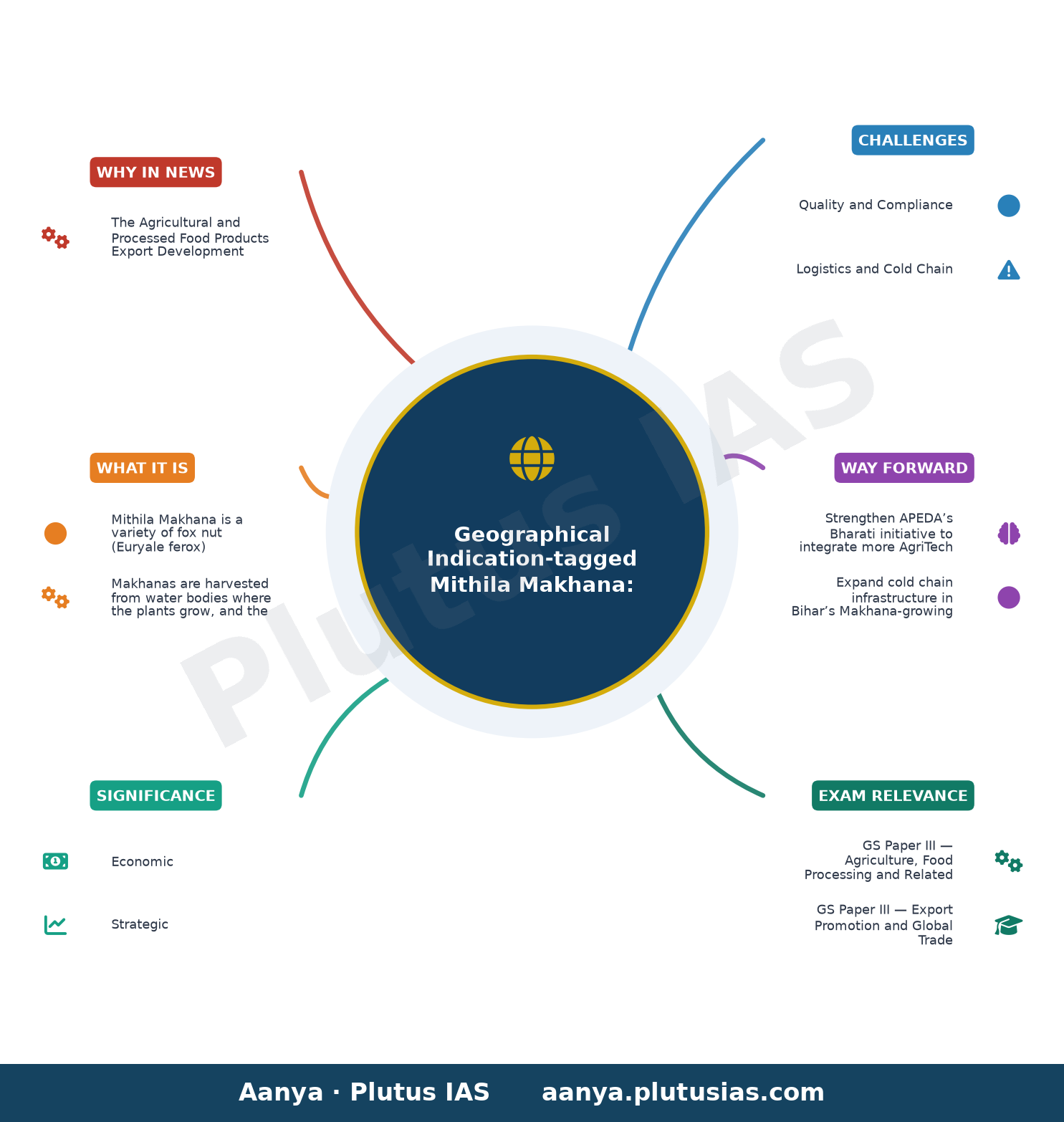
- GS Paper III — Agriculture, Food Processing and Related Industries | GS Paper III — Export Promotion and Global Trade | GS Paper III — Government Policies and Interventions for Development in Various Sectors
- Prelims: Geographical Indication (GI), Mithila Makhana, Agricultural and Processed Food Products Export Development Authority (APEDA), Export Promotion, Sea Freight Logistics, HS Code for Makhana, Farmer Producer Organisations (FPOs)
- Essay: The role of Geographical Indications in enhancing rural livelihoods and global market integration, Sustainable agricultural export strategies for India’s farmers in the 21st century
Quick Revision: Mithila Makhana’s GI tag and dedicated HS code (2025) have strengthened Bihar’s agricultural export potential, with APEDA facilitating first-ever sea-route consignment to Australia, enhancing farmer incomes and global market access.
Why is this in the news?
The Agricultural and Processed Food Products Export Development Authority (APEDA) facilitated the first-ever commercial consignment of 18 metric tonnes of Geographical Indication (GI)-tagged Mithila Makhana from Bihar, India, to Australia via sea route. This marks a significant milestone in expanding the global footprint of India’s GI-tagged agricultural products, enhancing export-based market access for local farmers, and underscoring the potential of sea freight for high-value agricultural exports. The initiative is expected to generate approximately 18% higher earnings for farmers compared to conventional market rates, thereby contributing to sustainable income growth and reinforcing Bihar’s position as a key producer of premium makhana.
Background
- Mithila Makhana, a GI-tagged product from the Mithila region of Bihar, is a premium variety of fox nut cultivated in stagnant water bodies, primarily in Darbhanga, Madhubani, and Samastipur districts.
- Bihar contributes approximately 85% to India’s total makhana production, establishing it as the epicentre of makhana cultivation in the country.
- The Finance Bill 2025 introduced a dedicated Harmonised System (HS) code for makhana in July 2025, aimed at streamlining trade data, improving export tracking, and enhancing market transparency for makhana and its value-added products.
- APEDA, under the Ministry of Commerce and Industry, plays a pivotal role in promoting agricultural exports by providing market access, capacity-building, and logistical support to stakeholders, including farmers, exporters, and FPOs.
- India exported over 7,000 metric tonnes of makhana and value-added makhana products to more than 20 international destinations, including the USA, Middle East, and Africa, during the fiscal year 2025–26.
What is Mithila Makhana?
- Mithila Makhana is a variety of fox nut (Euryale ferox) cultivated in the Mithila region of Bihar, primarily in districts such as Darbhanga, Madhubani, and Samastipur.
- Makhanas are harvested from water bodies where the plants grow, and the seeds are processed through drying, peeling, and roasting to achieve the final product, which is rich in protein, fibre, and essential minerals.
- The GI tag ensures authenticity, prevents misappropriation, and enhances the market value of the product, making it eligible for premium pricing in domestic and international markets.
- Mithila Makhana is consumed as a snack, used in religious rituals, and incorporated into Ayurvedic formulations due to its nutritional and medicinal properties.
- The crop is predominantly cultivated by marginal and small farmers, making it a significant contributor to rural livelihoods and women-led agricultural economies in Bihar.
- The introduction of a dedicated HS code for makhana in 2025 has facilitated better trade data collection, improved export logistics, and enhanced market competitiveness for Indian makhana products.
Key Features
| Feature | Significance |
|---|---|
| Geographical Indication (GI) tag for Mithila Makhana | Ensures authenticity, protects traditional knowledge, and enhances market value for Bihar’s Makhana producers. |
| First commercial sea shipment to Australia | Demonstrates India’s capability in exporting high-value agricultural products via sea routes, reducing logistics costs and carbon footprint. |
| 18% higher earnings for farmers | Direct market access and export-oriented value chains enable premium pricing, improving livelihoods of traditional Makhana cultivators. |
| Collaboration between APEDA and Bihar Government | Facilitates end-to-end support from procurement to export compliance, aligning state and central policies for agricultural exports. |
| Logistics support by AgriTech startups (e.g., Bharati initiative) | Leverages technology and innovation to streamline cold chain management and export documentation. |
Why it Matters
Economic
- Enhances foreign exchange earnings through high-value agricultural exports, contributing to India’s trade surplus in agri-commodities.
- Strengthens Bihar’s rural economy by linking traditional farmers to global markets, reducing dependence on local middlemen.
- Demonstrates India’s potential to diversify export baskets beyond traditional staples, tapping into niche markets like premium health foods.
Strategic
- Expands India’s agricultural footprint in Oceania, complementing existing trade relations with Australia in pulses and spices.
- Validates India’s commitment to sustainable trade practices by prioritizing sea routes over air freight, reducing carbon emissions.
- Positions Mithila Makhana as a flagship GI product, reinforcing India’s intellectual property rights in global agricultural trade.
Social
- Preserves traditional knowledge and livelihoods of the Mithila community, particularly the ‘Foori’ community, whose indigenous processing techniques are integral to Makhana production.
- Empowers small and marginal farmers by providing direct market access, ensuring equitable distribution of export benefits.
Policy
- Validates the efficacy of APEDA’s Bharati initiative in bridging gaps between farmers, exporters, and global markets through AgriTech interventions.
- Highlights the role of GI tags in enhancing the competitiveness of Indian agricultural products in international trade.
Challenges
1. Quality and Compliance
- Maintaining strict quality standards (e.g., aflatoxin levels, moisture content) to meet Australia’s import regulations and avoid rejections.
- Ensuring traceability from farm to export to comply with sanitary and phytosanitary (SPS) measures.
UPSC Link: Agricultural Exports and SPS Measures
2. Logistics and Cold Chain
- Managing temperature-sensitive Makhana during sea transit to prevent spoilage or quality degradation.
- Coordinating with multiple stakeholders (exporters, logistics partners, customs) to ensure timely and cost-effective delivery.
UPSC Link: Agricultural Marketing and Supply Chain
3. Market Access and Competition
- Overcoming non-tariff barriers in Australia, such as stringent labeling and packaging requirements.
- Competing with established suppliers of Makhana or substitute products (e.g., lotus seeds from China) in global markets.
UPSC Link: International Trade and Non-Tariff Barriers
4. Farmer Awareness and Capacity
- Educating small farmers on export-oriented farming practices, including post-harvest handling and certification requirements.
- Ensuring equitable participation of all stakeholders, particularly marginalized communities, in the value chain.
UPSC Link: Agricultural Extension Services
Challenges — UPSC Perspective
| Issue | Concern |
|---|---|
| GI tag enforcement | Preventing counterfeiting and ensuring only authentic Mithila Makhana is exported under the GI tag. |
| Climate vulnerability | Erratic monsoons and floods in Bihar can disrupt Makhana cultivation, affecting supply consistency. |
| Price volatility | Fluctuations in global demand or supply chain disruptions can impact farmer incomes despite export premiums. |
| Regulatory hurdles | Navigating Australia’s biosecurity and food safety regulations for agricultural imports. |
| Infrastructure gaps | Limited cold storage and processing facilities in Bihar’s rural areas hinder value addition. |
Way Forward
- Strengthen APEDA’s Bharati initiative to integrate more AgriTech solutions for post-harvest management and market access.
- Expand cold chain infrastructure in Bihar’s Makhana-growing regions to reduce spoilage and enhance export readiness.
- Conduct targeted training programs for farmers on export-oriented processing, packaging, and certification standards.
- Leverage GI tag to promote Mithila Makhana in niche markets (e.g., organic, vegan, or Ayurvedic segments) for higher premiums.
- Collaborate with Australian importers to establish long-term supply contracts, ensuring stable demand for Bihar’s Makhana.
- Enhance traceability systems (e.g., blockchain) to provide real-time tracking of Makhana from farm to foreign consumer.
- Advocate for the inclusion of Makhana under the proposed Agricultural Export Policy to streamline export incentives.
UPSC Value Addition
Keywords for Mains Answer-Writing
Geographical Indication (GI) tag · Mithila Makhana · APEDA · Bihar agriculture · Export promotion · Sustainable livelihoods · Global value chains · GI-tagged products · Maritime export logistics · Farmers’ income · GI Act 1999 · Agri-export policy · Value addition in agriculture · GI protection and trade · Bihar’s GI ecosystem
Concept Flow
Traditional Mithila Makhana cultivation (Foori community) → GI tagging (2018) → State-led promotion (Bihar Government) → APEDA’s market development initiatives → Export facilitation (Bharati initiative) → First sea shipment to Australia → Enhanced farmer incomes and global market presence.
Prelims Practice Questions
Q1. Consider the following statements regarding the Geographical Indication (GI) tag:
1. A GI tag is granted to products that originate from a specific geographical location and possess qualities or reputation attributable to that origin.
2. The GI tag is governed by the World Intellectual Property Organization (WIPO).
3. The GI tag for Mithila Makhana was granted to Bihar for its unique processing methods and cultural significance.
4. The GI tag confers exclusive rights to the producer of the product to prevent unauthorized use by others.
How many of the above statements are correct?
- Only one
- Only two
- Only three
- All
Answer: Only three — Statements 1, 3, and 4 are correct. Statement 2 is incorrect because the GI tag is governed by the TRIPS Agreement under the WTO, not WIPO.
Q2. Assertion (A): The Agricultural and Processed Food Products Export Development Authority (APEDA) plays a pivotal role in promoting the export of GI-tagged agricultural products from India.
Reason (R): APEDA provides market access facilitation, capacity building, and logistical support to exporters, including those dealing with GI-tagged products like Mithila Makhana.
In the context of the above two statements, which of the following is correct?
- Both A and R are true, and R is the correct explanation of A.
- Both A and R are true, but R is NOT the correct explanation of A.
- A is true, but R is false.
- A is false, but R is true.
Answer: Both A and R are true, but R is NOT the correct explanation of A. — Both A and R are true, and R correctly explains A as APEDA’s functions directly support the export of GI-tagged products through facilitation and capacity building.
Q3. Match the following GI-tagged products with their respective states of origin:
Column I (GI-tagged product) | Column II (State of origin)
1. Mithila Makhana | A. Kerala
2. Darjeeling Tea | B. Tamil Nadu
3. Banarasi Saree | C. West Bengal
4. Kancheepuram Silk Saree | D. Bihar
Select the correct match:
- 1-D, 2-C, 3-A, 4-B
- 1-A, 2-B, 3-C, 4-D
- 1-D, 2-A, 3-B, 4-C
- 1-C, 2-D, 3-A, 4-B
Answer: 1-D, 2-C, 3-A, 4-B — Correct matches are: 1-D (Mithila Makhana from Bihar), 2-C (Darjeeling Tea from West Bengal), 3-A (Banarasi Saree from Uttar Pradesh), 4-B (Kancheepuram Silk Saree from Tamil Nadu).
Mains Practice Question
✍ The export of GI-tagged Mithila Makhana from Bihar to Australia via maritime routes represents a significant milestone in India’s agricultural export strategy. Critically examine the role of Geographical Indications in enhancing farmers’ income and promoting sustainable agricultural practices in India. (15 Marks)
Approach: MODEL-ANSWER SKELETON:
1. **Definition and Legal Framework of GI Tags**
– Brief explanation of GI tags under the Geographical Indications of Goods (Registration and Protection) Act, 1999.
– Role of the GI Registry and the criteria for granting GI status (distinctiveness, reputation, and geographical linkage).
2. **Economic and Social Benefits for Farmers**
– **Premium Pricing**: How GI tags enable farmers to command higher prices due to unique product attributes (e.g., Mithila Makhana’s cultural and processing uniqueness).
– **Market Access**: Expansion of export markets (e.g., Australia) and reduction of intermediaries, ensuring direct farmer benefits.
– **Income Stabilization**: Case study of Bihar’s Mithila Makhana farmers achieving ~18% higher earnings through export-oriented value chains.
3. **Sustainable Agricultural Practices**
– **Preservation of Traditional Knowledge**: GI tags incentivize the continuation of indigenous processing techniques (e.g., traditional drying and roasting methods for Mithila Makhana).
– **Biodiversity Conservation**: Link GI production to sustainable agro-biodiversity practices (e.g., water management in makhana cultivation).
– **Reduction of Chemical Inputs**: GI-tagged products often rely on traditional, low-input methods, promoting eco-friendly agriculture.
4. **Challenges and Criticisms**
– **Enforcement Issues**: Weak monitoring of unauthorized use of GI tags domestically and internationally.
– **Exploitation by Middlemen**: Risk of large traders or exporters capturing a disproportionate share of the premium.
– **Market Dependency**: Over-reliance on export markets may expose farmers to global price volatility.
5. **Role of Institutions**
– **APEDA’s Facilitation**: How APEDA’s initiatives (e.g., Bharati AgriTech Hub) support GI exporters through logistical and market access support.
– **State Government Support**: Bihar’s agricultural policies (e.g., subsidies, FPO promotion) in strengthening the makhana value chain.
6. **Conclusion**
– GI tags are a powerful tool for rural transformation but require robust institutional support, enforcement, and farmer-centric policies to realize their full potential. Emphasize the need for a balanced approach combining GI protection with sustainable agricultural practices.
Source: PIB (Press Information Bureau)
Generated by AanyaAi for educational purpose.

- Exercise Tarang Shakti 2026: India’s Mega Multi-Nation Air Power Showcase - September 27, 2026
- रबी अभियान 2026: राष्ट्रीय सम्मेलन में केंद्र-राज्य तालमेल पर होगा जोर - September 27, 2026
- Himachal CM Sukhu: All Doctor Vacancies to be Filled by March - September 27, 2026

No Comments