


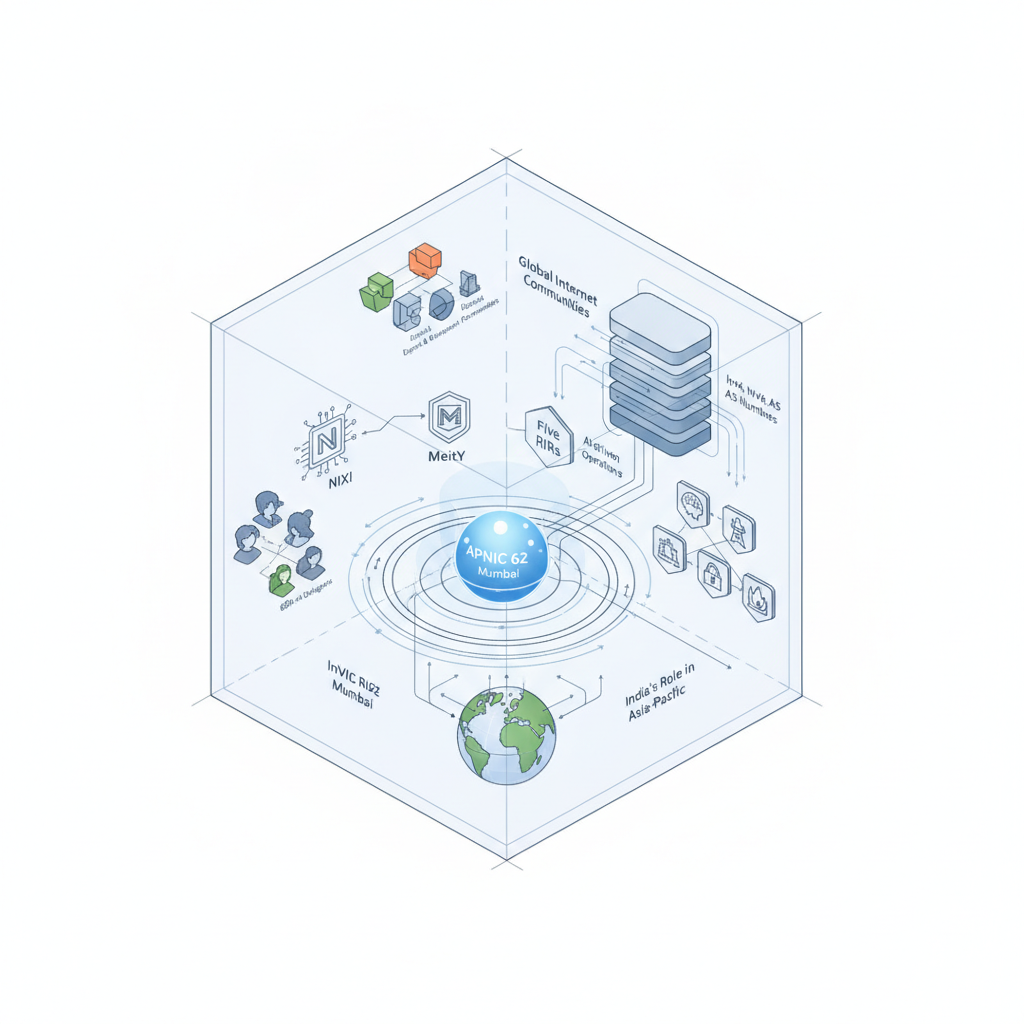
08 Sep APNIC 62 in Mumbai: AI, Cybersecurity & Future of Internet Infrastructure
✎ APNIC 62 in Mumbai (4–10 September 2026) is a critical forum for advancing IPv6 adoption, routing security, and AI-driven network operations, reinforcing India’s role in shaping a secure, scalable, and inclusive internet…
Subject Relevance — Where This Topic Fits
- GS Paper II — International Relations: Global Internet Governance and Regional Institutions | GS Paper III — Science and Technology: Internet Infrastructure, Cybersecurity, and Digital Public Infrastructure
- Prelims: APNIC, NIXI, IPv6, Internet Exchange Points (IXPs), Cybersecurity, Digital Public Infrastructure (DPI), MEITY, IANA, Regional Internet Registries (RIRs)
- Essay: The Role of Global Internet Governance in Shaping a Secure and Inclusive Digital Future, Technological Sovereignty and Digital Infrastructure: India’s Strategic Position
Quick Revision: APNIC 62 in Mumbai (4–10 September 2026) is a critical forum for advancing IPv6 adoption, routing security, and AI-driven network operations, reinforcing India’s role in shaping a secure, scalable, and inclusive internet infrastructure for the Asia-Pacific region.
Why is this in the news?
The 62nd Asia Pacific Network Information Centre (APNIC) conference, APNIC 62, is being hosted in Mumbai from 4 to 10 September 2026, organised by the National Internet Exchange of India (NIXI) under the aegis of the Ministry of Electronics and Information Technology (MeitY). The event brings together over 600 internet experts, policymakers, and technical leaders to deliberate on critical challenges such as AI-driven services, network operations, routing security, and cybersecurity, underscoring India’s growing role in shaping the future of internet infrastructure in the Asia-Pacific region.
Background
- APNIC is one of five Regional Internet Registries (RIRs) responsible for the allocation and registration of Internet number resources (IPv4, IPv6, and AS numbers) within the Asia-Pacific region, ensuring the stability and growth of the internet.
- NIXI, established in 2003, operates India’s largest Internet Exchange Point (IXP) in Mumbai, facilitating faster and more secure internet traffic exchange among domestic and international networks.
- The adoption of IPv6, the next-generation Internet Protocol, is critical to address the exhaustion of IPv4 addresses and enable the expansion of the Internet of Things (IoT) and AI-driven services.
- India’s Digital Public Infrastructure (DPI) initiatives, such as Aadhaar, UPI, and the India Stack, have positioned the country as a global leader in digital governance and technological innovation.
- Cybersecurity threats, including ransomware, data breaches, and state-sponsored attacks, have intensified with the proliferation of digital services, necessitating robust infrastructure and policy frameworks.
- The Asia-Pacific region accounts for over 50% of global internet users, making regional cooperation in internet governance and infrastructure development essential for a secure and inclusive digital ecosystem.
What is APNIC 62?
- APNIC 62 is the 62nd annual conference of the Asia Pacific Network Information Centre (APNIC), a non-profit organisation responsible for managing and distributing Internet number resources in the Asia-Pacific region.
- The conference serves as a global platform for internet stakeholders—technical experts, network operators, policymakers, and industry leaders—to discuss emerging trends, challenges, and solutions in internet infrastructure, governance, and security.
- Key thematic areas include IPv6 adoption, routing security, AI-driven network operations, cybersecurity frameworks, and the scalability of digital public infrastructure to support future technologies like 6G and quantum computing.
- APNIC 62 is being hosted in Mumbai, India, in collaboration with NIXI, MeitY, and the Government of Maharashtra, reflecting India’s strategic role in the region’s digital transformation.
- The event will feature high-level discussions, technical workshops, and policy dialogues aimed at strengthening regional cooperation for a secure, resilient, and inclusive internet ecosystem.
- APNIC 62 underscores the importance of multi-stakeholder governance in internet policy, aligning technical innovation with regulatory frameworks to address the evolving needs of users and businesses.
- The conference also highlights India’s leadership in digital public infrastructure, with initiatives like the Digital India programme and the India Stack serving as models for other nations.
Key Features
| Feature | Significance |
|---|---|
| APNIC 62 Conference | A regional forum for Internet infrastructure governance, policy discussion, and technical collaboration among Asia-Pacific stakeholders, focusing on IPv6 adoption, routing security, and AI-driven network operations. |
| IPv6 Deployment | Next-generation Internet Protocol essential for scalable addressing, reduced latency, and enhanced security; India’s leadership in adoption is highlighted as a model for the region. |
| Routing Security Measures | Implementation of RPKI (Resource Public Key Infrastructure) and BGP security to mitigate route hijacking and ensure stable, resilient Internet traffic flow. |
| AI in Network Operations | Integration of artificial intelligence for predictive maintenance, anomaly detection, and automated response in large-scale Internet infrastructure management. |
| Cybersecurity Collaboration | Multi-stakeholder dialogue on trust frameworks, incident response protocols, and capacity-building to address evolving cyber threats in digital ecosystems. |
| NIXI’s Role | National Internet Exchange of India (NIXI) serves as the host entity, facilitating technical exchanges, policy alignment, and infrastructure standardization in alignment with global best practices. |
Why it Matters
Economic and Strategic
- Enhances India’s position as a key player in the Asia-Pacific Internet governance ecosystem, reinforcing digital sovereignty and technological self-reliance.
- Facilitates knowledge transfer and best practices in Internet infrastructure, reducing dependency on foreign technologies and fostering indigenous innovation.
- Supports the growth of India’s digital economy by ensuring robust, scalable, and secure Internet connectivity, critical for sectors like e-commerce, fintech, and telemedicine.
- Strengthens regional cooperation through shared technical standards and collaborative problem-solving, particularly in addressing cross-border cyber threats.
Technological and Infrastructure
- Accelerates the transition from IPv4 to IPv6, addressing the exhaustion of IPv4 addresses and enabling the expansion of IoT, 5G, and AI-driven services.
- Promotes the deployment of RPKI and BGP security protocols to mitigate risks of route hijacking, route leaks, and other forms of network instability.
- Encourages the adoption of AI and automation in network management, improving efficiency, reducing human error, and enhancing real-time threat detection.
- Provides a platform for Indian Internet Service Providers (ISPs) and network operators to benchmark against global standards and integrate cutting-edge technologies.
Policy and Governance
- Serves as a neutral forum for policymakers, technologists, and industry leaders to align on regulatory frameworks, ethical guidelines, and technical standards for Internet governance.
- Reinforces India’s commitment to an open, inclusive, and multistakeholder approach to Internet governance, in line with principles outlined in the UN’s Internet Governance Forum (IGF).
- Facilitates the exchange of insights on data sovereignty, cross-border data flows, and the role of national registries in ensuring secure and reliable Internet operations.
Social and Inclusive Development
- Promotes digital inclusion by ensuring that advanced Internet infrastructure reaches underserved regions, thereby bridging the urban-rural digital divide.
- Encourages discussions on ethical AI, data privacy, and equitable access to digital services, aligning with global frameworks such as the UNESCO Recommendation on the Ethics of AI.
- Supports capacity-building initiatives for developing nations in the Asia-Pacific region, fostering a collaborative ecosystem for sustainable digital growth.
Challenges
1. IPv6 Adoption and Transition Costs
- High initial investment required for infrastructure upgrades, including hardware compatibility, staff training, and network reconfiguration.
- Resistance from legacy systems and service providers accustomed to IPv4, necessitating phased migration strategies and incentives for adoption.
- Coordination challenges among stakeholders to ensure seamless transition without disrupting existing services or creating fragmentation in the Internet ecosystem.
UPSC Link: GS3: Digital Infrastructure
2. Routing Security and BGP Vulnerabilities
- BGP hijacking and route leaks remain persistent threats, with potential for large-scale Internet disruptions and data breaches.
- Lack of universal adoption of RPKI and BGP security protocols across ISPs and network operators, particularly in smaller or less-resourced entities.
- Need for standardized incident response protocols and cross-border collaboration to mitigate the impact of routing attacks.
UPSC Link: GS3: Cybersecurity
3. AI Integration and Ethical Concerns
- Risk of algorithmic bias in AI-driven network management, leading to unequal service delivery or unintended disruptions.
- Data privacy and surveillance concerns arising from the use of AI in monitoring and optimizing network traffic.
- Regulatory gaps in addressing accountability, transparency, and liability in AI-enabled infrastructure operations.
UPSC Link: GS4: Ethical Governance
4. Digital Divide and Regional Disparities
- Uneven distribution of advanced Internet infrastructure, with rural and remote areas lagging behind urban centers in access to high-speed connectivity.
- Socioeconomic barriers to participation in digital ecosystems, including affordability of devices, digital literacy, and access to reliable power supply.
- Need for targeted policy interventions to ensure inclusive growth and prevent the exacerbation of existing inequalities.
UPSC Link: GS2: Social Justice
5. Cross-Border Cyber Threats
- Increasing sophistication of cyberattacks, including state-sponsored threats, ransomware, and supply-chain attacks targeting Internet infrastructure.
- Challenges in international cooperation due to differing legal frameworks, jurisdictional complexities, and geopolitical tensions.
- Requirement for harmonized global standards and collaborative frameworks to address transnational cyber risks effectively.
UPSC Link: GS3: Internal Security
6. Regulatory and Compliance Burdens
- Complex and evolving regulatory landscape for Internet governance, data protection, and cybersecurity, posing compliance challenges for stakeholders.
- Balancing innovation with regulatory oversight to avoid stifling technological progress while ensuring public interest and security.
- Need for agile policy frameworks that can adapt to rapid technological advancements without compromising on accountability or transparency.
UPSC Link: GS2: Governance
Challenges — UPSC Perspective
| Issue | Concern |
|---|---|
| IPv4 Exhaustion | Limited address space restricts the expansion of Internet-connected devices and services, necessitating a transition to IPv6. |
| BGP Route Hijacking | Malicious actors exploit vulnerabilities in BGP to redirect traffic, leading to service disruptions and data breaches. |
| RPKI Adoption Gaps | Incomplete deployment of RPKI leaves networks vulnerable to route spoofing and misconfigurations. |
| AI Bias in Network Management | Algorithmic decisions in AI-driven systems may inadvertently favor certain users or regions, exacerbating inequalities. |
| Rural-Urban Digital Divide | Disparities in Internet access and infrastructure limit the participation of marginalized communities in the digital economy. |
| Cross-Border Data Flows | Divergent national regulations on data localization and sovereignty complicate seamless digital operations across regions. |
| Cybersecurity Skill Gaps | Shortage of trained professionals in cybersecurity and network operations hinders effective threat mitigation and response. |
Way Forward
- Accelerate IPv6 adoption through targeted incentives, subsidies for SMEs, and mandatory compliance for government and large-scale ISPs.
- Strengthen routing security by mandating RPKI deployment for all ISPs and network operators, with phased implementation timelines.
- Establish a national AI governance framework for network operations, including ethical guidelines, transparency requirements, and accountability mechanisms.
- Expand digital infrastructure in rural and remote areas through public-private partnerships, leveraging BharatNet and other connectivity initiatives.
- Develop a national cybersecurity strategy for Internet infrastructure, focusing on threat intelligence sharing, incident response protocols, and capacity-building programs.
- Promote regional cooperation in Asia-Pacific by hosting similar forums, facilitating knowledge exchange, and aligning on technical standards.
- Invest in R&D for next-generation Internet technologies, including quantum-resistant encryption, edge computing, and AI-driven automation.
- Enhance digital literacy programs to bridge the skills gap, ensuring a workforce capable of managing advanced Internet infrastructure.
UPSC Value Addition
Keywords for Mains Answer-Writing
APNIC 62 · Internet governance · IPv6 adoption · Routing security · National Internet Exchange of India (NIXI) · Ministry of Electronics and Information Technology (MeitY) · Asia Pacific Network Information Centre (APNIC) · Cybersecurity · Artificial Intelligence (AI) in network operations · Digital infrastructure resilience · Internet Number Registry · Multi-stakeholder Internet governance · IPv6 deployment · Border Gateway Protocol (BGP) security · Digital public infrastructure (DPI) in India
Concept Flow
Rising demand for AI, cybersecurity, and digital services → Increased pressure on Internet infrastructure → Need for scalable, secure, and resilient network architecture. → Exhaustion of IPv4 addresses and vulnerabilities in BGP routing → Recognition of IPv6 and RPKI as critical solutions. → India’s leadership in IPv6 adoption and NIXI’s role as a regional hub → Hosting of APNIC 62 in Mumbai to foster collaboration. → Multi-stakeholder participation (technical experts, policymakers, ISPs) → Exchange of best practices and policy alignment. → Signing of MoUs on IPv6 and routing security → Implementation of technical standards and capacity-building initiatives. → Enhanced Internet infrastructure → Support for digital economy, innovation, and inclusive development across regions.
Prelims Practice Questions
Q1. Consider the following statements regarding APNIC and its role in Internet governance:
1. APNIC is a non-profit Internet Number Registry for the Asia-Pacific region.
2. APNIC is responsible for the allocation and registration of Internet Protocol (IP) addresses and autonomous system (AS) numbers.
3. APNIC operates under the direct supervision of the Government of India.
4. APNIC 62 is being hosted in Mumbai in collaboration with NIXI and MeitY.
How many of the above statements are correct?
- Only one
- Only two
- Only three
- All
Answer: All — Statements 1, 2, and 4 are correct. APNIC is indeed a non-profit Internet Number Registry for the Asia-Pacific region, responsible for IP address and AS number allocation. Statement 3 is incorrect as APNIC operates independently and is not under the direct supervision of the Government of India.
Q2. Assertion (A): The adoption of IPv6 is critical for the scalability and future-readiness of India’s digital infrastructure.
Reason (R): IPv6 provides a significantly larger address space compared to IPv4, enabling the expansion of Internet-connected devices and services.
Options:
A. Both A and R are true, and R is the correct explanation of A.
B. Both A and R are true, but R is not the correct explanation of A.
C. A is true, but R is false.
D. A is false, but R is true.
Answer: ? — Both the assertion and reason are true. IPv6 adoption is essential for India’s digital growth due to its expanded address space, which supports scalability and future-readiness of the Internet infrastructure.
Q3. Match the following initiatives/policies with their respective objectives:
Column I (Initiative/Policy) Column II (Objective)
1. APNIC 62 A. Strengthening cybersecurity frameworks
2. IPv6 Deployment B. Enhancing routing security (e.g., BGP security)
3. MeitY’s Digital India Mission C. Facilitating multi-stakeholder dialogue on Internet governance
4. NIXI D. Promoting adoption of next-generation Internet Protocol
Options:
1-C, 2-D, 3-B, 4-A
1-C, 2-D, 3-A, 4-B
1-B, 2-D, 3-C, 4-A
1-C, 2-A, 3-D, 4-B
Answer: ? — The correct match is: 1-C (APNIC 62 facilitates multi-stakeholder dialogue), 2-D (IPv6 Deployment promotes adoption of next-generation Internet Protocol), 3-A (MeitY’s Digital India Mission strengthens cybersecurity frameworks), 4-B (NIXI enhances routing security).
Mains Practice Question
✍ The hosting of APNIC 62 in Mumbai underscores the critical role of multi-stakeholder governance in shaping the future of the Internet. Critically examine the significance of India’s engagement with regional Internet governance bodies like APNIC, with particular reference to IPv6 adoption, routing security, and AI-driven network operations. (15 Marks)
Approach: MODEL-ANSWER SKELETON:
1. **Context and Significance of APNIC 62**:
– Brief about APNIC as the regional Internet Number Registry for Asia-Pacific.
– Role of multi-stakeholder governance in Internet governance (IGF, ICANN, APNIC).
– India’s hosting of APNIC 62 as a strategic move to position itself as a leader in digital infrastructure.
2. **IPv6 Adoption in India**:
– IPv6’s advantages over IPv4 (scalability, address space, reduced NAT dependency).
– India’s progress in IPv6 adoption (data from TRAI, MeitY, or APNIC reports).
– Challenges: legacy infrastructure, awareness, and policy push.
– Role of NIXI and MeitY in accelerating IPv6 deployment.
3. **Routing Security and BGP**:
– Importance of BGP security in preventing route hijacking and misconfigurations.
– India’s initiatives: NIXI’s role in routing security, MoUs signed during APNIC 62.
– Global best practices (RPKI, MANRS) and India’s alignment with them.
4. **AI in Network Operations**:
– AI’s role in optimizing network performance, predictive maintenance, and threat detection.
– Ethical and governance challenges: data privacy, algorithmic bias, and accountability.
– India’s approach: MeitY’s AI strategy, NIXI’s AI-driven initiatives.
5. **Critical Examination**:
– **Opportunities**: India’s leadership in digital public infrastructure (DPI), potential for export of best practices, and alignment with global standards.
– **Challenges**: Digital divide, cybersecurity threats, regulatory fragmentation, and the need for sustained investment.
– **Way Forward**: Strengthening public-private partnerships, capacity building, and integrating AI with traditional network security frameworks.
6. **Conclusion**:
– Summarize India’s strategic engagement with APNIC and its implications for the future of the Internet in the Asia-Pacific region.
Source: PIB (Press Information Bureau)
Maharashtra PCS (MPSC) — State PCS Practice
Prelims: Which of the following statements is correct regarding the APNIC 62 event held in Mumbai, organized by NIXI under the Ministry of Electronics and Information Technology?
- APNIC 62 is a global internet community event focused on cybersecurity and digital governance.
- APNIC 62 is the 62nd annual meeting of the Asia-Pacific Network Information Centre, addressing internet infrastructure and policy issues.
- APNIC 62 is a regional conference exclusively for Indian internet service providers to discuss local internet regulations.
- APNIC 62 is a technology expo organized by NIXI to promote electronic manufacturing in Maharashtra.
Answer: APNIC 62 is the 62nd annual meeting of the Asia-Pacific Network Information Centre, addressing internet infrastructure and policy issues. — APNIC 62 is the 62nd annual meeting of the Asia-Pacific Network Information Centre, focusing on internet infrastructure, policy, and community engagement.
Mains: Discuss the significance of hosting APNIC 62 in Mumbai for Maharashtra’s digital economy and internet governance. How can the state leverage this event to enhance its position as a global hub for information technology and innovation? (Answer in 250-300 words)
Generated by AanyaAi for educational purpose.
Related guides on our sites
- How to prepare for GS paper 1 for UPSC CSE mains exam
- Best UPSC coaching for IFOS exam
- Best ias coaching in mumbai
- Best mentorship programme for upsc

- उत्तराखंड राज्यपाल की पीएम मोदी से महत्वपूर्ण बैठक: जानिए मुख्य बिंदु - October 23, 2026
- How India’s Rs 20,000 Cr CCUS Budget Can Drive Net-Zero Goals - October 23, 2026
- पंजाब-हरियाणा में पराली जलाने पर सीएक्यूएम की सख्त समीक्षा, तुरंत उठाये गये कदमों पर जोर - October 23, 2026

No Comments