


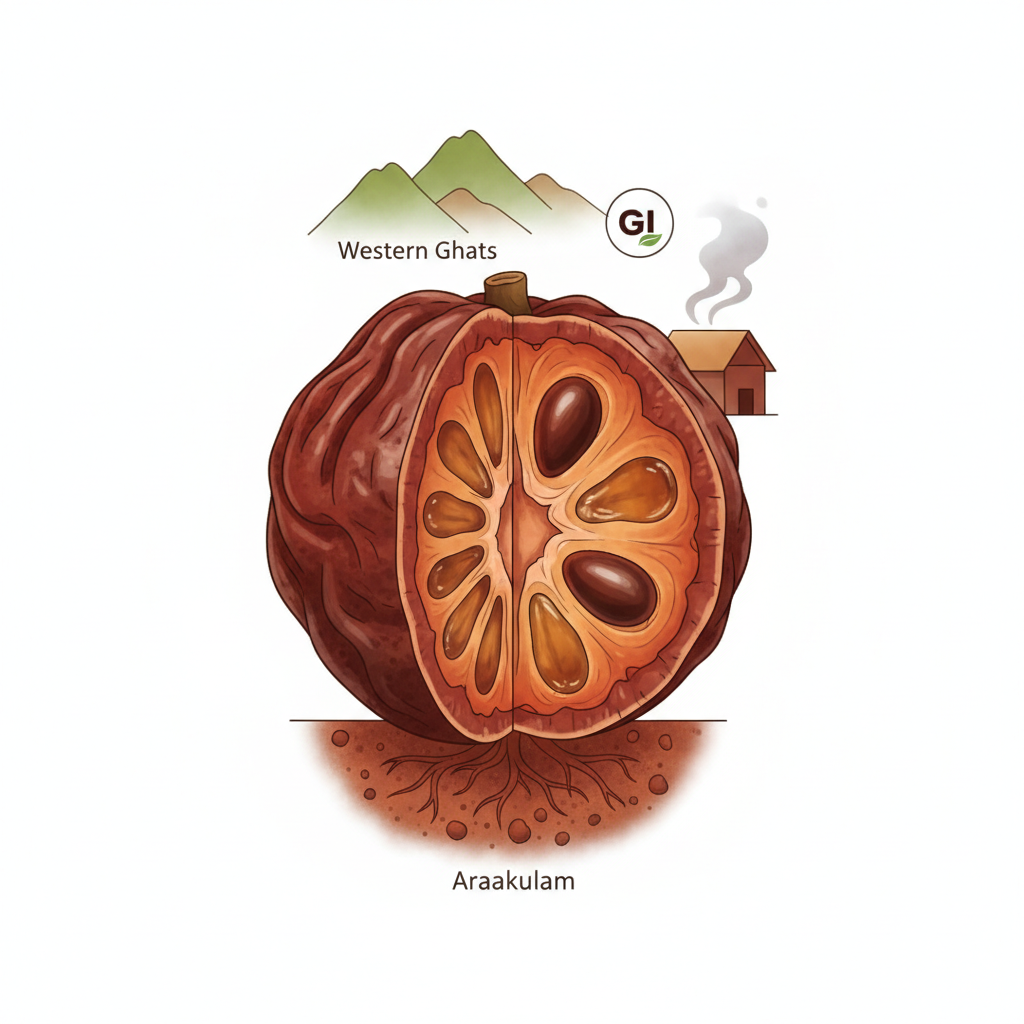
13 Sep Arakkulam’s Unique Tamarind Seeks GI Tag for UPSC & State PCS Exam
✎ A Geographical Indication (GI) tag legally protects a product’s unique identity linked to its geographical origin, ensuring authenticity, preventing misuse, and enhancing market access for indigenous producers.
Subject Relevance — Where This Topic Fits
- GS Paper III — Agriculture and Food Processing | GS Paper III — Intellectual Property Rights and Patents | GS Paper II — Government Policies and Interventions for Development in Various Sectors | GS Paper III — Role of Panchayati Raj Institutions in Rural Development
- Prelims: Geographical Indication (GI) Tag, Malabar tamarind (Garcinia gummi-gutta), One District One Product (ODOP) Scheme, Traditional knowledge and indigenous agricultural practices, Intellectual Property Rights (IPR), Panchayati Raj Institutions (PRIs), Kerala Agricultural University (KAU), Tribal livelihoods and forest-based economies
- Essay: The role of indigenous knowledge systems in sustainable development, Balancing economic incentives with cultural preservation in rural economies
Quick Revision: A Geographical Indication (GI) tag legally protects a product’s unique identity linked to its geographical origin, ensuring authenticity, preventing misuse, and enhancing market access for indigenous producers.
Why is this in the news?
The Arakkulam panchayat in Idukki district, Kerala, has initiated steps to secure a Geographical Indication (GI) tag for its unique variety of Malabar tamarind, locally known as ‘Pulikkathadam Puli’ or ‘Kudampuli’. This initiative aims to protect the indigenous genotype, ensure fair remuneration for tribal and local farming communities, and enhance market access for the produce, which is renowned for its distinct flavour, thicker rind, and smaller seeds. The move underscores the significance of GI tags in preserving traditional agricultural practices and supporting rural livelihoods.
Background
- The Malabar tamarind (Garcinia gummi-gutta), commonly referred to as ‘Kudampuli’ in Kerala, is a tropical fruit native to the Western Ghats, including the hilly regions of Idukki district.
- Traditional smoke-drying methods are employed by local communities, particularly the Mala Araya tribal households, for processing the tamarind, distinguishing it from mechanised processing techniques.
- The ‘One Krishi Bhavan, One Product’ scheme of the Kerala Agriculture Department has previously promoted the cultivation and marketing of Kudampuli, highlighting its economic potential.
- The Arakkulam panchayat has allocated ₹2 lakh for the GI application process, indicating local government commitment to the initiative.
- The tamarind trees in the region are often over a century old, growing naturally on steep slopes exceeding 45 degrees, which contributes to the fruit’s unique characteristics.
What is a Geographical Indication (GI) Tag?
- A Geographical Indication (GI) is an intellectual property right that identifies a product as originating from a specific geographical location, where a particular quality, reputation, or other characteristic is essentially attributable to its geographical origin.
- GI tags are governed by the Geographical Indications of Goods (Registration and Protection) Act, 1999, and are administered by the Controller General of Patents, Designs, and Trademarks under the Department for Promotion of Industry and Internal Trade (DPIIT), Ministry of Commerce and Industry.
- The primary objectives of GI tags include protecting the interests of producers, preventing misuse of the product’s name, and promoting economic development in the region of origin.
- GI tags can enhance marketability by providing legal protection and ensuring authenticity, which is particularly beneficial for small-scale and tribal producers.
- The application process for a GI tag involves detailed documentation, including geographical boundaries, historical significance, unique characteristics, and evidence of the product’s distinctiveness compared to similar products from other regions.
- Once granted, a GI tag is valid for a period of 10 years and can be renewed, providing long-term protection and recognition to the product and its producers.
- GI tags also contribute to the preservation of traditional knowledge systems and cultural heritage associated with the product.
- In India, GI tags have been awarded to a diverse range of products, including agricultural produce (e.g., Darjeeling tea, Basmati rice), handicrafts (e.g., Banarasi silk, Pashmina shawls), and food items (e.g., Tirupati laddu, Kangra tea).
Key Features
| Feature | Significance |
|---|---|
| Botanical identity | The Pulikkathadam variety of Malabar tamarind (Kudampuli) exhibits a thicker rind and smaller seeds compared to other varieties, indicating a distinct genotype. |
| Geographical origin | The tamarind grows naturally across the hilly terrain of Arakkulam panchayat in Idukki district, Kerala, with steep slopes exceeding 45 degrees. |
| Traditional processing | Farmers predominantly use smoke-drying methods rather than mechanical dryers, preserving traditional knowledge and adding unique flavour characteristics. |
| Agricultural dependency | Over 300 families, including tribal households (Mala Araya), rely on Kudampuli processing as a primary source of income. |
| Market recognition | The tamarind is renowned in local markets for its signature flavour and distinct quality, with strong public response in agricultural exhibitions. |
Why it Matters
Economic Empowerment
- Facilitates fair pricing for producers by preventing misrepresentation and ensuring premium returns for authentic produce.
- Enhances market access for small and tribal farmers by providing a verified identity for their product in domestic and global markets.
- Promotes sustainable livelihoods in hilly regions by leveraging traditional knowledge and indigenous practices.
Intellectual Property Governance
- GI tag confers legal protection against unauthorized use, ensuring that only produce from Arakkulam-Pulikkathadam qualifies for the designation.
- Strengthens the intellectual property ecosystem in agriculture by establishing a model for community-led GI applications.
- Encourages documentation of traditional knowledge and botanical uniqueness, contributing to scientific and cultural preservation.
Agricultural and Ecological Sustainability
- Supports conservation of indigenous crop varieties by incentivizing cultivation of naturally grown, centuries-old trees.
- Promotes agroforestry in hilly terrains, reducing soil erosion and maintaining biodiversity in fragile ecosystems.
- Aligns with Kerala’s ‘One Krishi Bhavan, One Product’ scheme to diversify agricultural income sources.
Community and Cultural Preservation
- Preserves traditional processing techniques (e.g., smoke-drying) integral to the cultural identity of tribal and local communities.
- Enhances visibility and recognition of indigenous agricultural practices, fostering intergenerational knowledge transfer.
- Strengthens local self-governance by enabling panchayats to lead economic and cultural initiatives.
Challenges
1. Documentation and Scientific Validation
- Requires comprehensive botanical, chemical, and historical studies to substantiate the uniqueness of the Pulikkathadam variety for GI registration.
- Demands coordination among local bodies, agricultural departments, and research institutions (e.g., Kerala Agricultural University) to gather evidence.
- Ensuring accuracy in defining the geographical boundary of the GI to prevent dilution or disputes.
UPSC Link: GS-III: IPR and GI tags
2. Market Competition and Branding
- Competing with other Malabar tamarind varieties that may lack GI protection but are marketed under similar names, leading to consumer confusion.
- Building consumer trust and premium pricing requires robust marketing strategies and traceability systems.
- Accessing global markets necessitates compliance with international standards and certifications beyond GI.
UPSC Link: GS-III: Agricultural Marketing
3. Resource Mobilisation and Awareness
- Limited financial resources at the panchayat level (e.g., ₹2 lakh allocated) may constrain comprehensive GI application processes or post-tagging initiatives.
- Low awareness among farmers about the benefits of GI tags and the procedural requirements for participation.
- Need for capacity-building among tribal and smallholder farmers to adopt modern processing or documentation practices.
UPSC Link: GS-II: Panchayati Raj and Local Governance
4. Climate and Agricultural Vulnerabilities
- Climate change impacts on hilly ecosystems may affect the natural growth conditions of Kudampuli, necessitating adaptive agricultural practices.
- Deforestation or land-use changes could threaten the existence of naturally grown tamarind trees, especially older specimens.
- Dependence on monsoon patterns for cultivation requires integrated water management strategies.
UPSC Link: GS-III: Climate Change and Agriculture
5. Legal and Institutional Coordination
- Ensuring seamless coordination between the panchayat, state agriculture department, and central GI registry (e.g., Controller General of Patents, Designs and Trademarks).
- Addressing potential disputes over land rights or access to tamarind-bearing trees, particularly in tribal areas.
- Streamlining the GI application process to avoid delays in registration and subsequent enforcement.
UPSC Link: GS-II: Constitutional and Statutory Bodies
Challenges — UPSC Perspective
| Issue | Concern |
|---|---|
| Scientific substantiation | Lack of detailed botanical and chemical studies to prove uniqueness for GI registration. |
| Market differentiation | Risk of misrepresentation by competing tamarind varieties lacking GI protection. |
| Resource constraints | Limited financial and technical capacity at the panchayat level for GI application and post-tagging activities. |
| Traditional knowledge erosion | Gradual loss of indigenous processing techniques due to lack of documentation and intergenerational transfer. |
| Climate vulnerability | Potential decline in tamarind cultivation due to changing climatic conditions in hilly ecosystems. |
| Institutional coordination | Need for seamless collaboration between local bodies, research institutions, and central authorities for effective GI implementation. |
Way Forward
- Conduct a detailed botanical and chemical analysis of the Pulikkathadam tamarind in collaboration with Kerala Agricultural University to substantiate its uniqueness for GI registration.
- Organize capacity-building workshops for farmers, particularly tribal communities, on GI benefits, documentation requirements, and traditional processing techniques.
- Develop a traceability system (e.g., QR codes or blockchain) to authenticate the origin of the tamarind and prevent misrepresentation in markets.
- Leverage the ‘One Krishi Bhavan, One Product’ scheme to promote the tamarind in agricultural exhibitions and connect producers with potential buyers.
- Allocate additional resources (public or private) to support the GI application process and post-tagging initiatives, including marketing and branding.
- Collaborate with the Kerala State Biodiversity Board to document traditional knowledge and promote sustainable harvesting practices.
- Establish a panchayat-led cooperative for Kudampuli growers to streamline processing, marketing, and price negotiations.
- Engage with central agencies (e.g., Geographical Indications Registry) to expedite the GI registration process and address procedural bottlenecks.
UPSC Value Addition
Keywords for Mains Answer-Writing
Geographical Indications (GI) Tag · Intellectual Property Rights (IPR) · Traditional Knowledge Protection · Agricultural Biodiversity Conservation · Local Self-Government and Economic Empowerment · Tribal Livelihoods and Forest Produce · One District One Product (ODOP) Scheme · Traditional Ecological Knowledge · Market Access for Indigenous Produce · Sustainable Agriculture and Rural Development
Concept Flow
Local cultivation and traditional processing of Pulikkathadam tamarind in Arakkulam panchayat → Recognition of unique botanical and cultural attributes → Initiation of GI tag application by panchayat → Scientific validation and documentation → Submission to central GI registry → Legal protection and market differentiation → Enhanced livelihoods and community empowerment.
Prelims Practice Questions
Q1. Consider the following statements about Geographical Indications (GI) in India:
1. A GI tag is granted under the Geographical Indications of Goods (Registration and Protection) Act, 1999.
2. The application for a GI tag can be made by any individual or entity engaged in the production of the good.
3. The term of protection granted by a GI tag is 20 years from the date of registration.
4. The GI tag ensures that only authorized users can use the GI-protected name for a product.
How many of the above statements are correct?
- Only one
- Only two
- Only three
- All
Answer: Only three — Statements 1 and 4 are correct. Statement 2 is incorrect because the application must be made by a competent authority or an association of persons/producers. Statement 3 is incorrect as the term of protection is 10 years, renewable indefinitely.
Q2. Assertion (A): The Pulikkathadam tamarind variety from Arakkulam panchayat in Idukki is being pursued for a GI tag primarily to enhance its market value and ensure fair pricing for growers.
Reason (R): The GI tag confers legal protection to the geographical origin of a product, preventing unauthorized use and promoting traditional knowledge systems.
Options:
A. Both A and R are true, and R is the correct explanation of A.
B. Both A and R are true, but R is not the correct explanation of A.
C. A is true, but R is false.
D. A is false, but R is true.
Answer: ? — Both A and R are true, and R correctly explains A. The GI tag aims to protect the unique characteristics of the product linked to its geographical origin, thereby enhancing market access and fair pricing for producers.
Q3. Match the following pairs related to Intellectual Property Rights (IPR) in India:
Column I (Term) | Column II (Description)
—————-|———————–
A. GI Tag | 1. Protects inventions and grants exclusive rights for a limited period.
B. Copyright | 2. Protects the geographical origin of goods and prevents unauthorized use.
C. Patent | 3. Protects original works of authorship, including literary and artistic works.
D. Trademark | 4. Protects distinctive signs, symbols, or expressions that identify goods or services.
Options:
A. A-2, B-3, C-1, D-4
B. A-1, B-2, C-3, D-4
C. A-4, B-3, C-2, D-1
D. A-3, B-1, C-4, D-2
Answer: ? — Correct matches: A-2 (GI Tag protects geographical origin), B-3 (Copyright protects original works), C-1 (Patent protects inventions), D-4 (Trademark protects distinctive signs).
Mains Practice Question
✍ The Geographical Indications (GI) regime in India serves as a critical instrument for the protection of traditional knowledge, agricultural biodiversity, and the economic empowerment of local communities. In this context, critically examine the significance of the proposed GI tag for the Pulikkathadam tamarind variety from Arakkulam panchayat in Idukki. (15 Marks)
Approach: MODEL-ANSWER SKELETON:
1. Introduction (2 marks): Define Geographical Indications (GI) under the Geographical Indications of Goods (Registration and Protection) Act, 1999. State the objective of GI tags in protecting traditional knowledge, ensuring quality, and promoting economic benefits for local communities.
2. Significance of GI for Pulikkathadam Tamarind (5 marks):
– Unique characteristics: Thicker rind, smaller seeds, distinct aroma, and traditional smoke-drying methods.
– Link to geographical origin: Hilly terrain, climate, and centuries-old trees in Arakkulam panchayat.
– Protection of traditional knowledge: Preservation of indigenous processing techniques and biodiversity.
– Economic empowerment: Fair pricing, market access, and livelihood support for 300+ families, predominantly tribal.
– Legal safeguards: Prevention of unauthorized use and misrepresentation, ensuring authenticity.
3. Broader Implications for Agricultural Biodiversity and Rural Development (5 marks):
– Conservation of traditional varieties: Role in preventing genetic erosion and promoting sustainable agriculture.
– Alignment with schemes: Link to ‘One District One Product (ODOP)’ and ‘One Krishi Bhavan, One Product’ initiatives.
– Community-based IPR: Empowerment of local self-governments (panchayats) and tribal communities in IPR governance.
– Challenges: Documentation burden, need for scientific validation, and ensuring equitable benefits.
4. Conclusion (3 marks):
– Summarize the role of GI tags in balancing economic, ecological, and cultural objectives.
– Highlight the need for supportive policies, capacity building, and market linkages to maximize benefits.
– Emphasize the importance of GI tags in achieving Sustainable Development Goals (SDGs) 1 (No Poverty), 2 (Zero Hunger), and 15 (Life on Land).
Source: The Hindu
Generated by AanyaAi for educational purpose.
Related guides on our sites
- Current affairs for upsc 2026
- How to prepare for GS paper 1 for UPSC CSE mains exam
- Best UPSC coaching for IFOS exam
- Best mentorship programme for upsc


No Comments