


05 Aug Article 370 Revocation 7 Years: Kashmir Security Tightens Ahead of Protests
✎ Article 370 was a temporary provision granting Jammu and Kashmir special status; its abrogation in 2019 integrated the region fully into the Indian Union, though its political and constitutional legacy remains contested.
Subject Relevance — Where This Topic Fits
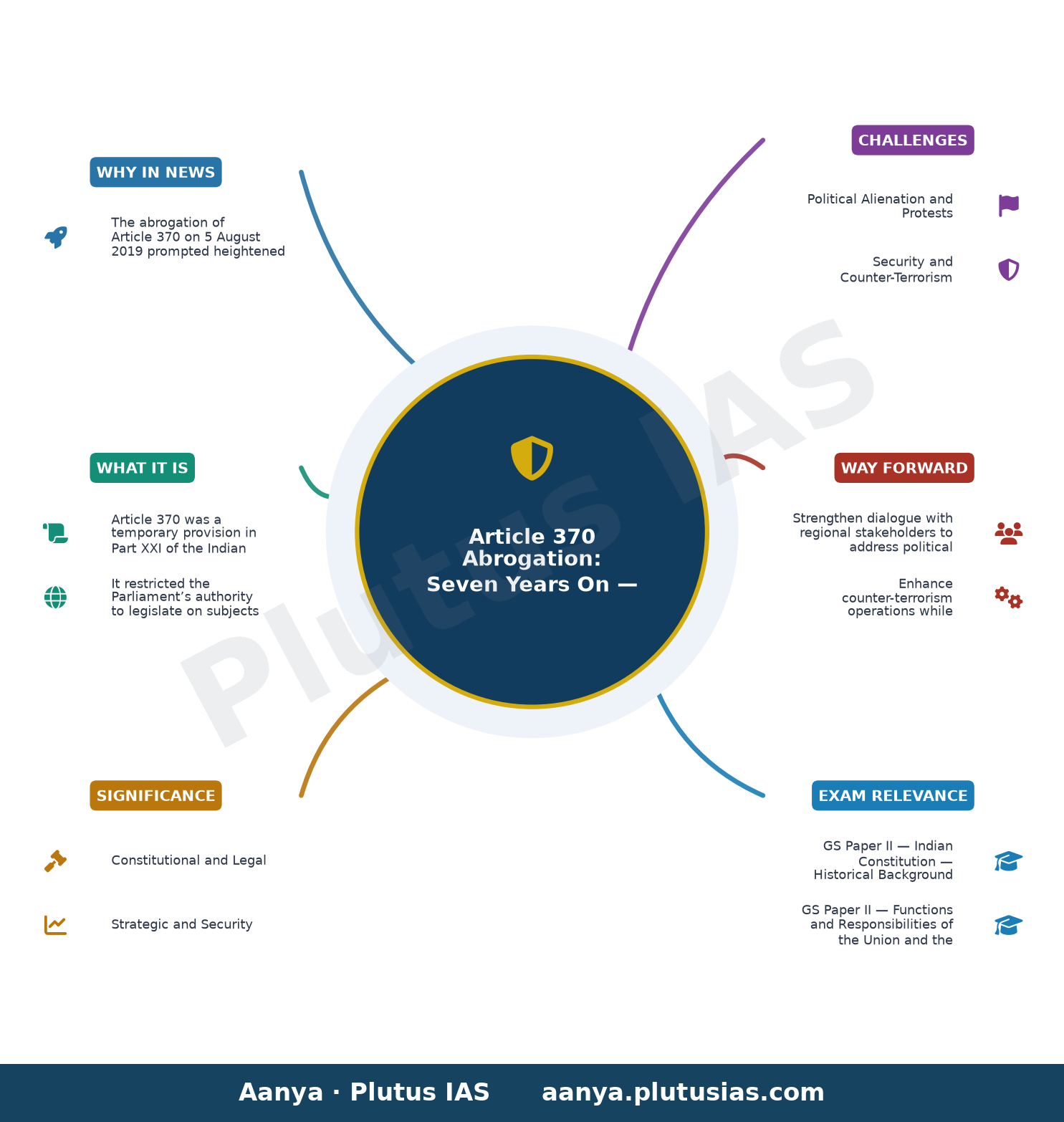
- GS Paper II — Indian Constitution — Historical Background and Evolution of Constitutional Provisions | GS Paper II — Functions and Responsibilities of the Union and the States, Issues and Challenges Pertaining to Federal Structure | GS Paper III — Internal Security — Challenges in Border Areas
- Prelims: Article 370, Article 35A, Jammu and Kashmir Reorganisation Act, 2019, Union Territory of Jammu and Kashmir, Union Territory of Ladakh, Kashmir Valley Insurgency, AFSPA, Public Order and Police Powers
- Essay: Federalism and the Idea of India: Balancing Unity and Diversity, Internal Security Challenges in India: Lessons from Jammu and Kashmir
Quick Revision: Article 370 was a temporary provision granting Jammu and Kashmir special status; its abrogation in 2019 integrated the region fully into the Indian Union, though its political and constitutional legacy remains contested.
Why is this in the news?
The abrogation of Article 370 on 5 August 2019 prompted heightened security measures in Jammu and Kashmir. Political leaders such as Mehbooba Mufti have called for protests, while authorities have imposed restrictions on public gatherings without prior permission. This anniversary has reignited debates on the constitutional status of Jammu and Kashmir, the efficacy of security policies, and the evolving political landscape in the Union Territory.
Background
- Article 370 of the Indian Constitution granted Jammu and Kashmir a special status, limiting the Parliament’s legislative powers over the state except in matters of defence, foreign affairs, and communications.
- Article 35A, introduced via the Constitution (Application to Jammu and Kashmir) Order, 1954, empowered the state legislature to define permanent residents and their rights, including property ownership and employment.
- On 5 August 2019, the Government of India revoked Articles 370 and 35A through a Presidential Order, followed by the Jammu and Kashmir Reorganisation Act, 2019, which bifurcated the state into two Union Territories: Jammu and Kashmir, and Ladakh.
- The abrogation was justified on grounds of integrating Jammu and Kashmir fully into the Indian Union, promoting development, and addressing historical grievances linked to separatism and terrorism.
- The move was accompanied by a security lockdown, communication blackouts, and the detention of political leaders, including former Chief Ministers like Mehbooba Mufti and Omar Abdullah.
- Over the past five years, the Union Territory has witnessed a decline in large-scale insurgent violence, though sporadic terrorist attacks and targeted killings have persisted.
What is Article 370 and its Implications?
- Article 370 was a temporary provision in Part XXI of the Indian Constitution, titled ‘Temporary, Transitional and Special Provisions’, applicable to Jammu and Kashmir.
- It restricted the Parliament’s authority to legislate on subjects outside defence, foreign affairs, and communications, requiring concurrence from the state government for other laws.
- Article 35A empowered the Jammu and Kashmir legislature to define ‘permanent residents’ and confer special rights, including restrictions on property ownership and government employment for non-residents.
- The abrogation of Article 370 was effected through the Constitution (Application to Jammu and Kashmir) Order, 2019, which superseded the earlier order and extended all provisions of the Constitution to Jammu and Kashmir.
- The Jammu and Kashmir Reorganisation Act, 2019, replaced the state with two Union Territories: Jammu and Kashmir (with a legislature) and Ladakh (without a legislature), aimed at better governance and integration.
- Critics argue that the abrogation undermined the autonomy promised to Jammu and Kashmir, while proponents highlight its role in ending a ‘separate constitution’ and promoting national integration.
- The legal validity of the abrogation was upheld by the Supreme Court of India in the landmark judgment of *Re: Article 370 of the Constitution of India* (2023), which confirmed the President’s power to revoke Article 370.
- The political fallout included the detention of mainstream political leaders, the formation of new regional parties, and ongoing debates over the restoration of statehood and assembly elections.
Key Features
| Feature | Significance |
|---|---|
| Article 370 Revocation | Constitutional abrogation of a temporary provision granting special status to Jammu & Kashmir, integrating the state fully into the Indian Union. |
| Security Measures | Enhanced deployment of security forces, night flag marches, and intensified monitoring along the Line of Control (LoC) to prevent unrest. |
| Public Advisory | Ban on unauthorized rallies, processions, and protests under Section 144 CrPC to maintain public order and prevent incitement. |
| Flag Code Compliance | Strict enforcement of the Flag Code of India to prevent misuse of the national flag during protests, ensuring adherence to protocol. |
| PDP’s Protest Call | Mahbooba Mufti’s appeal for public demonstrations on 5 August 2026, reflecting continued political opposition to the revocation. |
Why it Matters
Constitutional and Legal
- The abrogation of Article 370 and Article 35A in 2019 was a landmark constitutional amendment, altering the federal structure by revoking Jammu & Kashmir’s special status under Part XXI of the Constitution.
- The Supreme Court’s 2023 judgment in *In Re: Article 370 of the Constitution* upheld the revocation, affirming the President’s power under Article 370(3) to declare the provision inoperative.
- The case reinforced the principle that temporary provisions in the Constitution can be amended or abrogated by the Parliament, subject to judicial review.
- The revocation also led to the bifurcation of Jammu & Kashmir into two Union Territories (J&K and Ladakh), altering the administrative structure of the region.
Strategic and Security
- The revocation aimed to integrate Jammu & Kashmir fully into India’s security and administrative framework, reducing separatist influence and cross-border terrorism.
- Enhanced security measures, including night flag marches and LoC monitoring, are designed to deter infiltration and maintain territorial integrity.
- The presence of security forces in sensitive areas reflects the government’s commitment to preventing unrest and ensuring stability in the region.
- The revocation has been cited as a measure to curb terrorism, with data suggesting a decline in terrorist incidents post-2019.
Political and Social
- The revocation remains a polarizing issue, with political parties like the PDP continuing to demand its reversal, citing concerns over democratic rights and autonomy.
- Public protests, such as those led by Mahbooba Mufti, highlight the ongoing political dissent and the challenge of reconciling regional aspirations with national integration.
- The enforcement of the Flag Code during protests underscores the state’s emphasis on maintaining national symbols’ sanctity, even in dissent.
- The advisory against unauthorized protests reflects the government’s prioritization of law and order over political expression in sensitive regions.
Administrative and Governance
- The revocation facilitated the application of central laws to Jammu & Kashmir, streamlining governance and reducing bureaucratic delays.
- The bifurcation into Union Territories has enabled targeted development initiatives, though challenges persist in ensuring equitable progress across regions.
- The revocation also led to the dissolution of the Jammu & Kashmir Legislative Assembly, necessitating fresh elections to restore democratic representation.
Challenges
1. Political Alienation and Protests
- Continued political opposition from regional parties like the PDP, which frames the revocation as a violation of democratic rights and autonomy.
- Public protests, such as Mahbooba Mufti’s candle march, risk escalating into unrest, necessitating strict enforcement of public order laws.
- Balancing the right to protest with the need for security and stability remains a persistent challenge in the region.
UPSC Link: GS Paper 2: Federalism, Centre-State Relations
2. Security and Counter-Terrorism
- Despite a decline in terrorist incidents, the threat of cross-border terrorism and local militancy persists, requiring sustained vigilance.
- The revocation has not eliminated separatist sentiments, as evidenced by ongoing protests and calls for resistance.
- Ensuring the safety of civilians and security personnel while maintaining public order is a critical challenge.
UPSC Link: GS Paper 3: Internal Security, Terrorism
3. Administrative Integration
- Integrating Jammu & Kashmir into the Union’s administrative framework has faced bureaucratic and logistical hurdles, including delays in policy implementation.
- Ensuring equitable development across all regions of Jammu & Kashmir, particularly in areas previously marginalized, remains a long-term challenge.
- The absence of a functioning Legislative Assembly has delayed legislative and developmental initiatives, necessitating early elections.
UPSC Link: GS Paper 2: Governance, Constitutional Amendments
4. Human Rights and Civil Liberties
- The revocation of Article 370 has raised concerns about the curtailment of civil liberties, including restrictions on internet access and public gatherings.
- Balancing security imperatives with the protection of fundamental rights, such as freedom of expression and assembly, is a complex task.
- Ensuring transparency and accountability in governance, particularly in sensitive regions, is essential to address public skepticism.
UPSC Link: GS Paper 2: Fundamental Rights, Judicial Review
5. International Perceptions and Diplomacy
- The revocation has drawn international attention, with some countries and organizations expressing concerns over the region’s status and human rights.
- India’s diplomatic efforts to counter narratives of oppression and highlight developmental progress in Jammu & Kashmir are ongoing.
- Maintaining a balanced approach to international scrutiny while safeguarding national interests is a diplomatic challenge.
UPSC Link: GS Paper 2: International Relations, Diplomacy
Challenges — UPSC Perspective
| Issue | Concern |
|---|---|
| Political Opposition | Regional parties continue to challenge the revocation, risking unrest and political instability. |
| Security Threats | Cross-border terrorism and local militancy persist, requiring sustained counter-terrorism measures. |
| Administrative Hurdles | Delays in policy implementation and the absence of a Legislative Assembly hinder governance. |
| Civil Liberties | Restrictions on protests and internet access raise concerns about fundamental rights. |
| International Scrutiny | Negative perceptions abroad necessitate diplomatic efforts to counter misinformation. |
Way Forward
- Strengthen dialogue with regional stakeholders to address political alienation and reduce dissent.
- Enhance counter-terrorism operations while ensuring minimal collateral impact on civilians.
- Accelerate administrative reforms to integrate Jammu & Kashmir fully into the Union’s governance framework.
- Conduct early elections to restore democratic representation and address governance gaps.
- Implement targeted development schemes to bridge socio-economic disparities across regions.
- Promote transparency in governance to build public trust and counter misinformation.
- Engage in diplomatic outreach to counter international narratives and highlight developmental progress.
- Monitor and review security measures to balance law and order with civil liberties.
UPSC Value Addition
Keywords for Mains Answer-Writing
Article 370 abrogation · Jammu and Kashmir Reorganisation Act 2019 · Federalism in India · President’s Rule under Article 356 · Fundamental Rights and Directive Principles · Public Order and Security in J&K · Flag Code of India · Sedition and Unlawful Activities (Prevention) Act · Separatist politics in Kashmir · Supreme Court’s role in constitutional amendments
Constitutional & Policy Linkages
- Article 370 (Temporary Provisions for J&K) – Revoked in 2019.
- Article 35A (Special Rights for Permanent Residents) – Abrogated.
- Article 370(3) – Empowered President to declare the provision inoperative.
- Part XXI (Temporary, Transitional, and Special Provisions) – Framework for Article 370.
Concept Flow
Article 370 granted special status to J&K under Part XXI of the Constitution. → Constitutional amendment in 2019 revoked Article 370 and Article 35A. → Bifurcation of J&K into two Union Territories (J&K and Ladakh) followed. → Enhanced security measures implemented to maintain law and order. → Political opposition, including protests led by regional parties, emerged. → Public advisory issued to ban unauthorized protests and ensure compliance with the Flag Code. → Ongoing challenges in governance, security, and political integration persist.
Prelims Practice Questions
Q1. Consider the following statements regarding the abrogation of Article 370 in Jammu and Kashmir:
1. Article 370 was abrogated by a Presidential Order under Article 370(3) with the concurrence of the Jammu and Kashmir Constituent Assembly.
2. The Jammu and Kashmir Reorganisation Act, 2019 bifurcated the state into two Union Territories.
3. The abrogation of Article 370 was challenged in the Supreme Court under Article 32 of the Constitution.
How many of the above statements are correct?
- Only one
- Only two
- All three
- None
Answer: All three — Statement 1 is incorrect as the abrogation was done under Article 370(3) with the concurrence of the Parliament, not the J&K Constituent Assembly, which had ceased to exist. Statements 2 and 3 are correct.
Q2. Assertion (A): The President of India can declare a state under President’s Rule under Article 356 if the constitutional machinery in the state fails to function.
Reason (R): The Governor of the state must report the failure of constitutional machinery to the President before such a declaration is made.
Select the correct code:
(A) Both A and R are true, and R is the correct explanation of A.
(B) Both A and R are true, but R is not the correct explanation of A.
(C) A is true, but R is false.
(D) A is false, but R is true.
- A
- B
- C
- D
Answer: B — Both the assertion and reason are correct. The President can declare President’s Rule under Article 356 if the constitutional machinery fails, and the Governor’s report is a necessary condition for such a declaration.
Q3. Match the following provisions of the Indian Constitution with their respective Articles:
Column I (Provision) | Column II (Article)
1. Abrogation of Article 370 | A. Article 368
2. President’s Rule in a State | B. Article 356
3. Amendment of the Constitution | C. Article 370(3)
4. Fundamental Rights | D. Part III
- 1-C, 2-B, 3-A, 4-D; 1-A, 2-B, 3-C, 4-D; 1-B, 2-A, 3-D, 4-C; 1-D, 2-C, 3-B, 4-A
Answer: 1-C, 2-B, 3-A, 4-D; 1-A, 2-B, 3-C, 4-D; 1-B, 2-A, 3-D, 4-C; 1-D, 2-C, 3-B, 4-A — 1-C: Abrogation of Article 370 was done under Article 370(3). 2-B: President’s Rule is declared under Article 356. 3-A: Amendment of the Constitution is done under Article 368. 4-D: Fundamental Rights are enshrined in Part III of the Constitution.
Mains Practice Question
✍ Critically examine the constitutional validity of the abrogation of Article 370 of the Indian Constitution. Also, analyse the implications of this abrogation on the federal structure of India and the rights of the people of Jammu and Kashmir. (15 Marks)
Approach: MODEL-ANSWER SKELETON:
1. **Constitutional Validity**:
– **Legal Basis**: Abrogation under Article 370(3) via Presidential Order (C.O. 272) and subsequent J&K Reorganisation Act, 2019.
– **Supreme Court’s Role**: Reference to the Supreme Court’s 2023 judgment in *In Re: Article 370 of the Constitution of India* upholding the abrogation while emphasizing constitutional morality and federalism.
– **Parliamentary Consent**: Debate on whether Parliament’s role substituted the erstwhile Constituent Assembly’s consent.
2. **Federalism Implications**:
– **Erosion of Autonomy**: Comparison with the original intent of Article 370 as a temporary provision to accommodate J&K’s unique status.
– **Reorganisation Act**: Bifurcation into two Union Territories (J&K and Ladakh) and its impact on federal balance.
– **Constitutional Provisions**: Articles 1 and 2 read with the Seventh Schedule; debate on whether UT status undermines federalism.
3. **Rights of the People**:
– **Fundamental Rights**: Application of Part III to J&K post-abrogation; removal of discriminatory provisions like Article 35A.
– **Public Order and Security**: Recent measures (e.g., restrictions on protests, Flag Code enforcement) and their justification under Articles 19(2) and 21.
– **Separatist Politics**: Impact on separatist movements and the role of Article 19(1)(a) (freedom of speech) vs. public order concerns.
4. **Conclusion**:
– Balance between national integration and federal principles.
– Need for inclusive governance and restoration of democratic processes in J&K.
Source: bhaskar.com
Generated by AanyaAi for educational purpose.

- महाराष्ट्र में त्योहार जुलूसों पर बॉम्बे हाईकोर्ट का बड़ा फैसला: पटाखे, लेजर और संगीत पर रोक - September 24, 2026
- Bombay HC Bans Firecrackers, Music in Maharashtra Processions: Key UPSC Analysis - September 24, 2026
- तमिलनाडु में महिला कर्मचारियों के लिए सवैतनिक माहवारी अवकाश नीति पर HC का आदेश - September 24, 2026

No Comments