


20 Jul ASI Excavations in 5 Years: 121 Sites Unearthed, Key Finds & Expenditure
Subject Relevance — Where This Topic Fits
- GS Paper I — Indian Heritage and Culture | GS Paper I — Modern Indian History | GS Paper II — Governance and Institutions
- Prelims: Archaeological Survey of India (ASI), Ancient Monuments and Archaeological Sites and Remains Act, 1958, Cultural Heritage Conservation, Scientific Archaeology, Excavation Permissions, Ministry of Culture, Lok Sabha Written Answers
- Essay: The Role of Archaeology in Reconstructing India’s Past, Science and Heritage: Balancing Preservation and Discovery
Quick Revision: The Archaeological Survey of India conducts excavations under the Ancient Monuments and Archaeological Sites and Remains Act, 1958, following a multi-disciplinary, legally compliant, and scientifically rigorous methodology to preserve and interpret India’s cultural heritage.
Previously Asked: Asked in UPSC Prelims 2018 (Question related to ASI’s role in heritage conservation)
Why is this in the news?
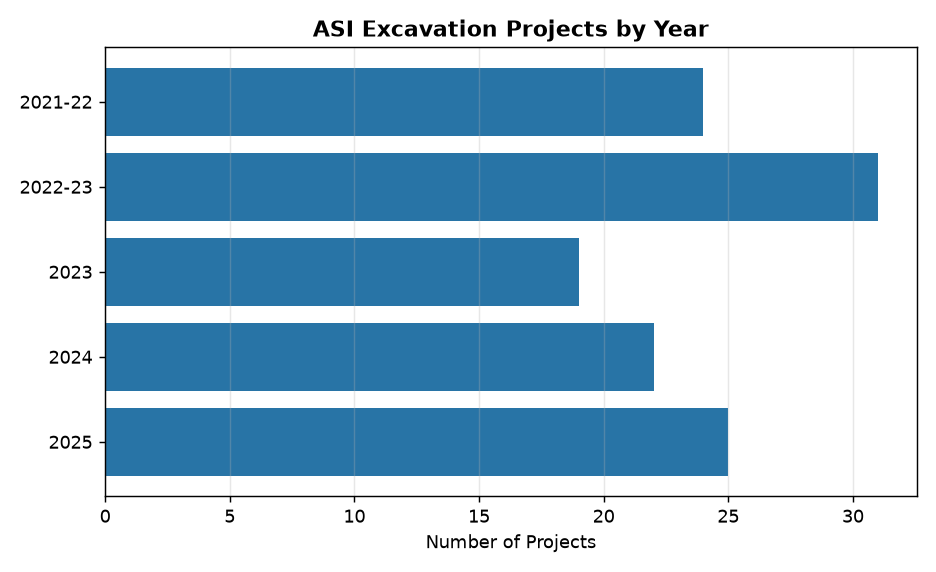
The Union Minister of Culture and Tourism, Shri Gajendra Singh Shekhawat, recently informed the Lok Sabha in a written reply that the Archaeological Survey of India (ASI) has conducted 121 archaeological excavation projects across the country over the past five years (2021–2026). The disclosure, accompanied by expenditure details and site-specific data, underscores the ASI’s expanding role in systematic exploration, scientific documentation, and heritage conservation, while also highlighting the procedural transparency and judicial oversight governing such activities.
Background
- The Archaeological Survey of India (ASI), established in 1861 under the British colonial administration, is the premier statutory body responsible for the archaeological research and protection of cultural heritage in India.
- The ASI functions under the Ministry of Culture, Government of India, and derives its mandate from the Ancient Monuments and Archaeological Sites and Remains Act, 1958, which regulates the preservation and excavation of protected monuments and sites.
- Excavation in India is governed by a rigorous protocol involving site selection, permission from the competent authority, field documentation, artefact recovery, scientific analysis, and periodic reporting to ensure legal and ethical compliance.
- The ASI’s excavation projects are not merely exploratory but serve as critical tools for validating historical narratives, reconstructing socio-economic systems, and preserving intangible cultural heritage through material evidence.
- Over the past decade, the ASI has increasingly integrated modern scientific techniques—such as radiocarbon dating, stable isotope analysis, and GIS mapping—into its archaeological methodology to enhance precision and reliability.
- The Union Government’s written reply to Parliament reflects a growing emphasis on transparency and accountability in heritage administration, particularly in response to parliamentary queries and public interest litigation.
What constitutes an archaeological excavation by the ASI?
- An archaeological excavation is a systematic, scientific process of uncovering, recording, and interpreting material remains buried beneath the earth’s surface, including structural ruins, artefacts, ecofacts, and human skeletal remains.
- The ASI’s excavations are conducted under the provisions of the Ancient Monuments and Archaeological Sites and Remains Act, 1958, and require prior approval from the competent authority to ensure compliance with legal and ethical standards.
- Excavation projects are typically multi-disciplinary, involving archaeologists, geologists, anthropologists, conservators, and laboratory technicians to ensure holistic interpretation of findings.
- The ASI follows a phased approach: reconnaissance survey, trial trenching, full-scale excavation, artefact analysis, and final documentation, often extending over multiple field seasons.
- Excavated artefacts—such as pottery shards, coins, beads, jewellery, agricultural tools, and skeletal remains—are catalogued, photographed, and stored in designated repositories under controlled environmental conditions.
- Scientific verification of samples, including radiocarbon dating and DNA analysis, is conducted in collaboration with institutions such as the Birbal Sahni Institute of Palaeosciences, Deccan College Post-Graduate and Research Institute, and the Indian Institute of Technology.
- The ASI’s excavation policy mandates the preparation of detailed excavation reports, which are submitted to the competent authority and, where applicable, published in academic journals or monographs for scholarly dissemination.
- Excavation sites are selected based on historical references, local traditions, satellite imagery, and previous surveys, with priority given to sites of national and international significance.
Key Features
| Feature | Significance |
|---|---|
| Number of excavations (2021-2025) | Demonstrates sustained archaeological activity across diverse geographical and temporal contexts, indicating systematic exploration of India’s cultural heritage. |
| Types of artefacts recovered | Structural remains, pottery, coins, beads, jewellery, agricultural tools, and urn burials provide material evidence for socio-economic, technological, and religious practices of ancient societies. |
| Scientific validation of artefacts | Mandatory laboratory analysis ensures authenticity and chronological precision, enhancing the reliability of archaeological interpretations. |
| Absence of judicial interventions | No court orders to halt or modify excavations underscores procedural transparency and adherence to statutory frameworks under the Ancient Monuments and Archaeological Sites and Remains Act, 1958. |
| Expenditure allocation | Budgetary transparency in fund utilisation reflects accountability in public expenditure for heritage conservation and research. |
Why it Matters
Cultural Heritage Preservation
- Reconstruction of India’s historical narrative through material culture, bridging gaps in textual and oral traditions.
- Identification of urban centres, trade routes, and craft specialisation in ancient India, corroborating literary and epigraphic sources.
- Enhancement of intangible heritage by linking archaeological finds (e.g., beads, tools) to traditional practices still extant in local communities.
Scientific and Academic Impact
- Advancement of stratigraphic and typological studies in Indian archaeology through systematic excavation and dating techniques.
- Collaboration with institutions like IITs, universities, and laboratories for radiocarbon dating and material analysis.
- Publication of findings in peer-reviewed journals, contributing to global archaeological discourse on South Asian antiquity.
Policy and Governance
- Implementation of the ASI’s mandate under the Ancient Monuments and Archaeological Sites and Remains Act, 1958, ensuring legal protection of heritage sites.
- Integration of archaeological data into heritage conservation policies, such as the National Mission on Monuments and Antiquities (NMMA).
- Facilitation of international collaborations under UNESCO conventions (e.g., 1970 Convention on the Means of Prohibiting and Preventing the Illicit Import, Export and Transfer of Ownership of Cultural Property).
Socio-Economic Dimensions
- Tourism potential of excavated sites (e.g., Rakhigarhi, Lothal) as drivers of local economic development and heritage-based livelihoods.
- Skill development in archaeology, conservation, and allied fields through field projects and institutional partnerships.
- Community engagement in heritage preservation, fostering pride and ownership among local populations.
Challenges
1. Illicit Excavation and Antiquities Trafficking
- Proliferation of illegal digs in unprotected sites, leading to loss of contextual data and smuggling of artefacts to foreign markets.
- Inadequate border controls and weak enforcement of the Antiquities and Art Treasures Act, 1972, exacerbating the problem.
UPSC Link: GS Paper 1: Indian Culture
2. Resource Constraints and Prioritisation
- Limited budgetary allocation for large-scale excavations, necessitating prioritisation of sites with high historical significance.
- Dependence on external funding (e.g., corporate CSR) may compromise scientific rigour or lead to commercialisation of heritage.
UPSC Link: GS Paper 2: Government Policies
3. Climate Change and Site Vulnerability
- Accelerated erosion and flooding threaten coastal and riverine sites (e.g., Dwarka, Lothal), requiring adaptive conservation strategies.
- Groundwater extraction and urbanisation encroach upon archaeological zones, risking structural integrity.
UPSC Link: GS Paper 3: Environmental Conservation
4. Interdisciplinary Collaboration Gaps
- Limited integration between archaeologists, geologists, and historians, hindering holistic interpretations of excavation data.
- Insufficient participation of local communities in research design, leading to gaps in ethnographic context.
UPSC Link: GS Paper 1: Indian Culture
5. Ethical and Repatriation Dilemmas
- Ownership disputes over artefacts recovered from contested historical regions (e.g., colonial-era acquisitions).
- Challenges in balancing scientific study with the moral imperative to repatriate human remains (e.g., urn burials) to descendant communities.
UPSC Link: GS Paper 4: Ethics
6. Public Awareness and Misinformation
- Misconceptions about excavations (e.g., equating them with treasure hunting) undermine public support for heritage projects.
- Lack of dissemination of findings in accessible formats, limiting outreach beyond academic circles.
UPSC Link: GS Paper 4: Ethics
Challenges — UPSC Perspective
| Issue | Concern |
|---|---|
| Illegal excavations | Loss of archaeological context and smuggling of artefacts |
| Budgetary limitations | Prioritisation of sites and risk of commercialisation |
| Climate-induced degradation | Erosion and flooding of coastal sites |
| Weak inter-disciplinary integration | Fragmented interpretations of excavation data |
| Ethical dilemmas in repatriation | Conflicts over ownership of human remains |
| Public misinformation | Undermining of heritage conservation efforts |
Way Forward
- Strengthen enforcement of the Antiquities and Art Treasures Act, 1972, with dedicated task forces for anti-smuggling operations.
- Expand the National Mission on Monuments and Antiquities (NMMA) to include community-led documentation of heritage sites.
- Integrate climate resilience into conservation plans for vulnerable sites, leveraging geospatial technologies for risk assessment.
- Establish a national database of excavated artefacts with open-access metadata to enhance research collaboration.
- Promote interdisciplinary research by mandating collaborations between archaeologists, historians, and climate scientists in excavation projects.
- Launch public awareness campaigns to educate communities on the scientific purpose of excavations and their role in heritage preservation.
- Develop repatriation protocols for human remains and contested artefacts, in consultation with descendant communities and ethical guidelines.
- Increase budgetary allocation for ASI’s excavation projects, with transparent audits to ensure optimal fund utilisation.
UPSC Value Addition
Keywords for Mains Answer-Writing
Indian Archaeological Survey (ASI) · Excavation and preservation of ancient sites · Cultural heritage management · Archaeological findings in India · Prehistoric and historical sites · Scientific validation of artifacts · Funding and execution of archaeological projects · Cultural resource conservation · Indus Valley Civilization · Mauryan and post-Mauryan period sites · Maritime archaeology · Sangam period sites · Ancient urban centers · Epigraphical studies · Artifact analysis and dating · Cultural tourism and heritage sites
Constitutional & Policy Linkages
- Article 49: Protection of monuments and places of national importance (Directive Principles of State Policy).
Concept Flow
Increased archaeological excavations → Discovery of artefacts and structural remains → Scientific validation and dating → Integration into historical narratives → Policy formulation for heritage conservation → Public engagement and education → Strengthened cultural identity and tourism.
Prelims Practice Questions
Q1. Which of the following sites is NOT mentioned in the recent ASI excavation list provided by the Union Culture Minister?
- Rakhigarhi, Haryana
- Dwarka, Gujarat
- Sanchi, Madhya Pradesh
- Piprahwa, Uttar Pradesh
Answer: Sanchi, Madhya Pradesh — Sanchi, Madhya Pradesh, is a well-known Buddhist site but is not listed in the ASI excavation projects mentioned in the PIB release. The other three sites are explicitly mentioned in the document.
Q2. The ASI’s excavation projects over the past five years have primarily focused on:
- Restoration of colonial-era buildings
- Preservation of modern art installations
- Excavation of prehistoric and historical sites
- Construction of new museums
Answer: Excavation of prehistoric and historical sites — The ASI’s projects, as per the PIB release, involve the excavation of prehistoric and historical sites, including Indus Valley Civilization sites like Rakhigarhi and Lothal, and other ancient urban centers.
Q3. Which of the following artifacts is NOT typically recovered during ASI excavations as per the given data?
- Structural remains
- Coins and pottery
- Agricultural tools
- Fossilized dinosaur bones
Answer: Fossilized dinosaur bones — The PIB release mentions the recovery of structural remains, coins, pottery, beads, jewelry, agricultural tools, and urns. Fossilized dinosaur bones are not part of ASI’s archaeological focus.
Mains Practice Question
✍ Analyze the significance of the Indian Archaeological Survey’s (ASI) recent excavation projects in preserving India’s cultural heritage. How do these efforts contribute to historical research and public awareness? Suggest measures to enhance the effectiveness of such initiatives.
Approach: The answer should begin by outlining the role of ASI in archaeological excavations and heritage preservation. Discuss the key findings from recent projects, such as those at Rakhigarhi, Lothal, and Piprahwa, and their historical significance in understanding India’s ancient civilizations. Highlight the scientific validation process for artifacts and the importance of interdisciplinary collaboration. Address the challenges in heritage conservation, such as funding, public awareness, and legal frameworks. Conclude with actionable suggestions, such as leveraging digital documentation, community involvement, and international collaborations to strengthen ASI’s initiatives.
Source: PIB (Press Information Bureau)
Generated by AanyaAi for educational purpose.

- AI एजेंटों की स्वतंत्रता: कंपनियां कैसे रखती हैं नियंत्रण? जानिए पूरी प्रक्रिया - October 3, 2026
- Harivansh Leads India at 153rd IPU Assembly in Tanzania - October 3, 2026
- अमेरिका में व्यापार मिशन: भारत की बड़ी योजना, जानिए क्या है सरकार की रणनीति - October 3, 2026

No Comments