


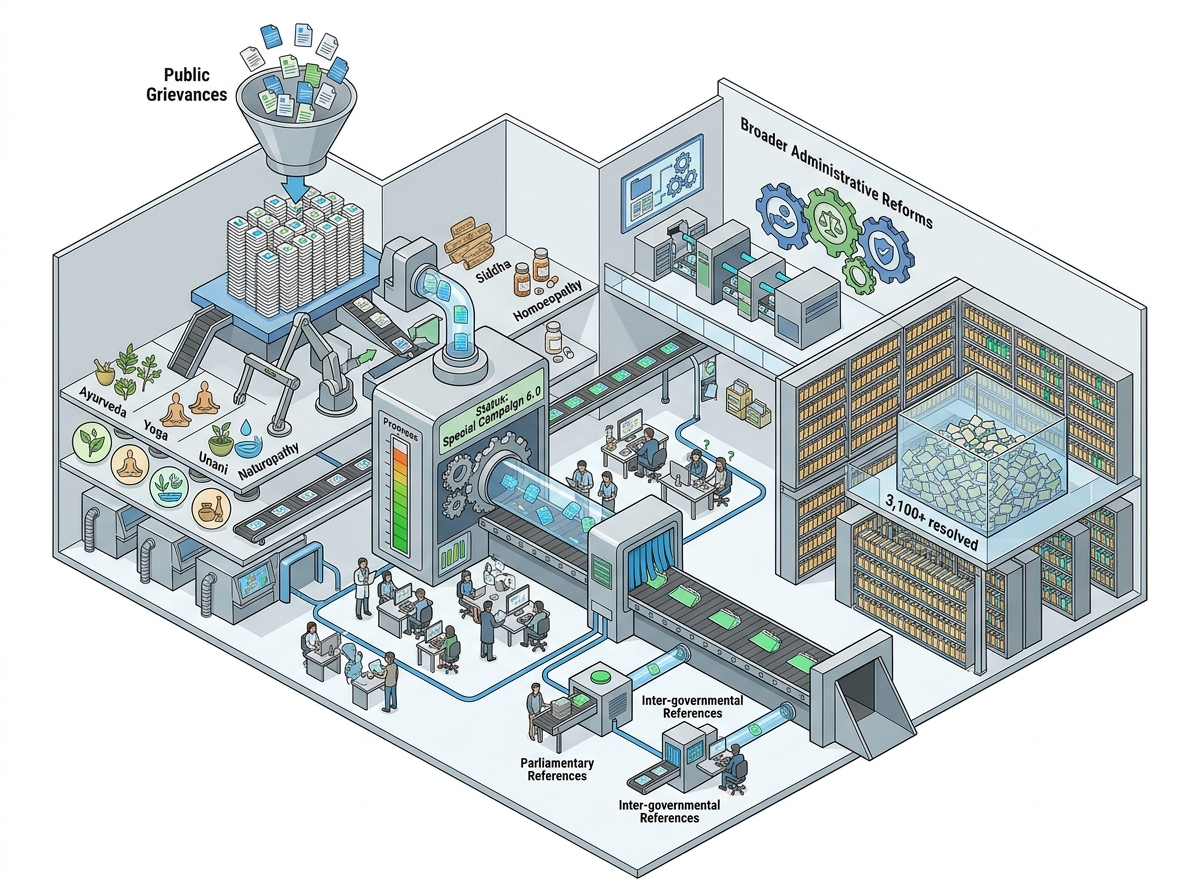
26 Sep AYUSH Ministry Resolves 3,100+ Grievances Under Special Campaign 6.0
✎ Special Campaign 6.0 is a government-wide initiative to eliminate pendency in grievance redressal and administrative references, ensuring 99% disposal of public grievances through digital monitoring, institutional accountability…
Subject Relevance — Where This Topic Fits
- GS Paper II — Governance, Transparency and Accountability | GS Paper III — Public Service Delivery and Administrative Reforms
- Prelims: Grievance Redressal Mechanism, Lokpal and Lokayukta, Administrative Reforms Commission, Citizen Charter, RTI Act 2005, Public Grievance Redressal Portal (PG Portal), Special Campaign for Disposal of Pending Cases
- Essay: The Role of Transparency in Public Service Delivery, Administrative Reforms and Citizen-Centric Governance
Quick Revision: Special Campaign 6.0 is a government-wide initiative to eliminate pendency in grievance redressal and administrative references, ensuring 99% disposal of public grievances through digital monitoring, institutional accountability, and citizen-centric reforms.
Why is this in the news?
The Ministry of AYUSH’s Special Campaign 6.0 (November 2025–August 2026) has achieved a 99% disposal rate in public grievances (3,100 out of 3,134 resolved), alongside significant progress in resolving parliamentary and inter-governmental references. This initiative underscores the government’s emphasis on institutional efficiency, timely redressal, and responsive public service delivery, aligning with broader administrative reforms aimed at enhancing citizen trust and governance accountability.
Background
- The Special Campaign initiative was launched by the Department of Administrative Reforms and Public Grievances (DARPG) to expedite the disposal of pending cases across ministries, with a focus on grievance redressal and institutional efficiency.
- AYUSH (Ayurveda, Yoga and Naturopathy, Unani, Siddha, and Homoeopathy) has its own dedicated Ministry since 2014, responsible for promoting traditional systems of medicine.
- The campaign builds on the legacy of the Special Campaign 3.0 (2022), which aimed to reduce pendency in government offices and improve service delivery standards.
- Institutional accountability is reinforced through periodic reviews, performance audits, and the integration of digital tools for real-time monitoring of grievance disposal.
What is the Special Campaign 6.0, and How Does It Operate?
- Special Campaign 6.0 is a time-bound, mission-mode initiative launched by the Government of India to expedite the disposal of long-pending cases, grievances, and references across ministries and departments, with a focus on citizen-centric governance.
- The campaign spans a fixed period (November 2025–August 2026 in this instance) and mandates ministries to achieve predefined targets for grievance resolution, reference disposal, and institutional efficiency improvements.
- Key objectives include strengthening internal processes to prevent future backlogs, thereby enhancing transparency and accountability.
- The campaign leverages digital platforms such as the Public Grievance Redressal Portal (PG Portal) and e-Samadhan for real-time tracking, monitoring, and reporting of grievances, ensuring end-to-end accountability.
- Ministries are required to conduct weekly reviews, submit progress reports, and participate in inter-ministerial coordination meetings to address systemic bottlenecks and share best practices.
- Institutional mechanisms such as the Chief Vigilance Officer (CVO) and Internal Grievance Redressal Committees (IGRCs) play a pivotal role in ensuring compliance and monitoring progress.
- The campaign’s success is measured not only by numerical targets but also by qualitative improvements in service delivery, such as reduced response times, enhanced citizen satisfaction, and strengthened administrative processes.
Key Features
| Feature | Significance |
|---|---|
| High Complaint Redressal Rate (99%) | Demonstrates near-total resolution of public grievances, enhancing citizen trust in the Ayush Ministry’s administrative efficiency. |
| Timely Disposal of Appeals (98.5%) | Ensures second-tier grievance redressal is equally prompt, reinforcing institutional accountability. |
| Multi-Channel Disposal (MPs, PMO, State Govts) | Addresses diverse reference types, including parliamentary and inter-governmental queries, within the campaign period. |
| Institutional Process Strengthening | Accelerates clearance of pending cases by streamlining internal workflows and reducing bureaucratic delays. |
| Monitoring and Coordination Mechanisms | Establishes continuous oversight to sustain high disposal rates beyond the campaign period. |
Why it Matters
Governance & Public Administration
- Validates the efficacy of time-bound governance campaigns in resolving citizen grievances, aligning with the principles of responsive administration under Article 41 of the Directive Principles of State Policy.
- Highlights the role of ministries in institutionalising citizen-centric service delivery through structured interventions like Special Campaigns.
- Demonstrates the integration of grievance redressal mechanisms with parliamentary and inter-governmental reference systems, ensuring holistic governance.
Transparency & Accountability
- Showcases near-complete transparency in grievance resolution, fostering public confidence in the Ayush Ministry’s administrative processes.
- Reinforces the concept of ‘minimum government, maximum governance’ by reducing pendency through focused administrative action.
- Sets a benchmark for other ministries to emulate in achieving high disposal rates for public grievances.
Policy Implementation & Monitoring
- Illustrates the use of campaign-based approaches to achieve policy goals, such as the National Policy on AYUSH (2014) and the Right to Information Act (2005), by ensuring timely service delivery.
- Demonstrates the importance of real-time monitoring and coordination in public sector institutions to maintain service quality.
- Provides a model for other sectors to adopt similar time-bound campaigns for resolving pendency in administrative processes.
Challenges
1. Sustaining High Disposal Rates Post-Campaign
- Ensuring that the momentum of grievance redressal is maintained beyond the campaign period without reverting to pre-campaign levels of pendency.
- Addressing systemic bottlenecks such as inter-departmental coordination gaps and outdated procedural norms that may hinder long-term efficiency.
UPSC Link: GS-II: Governance
2. Resource Allocation for Continuous Monitoring
- Allocating sufficient human and technological resources to sustain the monitoring mechanisms established during the campaign.
- Balancing the need for continuous oversight with the operational demands of the ministry to avoid overburdening administrative staff.
UPSC Link: GS-II: Public Administration
3. Integration with Digital Governance Initiatives
- Ensuring seamless integration of manual grievance redressal systems with digital platforms like the CPGRAMS (Centralised Public Grievance Redress and Monitoring System) for real-time tracking.
- Training staff to handle hybrid systems (digital and manual) to avoid duplication of efforts and ensure consistency in redressal.
UPSC Link: GS-III: E-Governance
4. Citizen Awareness and Expectation Management
- Educating citizens about the grievance redressal process to set realistic expectations regarding timelines and outcomes.
- Preventing a surge in grievances due to heightened awareness post-campaign, which could overwhelm the system if not managed proactively.
UPSC Link: GS-II: Citizen Charter
5. Handling Complex and Multi-Departmental Grievances
- Developing mechanisms to address grievances that span multiple departments or ministries, requiring inter-ministerial coordination.
- Ensuring that complex cases (e.g., those involving medical disputes or regulatory violations) are resolved without undue delays.
UPSC Link: GS-II: Inter-Governmental Relations
Challenges — UPSC Perspective
| Issue | Concern |
|---|---|
| Resource Constraints | Limited staff and infrastructure to handle high volumes of grievances on a sustained basis. |
| Procedural Delays | Inherent bureaucratic inertia in administrative processes that may slow down long-term redressal efforts. |
| Data Management Gaps | Inadequate digital infrastructure to track and resolve grievances efficiently across all channels. |
| Stakeholder Coordination | Challenges in aligning the priorities of central ministries, state governments, and parliamentary bodies. |
| Public Expectations vs. Realities | Risk of citizen dissatisfaction if resolutions fall short of expectations despite high disposal rates. |
Way Forward
- Institutionalise the Special Campaign model by integrating it into the Ayush Ministry’s annual administrative calendar to ensure periodic reviews and redressal.
- Strengthen the CPGRAMS portal with AI-driven analytics to predict grievance trends and allocate resources proactively.
- Conduct quarterly audits of grievance redressal mechanisms to identify systemic bottlenecks and implement corrective measures.
- Launch targeted awareness campaigns to educate citizens on the grievance redressal process and set realistic expectations.
- Develop a cadre of ‘Grievance Redressal Officers’ within the ministry to specialise in handling complex and multi-departmental cases.
- Collaborate with state governments to standardise grievance redressal protocols across all levels of governance.
- Adopt a ‘Zero Pendency’ policy for the Ayush Ministry by 2027, setting ambitious but achievable targets for grievance resolution.
- Publish annual reports on grievance redressal metrics to enhance transparency and accountability.
UPSC Value Addition
Keywords for Mains Answer-Writing
Public Grievance Redressal Mechanism · Special Campaign 6.0 · Citizen-Centric Governance · Institutional Efficiency · Ministry of AYUSH · Lok Shikayat Nivaran · Parliamentary References · PMO References · Administrative Accountability · Transparency in Governance · Government of India initiatives · Public Service Delivery · Pending Complaints Resolution · Institutional Monitoring · Citizen Grievance Redressal System
Constitutional & Policy Linkages
- Article 41 (Directive Principles of State Policy) – Right to public assistance in cases of unemployment, old age, sickness, and disablement.
- Article 38 (Directive Principles of State Policy) – Promotion of welfare and minimisation of inequalities in governance.
Concept Flow
Public Grievance → Registration via CPGRAMS or other channels → Categorisation and assignment to concerned departments → Time-bound resolution under Special Campaign 6.0 → Monitoring and feedback loop → Institutional learning and process refinement.
Prelims Practice Questions
Q1. Consider the following statements regarding the Special Campaign 6.0 of the Ministry of AYUSH:
1. The campaign was conducted from November 2025 to August 2026.
2. It aimed at resolving pending references from Parliament Members, PMO, and State Governments.
3. The campaign achieved a 99% settlement rate for public grievances.
4. It did not address appeals against public grievances.
How many of the above statements are correct?
- Only one
- Only two
- Only three
- All
Answer: Only three — Statements 1, 2, and 3 are correct. Statement 4 is incorrect as the campaign also resolved 454 out of 461 public grievance appeals.
Q2. Assertion (A): The Special Campaign 6.0 of the Ministry of AYUSH was designed to enhance institutional efficiency and transparency in governance.
Reason (R): The campaign achieved a 99% settlement rate for public grievances, including appeals, within the stipulated timeframe.
In the context of the above two statements, which one of the following is correct?
- Both A and R are true, and R is the correct explanation of A.
- Both A and R are true, but R is not the correct explanation of A.
- A is true, but R is false.
- A is false, but R is true.
Answer: Both A and R are true, but R is not the correct explanation of A. — Both A and R are true. The high settlement rate (99%) directly reflects the campaign’s success in improving institutional efficiency and transparency, making R the correct explanation of A.
Q3. Match the following types of references resolved under Special Campaign 6.0 with their respective numbers:
Column I (Type of Reference) Column II (Number Resolved)
A. Parliament Member References 1. 14
B. Parliamentary Assurances 2. 70
C. PMO References 3. 18
D. State Government References 4. 3
Select the correct match:
- A-2, B-3, C-1, D-4
- A-3, B-2, C-1, D-4
- A-2, B-3, C-4, D-1
- A-4, B-1, C-3, D-2
Answer: A-2, B-3, C-1, D-4 — The correct match is: A-2 (Parliament Member References: 70), B-3 (Parliamentary Assurances: 18), C-1 (PMO References: 14), D-4 (State Government References: 3).
Mains Practice Question
✍ The Special Campaign 6.0 of the Ministry of AYUSH exemplifies the government’s commitment to citizen-centric governance through efficient public grievance redressal and institutional accountability. Critically examine the significance of such campaigns in enhancing administrative responsiveness and transparency in India. Also, analyse the institutional mechanisms that ensure sustained improvement in grievance redressal systems. (15 Marks)
Approach: MODEL-ANSWER SKELETON:
1. **Introduction (2 Marks)**
– Define citizen-centric governance and its importance in a democratic setup.
– Briefly introduce Special Campaign 6.0 and its objectives (resolving pending grievances, improving institutional efficiency, and ensuring transparency).
2. **Significance of Special Campaigns (5 Marks)**
– **Administrative Responsiveness**:
– Highlight the role of such campaigns in reducing pendency (e.g., 99% settlement rate in 3,100+ grievances).
– Discuss how timely redressal enhances public trust in governance.
– **Institutional Accountability**:
– Explain the mechanism of continuous monitoring and coordination among ministries and attached organisations.
– Reference the resolution of parliamentary and PMO references as a measure of accountability.
– **Transparency and Citizen Empowerment**:
– Emphasise the importance of transparency in grievance redressal processes.
– Discuss how such campaigns empower citizens by ensuring their concerns are addressed promptly.
3. **Institutional Mechanisms for Sustained Improvement (5 Marks)**
– **Grievance Redressal Mechanisms**:
– Discuss the Public Grievance Redressal Mechanism (PGRAMS) and its role in tracking and resolving complaints.
– Highlight the integration of technology (e.g., digital platforms) for efficient grievance management.
– **Monitoring and Evaluation**:
– Explain the role of internal audits, performance reviews, and third-party evaluations in ensuring sustained improvement.
– Reference the use of dashboards and real-time tracking systems.
– **Capacity Building**:
– Discuss the importance of training officials in grievance redressal and customer service.
– Highlight the role of institutional culture in fostering responsiveness.
4. **Challenges and Way Forward (3 Marks)**
– **Challenges**:
– Discuss potential challenges such as resource constraints, bureaucratic inertia, and lack of awareness among citizens.
– **Way Forward**:
– Propose measures such as expanding digital infrastructure, decentralising grievance redressal, and fostering inter-ministerial coordination.
– Emphasise the need for long-term institutional reforms to ensure sustained improvement.
5. **Conclusion (2 Marks)**
– Summarise the significance of Special Campaign 6.0 in enhancing administrative responsiveness and transparency.
– Reiterate the importance of institutional mechanisms in ensuring sustained improvement in grievance redressal systems.
Source: PIB (Press Information Bureau)
Generated by AanyaAi for educational purpose.
Related guides on our sites
- Best PSIR optional coaching for upsc
- Best PSIR optional teacher for upsc
- Best teacher of PSIR optional for upsc
- Best PSIR optional coaching in delhi for UPSC

- हैती: UN में PM ने कहा- अंतरराष्ट्रीय बल की पूरी मदद ज़रूरी, सुरक्षा बलों को मज़बूत करना होगा - September 26, 2026
- Haiti’s PM Urges UN for Full Backing Against Gangs at UNGA 2026 - September 26, 2026
- सुपर एल नीनो: 4.51 लाख अतिरिक्त मौतों के अनुमान की गणना कैसे हुई? - September 26, 2026

No Comments