


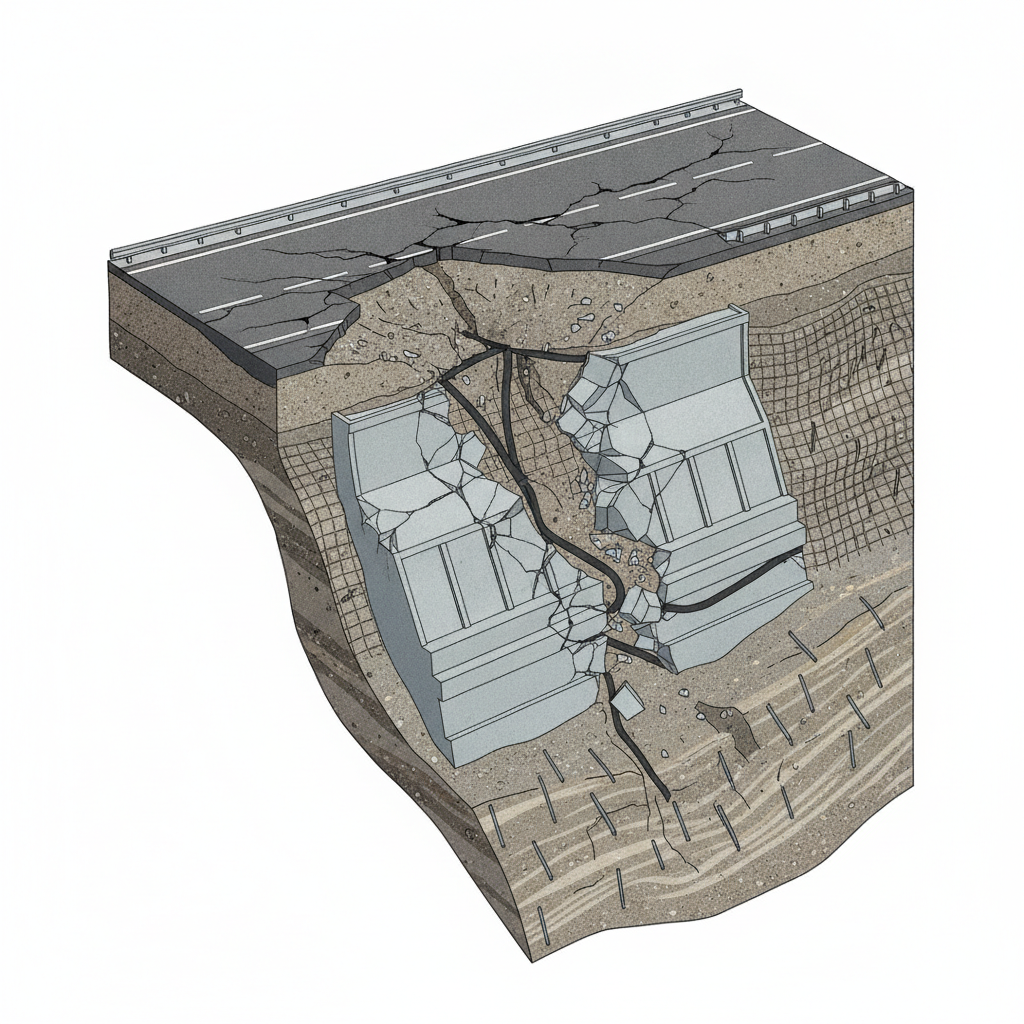
08 Aug Badrinath Highway: All-Weather Road Fails First Monsoon Test, Wall Collapses
✎ Himalayan highway projects must integrate real-time geotechnical monitoring, adaptive engineering designs, and robust post-construction maintenance to mitigate landslide risks in fragile terrains.
Subject Relevance — Where This Topic Fits
- GS Paper III — Infrastructure: Energy, Ports, Roads, Airports, Railways; Environmental Impact Assessment | GS Paper III — Disaster Management
- Prelims: Landslide-prone zones, NHIDCL, All-Weather Road Project, Himalayan geology, EIA norms, Geotechnical audits, Slope stability analysis, NH-58
- Essay: Sustainable development in ecologically fragile regions: Balancing infrastructure and environmental conservation
Quick Revision: Himalayan highway projects must integrate real-time geotechnical monitoring, adaptive engineering designs, and robust post-construction maintenance to mitigate landslide risks in fragile terrains.
Why is this in the news?
The Badrinath All-Weather Road Project, a flagship infrastructure initiative under the Char Dham Pariyojana, has suffered structural failures within months of completion, with critical sections of retaining walls collapsing and new cracks emerging in sensitive landslide zones like Kamera and Belakuchi. This incident underscores systemic deficiencies in geotechnical assessments, construction oversight, and environmental safeguards in Himalayan highway development.
Background
- The Badrinath All-Weather Road Project is a component of the broader Char Dham Pariyojana, aimed at providing year-round connectivity to the four Hindu pilgrimage sites in Uttarakhand.
- The project traverses the highly fragile and seismically active Himalayan terrain, characterized by steep slopes, weak geological formations, and intense monsoon precipitation.
- The National Highways and Infrastructure Development Corporation Limited (NHIDCL) is the nodal agency responsible for the execution of the project.
- Uttarakhand is a landslide-prone state, with over 80% of its area classified as geologically unstable, necessitating stringent geotechnical and environmental protocols.
- The project has faced recurring delays due to environmental clearances, land acquisition challenges, and adverse weather conditions.
- Recent incidents of slope failures and retaining wall collapses highlight the inadequacies in pre-construction geological surveys and post-construction monitoring mechanisms.
What is the Badrinath All-Weather Road Project and why is it significant?
- The road alignment passes through the Himalayan foothills and higher reaches, where geological formations are predominantly composed of weak sedimentary rocks, schists, and gneisses, making them highly susceptible to erosion and landslides.
- The project employs modern engineering techniques, including reinforced soil slopes, rock bolting, and retaining walls, to stabilize the terrain and mitigate landslide risks.
- The project is critical for socio-economic development, reducing travel time from 10-12 hours to 6-7 hours and enhancing disaster response capabilities in the region.
- The project has faced criticism for alleged violations of environmental norms, including deforestation, riverbed mining, and inadequate mitigation measures in ecologically sensitive zones.
- The recent structural failures raise questions about the efficacy of geotechnical audits, construction quality control, and long-term maintenance protocols in high-risk Himalayan terrains.
Key Features
| Feature | Significance |
|---|---|
| All-Weather Road Project under Badrinath Highway | Aims to provide year-round connectivity to the Badrinath Dham pilgrimage route, enhancing accessibility and reducing seasonal disruptions. |
| Construction of Retaining Walls and Anchoring Structures | Critical for stabilizing slopes and preventing landslides in geologically fragile Himalayan terrain. |
| Geological Vulnerability of Chamoli District | Region prone to landslides and soil erosion due to fragile rock formations, steep slopes, and high seismic activity. |
| NHIDCL as Implementing Agency | National Highways and Infrastructure Development Corporation Limited is responsible for executing highway projects with technical oversight. |
| Immediate Post-Rain Structural Failures | Exposure of poor construction quality and inadequate geological assessment within the first monsoon season. |
Why it Matters
Strategic Infrastructure
- Ensures uninterrupted pilgrimage access to Badrinath Dham, a critical religious and economic hub in Uttarakhand.
- Supports national security by facilitating troop movement and logistics in sensitive border regions.
- Promotes tourism, generating revenue for local economies in Uttarakhand and neighboring states.
Geological and Environmental
- Highlights the fragility of Himalayan ecosystems and the risks of unplanned infrastructure development.
- Underscores the need for rigorous environmental impact assessments (EIAs) and geo-technical studies.
- Demonstrates the consequences of ignoring local geological conditions in construction projects.
Economic Implications
- Delays and repairs due to structural failures incur additional financial burdens on public exchequer.
- Potential loss of investor confidence in infrastructure projects in ecologically sensitive zones.
- Impacts local livelihoods dependent on tourism and pilgrimage-related activities.
Challenges
1. Geological Instability in Himalayan Terrain
- Fragile rock formations, steep slopes, and high seismic activity make the region inherently prone to landslides.
- Inadequate geological surveys and underestimation of soil erosion risks lead to structural failures.
- Climate change exacerbates rainfall intensity, increasing the vulnerability of untested constructions.
UPSC Link: GS Paper 1: Geographical features and their impact on human settlements.
2. Quality Control and Construction Oversight
- Lack of stringent quality control measures during construction results in substandard infrastructure.
- Insufficient post-construction monitoring and maintenance exacerbate structural weaknesses.
- Corruption and lack of accountability in project execution contribute to systemic failures.
UPSC Link: GS Paper 3: Infrastructure development and challenges.
3. Environmental Degradation and Ecological Balance
- Unsustainable construction practices disrupt local ecosystems and biodiversity.
- Deforestation and slope destabilization increase the risk of landslides and soil erosion.
- Violation of environmental norms and lack of compliance with EIA guidelines.
UPSC Link: GS Paper 3: Environmental conservation and sustainable development.
4. Operational and Logistical Challenges
- Frequent landslides and structural failures disrupt traffic flow and increase travel time.
- Emergency response and repair work face logistical hurdles due to remote and inaccessible terrain.
- Delays in project completion impact economic activities and pilgrimage schedules.
UPSC Link: GS Paper 3: Disaster management and infrastructure resilience.
5. Policy and Governance Gaps
- Lack of integrated planning between central and state agencies leads to disjointed project execution.
- Inadequate enforcement of environmental and safety regulations by regulatory bodies.
- Limited community participation and lack of awareness about local geological risks.
UPSC Link: GS Paper 2: Government policies and their implementation.
Challenges — UPSC Perspective
| Issue | Concern |
|---|---|
| Inadequate Geological Assessments | Failure to account for local soil composition, slope stability, and seismic risks. |
| Poor Construction Practices | Use of substandard materials and lack of adherence to engineering standards. |
| Climate Change Impact | Increased rainfall intensity and frequency exacerbating landslide risks. |
| Regulatory Non-Compliance | Violation of environmental norms and lack of enforcement by oversight bodies. |
| Maintenance Deficit | Neglect of post-construction monitoring and repair work. |
| Community Displacement | Potential loss of livelihoods and displacement due to construction-related disruptions. |
Government Initiatives — Must-Memorise for Prelims
- Badrinath Dham All-Weather Road Project (as reported)
Way Forward
- Conduct comprehensive geo-technical surveys and stability analyses for all ongoing and proposed projects in the Himalayan region.
- Implement stringent quality control measures and third-party audits for construction materials and techniques.
- Enforce mandatory environmental impact assessments (EIAs) and compliance with forest clearance norms.
- Establish a dedicated disaster management and resilience framework for infrastructure projects in ecologically fragile zones.
- Promote community-based monitoring and awareness programs to report early signs of structural or geological instability.
- Adopt climate-resilient design principles to account for increased rainfall intensity and seismic activity.
- Strengthen inter-agency coordination between NHIDCL, state governments, and environmental regulators.
- Prioritize maintenance and periodic structural health monitoring to ensure long-term durability of highway infrastructure.
UPSC Value Addition
Keywords for Mains Answer-Writing
All-Weather Road Project · Badrinath Highway · Geological fragility · Himalayan road infrastructure · Landslide vulnerability · National Highways and Infrastructure Development Corporation Limited (NHIDCL) · Environmental impact of infrastructure · Sustainable engineering practices · Himalayan ecosystem · Disaster resilience in infrastructure · Geotechnical failures · Uttarakhand landslides
Concept Flow
Geological fragility of Himalayan terrain (fragile rock, steep slopes, seismic activity) → Inadequate pre-construction geological surveys → Substandard construction practices → Structural failures during first monsoon → Landslides and soil erosion → Disruption of pilgrimage and economic activities → Calls for policy reforms and sustainable infrastructure development.
Prelims Practice Questions
Q1. Consider the following statements regarding the National Highways and Infrastructure Development Corporation Limited (NHIDCL):
1. NHIDCL is a statutory body established under the National Highways Authority of India Act, 1995.
2. It is responsible for the development and maintenance of national highways in strategically important areas, including border regions.
3. NHIDCL operates under the administrative control of the Ministry of Road Transport and Highways.
How many of the above statements are correct?
- Only one
- Only two
- All three
- None
Answer: All three — Statement 1 is incorrect because NHIDCL is not a statutory body under NHAI Act, 1995; it is a fully owned Government of India company. Statements 2 and 3 are correct.
Q2. Assertion (A): The construction of all-weather roads in the Himalayan region often faces challenges due to geological fragility and high susceptibility to landslides.
Reason (R): The Himalayas are young fold mountains with active tectonic movements, making them prone to seismic and landslide events.
Options:
A. Both A and R are true, and R is the correct explanation of A.
B. Both A and R are true, but R is NOT the correct explanation of A.
C. A is true, but R is false.
D. A is false, but R is true.
Answer: ? — Both A and R are true. The Himalayas’ geological youth and tectonic activity (R) directly explain the fragility and landslide susceptibility (A).
Q3. Match the following pairs related to infrastructure projects in ecologically sensitive regions:
Column I (Project) | Column II (Region/Feature)
———————————–|———————————–
1. Badrinath All-Weather Road | A. Uttarakhand
2. Z-Morh Tunnel | B. Jammu & Kashmir
3. Atal Tunnel | C. Himachal Pradesh
4. Rohtang Tunnel | D. Himachal Pradesh (alternate name)
Options:
A. 1-A, 2-B, 3-C, 4-D
B. 1-B, 2-A, 3-C, 4-D
C. 1-A, 2-B, 3-D, 4-C
D. 1-D, 2-A, 3-B, 4-C
- A
- B
- C
- D
Answer: A — 1-A: Badrinath All-Weather Road is in Uttarakhand. 2-B: Z-Morh Tunnel is in Jammu & Kashmir. 3-C: Atal Tunnel is in Himachal Pradesh. 4-D: Rohtang Tunnel is an alternate name for Atal Tunnel in Himachal Pradesh.
Mains Practice Question
✍ The failure of the Badrinath All-Weather Road Project to withstand even a single monsoon spell underscores systemic deficiencies in Himalayan road infrastructure development. Critically analyse the causes of such failures and suggest measures for ensuring sustainable and resilient infrastructure in ecologically fragile regions. (15 Marks)
Approach: MODEL-ANSWER SKELETON:
1. Introduction (2 marks):
– Briefly define the Badrinath All-Weather Road Project and its strategic importance for pilgrimage and connectivity.
– State the observed failure (e.g., collapse of retaining walls, landslides in sensitive zones like Komeda and Belakuchi).
2. Causes of Failure (5 marks):
– Geological factors: Himalayas as young fold mountains with active tectonics, high seismic vulnerability (mention Bhuj 2001, Nepal 2015 earthquakes).
– Engineering lapses: Poor geotechnical investigations, inadequate drainage systems, substandard construction materials, and lack of adherence to sustainable engineering practices.
– Environmental neglect: Deforestation, unregulated blasting, and disregard for carrying capacity of Himalayan ecosystems.
– Institutional issues: Lack of inter-agency coordination (e.g., NHIDCL, state agencies, MoEFCC), absence of long-term monitoring, and pressure-driven project execution.
– Climate change: Increased intensity and frequency of extreme weather events exacerbating landslide risks.
3. Measures for Sustainable Infrastructure (5 marks):
– Pre-construction: Comprehensive geotechnical surveys, hazard zonation mapping, and environmental impact assessments (EIAs) with strict compliance.
– Design and construction: Adoption of eco-friendly techniques (e.g., NATM tunnels, bioengineering for slope stabilization), use of locally sourced materials, and incorporation of climate-resilient designs.
– Post-construction: Real-time monitoring systems (e.g., IoT-based sensors for landslide detection), regular maintenance schedules, and community-based disaster risk reduction (CBDRR) initiatives.
– Institutional reforms: Strengthening NHIDCL with multi-disciplinary expertise, mandating third-party audits, and enforcing accountability for lapses.
– Policy integration: Alignment with the National Disaster Management Authority (NDMA) guidelines, National Mission on Himalayan Studies (NMHS), and Sustainable Development Goals (SDGs).
4. Conclusion (3 marks):
– Emphasize the need for a paradigm shift from ‘speed-driven’ to ‘sustainability-driven’ infrastructure development in the Himalayas.
– Highlight the role of technology (e.g., LiDAR, remote sensing) and community participation in ensuring resilience.
– Conclude with a forward-looking statement on balancing development imperatives with ecological integrity.
Source: amarujala.com
Generated by AanyaAi for educational purpose.

- Next-Gen GST: Boosting India’s Economy for Viksit Bharat Aspirants - October 5, 2026
- केरल उच्च न्यायालय ने 14 साल पुराने सैनिक लापता मामले में सीबीआई जांच का दिया आदेश - October 5, 2026
- ECI’s constitutional mandate under strain: UPSC & State PCS analysis - October 5, 2026

No Comments