


08 Aug Belagavi Row: Kannada Groups Demand Action Against BCC Over Mahajan Commission Delay
Belagavi City CorporationMahajan CommissionKarnataka State legislatureBelagavi border dispute✎ The 74th Constitutional Amendment Act, 1992, mandates that urban local bodies function as institutions of self-government, but their role in affirming state policies—such as those related to border disputes—remains…
Subject Relevance — Where This Topic Fits
- GS Paper II — Functions and Responsibilities of the Union and the States, Issues and Challenges pertaining to the Federal Structure, Devolution of Powers and Finances up to Local Levels and Challenges therein | GS Paper II — Role of Civil Services in a Democracy
- Prelims: Belagavi border dispute, Mahajan Commission, 73rd and 74th Constitutional Amendments, Urban Local Bodies (ULBs), Constitutional provisions on federalism, Karnataka State Border and River Protection Commission, Article 243W of the Constitution
- Essay: Federalism in India: Balancing Unity and Diversity, Role of Local Governance in National Integration
Quick Revision: The 74th Constitutional Amendment Act, 1992, mandates that urban local bodies function as institutions of self-government, but their role in affirming state policies—such as those related to border disputes—remains constitutionally and politically contested.
Why is this in the news?
The delay by the Belagavi City Corporation (BCC) in passing a resolution affirming Belagavi as an integral part of Karnataka, despite clear legal opinions and state government directives, has reignited debates on the efficacy of urban local bodies in implementing state policies. This issue underscores the constitutional obligations of local governments in upholding the federal structure and the challenges in ensuring uniformity in policy implementation across administrative tiers.
Background
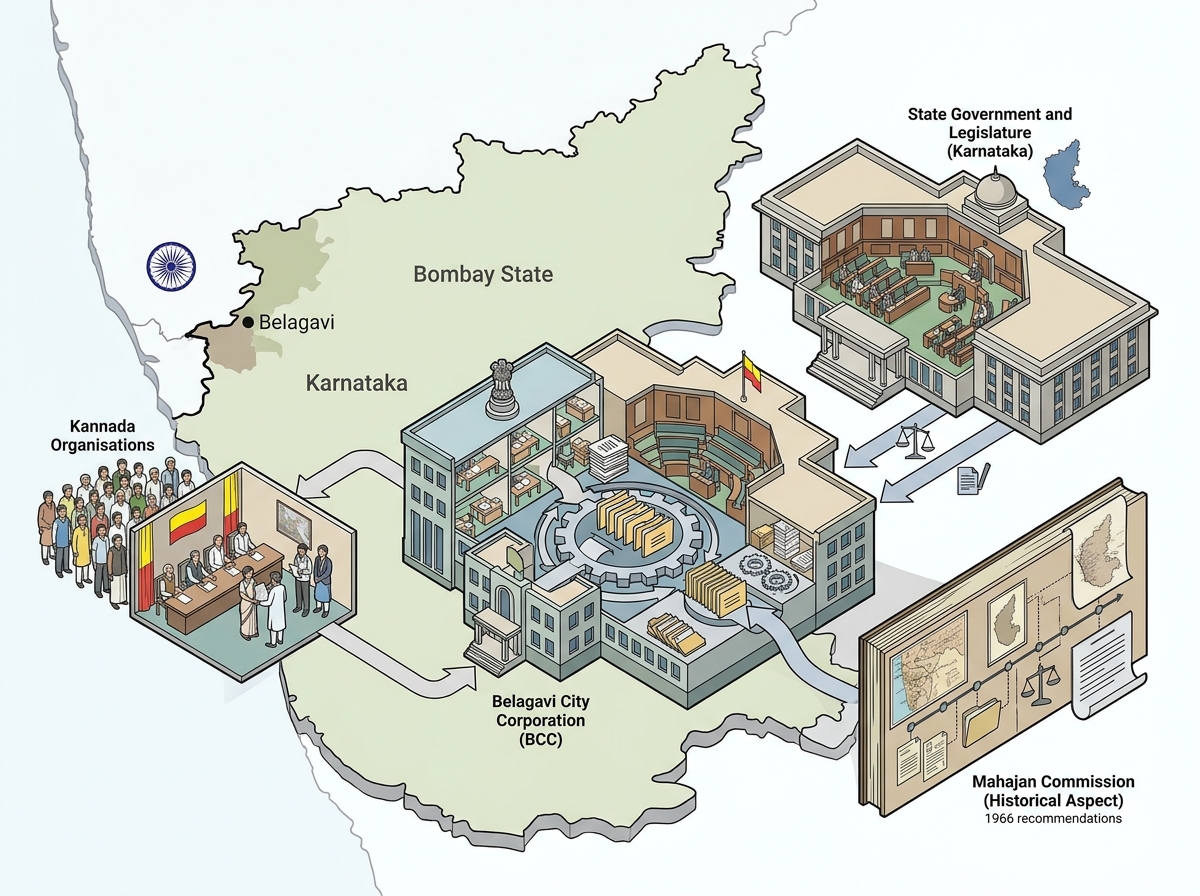
- The Belagavi border dispute has historical roots, with the Mahajan Commission (1966) recommending the transfer of certain territories to Karnataka, including Belagavi, which was then part of the Bombay State.
- The Karnataka State legislature has, on multiple occasions, passed resolutions affirming Belagavi as an integral part of Karnataka, in line with the Mahajan Commission’s recommendations.
- Urban local bodies (ULBs) like the BCC are constitutional entities under the 74th Constitutional Amendment Act, 1992, tasked with functions such as urban planning and regulation of land use, but their role in affirming state policies remains ambiguous.
- The BCC’s delay in passing the resolution has been attributed to procedural ambiguities and lack of clarity on the legal implications of such a resolution, despite the state government’s explicit endorsement of the Mahajan Commission’s findings.
- The issue has sparked protests by Kannada organisations, including arrests of activists, highlighting the socio-political sensitivities surrounding the border dispute.
- The state government’s legal opinion, as conveyed by the Chief Secretary’s office, has consistently affirmed that there are no legal hurdles to passing the resolution, reinforcing the constitutional obligation of the BCC.
What is the Mahajan Commission and its relevance to the Belagavi border dispute?
- The Mahajan Commission was constituted in 1966 to resolve the dispute between Karnataka and Maharashtra over the territorial jurisdiction of Belagavi and other border areas.
- The Commission recommended the transfer of certain territories, including Belagavi, to Karnataka, based on linguistic and administrative considerations, thereby affirming the region’s integration into Karnataka.
- The dispute resurfaced periodically, particularly in the context of demands for linguistic states and assertions of regional identity, necessitating repeated affirmations of Karnataka’s sovereignty over Belagavi.
- The Karnataka State legislature has passed resolutions on multiple occasions, including in 2006 and 2013, reaffirming Belagavi as an integral part of Karnataka, in alignment with the Mahajan Commission’s recommendations.
- The issue is not merely administrative but also constitutional, as it involves the interpretation of federal principles and the role of local governments in upholding state policies.
- The delay by the BCC in passing the resolution raises questions about the effectiveness of decentralised governance in implementing national and state-level policies, particularly in sensitive border regions.
- The Mahajan Commission’s findings are often cited in legal and political discourse as a definitive resolution to the border dispute, though their implementation remains contingent on administrative and political will.
Key Features
| Feature | Significance |
|---|---|
| Mahajan Commission Recommendations | Establishes Belagavi as an integral part of Karnataka, resolving historical border disputes with Maharashtra. |
| Belagavi City Corporation (BCC) Resolution Delay | Demonstrates institutional inertia and political hesitation in implementing constitutional and judicial directives. |
| Legal Opinion from State Government | Reaffirms the absence of legal impediments to passing the resolution, reinforcing the state’s sovereign claim. |
| Kannada Organisations’ Protests | Highlights grassroots mobilisation and public pressure to uphold regional identity and administrative unity. |
| Mayor’s Reference to State Government | Exemplifies bureaucratic procedural delay despite clear legal clarity on the issue. |
Why it Matters
Administrative and Legal
- The delay in passing the BCC resolution contravenes the state government’s explicit legal stance, undermining administrative coherence.
- The issue tests the efficacy of local governance institutions in aligning with higher judicial and executive directives.
- The legal opinion from the Chief Secretary’s office serves as a binding precedent for resolving similar border disputes in other regions.
Political and Social
- The protests underscore the emotional and cultural significance of Belagavi to Karnataka, transcending administrative and legal considerations.
- The inaction by the BCC risks eroding public trust in local governance and fuels regionalist sentiments.
- The Minister’s engagement with stakeholders reflects the political sensitivity of border-related issues in federal structures.
Strategic and Governance
- The episode highlights the need for streamlined mechanisms to implement judicial recommendations at the local government level.
- Supersession of the BCC, if pursued, would set a precedent for central intervention in local administrative failures, raising federalism concerns.
Challenges
1. Institutional Delay and Bureaucratic Inertia
- The BCC’s failure to act despite clear legal and executive directives demonstrates systemic inefficiency in local governance.
- Procedural referrals to higher authorities, even when unnecessary, exacerbate delays and dilute accountability.
- The Mayor’s reluctance to convene meetings reflects political caution, potentially prioritising short-term stability over long-term governance.
UPSC Link: GS-II: Local Governance
2. Public Trust and Regional Identity
- Prolonged delays risk normalising administrative neglect, eroding citizen confidence in local institutions.
- Grassroots mobilisation, while democratic, can escalate into law-and-order challenges if unresolved promptly.
- The cultural and linguistic significance of Belagavi to Karnataka intensifies the political stakes of inaction.
UPSC Link: GS-II: Federalism and Regionalism
3. Legal and Constitutional Compliance
- The state government’s legal opinion, while clear, is not self-executing, requiring local bodies to act on it.
- Discrepancies between judicial recommendations and local implementation highlight gaps in the enforcement of constitutional provisions.
- The absence of a statutory timeline for implementing such resolutions creates ambiguity in governance obligations.
UPSC Link: GS-II: Constitutional Provisions
4. Federalism and Centre-State Relations
- The episode tests the balance between state autonomy in local governance and the Centre’s role in resolving disputes.
- Supersession of the BCC, if pursued, could set a precedent for central intervention, raising concerns about federalism.
- The state’s insistence on its claim over Belagavi reflects the broader challenge of maintaining territorial integrity in federal structures.
UPSC Link: GS-II: Federalism
Challenges — UPSC Perspective
| Issue | Concern |
|---|---|
| Delay in BCC Resolution | Undermines administrative coherence and public trust in local governance. |
| Political Hesitation | Risks prioritising short-term stability over long-term governance and legal compliance. |
| Grassroots Mobilisation | Can escalate into law-and-order challenges if unresolved promptly. |
| Legal Ambiguity | Lack of statutory timelines for implementing judicial recommendations creates enforcement gaps. |
| Federalism Concerns | Potential central intervention in local governance may set a precedent for future disputes. |
Way Forward
- The State Government must issue a directive to the BCC, mandating the passage of the resolution within a stipulated timeline to prevent further delays.
- The Chief Secretary should convene a meeting with the Mayor and BCC officials to clarify procedural obligations and remove bureaucratic hurdles.
- Legal experts, including Justice Nagamohan Das, should be consulted to draft a model resolution for local bodies to adopt uniformly.
- Public awareness campaigns should be launched to educate citizens on the legal and constitutional basis of Belagavi’s integration with Karnataka.
- A dedicated grievance redressal mechanism should be established to address similar disputes in other border regions promptly.
- The state government should consider amending local governance rules to include time-bound frameworks for implementing judicial recommendations.
- Political parties should depoliticise the issue by framing it as a governance imperative rather than a regionalist cause.
- Monitoring committees comprising representatives from Kannada organisations and administrative officials should be constituted to oversee progress.
UPSC Value Addition
Keywords for Mains Answer-Writing
Karnataka-Karnataka border dispute · Belagavi territorial integrity · Mahajan Commission recommendations · Belagavi City Corporation (BCC) · Article 243U of the Constitution · State legislature resolutions on border disputes · Local self-government and federalism · Inter-State boundary disputes · Karnataka State Border and River Protection Commission · Constitutional provisions for urban local bodies · Executive-legislative relations in States · Legal opinions and administrative delays
Constitutional & Policy Linkages
- Article 243G: Powers, authority, and responsibilities of Municipalities (12th Schedule).
- Article 243W: Powers, authority, and responsibilities of Municipal Corporations.
Concept Flow
Historical border dispute between Karnataka and Maharashtra over Belagavi → Formation of the Mahajan Commission to resolve the dispute → Commission’s recommendations affirming Belagavi as part of Karnataka → State government’s acceptance of recommendations and issuance of legal opinion → BCC’s failure to pass resolution despite clear directives → Grassroots protests and political pressure from Kannada organisations → Potential escalation to legal or administrative intervention to enforce compliance
Prelims Practice Questions
Q1. Consider the following statements regarding the Mahajan Commission and its recommendations on the Belagavi border dispute:
1. The Mahajan Commission was constituted to resolve the inter-State border dispute between Karnataka and Maharashtra.
2. The Commission recommended that Belagavi be declared an integral part of Karnataka.
3. The recommendations of the Mahajan Commission were legally binding on the State governments.
How many of the above statements are correct?
- Only one
- Only two
- All three
- None
Answer: Only two — Statement 1 is correct as the Mahajan Commission was indeed constituted to resolve the inter-State border dispute between Karnataka and Maharashtra. Statement 2 is correct as the Commission recommended Belagavi’s inclusion in Karnataka. Statement 3 is incorrect as the recommendations of the Commission are not legally binding; they are advisory in nature.
Q2. Assertion (A): The Belagavi City Corporation (BCC) is constitutionally mandated to pass resolutions on issues of territorial integrity as per Article 243U of the Constitution.
Reason (R): Article 243U empowers urban local bodies to perform functions as may be entrusted to them by the State legislature, including matters related to local governance and administration.
Options:
A. Both A and R are true, and R is the correct explanation of A.
B. Both A and R are true, but R is not the correct explanation of A.
C. A is true, but R is false.
D. A is false, but R is true.
Answer: ? — Assertion (A) is true as the BCC, being an urban local body, can pass resolutions on matters entrusted by the State legislature, including those related to territorial integrity. Reason (R) is also true and correctly explains A, as Article 243U empowers urban local bodies to perform such functions.
Mains Practice Question
✍ The refusal of the Belagavi City Corporation (BCC) to pass a resolution affirming Belagavi as an integral part of Karnataka, despite the State government’s clear stance and legal opinions, raises critical questions about the interplay between local self-government, federalism, and constitutional obligations. Critically examine the constitutional and administrative dimensions of this issue. Also, analyse the implications of such delays for the federal structure of India. (15 Marks)
Approach: MODEL-ANSWER SKELETON:
1. **Constitutional Provisions and Local Self-Government**:
– Article 243U of the Constitution empowers urban local bodies (ULBs) like the BCC to perform functions entrusted by the State legislature.
– The 74th Amendment Act, 1992, underscores the role of ULBs in local governance, including matters of public importance.
– The BCC’s refusal to pass the resolution despite the State government’s stance suggests a conflict between local autonomy and State directives.
2. **Federalism and Inter-State Relations**:
– The Mahajan Commission’s recommendations are advisory, not binding, but the State government’s acceptance of them reflects its political and administrative stance.
– The delay in passing the resolution undermines the State’s authority and weakens the federal structure by allowing local bodies to override State policy.
3. **Legal Opinions and Administrative Delays**:
– The State government and Chief Secretary’s office have opined that there are no legal hurdles to passing the resolution.
– The Mayor’s referral to the State government for a legal opinion, despite the absence of legal barriers, indicates administrative inertia or political hesitancy.
4. **Implications for Federal Structure**:
– Such delays erode trust in the federal framework, as local bodies may prioritise parochial interests over State-wide policies.
– It sets a precedent for other ULBs to challenge State decisions, potentially destabilising governance.
5. **Way Forward**:
– The State government must assert its authority by issuing clear directives to the BCC under Article 243U.
– Mechanisms for expediting resolutions on critical issues should be institutionalised to prevent administrative delays.
Balance of Views:
– Proponents of local autonomy may argue that ULBs should have the discretion to pass or reject resolutions.
– Federalism advocates would emphasise the need for State-level coherence and the supremacy of State policies in matters of territorial integrity.
Source: The Hindu
Generated by AanyaAi for educational purpose.

- मुस्लिम महिलाओं को विरासत में समान अधिकार: सुप्रीम कोर्ट ने केंद्र से पूछा जवाब - September 23, 2026
- Supreme Court Questions Muslim Women’s Inheritance Rights Under Personal Law - September 23, 2026
- सुप्रीम कोर्ट ने पटना हाईकोर्ट के बलात्कार फैसले पर लिया स्वतः संज्ञान - September 23, 2026

No Comments