


23 Sep Bengaluru Investor Meet: ₹5,500 Cr Investment Proposed for Gwalior Telecom Manufacturing Zone
✎ Telecom Manufacturing Zones (TMZs) are strategic industrial clusters designed to boost domestic telecom equipment manufacturing, reduce import dependency, and position India as a global hub for telecom and electronics production…
Subject Relevance — Where This Topic Fits
- GS Paper II — Government Policies and Interventions for Development in various sectors | GS Paper III — Industrial Policy, Investment Models, and Manufacturing Sector
- Prelims: Telecom Manufacturing Zones (TMZs), Production-Linked Incentive (PLI) Scheme for Telecom and Networking Products, Make in India, Make for the World, Semiconductor Mission, Atmanirbhar Bharat, Telecom Regulatory Authority of India (TRAI), Foreign Direct Investment (FDI) in Telecom Manufacturing, Gigafactories, Value Addition in Manufacturing, Intellectual Property Rights (IPR) in Telecom
- Essay: India’s journey from a service economy to a manufacturing powerhouse: Challenges and opportunities, The role of state-led industrial policy in catalysing private investment and innovation
Quick Revision: Telecom Manufacturing Zones (TMZs) are strategic industrial clusters designed to boost domestic telecom equipment manufacturing, reduce import dependency, and position India as a global hub for telecom and electronics production, aligned with the ‘Atmanirbhar Bharat’ and ‘Make in India’ initiatives.
Why is this in the news?
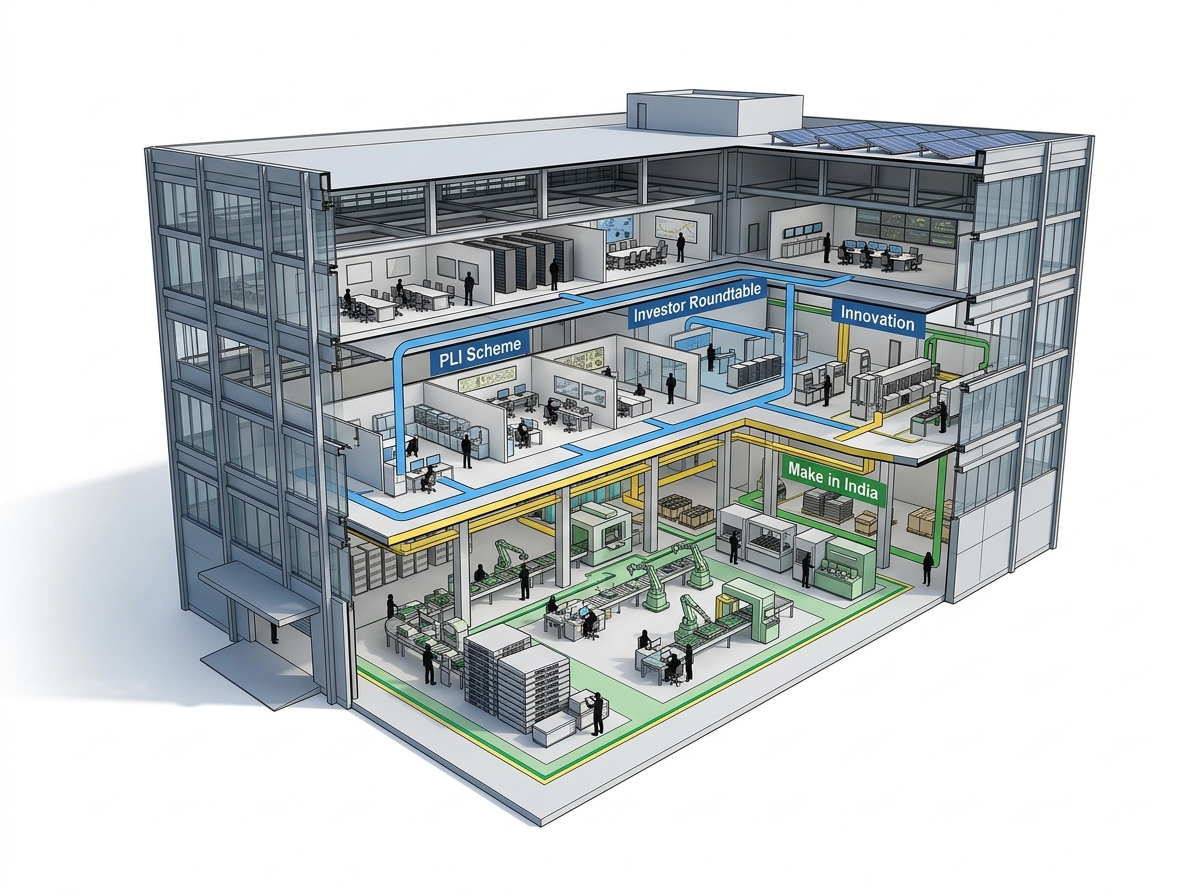
The Department of Telecommunications (DoT) organised the third Investor Roundtable in Bengaluru on 22 September 2026 to attract investment, foster innovation, and promote domestic manufacturing in the telecom sector, with a focus on India’s first integrated Telecom Manufacturing Zone (TMZ) in Gwalior, Madhya Pradesh. This initiative aligns with the vision of self-reliance in critical sectors and seeks to position India as a global hub for telecom equipment production.
Background
- The Government of India launched the ‘Make in India’ initiative in 2014 to encourage domestic manufacturing and reduce import dependency across sectors, including telecommunications.
- The Production-Linked Incentive (PLI) Scheme for Telecom and Networking Products was notified in 2021 to incentivise large-scale manufacturing of telecom equipment in India, with a budgetary outlay of ₹12,195 crore over five years.
- The Semiconductor Mission, approved in 2021 with an outlay of ₹76,000 crore, aims to establish India as a global semiconductor hub, which is critical for domestic telecom manufacturing.
- The National Telecommunications Policy 2018 emphasised the need for a robust domestic telecom manufacturing ecosystem to support national security and economic sovereignty.
- India’s telecom sector has historically been dominated by service providers, with limited domestic manufacturing of critical equipment such as base stations, switches, and semiconductors.
- The establishment of TMZs is a key component of the government’s strategy to transition from a service-driven economy to a product-driven economy, as articulated in the ‘Atmanirbhar Bharat’ vision.
What are Telecom Manufacturing Zones (TMZs)?
- TMZs are designated industrial zones established under the National Policy on Electronics 2019 to promote large-scale domestic manufacturing of telecom and networking products.
- These zones are designed to offer a conducive ecosystem for telecom equipment manufacturing, including infrastructure, fiscal incentives, and ease of doing business.
- The first TMZ is being set up in Gwalior, Madhya Pradesh, with an investment commitment of ₹5,500 crore from 24 companies, including a ₹700 crore commitment from a Bengaluru-based investor during the recent roundtable.
- TMZs aim to enhance domestic value addition in telecom equipment, reduce import dependence, and create a robust supply chain for critical components such as semiconductors, printed circuit boards (PCBs), and radio frequency modules.
- The zones are expected to attract global original equipment manufacturers (OEMs) and component suppliers, fostering technology transfer and skill development in the telecom manufacturing ecosystem.
- Fiscal incentives for TMZs include subsidies, tax exemptions, and land allocation at concessional rates, with Madhya Pradesh offering ₹8,000 crore in incentives and subsidies to attract investors.
- TMZs are aligned with the ‘Make in India’ and ‘Make for the World’ initiatives, aiming to position India as a global manufacturing hub for telecom and electronics products.
- The zones will also support research and development (R&D) and innovation through collaborations with academic institutions, industry associations, and technology parks.
Key Features
| Feature | Significance |
|---|---|
| Third Investor Roundtable (Bengaluru) | A high-level forum to attract private investment in India’s first integrated Telecom Manufacturing Zone (TMZ) at Gwalior, aligning with the ‘Make in India’ and ‘Atmanirbhar Bharat’ initiatives. |
| Focus on Domestic Manufacturing | Aims to reduce import dependence in telecom hardware, enhance value addition, and build a self-reliant ecosystem for telecom and electronics components. |
| Investment Commitments | 24 companies have already joined; Gwalior TMZ has received investment proposals worth ₹5,500 crore, with additional commitments of ₹700 crore during the Bengaluru roadshow. |
| State-Centre Collaboration | Demonstrates cooperative federalism, with the Madhya Pradesh government offering ₹8,000 crore in incentives and subsidies to attract investors and foster industrial growth. |
| Innovation and R&D Emphasis | Encourages the creation of intellectual property (IP) within India, design-led manufacturing, and the development of globally competitive telecom products. |
Why it Matters
Economic and Industrial
- Promotes import substitution in telecom manufacturing, reducing reliance on foreign-made hardware and strengthening domestic supply chains.
- Enhances value addition in the telecom sector, transitioning India from a service-driven to a product-driven economy.
- Creates high-skilled employment opportunities in manufacturing, R&D, and ancillary industries, particularly in tier-2 and tier-3 cities like Gwalior.
- Boosts exports of telecom and electronics goods, positioning India as a global manufacturing hub under the ‘Make for the World’ paradigm.
Strategic and Geopolitical
- Reduces vulnerability in critical infrastructure sectors by localising production of telecom equipment, including 5G/6G components.
- Supports India’s digital sovereignty goals by ensuring control over telecom hardware supply chains, aligning with national security imperatives.
- Strengthens India’s position in global supply chains, particularly in semiconductors and electronics, where China and other nations dominate.
Policy and Governance
- Demonstrates the efficacy of state-centre collaboration in industrial policy, with Madhya Pradesh offering fiscal incentives to attract investment.
- Aligns with the ‘Atmanirbhar Bharat’ vision and the Production-Linked Incentive (PLI) scheme for telecom and electronics manufacturing.
- Encourages a shift from service-led growth to manufacturing-led growth, diversifying India’s economic structure.
Challenges
1. High Initial Capital Investment
- Telecom manufacturing requires substantial upfront investment in machinery, R&D, and infrastructure, which may deter smaller firms from participation.
- The ₹5,500 crore investment proposal for Gwalior TMZ, while significant, represents only a fraction of the total capital required for full-scale industrialisation.
UPSC Link: Economic Survey: Industrialisation and Investment
2. Skilled Manpower Shortage
- India faces a deficit in skilled labour for high-tech manufacturing, particularly in areas like semiconductor fabrication, PCB assembly, and quality control.
- Vocational training and upskilling initiatives must be scaled up to meet the demands of the telecom manufacturing sector.
UPSC Link: Skill Development: National Skill Development Mission
3. Global Competition and Trade Barriers
- India competes with established manufacturing hubs like China, Vietnam, and South Korea, which have mature supply chains and lower production costs.
- Non-tariff barriers (e.g., technical standards, certification requirements) in export markets may hinder the entry of Indian-made telecom products.
UPSC Link: WTO and Trade Facilitation Agreement
4. Infrastructure Bottlenecks
- Reliable power supply, logistics, and industrial land availability are critical for telecom manufacturing zones but remain uneven across states.
- Madhya Pradesh’s commitment to infrastructure development must be matched by efficient implementation to avoid delays.
UPSC Link: Infrastructure: National Infrastructure Pipeline
5. Intellectual Property and Innovation Ecosystem
- India’s R&D expenditure in telecom and electronics is low compared to global peers, limiting indigenous innovation and IP creation.
- Collaboration between industry, academia, and government is essential to foster a culture of innovation and patenting.
UPSC Link: IPR Policy and Innovation Ecosystem
Challenges — UPSC Perspective
| Issue | Concern |
|---|---|
| Capital Intensity | High upfront costs deter SME participation in telecom manufacturing. |
| Skill Gap | Shortage of trained workforce for advanced manufacturing processes. |
| Global Competition | Established hubs (e.g., China) dominate telecom hardware supply chains. |
| Infrastructure Gaps | Inconsistent power, logistics, and land availability in potential TMZ locations. |
| Innovation Deficit | Low R&D expenditure limits indigenous IP creation and product differentiation. |
| Policy Implementation | Delays in disbursing incentives or approving projects may erode investor confidence. |
Government Initiatives — Must-Memorise for Prelims
- Production-Linked Incentive (PLI) Scheme for Telecom and Networking Products
- Scheme for Promotion of Manufacturing of Electronic Components and Semiconductors (SPECS)
- National Policy on Electronics (NPE) 2019
- Atmanirbhar Bharat Abhiyaan
Way Forward
- Accelerate the establishment of the Gwalior TMZ by streamlining land acquisition, power supply, and logistics infrastructure to meet investor timelines.
- Expand vocational training programs in collaboration with ITIs and polytechnics to address the skilled labour shortage in telecom manufacturing.
- Enhance R&D funding for telecom and electronics through public-private partnerships, with a focus on 5G/6G technologies and indigenous IP creation.
- Simplify regulatory processes for telecom equipment certification and export clearances to reduce non-tariff barriers in global markets.
- Leverage the PLI scheme to incentivise large-scale investments in telecom hardware manufacturing, ensuring compliance with local value addition targets.
- Develop a robust after-sales service and repair ecosystem to support domestic telecom products, enhancing their competitiveness against imported alternatives.
- Promote cluster-based development by identifying additional TMZ locations in states with strong industrial potential (e.g., Tamil Nadu, Gujarat, Uttar Pradesh).
- Establish a dedicated ‘Investor Facilitation Cell’ within the Department of Telecommunications to resolve grievances within 48 hours, as announced during the roundtable.
UPSC Value Addition
Keywords for Mains Answer-Writing
Telecom Manufacturing Zones (TMZs) · Make in India · Atmanirbhar Bharat · Semiconductor and Electronics Manufacturing · Investor Roundtable Conclave · Telecom Policy 2023 · Production-Linked Incentive (PLI) Scheme · Self-Reliance in Telecommunications · Gwalior TMZ · Value Addition in Manufacturing · Intellectual Property Creation in India · Export Promotion in Telecommunications · Cooperative Federalism in Industrial Policy · Telecom Sector Reforms · Indigenous Innovation Ecosystem
Concept Flow
Government announces ‘Atmanirbhar Bharat’ and ‘Make in India’ to reduce import dependence and boost domestic manufacturing. → Department of Telecommunications (DoT) identifies telecom manufacturing as a priority sector for localisation and value addition. → Madhya Pradesh government proposes the establishment of India’s first integrated Telecom Manufacturing Zone (TMZ) in Gwalior. → DoT organises investor roundtables (e.g., Bengaluru) to attract private investment, emphasising innovation, R&D, and export potential. → Investment commitments materialise, with 24 companies joining and proposals worth ₹5,500 crore submitted for the Gwalior TMZ. → State-centre collaboration strengthens, with Madhya Pradesh offering ₹8,000 crore in incentives to ensure project viability. → India transitions from a service-driven to a product-driven economy, with telecom manufacturing becoming a key pillar of industrial growth.
Prelims Practice Questions
Q1. Consider the following statements regarding the Telecom Manufacturing Zones (TMZs) initiative in India: 1. The TMZ initiative is aligned with the ‘Atmanirbhar Bharat’ vision and ‘Make in India’ program. 2. The first integrated TMZ is being established in Bengaluru, Karnataka. 3. The Department of Telecommunications (DoT) has organized investor roundtable conclaves to attract investments in the telecom manufacturing sector. 4. The PLI scheme provides financial incentives for telecom equipment manufacturing in India. How many of the above statements are correct?
- Only one
- Only two
- Only three
- All four
Answer: Only three — Statements 1, 3, and 4 are correct. Statement 2 is incorrect as the first integrated TMZ is being set up in Gwalior, Madhya Pradesh, not Bengaluru.
Q2. Assertion (A): The Telecom Manufacturing Zones (TMZs) aim to reduce India’s dependence on imported telecom equipment. Reason (R): The TMZ initiative focuses on promoting domestic value addition, innovation, and export competitiveness in the telecom manufacturing sector.
- Both A and R are true, and R is the correct explanation of A.
- Both A and R are true, but R is not the correct explanation of A.
- A is true but R is false.
- A is false but R is true.
Answer: Both A and R are true, and R is the correct explanation of A. — Both the assertion and reason are true. The TMZ initiative is designed to enhance domestic manufacturing capabilities, thereby reducing import dependence. The reason correctly explains the assertion.
Q3. Match the following initiatives with their respective objectives in the telecom manufacturing sector: Column I (Initiative) Column II (Objective) 1. Telecom Policy 2023 A. Promote domestic manufacturing and reduce import dependence 2. Production-Linked Incentive (PLI) Scheme B. Provide financial incentives for telecom equipment manufacturing 3. Make in India C. Encourage innovation and value addition in telecom manufacturing 4. Atmanirbhar Bharat D. Foster self-reliance and global competitiveness in manufacturing
Answer: ? — 1-A, 2-B, 3-C, 4-D. The Telecom Policy 2023 aims to promote domestic manufacturing and reduce import dependence. The PLI scheme provides financial incentives for telecom equipment manufacturing. ‘Make in India’ encourages innovation and value addition, while ‘Atmanirbhar Bharat’ fosters self-reliance and global competitiveness.
Mains Practice Question
✍ The establishment of Telecom Manufacturing Zones (TMZs) represents a strategic shift towards self-reliance in the telecom sector. Critically examine the policy framework, institutional mechanisms, and challenges associated with this initiative. Also, discuss how TMZs align with the broader goals of ‘Make in India’ and ‘Atmanirbhar Bharat’. (15 Marks)
Approach: MODEL-ANSWER SKELETON:
1. **Policy Framework**:
– Reference the **Telecom Policy 2023** and its objectives, including promotion of domestic manufacturing, reduction of import dependence, and fostering innovation.
– Highlight the role of the **Production-Linked Incentive (PLI) Scheme** for telecom and semiconductor manufacturing, with specific financial incentives (e.g., 25% to 4% subsidy on capital expenditure, as per recent guidelines).
– Discuss the **National Electronics Policy 2023** and its alignment with telecom manufacturing.
2. **Institutional Mechanisms**:
– Role of the **Department of Telecommunications (DoT)** in policy implementation and investor engagement (e.g., investor roundtable conclaves in Bengaluru and Gwalior).
– **Cooperative Federalism**: Centre-State collaboration, exemplified by the Gwalior TMZ project in Madhya Pradesh, with state-level incentives (e.g., ~₹8,000 crore subsidy package).
– **Public-Private Partnership (PPP)**: Models for infrastructure development, land allocation, and ease of doing business in TMZs.
3. **Challenges**:
– **Supply Chain Dependencies**: Reliance on imported components (e.g., semiconductors, rare earth materials) despite domestic assembly.
– **Skilled Workforce**: Shortage of specialized labor for high-tech manufacturing and R&D.
– **Regulatory Hurdles**: Complex approval processes, land acquisition issues, and environmental clearances.
– **Global Competition**: Competing with established telecom manufacturing hubs like China, Vietnam, and South Korea.
4. **Alignment with ‘Make in India’ and ‘Atmanirbhar Bharat’**:
– **Value Addition**: TMZs aim to move from assembly-line manufacturing to high-value R&D and design (e.g., ‘Design in India’ initiative).
– **Export Competitiveness**: Targeting global markets for telecom equipment (e.g., 5G infrastructure, IoT devices).
– **Intellectual Property (IP) Creation**: Encouraging indigenous innovation and patent filings in telecom technologies.
– **Self-Reliance**: Reducing import bills for telecom equipment, which stood at ~₹50,000 crore annually (as per recent industry estimates).
5. **Conclusion**:
– TMZs are a critical step toward reducing import dependence and fostering a competitive telecom manufacturing ecosystem.
– Success hinges on sustained policy support, infrastructure development, and skill-building initiatives.
– Long-term viability requires balancing domestic priorities with global market integration.
Source: PIB (Press Information Bureau)
Karnataka PCS (KPSC) — State PCS Practice
Prelims: Which of the following initiatives was the primary focus of the third Investor Roundtable Conference held in Bengaluru by the Department of Telecommunications (DoT) in 2024?
- Promoting investment, innovation, and domestic manufacturing in the telecom sector
- Expanding 5G network coverage across rural Karnataka
- Regulating telecom tariffs for affordable internet access
- Facilitating mergers and acquisitions in the telecom industry
Answer: Promoting investment, innovation, and domestic manufacturing in the telecom sector — The third Investor Roundtable Conference in Bengaluru, organized by the DoT, specifically aimed to boost investment, innovation, and domestic manufacturing in the telecom sector.
Mains: Analyze the significance of the third Investor Roundtable Conference held in Bengaluru for Karnataka’s telecom manufacturing sector. Discuss how this initiative aligns with the state’s industrial policy and its potential impact on job creation and technological advancement in Karnataka.
Generated by AanyaAi for educational purpose.
Related guides on our sites
- Best geography optional coaching
- Best geography optional coaching
- Best geography optional teacher
- Best geography optional teacher

- वस्त्र मंत्रालय द्वारा विशेष अभियान 6: स्वच्छता एवं ई-कचरा प्रबंधन पर फोकस - September 23, 2026
- Special Campaign 6: Textile Ministry to Focus on E-Waste & Pending Files - September 23, 2026
- चुनाव आयोग ने ‘असहमति रिपोर्ट’ पर सर्वसम्मत फैसला लिया, जानिए पूरा मामला - September 23, 2026

No Comments