


08 Aug Bengaluru Police Launch Drive to Identify & Deport Illegal Immigrants: Key Facts for UPSC
Bengaluru City PoliceFRROIllegal immigrantsDocument verificationDeportation drive✎ The Foreigners Act, 1946, and the FRRO are the primary legal and administrative mechanisms for identifying, monitoring, and deporting illegal immigrants in India.
Subject Relevance — Where This Topic Fits
- GS Paper II — Governance, Constitution, and Polity — Citizenship and Illegal Migration | GS Paper III — Security — Border Management and Internal Security
- Prelims: Foreigners Act, 1946, Foreigners Regional Registration Office (FRRO), Citizenship (Amendment) Act, 2019, Illegal Migrants (Determination by Tribunals) Act, 1983, Passport (Entry into India) Act, 1920, Bengaluru Police Commissionerate, Vidhana Soudha
Quick Revision: The Foreigners Act, 1946, and the FRRO are the primary legal and administrative mechanisms for identifying, monitoring, and deporting illegal immigrants in India.
Why is this in the news?
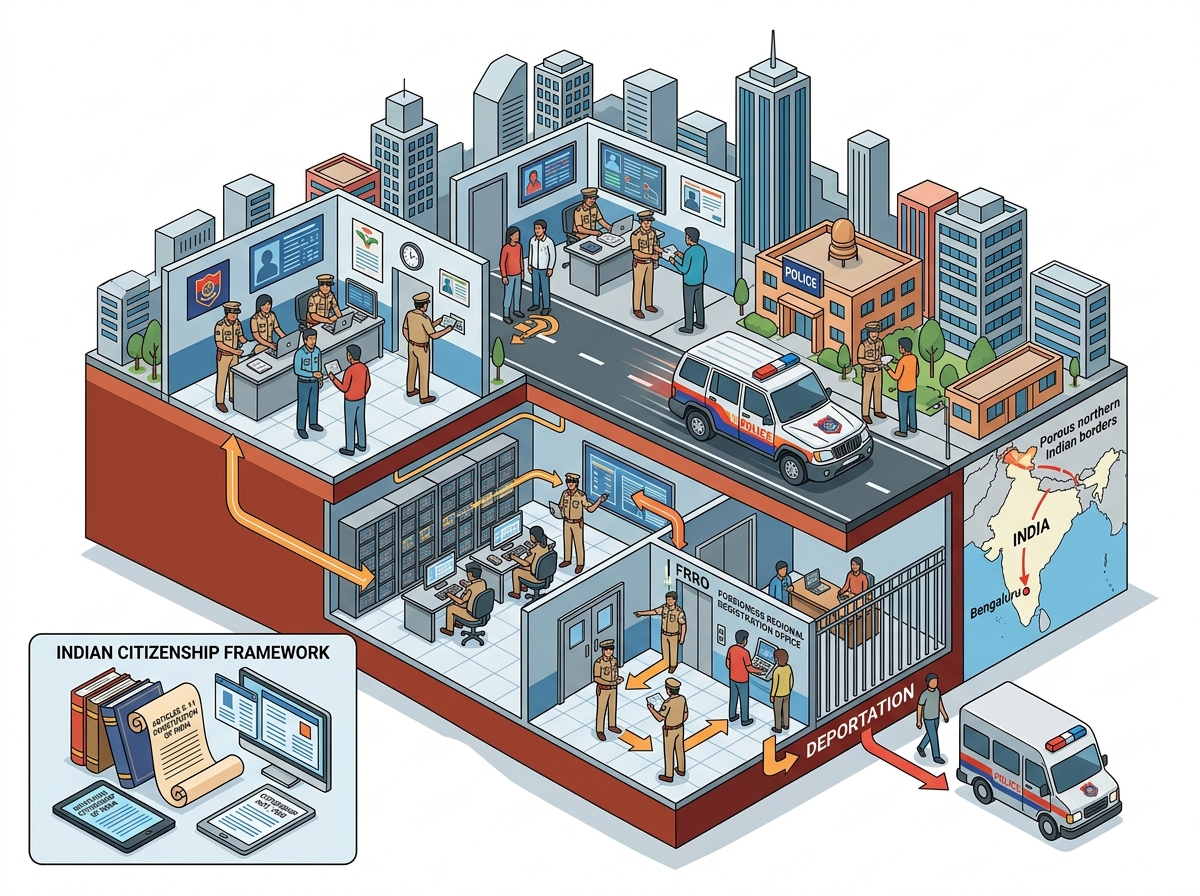
The Bengaluru City Police initiated a special verification drive on August 8, 2026, to identify and deport illegal immigrants residing in the city, particularly in eastern and southeastern areas. The operation, conducted under the supervision of the Bengaluru City Police Commissioner, involves document verification and collaboration with the Foreigners Regional Registration Office (FRRO) for legal deportation. This initiative assumes significance against the backdrop of rising concerns over porous borders in northern states and the absence of direct international borders with Bengaluru, highlighting the challenges of internal security and demographic management in urban centres.
Background
- The Constitution of India (Article 5 to 11) and the Citizenship Act, 1955, define the legal framework for citizenship, including provisions for acquisition and termination.
- The Foreigners Act, 1946, empowers the government to regulate the entry, presence, and deportation of foreigners in India, including illegal immigrants.
- The Foreigners Regional Registration Office (FRRO), established under the Ministry of Home Affairs, is the nodal agency for registering and monitoring foreigners in India.
- The Illegal Migrants (Determination by Tribunals) Act, 1983, provides a legal mechanism for identifying and deporting illegal migrants, though its implementation has been limited.
- Bengaluru, as a major metropolitan city, attracts a significant migrant population, including both legal and illegal immigrants, due to economic opportunities and urbanisation.
- The State of Karnataka does not share an international border, making illegal entry into Bengaluru contingent on transit through other states with porous borders, such as those in the northeast.
Illegal Immigration: Legal Framework and Administrative Mechanisms in India
- Illegal immigration refers to the entry, stay, or residence of foreign nationals in India without valid travel documents, overstaying visas, or violating the terms of their entry permits.
- The Foreigners Act, 1946, is the primary legislation governing the entry, presence, and deportation of foreigners in India, with penalties including imprisonment and deportation for violations.
- The Passport (Entry into India) Act, 1920, mandates that all foreign nationals entering India must possess a valid passport and visa, failing which they are deemed illegal immigrants.
- The Foreigners Regional Registration Office (FRRO) is responsible for the registration, monitoring, and deportation of foreigners in India, including illegal immigrants identified during drives like the one in Bengaluru.
- The Citizenship (Amendment) Act, 2019, provides a pathway to citizenship for persecuted non-Muslim migrants from Pakistan, Bangladesh, and Afghanistan, but does not address illegal immigrants from other countries.
- The Illegal Migrants (Determination by Tribunals) Act, 1983, was enacted to identify and deport illegal migrants, particularly in Assam, but its application remains limited due to legal and procedural challenges.
- State governments and police forces play a crucial role in identifying illegal immigrants, conducting verification drives, and collaborating with central agencies like the FRRO for deportation.
- The deportation process involves verification of documents, legal proceedings if necessary, and coordination with the country of origin for repatriation, ensuring adherence to international law and human rights standards.
Key Features
| Feature | Significance |
|---|---|
| Special police drive | A targeted enforcement action aimed at identifying and deporting illegal immigrants in Bengaluru, conducted under the authority of the Bengaluru City Police Commissioner. |
| Verification of documents | Police teams are scrutinising identity and travel documents to distinguish between legal residents and illegal immigrants, with a focus on foreign-issued documents. |
| Coordination with FRRO | The Foreigners Regional Registration Office (FRRO) is being engaged to process deportation cases legally, ensuring adherence to due process and international obligations. |
| Geographical focus | The drive prioritises eastern and southeastern Bengaluru, including high-density areas with migrant workers such as Whitefield, where over 50 sheds were inspected. |
| Political oversight | The Home Minister of Karnataka has publicly acknowledged the scale of the issue, indicating state-level commitment to addressing illegal immigration. |
Why it Matters
Legal and Administrative
- The drive underscores the constitutional duty of the state to regulate entry and stay of foreign nationals within India’s territory, as enshrined in Entry 17 of the Union List (Seventh Schedule).
- It highlights the operational role of state police forces in enforcing immigration laws, in coordination with central agencies like the FRRO.
- The initiative reflects a shift towards proactive enforcement, moving beyond reactive measures to curb illegal immigration.
- It demonstrates the intersection of state and central jurisdictions in managing foreign nationals, particularly in non-border states like Karnataka.
Economic
- Illegal immigration can distort labour markets by suppressing wages in informal sectors, particularly in construction, manufacturing, and services where migrant workers are prevalent.
- The presence of undocumented workers may lead to exploitative labour practices, undermining fair competition and social security provisions for documented workers.
- Enforcement drives may temporarily disrupt local economies dependent on migrant labour, necessitating phased implementation to mitigate adverse impacts.
- The drive could incentivise formalisation of the workforce, aligning with broader goals of economic transparency and tax compliance.
Social and Demographic
- Illegal immigration raises concerns about demographic changes, particularly in urban areas where concentrated migrant populations may alter local social dynamics.
- It poses challenges to social cohesion, as undocumented immigrants may face exclusion from public services, healthcare, and education, exacerbating vulnerabilities.
- The drive may address public perception issues, where illegal immigration is often conflated with security threats or cultural tensions, necessitating evidence-based policy communication.
Security and Governance
- Illegal immigration can pose security risks, including potential infiltration by individuals with malicious intent, necessitating robust screening mechanisms.
- The porous borders of northern states, as noted by the Home Minister, highlight systemic gaps in border management that require multi-state coordination.
- Enforcement drives serve as a deterrent, signalling the state’s commitment to upholding sovereignty and territorial integrity.
Challenges
1. Legal and Procedural Challenges
- The process of deportation is time-consuming and requires adherence to due process, including identification, documentation, and legal recourse, which may delay removals.
- Detainees may claim refugee status or asylum, complicating deportation procedures and necessitating inter-ministerial coordination.
- The lack of a national registry of immigrants makes it difficult to distinguish between legal and illegal residents, increasing the risk of erroneous deportations.
UPSC Link: Constitution of India, Article 21 (Protection of Life and Personal Liberty)
2. Operational and Logistical Challenges
- Identifying illegal immigrants in densely populated urban areas with high migrant populations requires significant manpower and resources.
- The drive may face resistance from local communities or labour groups, who may view enforcement as disruptive to livelihoods.
- Coordinating with central agencies like the FRRO and state governments adds layers of bureaucracy, potentially slowing down the process.
UPSC Link: Administrative Reforms Commission Reports
3. Ethical and Humanitarian Concerns
- Deportation of undocumented immigrants, particularly those who have lived in India for extended periods, raises ethical questions about family separation and humanitarian obligations.
- The drive may inadvertently target vulnerable groups, such as refugees or asylum seekers, who lack access to legal documentation.
- There is a risk of racial profiling or discrimination during enforcement, necessitating strict guidelines to ensure fairness.
UPSC Link: Universal Declaration of Human Rights, Article 14
4. Political and Diplomatic Challenges
- Illegal immigration often involves individuals from neighbouring countries, and deportation drives may strain diplomatic relations, particularly if large numbers are involved.
- The issue is politically sensitive, with potential backlash from both domestic and international stakeholders, including human rights organisations.
- Lack of a uniform national policy on illegal immigration complicates enforcement, as states may adopt divergent approaches.
UPSC Link: Foreigners Act, 1946
5. Economic Disruptions
- Sudden enforcement actions may lead to labour shortages in sectors reliant on migrant workers, such as construction, agriculture, and hospitality.
- Informal economies that depend on undocumented labour may face collapse, necessitating transitional measures to formalise the workforce.
- The drive could deter future migration, even legal migration, if the process is perceived as overly punitive or unpredictable.
UPSC Link: National Policy on Skill Development and Entrepreneurship
Challenges — UPSC Perspective
| Issue | Concern |
|---|---|
| Due process delays | Risk of prolonged detention or erroneous deportations due to bureaucratic and legal hurdles. |
| Resource constraints | Limited police and administrative capacity to conduct thorough verifications across urban areas. |
| Human rights violations | Potential for racial profiling, family separation, or denial of basic services to undocumented immigrants. |
| Diplomatic friction | Strain on bilateral relations if deportations are perceived as discriminatory or excessive. |
| Labour market disruption | Sudden removal of undocumented workers may create shortages in critical sectors. |
| Public perception | Risk of conflating illegal immigration with security threats, leading to social unrest or political backlash. |
Way Forward
- Constitute a multi-stakeholder task force comprising state police, FRRO, and civil society to oversee the drive, ensuring transparency and accountability.
- Develop a standardised verification protocol to distinguish between illegal immigrants, refugees, and legal migrants, minimising errors and delays.
- Strengthen border management in northern states through technological solutions (e.g., drones, biometric systems) to reduce illegal entry at source.
- Launch awareness campaigns in migrant-heavy areas to educate workers on legal documentation requirements and the consequences of illegal stay.
- Collaborate with local NGOs and community leaders to facilitate voluntary repatriation for those willing to return, reducing enforcement burdens.
- Integrate Aadhaar and other identity databases with FRRO records to create a unified system for tracking foreign nationals.
- Establish a grievance redressal mechanism for individuals affected by erroneous deportations or enforcement actions.
- Formulate a state-specific policy on illegal immigration, aligning with national frameworks while addressing local socio-economic realities.
UPSC Value Addition
Keywords for Mains Answer-Writing
illegal immigration · Foreigners Regional Registration Office (FRRO) · deportation procedures · Bengaluru City Police initiative · porous borders and internal security · Foreigners Act, 1946 · regional cooperation for border management · citizenship and identity verification · Union and State roles in immigration governance · national security and human rights balance
Constitutional & Policy Linkages
- Article 19(1)(d) – Freedom of movement (subject to reasonable restrictions)
- Article 21 – Protection of life and personal liberty (due process in deportation)
- Article 258 – Power of the Union to confer powers on states for enforcement
Concept Flow
Porous borders in northern states → Illegal entry into India → Concentration in urban centres like Bengaluru → Informal labour markets absorb undocumented workers → Social and economic pressures emerge → State police initiate enforcement drive → Verification of documents and identification of illegal immigrants → Coordination with FRRO for deportation → Potential humanitarian and diplomatic challenges → Need for systemic reforms in border management and labour policies.
Prelims Practice Questions
Q1. Consider the following statements regarding the Foreigners Regional Registration Office (FRRO):
1. FRRO is responsible for the registration of foreigners staying in India beyond the permitted duration.
2. It operates under the administrative control of the Ministry of External Affairs.
3. FRRO can initiate deportation proceedings against illegal immigrants under the provisions of the Foreigners Act, 1946.
How many of the above statements are correct?
- Only one
- Only two
- All
- None
Answer: All — Statements 1 and 3 are correct. Statement 2 is incorrect because FRRO operates under the Bureau of Immigration, Ministry of Home Affairs, not the Ministry of External Affairs.
Q2. Assertion (A): The Indian Constitution does not explicitly grant the power to deport illegal immigrants to the Union Government.
Reason (R): The power to deport illegal immigrants is derived from the Foreigners Act, 1946, which is a parliamentary legislation.
Options:
A. Both A and R are true, and R is the correct explanation of A.
B. Both A and R are true, but R is not the correct explanation of A.
C. A is true, but R is false.
D. A is false, but R is true.
Answer: ? — Both the assertion and reason are true. The power to deport illegal immigrants is indeed derived from the Foreigners Act, 1946, which empowers the Union Government to regulate the entry, stay, and exit of foreigners in India.
Q3. Which of the following pairs is correctly matched?
1. Foreigners Act, 1946 – Regulates entry and stay of foreigners in India
2. Citizenship Act, 1955 – Governs the process of deportation of illegal immigrants
3. Passport (Entry into India) Act, 1920 – Mandates registration of foreigners exceeding stipulated stay
Options:
A. 1 only
B. 1 and 2 only
C. 2 and 3 only
D. 1, 2 and 3
Answer: ? — Only pair 1 is correctly matched. The Citizenship Act, 1955 governs citizenship acquisition and termination, not deportation. The Passport (Entry into India) Act, 1920 mandates the possession of valid travel documents but does not specifically govern registration of foreigners.
Mains Practice Question
✍ The recent drive by the Bengaluru City Police to identify and deport illegal immigrants raises critical questions about the balance between national security and human rights in India’s immigration governance. Critically examine the legal and administrative framework governing the deportation of illegal immigrants in India, with reference to recent initiatives like the Bengaluru drive. Also, assess the challenges posed by porous borders and the role of regional cooperation in addressing illegal immigration. (15 Marks)
Approach: MODEL-ANSWER SKELETON:
1. **Legal Framework Governing Deportation:**
– Primary legislation: Foreigners Act, 1946 (Sections 3, 5, 14) and Passport (Entry into India) Act, 1920.
– Role of FRRO and Bureau of Immigration under the Ministry of Home Affairs.
– Constitutional provisions: Articles 19(1)(e) (freedom of movement) vs. reasonable restrictions under Article 19(5) and Article 21 (right to life and liberty).
– Judicial precedents: *State of Assam v. Union of India* (2021) on deportation procedures and *National Human Rights Commission v. State of Arunachal Pradesh* (1996) on protection of refugees.
2. **Administrative Mechanisms:**
– Identification: Use of Aadhaar, voter ID, and biometric databases for verification.
– Deportation process: Initiation by local police, referral to FRRO, and coordination with state governments.
– Recent initiatives: Bengaluru drive as a case study of localized enforcement.
3. **Challenges:**
– Porous borders: Highlight the role of northern states (e.g., West Bengal, Assam) in facilitating illegal entry.
– Data gaps: Lack of a centralized national registry of illegal immigrants.
– Human rights concerns: Risk of statelessness, family separation, and due process violations.
4. **Role of Regional Cooperation:**
– Bilateral agreements (e.g., India-Bangladesh border management).
– SAARC and BIMSTEC frameworks for regional security cooperation.
– Challenges in implementation: Political sensitivities, lack of trust, and varying national priorities.
5. **Balancing Security and Rights:**
– Need for a rights-based approach: Adherence to the principle of non-refoulement (as per international law).
– Strengthening inter-state coordination: Role of the National Investigation Agency (NIA) and Intelligence Bureau (IB).
– Suggested reforms: National Register of Foreigners (NRF), stricter visa regimes, and community policing.
Balance of views: Acknowledge the necessity of deportation for national security while critiquing potential overreach and the need for safeguards.
Source: The Hindu
Generated by AanyaAi for educational purpose.

- Madras HC slams petitioner for expecting instant POCSO probe - September 30, 2026
- एनएचएआई करेगा असामान्य बोली वाली परियोजनाओं की गुणवत्ता जाँच, जानिए कैसे - September 30, 2026
- Madras HC on Veeramani POCSO Case: Let SIT Work Without Interference - September 30, 2026

No Comments