


01 Sep Bima Sakhi Scheme: UPSC Analysis of Women-Led Insurance Revolution in Rural India
✎ The ‘Bima Sakhi’ scheme is an initiative to promote women entrepreneurship in the insurance sector by providing financial incentives, training, and access to LIC’s distribution network, thereby enhancing financial inclusion in…
Subject Relevance — Where This Topic Fits
- GS Paper III — Economy (Insurance Sector, Financial Inclusion)
- Prelims: Bima Sakhi Scheme, LIC, Financial Inclusion, Insurance Ombudsman, IRDAI, PMJJBY, PMSBY
Quick Revision: The ‘Bima Sakhi’ scheme is an initiative to promote women entrepreneurship in the insurance sector by providing financial incentives, training, and access to LIC’s distribution network, thereby enhancing financial inclusion in rural India.
Why is this in the news?
The ‘Bima Sakhi’ scheme has been highlighted for its role in enhancing women entrepreneurship in the insurance sector while expanding life insurance coverage in rural and underserved regions. The recognition comes during the 70th Insurance Week celebrations in Kadapa, Andhra Pradesh, where officials noted the scheme’s contribution to nearly 18% of the business generated by the Kadapa division of the Life Insurance Corporation (LIC) through 3,500 trained agents.
Background
- The Life Insurance Corporation (LIC) of India, a statutory body under the Ministry of Finance, operates as the largest state-owned life insurer in India.
- Financial inclusion remains a critical policy objective, with insurance penetration in rural India historically constrained by low awareness, limited access, and socio-economic barriers.
- The Insurance Regulatory and Development Authority of India (IRDAI) regulates the insurance sector, framing guidelines for agent recruitment, training, and remuneration.
- Schemes such as PMJJBY (Pradhan Mantri Jeevan Jyoti Bima Yojana) and PMSBY (Pradhan Mantri Suraksha Bima Yojana) aim to provide affordable life and accident insurance to vulnerable populations.
- The ‘Bima Sakhi’ scheme aligns with the government’s broader initiatives to promote women’s economic participation through skill development and entrepreneurship.
- Andhra Pradesh has been a focus state for insurance outreach, with Kadapa district reporting significant participation under the scheme.
What is the Bima Sakhi Scheme?
- Eligibility criteria include women who have completed Secondary School Certificate (SSC) education and are at least 18 years old, ensuring a minimum educational threshold for participation.
- The scheme provides a structured incentive mechanism: a monthly stipend of ₹7,000 in the first year, ₹6,000 in the second year, and ₹5,000 in the third year, in addition to commission-based earnings from insurance sales.
- Training and certification are integral components, equipping participants with the necessary skills to sell life insurance policies, particularly in rural and semi-urban areas.
- The scheme leverages the extensive network of the Life Insurance Corporation (LIC) to ensure last-mile delivery of insurance products, addressing gaps in coverage.
- By targeting women from rural backgrounds, the scheme not only enhances their economic independence but also contributes to the broader goal of reducing gender disparities in financial services.
- Performance metrics in Kadapa district indicate the scheme’s success, with 3,500 ‘Bima Sakhis’ contributing to 18% of the division’s business, demonstrating scalability and impact.
Key Features
| Feature | Significance |
|---|---|
| Eligibility Criteria | Targets women who have completed Secondary School Certificate (SSC) and are 18 years of age or older, ensuring a minimum educational threshold for agent recruitment. |
| Incentive Structure | Provides a graduated monthly stipend (₹7,000 in Year 1, ₹6,000 in Year 2, ₹5,000 in Year 3) to support livelihood during the initial phase of entrepreneurship. |
| Commission-Based Model | Enables income generation through life insurance policy sales, aligning entrepreneurial incentives with market performance. |
| Rural Focus | Aims to expand life insurance coverage in rural and underserved areas, addressing gaps in financial inclusion. |
| Localised Implementation | Operationalised through district-level agencies (e.g., Kadapa DRDA) for grassroots outreach and monitoring. |
Why it Matters
Economic Empowerment
- Enhances women’s economic participation by creating formal employment opportunities in the insurance sector, traditionally male-dominated.
- Generates secondary income streams for rural households, potentially improving household financial resilience.
- Contributes to the formalisation of the rural economy through documented financial transactions and insurance coverage.
Financial Inclusion
- Bridges the rural-urban divide in life insurance penetration by leveraging local agents familiar with community needs.
- Encourages long-term savings and risk mitigation among rural populations through accessible insurance products.
- Supports the achievement of Sustainable Development Goal 1 (No Poverty) and Goal 5 (Gender Equality) through targeted livelihood interventions.
Institutional Capacity Building
- Strengthens the distribution network of Life Insurance Corporation (LIC) by diversifying its agent base with women entrepreneurs.
- Demonstrates the scalability of public-private partnerships (e.g., LIC and DRDA) in implementing welfare-linked commercial initiatives.
- Provides a replicable model for other financial services sectors to engage women as frontline agents in rural markets.
Policy Relevance for UPSC
- Aligns with the Union Government’s ‘Insurance for All by 2047’ vision, a strategic initiative under the Insurance Regulatory and Development Authority of India (IRDAI).
- Reflects the implementation of gender-responsive policies under the National Mission for Financial Inclusion (NAFII) and the National Rural Livelihood Mission (NRLM).
- Highlights the role of district-level institutions in achieving national socio-economic objectives.
Challenges
1. Sustainability of Incentives
- Graduated stipends may create dependency concerns if beneficiaries become reliant on subsidies rather than sustainable earnings.
- Risk of attrition post-incentive period if agents do not achieve sufficient commission-based income to sustain livelihoods.
UPSC Link: GS-III: Financial Inclusion
2. Access and Awareness Barriers
- Low financial literacy in rural areas may hinder the effective utilisation of insurance products sold by ‘Bima Sakhis’.
- Cultural norms and mobility constraints may limit women’s participation as agents or clients in certain regions.
UPSC Link: GS-II: Social Justice
3. Quality of Service Delivery
- Ensuring consistent training and support for agents to maintain service standards across diverse rural geographies.
- Monitoring mechanisms to prevent mis-selling or exploitation of clients, particularly in low-trust environments.
UPSC Link: GS-III: Service Sector
4. Scalability and Replicability
- Adapting the model to states with lower insurance penetration or weaker district-level institutional capacity.
- Addressing logistical challenges such as connectivity, digital infrastructure, and last-mile delivery in remote areas.
UPSC Link: GS-II: Governance
5. Regulatory and Compliance Risks
- Compliance with IRDAI guidelines on agent remuneration, training, and grievance redressal mechanisms.
- Ensuring transparency in commission structures to avoid conflicts of interest or unethical practices.
UPSC Link: GS-III: Regulatory Bodies
Challenges — UPSC Perspective
| Issue | Concern |
|---|---|
| Agent Attrition | High dropout rates post-incentive period due to insufficient earnings from commissions. |
| Financial Literacy Gaps | Low understanding of insurance products among rural clients, leading to mis-selling risks. |
| Geographical Disparities | Uneven distribution of agents across states, exacerbating regional insurance gaps. |
| Training Quality | Inconsistent pre-service and in-service training for agents, affecting service standards. |
| Trust Deficit | Historical scepticism towards formal financial institutions in rural communities. |
| Data Privacy | Risks of data breaches or misuse of client information in digital insurance transactions. |
Government Initiatives — Must-Memorise for Prelims
- Life Insurance Corporation (LIC) Agent Distribution Model
- National Rural Livelihood Mission (NRLM)
Way Forward
- Strengthen pre-service training for ‘Bima Sakhis’ with modules on financial literacy, product knowledge, and ethical sales practices.
- Introduce tiered mentorship programmes where experienced agents guide new recruits, reducing attrition.
- Expand digital onboarding and transaction platforms to enhance agent efficiency and client trust.
- Conduct periodic impact assessments to evaluate the scheme’s contribution to rural insurance penetration and women’s economic empowerment.
- Collaborate with local self-help groups (SHGs) to leverage existing social capital for agent recruitment and client outreach.
- Integrate grievance redressal mechanisms with district-level ombudsman offices to address client complaints promptly.
- Pilot hybrid incentive models combining stipends with performance-linked bonuses to ensure long-term sustainability.
- Enhance inter-departmental coordination between DRDAs, LIC, and IRDAI to streamline implementation and monitoring.
UPSC Value Addition
Keywords for Mains Answer-Writing
Bima Sakhi scheme · Women entrepreneurship in insurance · Financial inclusion through women agents · Life Insurance Corporation (LIC) · Rural insurance penetration · Women self-help groups (SHGs) · Insurance intermediaries · Pradhan Mantri Jan Dhan Yojana (PMJDY) · Insurance Regulatory and Development Authority of India (IRDAI) · Financial literacy for women · Rural development schemes · Women empowerment through livelihood · Micro-insurance models · Skill development for women in financial services
Concept Flow
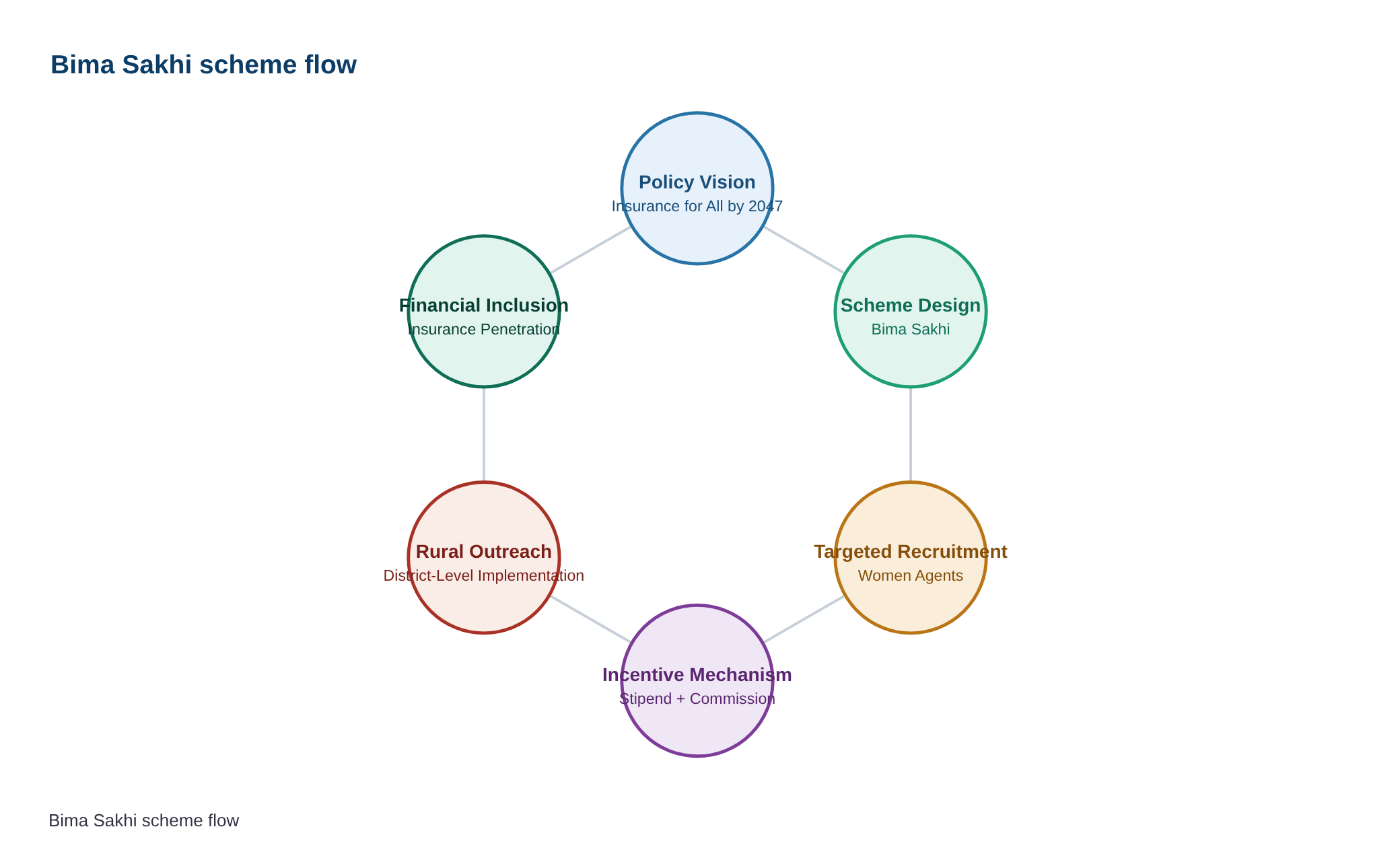
Policy Vision (Insurance for All by 2047) → Scheme Design (Bima Sakhi) → Targeted Recruitment (Women Agents) → Incentive Mechanism (Stipend + Commission) → Rural Outreach (District-Level Implementation) → Financial Inclusion (Insurance Penetration) → Socio-Economic Impact (Women Empowerment & Poverty Alleviation)
Prelims Practice Questions
Q1. Consider the following statements regarding the ‘Bima Sakhi’ scheme:
1. It is a Central Government initiative aimed at promoting women entrepreneurs in the insurance sector.
2. Under the scheme, women agents receive a monthly stipend of ₹7,000 during the first year.
3. The scheme is implemented exclusively through the State Bank of India (SBI).
4. The scheme provides incentives to women who have completed at least higher secondary education.
How many of the above statements are correct?
- Only one
- Only two
- Only three
- All four
Answer: Only three — Statements 1 and 2 are correct as per the scheme’s objectives and incentives. Statement 3 is incorrect as the scheme is implemented through LIC, not SBI. Statement 4 is incorrect as the scheme targets women who have completed SSC (Class 10) and are 18 years of age.
Q2. Assertion (A): The ‘Bima Sakhi’ scheme is designed to enhance financial inclusion in rural areas.
Reason (R): The scheme provides financial incentives to women agents, thereby encouraging them to promote life insurance policies in underserved regions.
Options:
A. Both A and R are true, and R is the correct explanation of A.
B. Both A and R are true, but R is not the correct explanation of A.
C. A is true, but R is false.
D. A is false, but R is true.
- A
- B
- C
- D
Answer: A — Both the assertion and reason are true, and the reason correctly explains the assertion. The scheme’s incentives are intended to motivate women agents to expand insurance coverage in rural areas, thereby promoting financial inclusion.
Q3. Match the following columns related to insurance intermediaries in India:
Column I (Scheme/Initiative)
A. Bima Sakhi
B. PMJDY
C. SHG-Bank Linkage Programme
D. IRDAI
Column II (Objective/Function)
1. Promotes financial inclusion through women agents in insurance
2. Provides universal access to banking services
3. Facilitates credit linkage for self-help groups
4. Regulates and supervises the insurance sector
Options:
A – 1, B – 2, C – 3, D – 4
A – 2, B – 1, C – 4, D – 3
A – 3, B – 2, C – 1, D – 4
A – 1, B – 2, C – 4, D – 3
- A – 1, B – 2, C – 3, D – 4
- A – 2, B – 1, C – 4, D – 3
- A – 3, B – 2, C – 1, D – 4
- A – 1, B – 2, C – 4, D – 3
Answer: A – 1, B – 2, C – 3, D – 4 — A matches with 1 (Bima Sakhi promotes women agents in insurance), B matches with 2 (PMJDY provides universal banking access), C matches with 3 (SHG-Bank Linkage Programme facilitates credit for SHGs), and D matches with 4 (IRDAI regulates the insurance sector).
Mains Practice Question
✍ Critically examine the role of the ‘Bima Sakhi’ scheme in promoting women entrepreneurship and financial inclusion in rural India. Also, discuss the potential challenges in scaling such initiatives to achieve broader socio-economic outcomes. (15 Marks)
Approach: MODEL-ANSWER SKELETON:
1. **Introduction (2 marks)**
– Define the ‘Bima Sakhi’ scheme: A Central Government initiative under LIC to engage women as life insurance agents, targeting rural areas.
– State its objectives: Enhancing women’s entrepreneurship, expanding insurance penetration, and promoting financial inclusion.
2. **Role in Women Entrepreneurship (4 marks)**
– **Empowerment through livelihood**: Scheme provides structured incentives (₹7,000, ₹6,000, ₹5,000 stipend over three years) and commission-based earnings, enabling women to establish independent careers.
– **Skill development**: Targets women with SSC education, offering on-the-job training in insurance sales and financial literacy.
– **Role model effect**: Kadapa division example (3,500 ‘Bima Sakhis’ generating 18% of LIC’s business) illustrates scalability and economic viability.
– **Link to SHGs**: Aligns with existing women’s collectives (e.g., SHGs under DAY-NRLM), leveraging grassroots networks for outreach.
3. **Role in Financial Inclusion (4 marks)**
– **Rural penetration**: Addresses the insurance gap in underserved areas by deploying local women agents who understand regional needs.
– **Trust-building**: Women agents act as credible intermediaries, bridging the trust deficit between insurers and rural populations.
– **Complementarity with PMJDY**: Synergy with Jan Dhan Yojana in creating a ‘last-mile’ financial ecosystem (bank accounts + insurance).
– **Data from Kadapa**: Highlight LIC’s performance metrics (business contribution, revenue generation) as empirical evidence of success.
4. **Challenges and Limitations (3 marks)**
– **Sustainability**: Stipends are time-bound; long-term viability depends on commission-based earnings, which may fluctuate with market conditions.
– **Regulatory hurdles**: IRDAI guidelines on agent licensing, training, and compliance add operational complexity.
– **Socio-cultural barriers**: Persistent gender norms in rural areas may hinder women’s mobility or acceptance as agents.
– **Quality vs. quantity**: Risk of prioritizing agent numbers over policy quality, leading to mis-selling or low-value policies.
5. **Broader Socio-Economic Outcomes (2 marks)**
– **Women’s agency**: Contributes to SDG 5 (Gender Equality) by enhancing economic participation and decision-making.
– **Macro-economic impact**: Expands the insurance market, reducing vulnerability to shocks (e.g., health, crop failure) in rural households.
– **Policy scalability**: Lessons from Kadapa can inform national replication, but require tailoring to diverse regional contexts.
6. **Conclusion (1 mark)**
– Summarize the scheme’s dual role in empowering women and deepening financial inclusion, while acknowledging structural challenges that necessitate multi-stakeholder interventions.
Source: The Hindu
Generated by AanyaAi for educational purpose.
Related guides on our sites
- Best PSIR optional coaching for upsc
- Best PSIR optional teacher for upsc
- Best teacher of PSIR optional for upsc
- Best PSIR optional coaching in delhi for UPSC

- Inter-Caste Marriage Scheme: UPSC Exam Polity & Governance Insight - October 24, 2026
- मध्य प्रदेश में 118 किमी रेल नेटवर्क का उद्घाटन: विंध्य क्षेत्र में पहली बार सीधी जुड़ा, जानिए पूरा विवरण - October 24, 2026
- DFPD extends Special Campaign 6 to achieve governance targets - October 24, 2026

No Comments