


07 Aug Bombay HC Allows Felling 847 Mangroves for Bullet Train: Key UPSC Polity Insights
✎ Compensatory afforestation must prioritise ecological restoration over numerical replacement, particularly in ecologically sensitive zones like mangroves, as reiterated by the Bombay High Court in its August 2026 judgment.
Subject Relevance — Where This Topic Fits
- GS Paper II — Judiciary and Constitutional Framework | GS Paper III — Environment and Ecology | GS Paper III — Infrastructure and Project Clearances
- Prelims: Mumbai-Ahmedabad Bullet Train Project, MahaTransco, Compensatory Afforestation Fund Management and Planning Authority (CAMPA), Forest (Conservation) Act, 1980, Mangrove Ecosystem, National Green Tribunal (NGT), Environmental Impact Assessment (EIA) 2006, Forest Rights Act, 2006
- Essay: Environmental governance: Balancing development and ecological preservation, Judicial activism and its role in environmental protection
Quick Revision: Compensatory afforestation must prioritise ecological restoration over numerical replacement, particularly in ecologically sensitive zones like mangroves, as reiterated by the Bombay High Court in its August 2026 judgment.
Why is this in the news?
The Bombay High Court’s August 2026 judgment permitting the felling of 847 mangrove trees for a Mumbai-Ahmedabad bullet train-linked transmission project has significant implications for environmental jurisprudence, compensatory afforestation policy, and the balance between developmental imperatives and ecological conservation. The ruling underscores the judiciary’s evolving role in scrutinising compensatory afforestation schemes, particularly in ecologically sensitive zones such as mangrove habitats, and highlights systemic deficiencies in the implementation of environmental safeguards by state authorities.
Background
- The Mumbai-Ahmedabad High Speed Rail Corridor, a flagship infrastructure project under the National High Speed Rail Corporation Limited (NHSRCL), requires extensive land acquisition and associated infrastructure, including transmission lines and substations.
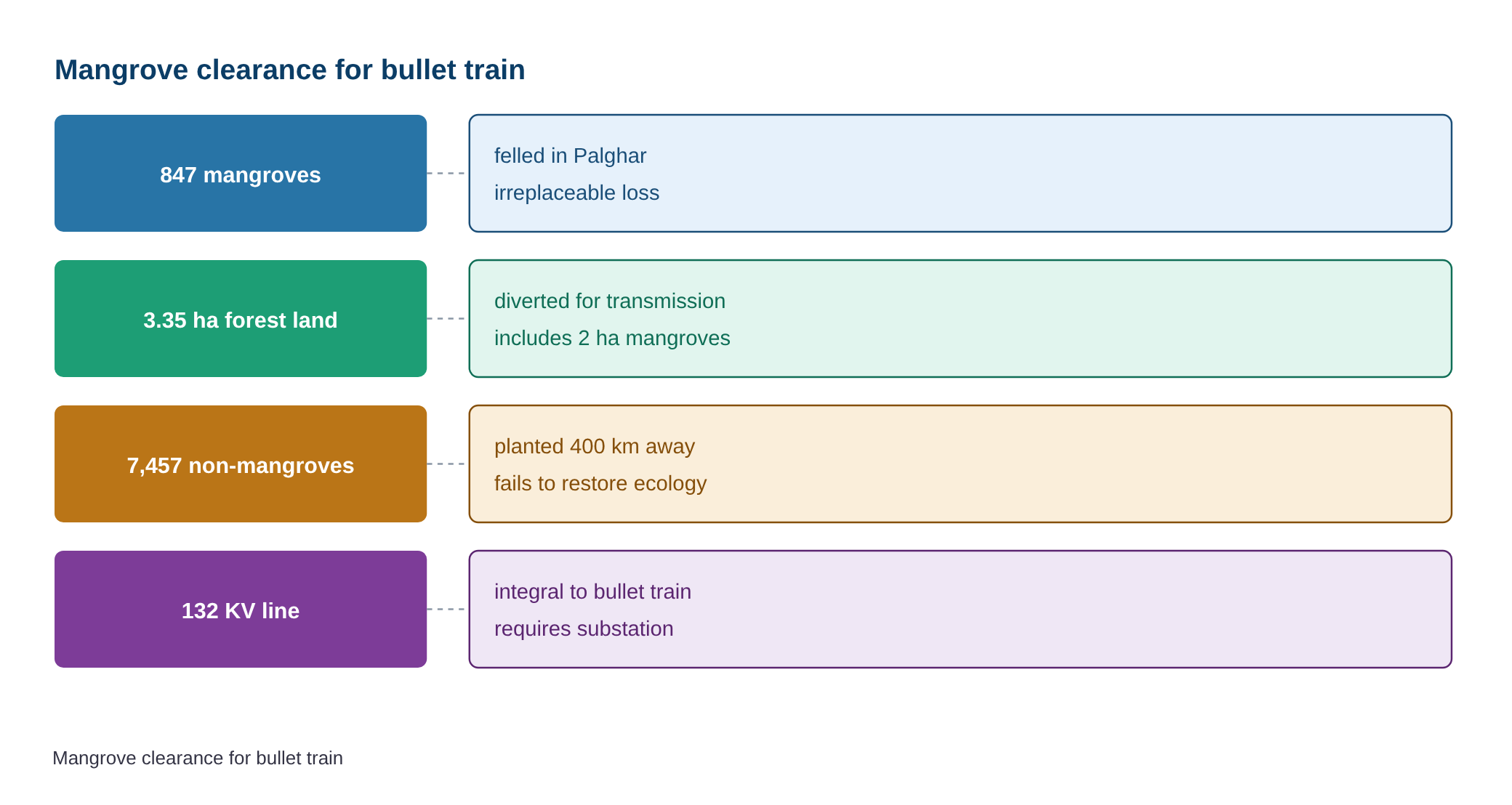
- Maharashtra State Electricity Transmission Company Limited (MahaTransco) sought permission to fell 847 mangrove trees and divert 3.35 hectares of forest land, including nearly two hectares of mangroves, for a 132 KV transmission line and substation integral to the bullet train corridor.
- The Maharashtra government proposed compensatory afforestation by planting 7,457 non-mangrove trees over 6.71 hectares in Sangola, Solapur district, approximately 400 km from the affected site in Palghar.
- Environmental groups, including the Bombay Environmental Action Group, challenged the compensatory afforestation plan, arguing that distant plantations fail to restore the ecological functions of mangroves, which provide critical ecosystem services such as coastal protection, carbon sequestration, and biodiversity support.
- The Bombay High Court, in a September 2025 order, had directed the state to implement reforms to make compensatory afforestation more transparent, ecologically meaningful, and compliant with judicial precedents, including the creation of afforestation land banks and establishment of a monitoring mechanism.
What is Compensatory Afforestation?
- Compensatory Afforestation refers to the mandatory afforestation and reforestation activities undertaken by project proponents to compensate for the loss of forest land diverted for non-forest purposes, as mandated under the Forest (Conservation) Act, 1980.
- The objective of compensatory afforestation is ecological restoration, not merely numerical replacement of trees felled. It aims to maintain or enhance the forest cover, biodiversity, and ecosystem services of the affected area.
- Compensatory afforestation is implemented through the Compensatory Afforestation Fund Management and Planning Authority (CAMPA), which manages funds collected from project proponents for afforestation activities.
- The Supreme Court, in the landmark case *T.N. Godavarman Thirumulpad v. Union of India* (1997) and subsequent judgments, has emphasised that compensatory afforestation must be ecologically meaningful and not merely a statistical exercise.
- Mangrove ecosystems are particularly sensitive due to their unique ecological functions, including storm protection, carbon storage, and support for marine biodiversity. Their loss cannot be adequately compensated by planting non-mangrove species or distant plantations.
- The National Green Tribunal (NGT) and various High Courts have repeatedly criticised the practice of compensatory afforestation being treated as a ‘numbers game’, where the focus is on the quantity of trees planted rather than the restoration of ecological functions.
Key Features
| Feature | Significance |
|---|---|
| Mangrove Ecosystem | Mangroves serve as critical coastal biodiversity hotspots, providing storm surge protection, carbon sequestration, and nursery grounds for marine species. |
| Compensatory Afforestation | A statutory mechanism under the Forest Conservation Act, 1980, to offset forest land diversion by planting equivalent or greater area of trees elsewhere. |
| Judicial Review of Development Projects | Courts assess ecological trade-offs while balancing developmental imperatives, ensuring compliance with environmental safeguards. |
| National Importance Projects | Projects declared of national importance under specific statutes, often exempt from stringent environmental scrutiny but not from judicial oversight. |
| Administrative Accountability | Judicial directives to executive agencies to enforce compliance with environmental regulations and reform procedural lapses. |
Why it Matters
Environmental
- The Bombay High Court’s ruling underscores the ecological irreparability of mangrove loss, rejecting compensatory afforestation as a mere numerical exercise.
- Mangroves in Palghar district provide irreplaceable ecosystem services, including coastal protection and biodiversity support, which distant plantations cannot replicate.
- The court’s emphasis on ecological restoration over statistical replacement aligns with the precautionary principle in environmental jurisprudence.
Judicial
- The judgment reinforces the judiciary’s role in scrutinising compensatory afforestation mechanisms, ensuring they meet ecological rather than administrative benchmarks.
- The court’s refusal to treat the order as a precedent maintains judicial discretion in balancing development and environmental conservation on a case-by-case basis.
- Judicial criticism of administrative apathy highlights the judiciary’s function in enforcing accountability for lapses in environmental governance.
Economic
- The Mumbai-Ahmedabad bullet train project, classified as of national importance, exemplifies India’s infrastructure-led growth strategy, necessitating robust environmental safeguards.
- Efficient power transmission infrastructure is critical for high-speed rail operations, justifying the project’s prioritisation despite ecological trade-offs.
- The court’s conditional clearance ensures that developmental projects do not proceed at the cost of irreversible ecological damage, safeguarding long-term economic sustainability.
Challenges
1. Ecological Irreversibility of Mangrove Loss
- Mangroves cannot be ecologically replicated through distant compensatory plantations, leading to permanent loss of coastal resilience and biodiversity.
- The court’s ruling highlights the inadequacy of compensatory afforestation in restoring ecosystem functions such as storm protection and carbon sequestration.
- This challenge underscores the need for stricter pre-project ecological impact assessments for mangrove-dependent infrastructure.
UPSC Link: Environmental Impact Assessment (EIA) Notification, 2006
2. Administrative Lapses in Environmental Governance
- The Maharashtra government’s failure to implement afforestation tracking reforms, despite judicial directives, reflects systemic inefficiencies in environmental compliance.
- Delays in creating afforestation land banks and publishing plantation data undermine transparency and ecological accountability.
- The court’s warning against theoretical compliance underscores the need for real-time monitoring mechanisms in compensatory afforestation.
UPSC Link: Forest Conservation Act, 1980
3. Balancing Development and Environmental Conservation
- The court’s conditional clearance demonstrates the tension between developmental imperatives and ecological conservation in high-priority infrastructure projects.
- The judgment necessitates a nuanced approach where development projects are not automatically exempt from environmental scrutiny, even when declared of national importance.
- This challenge highlights the need for integrated planning that prioritises both economic growth and ecological sustainability.
UPSC Link: National Forest Policy, 1988
4. Jurisdictional Challenges in Compensatory Afforestation
- Compensatory afforestation often involves planting trees in distant locations, which fails to restore local ecological functions and complicates regulatory oversight.
- The court’s insistence on ecological restoration over numerical replacement challenges existing compensatory afforestation frameworks.
- This issue necessitates a re-evaluation of compensatory afforestation policies to ensure they align with ecological realities rather than administrative convenience.
UPSC Link: Compensatory Afforestation Fund Management and Planning Authority (CAMPA)
Challenges — UPSC Perspective
| Issue | Concern |
|---|---|
| Irreversible Mangrove Loss | Permanent ecological damage due to inability of compensatory plantations to replicate mangrove functions. |
| Administrative Apathy | Failure to implement judicial directives, leading to systemic inefficiencies in environmental governance. |
| Development vs Conservation Trade-off | Balancing high-priority infrastructure projects with ecological conservation and judicial scrutiny. |
| Jurisdictional Gaps in Afforestation | Distant compensatory plantations failing to restore local ecological services and complicating oversight. |
| Lack of Transparency in Tracking | Inadequate monitoring and data publication in compensatory afforestation mechanisms. |
Way Forward
- Strengthen pre-project ecological impact assessments for infrastructure projects in mangrove-rich zones, ensuring no irreversible damage occurs.
- Implement real-time monitoring systems for compensatory afforestation, including geospatial tracking and third-party audits.
- Enforce strict timelines for compliance with judicial directives on afforestation tracking and land bank creation.
- Promote research on mangrove restoration techniques to enhance the success rate of compensatory plantations.
- Integrate ecological restoration principles into compensatory afforestation policies, prioritising local ecosystem functions over numerical targets.
- Enhance inter-departmental coordination between forest departments, project proponents, and judicial bodies to ensure seamless compliance.
- Conduct periodic reviews of high-priority infrastructure projects to assess their ecological impact and compliance with environmental safeguards.
UPSC Value Addition
Keywords for Mains Answer-Writing
Bombay High Court · Mumbai-Ahmedabad Bullet Train · Mangrove Conservation · Compensatory Afforestation · Ecological Restoration · Forest Rights Act, 2006 · National Green Tribunal · Environmental Impact Assessment · Maharashtra State Electricity Transmission Company (MahaTransco) · Supreme Court Judgment in M.C. Mehta Case · Forest Conservation Act, 1980 · Mangrove Ecosystems · Environmental Governance · Ecological Compensation
Constitutional & Policy Linkages
- [‘Article 48A’, ‘DPSP: Protection and improvement of environment’]
- [‘Article 51A(g)’, ‘Fundamental Duty: To protect and improve the natural environment’]
Concept Flow
Project Proposal Submission → Environmental Impact Assessment (EIA) → Forest Land Diversion Approval → Compensatory Afforestation Planning → Judicial Scrutiny → Conditional Clearance → Implementation with Monitoring → Mangrove Ecosystem Loss → Compensatory Afforestation Proposal → Ecological Impact Assessment → Judicial Review → Rejection of Distant Plantations → Conditional Clearance with Local Restoration Commitments → Administrative Lapses → Judicial Directives → Compliance Deadlines → Failure to Implement → Court Criticism → Reform Mandate → National Importance Project Declaration → Infrastructure Development → Power Transmission Needs → Mangrove Land Diversion → Environmental Trade-off → Conditional Judicial Approval → Compensatory Afforestation Policy → Numerical Replacement Approach → Judicial Rejection → Ecological Restoration Principle → Policy Reform Imperative → Forest Conservation Act, 1980 → Compensatory Afforestation Framework → CAMPA Implementation → Judicial Scrutiny → Policy Refinement
Prelims Practice Questions
Q1. Consider the following statements regarding compensatory afforestation in India:
1. The Forest Conservation Act, 1980 mandates compensatory afforestation for any diversion of forest land.
2. The Supreme Court in the M.C. Mehta case held that compensatory afforestation must restore the ecological functions of the affected area.
3. The National Green Tribunal (NGT) has the power to impose penalties for non-compliance with compensatory afforestation norms.
How many of the above statements are correct?
- Only one
- Only two
- All three
- None
Answer: All three — Statements 1 and 3 are correct. Statement 2 is correct as the Supreme Court in M.C. Mehta v. Union of India (1996) emphasized ecological restoration over mere numerical replacement of trees. Statement 3 is also correct as the NGT can impose penalties under the Environment Protection Act, 1986.
Q2. Assertion (A): The Bombay High Court, in its recent order, allowed the felling of 847 mangrove trees for the Mumbai-Ahmedabad bullet train project.
Reason (R): The court held that compensatory afforestation must be undertaken within the same ecological zone to restore ecological functions.
Options:
A. Both A and R are true, and R is the correct explanation of A.
B. Both A and R are true, but R is not the correct explanation of A.
C. A is true, but R is false.
D. A is false, but R is true.
Answer: ? — Both the Assertion (A) and Reason (R) are true. The Bombay High Court allowed the felling of mangroves but emphasized that compensatory afforestation must restore ecological functions, often requiring proximity to the affected site. However, R is not the sole reason for the court’s decision, as additional commitments by MahaTransco (e.g., planting mangroves near Thane) also influenced the order.
Q3. Match the following environmental legislations with their key provisions:
Column I (Legislation) | Column II (Key Provision)
—|—
1. Forest Conservation Act, 1980 | A. Mandates environmental clearance for projects involving forest land diversion
2. Environment Protection Act, 1986 | B. Regulates the diversion of forest land for non-forest purposes
3. Compensatory Afforestation Fund Act, 2016 | C. Establishes funds for afforestation and forest conservation
4. National Green Tribunal Act, 2010 | D. Provides for the establishment of a tribunal for effective and expeditious disposal of environmental disputes
Options:
A. 1-B, 2-A, 3-C, 4-D
B. 1-A, 2-B, 3-D, 4-C
C. 1-D, 2-C, 3-B, 4-A
D. 1-C, 2-D, 3-A, 4-B
Answer: ? — The correct matches are: 1-B (Forest Conservation Act, 1980 regulates diversion of forest land), 2-A (Environment Protection Act, 1986 mandates environmental clearance), 3-C (Compensatory Afforestation Fund Act, 2016 establishes funds), and 4-D (National Green Tribunal Act, 2010 establishes the tribunal).
Mains Practice Question
✍ Critically examine the judicial approach to compensatory afforestation in India, with particular reference to the Bombay High Court’s recent order allowing the felling of 847 mangrove trees for the Mumbai-Ahmedabad bullet train project. Also, discuss the implications of this judgment for environmental governance and the balance between development and ecological conservation. (15 Marks)
Approach: MODEL-ANSWER SKELETON:
1. **Introduction (2 marks)**: Define compensatory afforestation and its legal basis under the Forest Conservation Act, 1980 and the Environment Protection Act, 1986. Highlight the Bombay High Court’s order as a contemporary case study.
2. **Judicial Principles on Compensatory Afforestation (5 marks)**:
– Cite the Supreme Court’s judgment in *M.C. Mehta v. Union of India* (1996) emphasizing ecological restoration over numerical replacement of trees.
– Discuss the Forest Rights Act, 2006 and its provisions for forest dwellers in compensatory afforestation.
– Reference the National Green Tribunal’s role in monitoring compliance (e.g., *Vardhaman Kaushik v. Union of India*, 2019).
3. **Analysis of the Bombay High Court Order (5 marks)**:
– Examine the court’s emphasis on ecological restoration and the rejection of distant compensatory plantations (e.g., Solapur vs. Thane).
– Critique the court’s allowance of the project despite ecological concerns, citing the ‘exceptional measure’ clause and MahaTransco’s commitments.
– Highlight the court’s criticism of Maharashtra’s administrative apathy in implementing afforestation reforms.
4. **Implications for Environmental Governance (3 marks)**:
– Discuss the need for transparent afforestation land banks and real-time monitoring (as directed by the court).
– Address the tension between development projects (e.g., bullet train) and ecological conservation, citing the Forest Conservation Act’s provisions.
– Conclude with the broader lesson: compensatory afforestation must prioritize ecological functions, not just statistical compliance.
Source: The Indian Express
Generated by AanyaAi for educational purpose.

- महाराष्ट्र में त्योहार जुलूसों पर बॉम्बे हाईकोर्ट का बड़ा फैसला: पटाखे, लेजर और संगीत पर रोक - September 24, 2026
- Bombay HC Bans Firecrackers, Music in Maharashtra Processions: Key UPSC Analysis - September 24, 2026
- तमिलनाडु में महिला कर्मचारियों के लिए सवैतनिक माहवारी अवकाश नीति पर HC का आदेश - September 24, 2026

No Comments