


05 Aug Bombay HC Orders Removal of Deepfake Videos Targeting Nitin Gadkari
✎ Deepfakes exploit AI to fabricate synthetic media, posing legal and ethical challenges; India’s current framework relies on indirect provisions like IT Act Sections 66D and IPC Section 499, necessitating urgent policy reforms to…
Subject Relevance — Where This Topic Fits
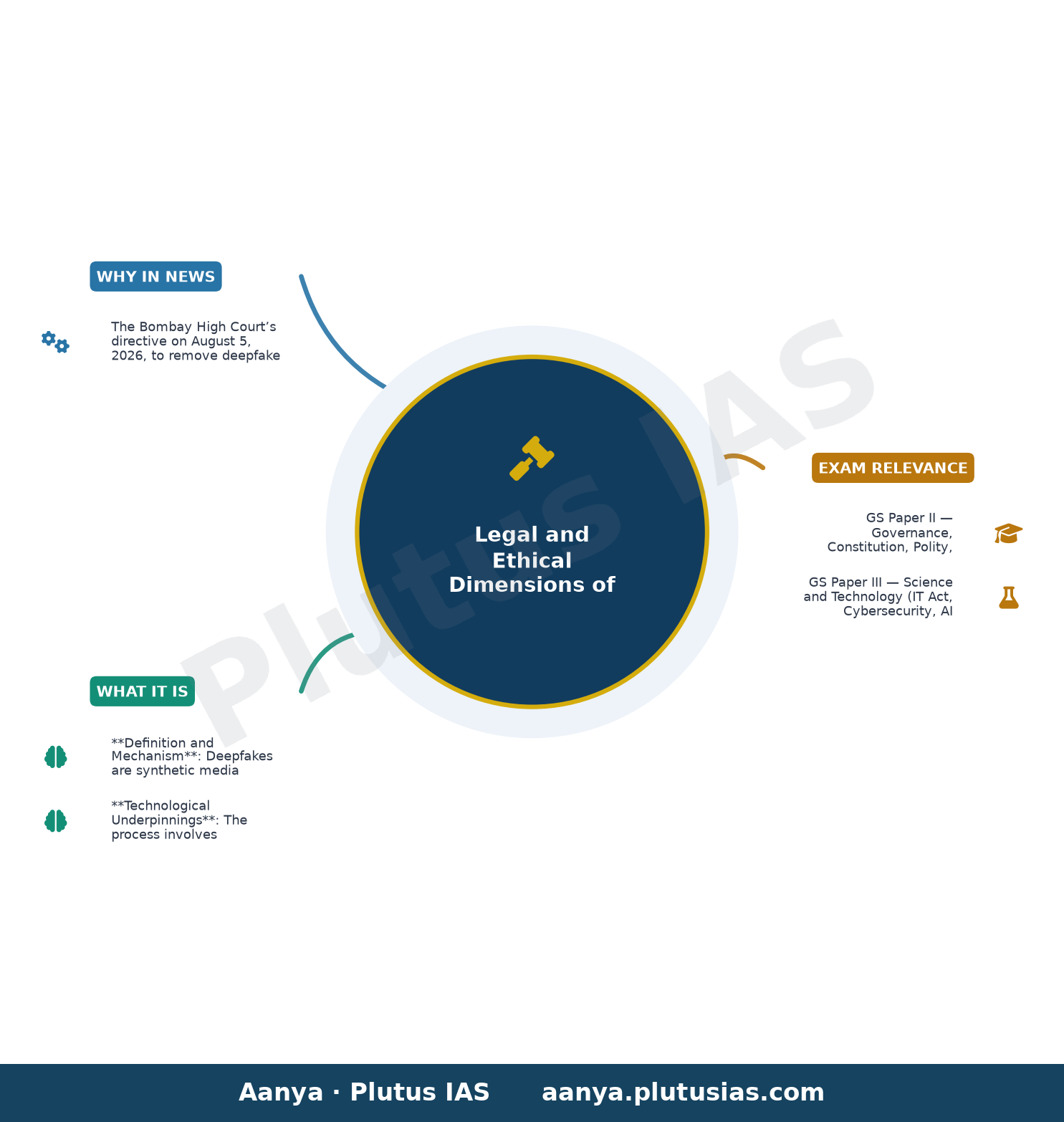
- GS Paper II — Governance, Constitution, Polity, Social Justice and International Relations (Role of Judiciary, Fundamental Rights) | GS Paper III — Science and Technology (IT Act, Cybersecurity, AI Ethics)
- Prelims: Deepfake technology, Section 66D of the IT Act (2000), Ethanol Blending Programme (EBP), Ministry of Electronics and Information Technology (MeitY), Personality rights, Defamation under IPC Section 499
- Essay: The interplay between technological innovation and ethical governance in the digital age, Judicial activism in safeguarding democratic discourse from disinformation
Quick Revision: Deepfakes exploit AI to fabricate synthetic media, posing legal and ethical challenges; India’s current framework relies on indirect provisions like IT Act Sections 66D and IPC Section 499, necessitating urgent policy reforms to address automated content moderation and accountability of intermediaries.
Why is this in the news?
The Bombay High Court’s directive on August 5, 2026, to remove deepfake videos targeting Union Minister Nitin Gadkari over the Ethanol Blending Programme (EBP) underscores the judiciary’s proactive role in addressing the proliferation of AI-generated disinformation. The order highlights critical gaps in India’s regulatory framework for digital content moderation, particularly the absence of a robust, automated mechanism to combat abusive or defamatory deepfakes without judicial recourse. This case also raises pertinent questions about the intersection of free speech, personality rights, and the accountability of social media platforms in the era of synthetic media.
Background
- The Ethanol Blending Programme (EBP) was introduced by the Government of India to promote the use of ethanol as a renewable fuel blend in petrol, aiming to reduce carbon emissions and enhance energy security.
- Deepfake technology, powered by artificial intelligence, enables the creation of hyper-realistic synthetic media by manipulating or generating audio-visual content, often used to spread misinformation or defame individuals.
- India lacks a dedicated legal framework to address deepfakes, relying instead on provisions under the Information Technology Act, 2000 (e.g., Section 66D for cheating by impersonation) and the Indian Penal Code (e.g., Section 499 for defamation).
- The Bombay High Court’s observation about the absence of a mechanism for content removal without judicial intervention reflects a systemic delay in policy evolution to match technological advancements.
- The case also intersects with broader debates on the ethical use of AI, the responsibility of social media intermediaries under the IT Rules, 2021, and the protection of public figures from malicious disinformation.
Deepfakes: Technology, Legal Challenges, and Policy Implications
- **Definition and Mechanism**: Deepfakes are synthetic media generated using deep learning techniques, such as Generative Adversarial Networks (GANs), which can create realistic audio, video, or images of individuals without their consent, often for malicious purposes like defamation or misinformation.
- **Technological Underpinnings**: The process involves training AI models on large datasets of a person’s voice, facial expressions, or mannerisms to produce convincing forgeries. Advances in AI have democratised deepfake creation, making it accessible even to non-experts via user-friendly tools.
- **Legal Provisions in India**: Current laws address deepfakes indirectly through the IT Act, 2000 (Section 66D) and the Indian Penal Code (Section 499 for defamation). However, these provisions are not tailored specifically for deepfakes, leading to enforcement challenges.
- **Judicial Precedents**: Courts have increasingly intervened in cases involving deepfakes, recognising the need to balance free speech with protection against harm. The Bombay High Court’s order in Gadkari’s case aligns with earlier rulings that emphasise the role of intermediaries in removing defamatory content expeditiously.
- **Ethical and Societal Impact**: Deepfakes pose significant risks to democratic processes, personal reputation, and societal trust. They can be weaponised during elections, corporate disputes, or personal vendettas, exacerbating social polarisation and eroding public confidence in institutions.
- **Regulatory Gaps**: India’s IT Rules, 2021, mandate due diligence by social media platforms but lack specific provisions for automated detection and removal of deepfakes. The absence of a statutory body to oversee AI-generated content moderation further complicates enforcement.
- **Global Approaches**: Jurisdictions like the EU (AI Act) and the US (proposed bills such as the DEEPFAKES Accountability Act) are exploring dedicated regulations for deepfakes, including mandatory disclosure, watermarking, and penalties for malicious use. India’s approach remains fragmented, relying on ad hoc judicial interventions.
- **Personality Rights**: Public figures possess inherent rights over their likeness and identity. Deepfakes that exploit these rights without consent can be challenged under tort law or specific statutes, as seen in the Gadkari case.
UPSC Value Addition
Keywords for Mains Answer-Writing
Deepfake regulation in India · Right to Privacy under Article 21 · Defamation and free speech balance · Ethanol Blending Programme (EBP) · Ministry of Petroleum and Natural Gas · Intermediary liability under IT Rules 2021 · Judicial intervention in digital content removal · Personality rights and publicity rights · AI-generated misinformation · Constitutional remedies for digital harm
Prelims Practice Questions
Q1. Consider the following statements regarding the Ethanol Blending Programme (EBP) in India:
1. The EBP was introduced by the central government in 2003.
2. The current administration achieved 20% ethanol blending with petrol in 2025-2026.
3. The Ministry of Road Transport and Highways is the nodal agency for implementing the EBP.
How many of the above statements are correct?
- Only one
- Only two
- All three
- None
Answer: Only two — Statement 1 and 2 are correct as per the article. Statement 3 is incorrect because the Ministry of Petroleum and Natural Gas is the nodal agency for EBP, not the Ministry of Road Transport and Highways.
Q2. Assertion (A): The Bombay High Court’s order in the Nitin Gadkari deepfake case highlights the absence of a statutory mechanism for the removal of abusive digital content without judicial intervention.
Reason (R): The Information Technology (Intermediary Guidelines and Digital Media Ethics Code) Rules, 2021, do not provide for suo motu removal of content by intermediaries.
- Both A and R are true, and R is the correct explanation of A.
- Both A and R are true, but R is not the correct explanation of A.
- A is true, but R is false.
- A is false, but R is true.
Answer: Both A and R are true, and R is the correct explanation of A. — Both the assertion and reason are true. The IT Rules 2021 require intermediaries to act upon complaints or court orders but do not mandate suo motu removal, necessitating judicial intervention in cases like the one cited.
Q3. Match the following columns with reference to the legal framework governing digital content in India:
Column I
A. Intermediary liability
B. Right to be forgotten
C. Defamation
D. Personality rights
Column II
1. Article 21 of the Constitution
2. Information Technology (Intermediary Guidelines and Digital Media Ethics Code) Rules, 2021
3. Indian Penal Code, 1860
4. Civil Law (Tort of Passing Off)
- A-2, B-1, C-3, D-4
- A-1, B-2, C-3, D-4
- A-2, B-3, C-1, D-4
- A-4, B-1, C-3, D-2
Answer: A-2, B-1, C-3, D-4 — A (Intermediary liability) is governed by IT Rules 2021; B (Right to be forgotten) is derived from the right to privacy under Article 21; C (Defamation) is covered under the Indian Penal Code; D (Personality rights) fall under the tort of passing off in civil law.
Mains Practice Question
✍ The Bombay High Court’s intervention in the Nitin Gadkari deepfake case underscores the inadequacy of existing legal frameworks to address AI-generated misinformation and defamation. Critically analyse the constitutional and statutory provisions governing digital content regulation in India, with particular reference to the balance between free speech and the right to reputation. (15 Marks)
Approach: MODEL-ANSWER SKELETON:
1. **Constitutional Framework**:
– Right to Freedom of Speech and Expression (Article 19(1)(a)) vs. Right to Reputation (Article 21).
– Landmark judgments: *Subramanian Swamy v. Union of India* (2016) on defamation; *Puttaswamy v. Union of India* (2017) on privacy.
2. **Statutory Provisions**:
– Information Technology Act, 2000 (Sections 66A, 67, 67A) and their judicial scrutiny.
– IT Rules 2021: Intermediary liability (Rule 3), grievance redressal mechanism (Rule 4), and lack of suo motu powers.
3. **Judicial Precedents**:
– *Shreya Singhal v. Union of India* (2015) on Section 66A.
– *Ashish Bhalla v. Suresh Chawdhury* (2016) on defamation in digital space.
– *Justice K.S. Puttaswamy (Retd.) v. Union of India* (2017) on privacy and digital harm.
4. **Gaps and Challenges**:
– Absence of a dedicated statute for AI-generated content.
– Over-reliance on judicial intervention (as noted by the Bombay High Court).
– Enforcement challenges: jurisdictional issues, anonymity, and cross-border nature of digital content.
5. **Way Forward**:
– Need for a comprehensive Digital Content Regulation Act.
– Strengthening intermediary due diligence (e.g., proactive monitoring for deepfakes).
– Balancing free speech with accountability: adopting the *notice-and-takedown* model with judicial oversight.
6. **Conclusion**:
– The Gadkari case exemplifies the urgent need for legislative and institutional reforms to address the lacunae in digital content regulation while upholding constitutional values.
Source: The Hindu
Generated by AanyaAi for educational purpose.

- संयुक्त राष्ट्र की विफलता पर तुर्की राष्ट्रपति ने उठाया बड़ा सवाल, जानिए पूरा मामला - September 23, 2026
- UN’s Failure in Peacekeeping: Erdoğan’s Critique on UNSC Reforms for UPSC 2026 - September 23, 2026
- मद्रास उच्च न्यायालय ने 50 वर्ष से अधिक उम्र की विदेशी महिला को दिया आईवीएफ उपचार का अधिकार - September 23, 2026

No Comments