


11 Sep BRICS at 20: A New Global Power Shift for UPSC & State PCS
✎ The BRICS grouping, now comprising 11 members, represents a shift toward multipolarity in global governance to challenge Western dominance in international financial architecture.
Subject Relevance — Where This Topic Fits
- GS Paper II — International Relations: Global Groupings and Agreements involving India and/or affecting India’s interests | GS Paper III — Indian Economy: International Financial Institutions and Multilateral Development Banks
- Prelims: BRICS, New Development Bank (NDB), Multipolarity, Global South, Purchasing Power Parity (PPP), G7, Bretton Woods Institutions, Multilateral Development Banks (MDBs)
- Essay: The shifting paradigms of global governance: From unipolarity to multipolarity, The role of emerging economies in redefining international economic and political order
Quick Revision: The BRICS grouping, now comprising 11 members, represents a shift toward multipolarity in global governance to challenge Western dominance in international financial architecture.
Why is this in the news?
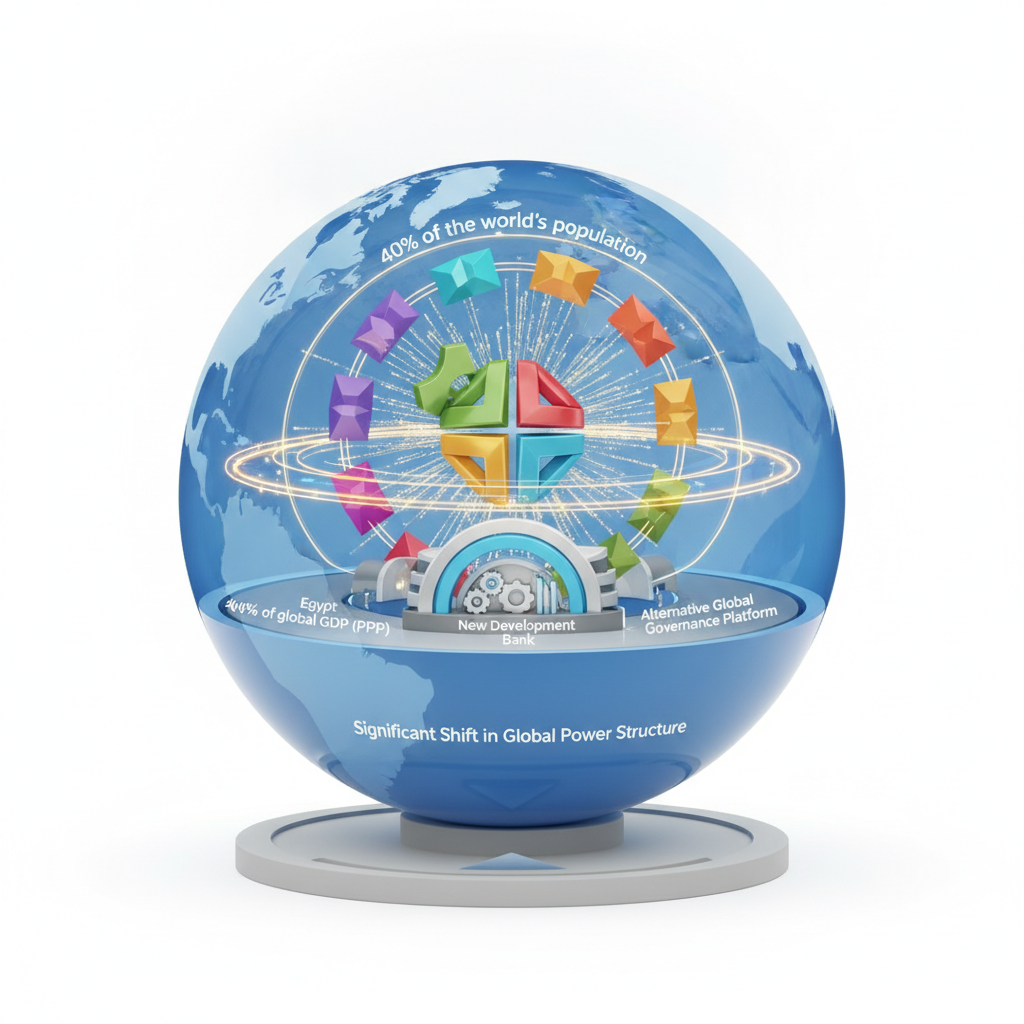
The BRICS grouping, originally an acronym coined by Goldman Sachs in 2001 to denote four high-growth emerging markets, has completed two decades of existence. Its evolution from a conceptual framework to an 11-member political and economic coalition, now accounting for nearly 40% of global GDP (PPP terms) and half of the world’s population, marks a significant shift in the global power structure. The expansion of BRICS in 2024–25 to include Egypt, Ethiopia, Indonesia, Iran, Saudi Arabia, and the UAE, alongside its institutional initiatives such as the New Development Bank, underscores its growing role as an alternative platform for global governance, challenging the dominance of Western-led institutions.
Background
- The term ‘BRIC’ was first coined by Jim O’Neill, then Chief Economist of Goldman Sachs, in a 2001 research paper to highlight the economic potential of Brazil, Russia, India, and China as fast-growing emerging markets.
- The first formal meeting of BRIC foreign ministers was held in September 2006, followed by the inaugural BRIC summit in Yekaterinburg, Russia, in June 2009, marking the institutionalisation of the grouping.
- South Africa joined the grouping in 2011, leading to the acronym ‘BRICS’ (adding ‘S’ for South Africa).
- The grouping expanded further in 2024–25 with the inclusion of Egypt, Ethiopia, Indonesia, Iran, Saudi Arabia, and the United Arab Emirates, reflecting its growing appeal among Global South nations.
- The BRICS accounts for approximately 40% of global GDP in PPP terms and nearly 50% of the world’s population, compared to the G7’s less than 30% of global GDP and under 10% of the global population.
- The economic slowdown in advanced economies since the 1990s and the perceived decline in Western global leadership have accelerated the shift toward a multipolar world order, providing fertile ground for the BRICS to emerge as a counterbalance to Western-centric institutions.
What is the BRICS grouping?
- The BRICS is a political and economic coalition of emerging market economies, originally comprising Brazil, Russia, India, China, and South Africa, and now expanded to 11 members.
- It represents an experiment in international cooperation aimed at rebalancing global power away from Western dominance and fostering a multipolar world order.
- The grouping serves as a platform for strategic autonomy and economic cooperation among non-Western nations, providing an alternative to Bretton Woods institutions like the World Bank and IMF.
- BRICS members collectively account for nearly 40% of global GDP (PPP terms) and half of the world’s population, making it a significant player in the global economy.
- The BRICS operates through annual summits, ministerial meetings, and a network of partner countries and institutions, facilitating dialogue and cooperation on economic, financial, and geopolitical issues.
- The grouping challenges the assumption that global governance should remain centred on Western-led institutions established post-World War II, advocating for a more inclusive and representative international order.
- BRICS also includes ‘partner countries’—such as Belarus, Bolivia, Kazakhstan, Cuba, Malaysia, Nigeria, Thailand, Uganda, Uzbekistan, and Vietnam—who participate in summits and cooperation frameworks without full membership.
Key Features
| Feature | Significance |
|---|---|
| Evolution from BRIC to BRICS | Demonstrates the transformation of an economic acronym into a geopolitical coalition, reflecting the rise of emerging economies and the shifting global power dynamics. |
| New Development Bank (NDB) | A multilateral development bank led by emerging economies, providing an alternative to Western-dominated institutions like the World Bank and IMF, with equal voting rights among founding members. |
| Expansion to 11 members (2024-25) | Inclusion of Egypt, Ethiopia, Indonesia, Iran, Saudi Arabia, and UAE broadens the coalition’s geographic and economic diversity, enhancing its representativeness of the Global South. |
| Partner Countries Framework | Ten partner countries (e.g., Belarus, Vietnam, Nigeria) participate in summits without full membership, expanding the BRICS’ cooperative network while maintaining cohesion. |
| Economic Weight (PPP terms) | BRICS now accounts for ~40% of global GDP (PPP) and ~50% of the world’s population, surpassing the G7’s economic and demographic share, underscoring its growing influence. |
Why it Matters
Economic Significance
- Provides an alternative financial architecture to Western-dominated institutions, reducing dependency on Bretton Woods bodies for development financing.
- Promotes intra-BRICS trade and investment, fostering South-South economic cooperation and reducing reliance on traditional export markets.
- NDB’s focus on sustainable infrastructure projects aligns with global development goals, offering concessional financing for emerging economies.
- The grouping’s economic weight challenges the dominance of advanced economies in global trade and financial governance.
Geopolitical Significance
- Represents a counterbalance to Western-led global governance, reflecting the rise of multipolarity and the diffusion of power away from traditional centres.
- Offers a platform for non-Western countries to assert strategic autonomy, particularly in the context of perceived US retreat from multilateralism.
- Enhances the bargaining power of Global South nations in international forums, including climate negotiations and trade agreements.
- Facilitates alignment on issues like de-dollarisation, energy security, and technological sovereignty among diverse member states.
Institutional Significance
- Demonstrates the capacity of emerging economies to establish and lead multilateral institutions, contrasting with historical Western dominance in global governance.
- NDB’s operational model—equal voting rights and shared leadership—challenges the weighted-voting systems of the World Bank and IMF, promoting equity in decision-making.
- The partner countries framework allows for flexible engagement without diluting the coalition’s core objectives, balancing inclusivity and cohesion.
Symbolic Significance
- Signals the end of the post-Cold War unipolar moment, marking a structural shift toward multipolarity in the 21st century.
- Reinforces the narrative of Global South solidarity, providing a collective voice for countries historically marginalised in global decision-making.
- Challenges the assumption that global governance must remain centred on Western institutions, advocating for a more inclusive and representative system.
Challenges
1. Internal Cohesion and Decision-Making
- Diverse economic, political, and strategic interests among members may hinder consensus on key issues, such as sanctions or trade policies.
- Expansion to 11 members increases the risk of dilution of the grouping’s original objectives, complicating policy coordination.
- Historical rivalries (e.g., India-China border tensions) and geopolitical alignments (e.g., Saudi Arabia’s ties with the US) pose challenges to unified action.
UPSC Link: GS-II: Multipolarity and global governance
2. Institutional Capacity and Credibility
- NDB’s operational scale remains limited compared to the World Bank and IMF, raising questions about its ability to meet the financing needs of member states.
- Lack of a unified monetary or trade policy framework weakens the BRICS’ ability to challenge Western economic dominance effectively.
- Perceived lack of transparency in decision-making processes may undermine the grouping’s credibility among potential members and global partners.
UPSC Link: GS-III: Multilateral development banks
3. Global Perception and Western Resistance
- Western powers may view the BRICS as a threat to the existing liberal international order, leading to resistance or attempts to marginalise the grouping.
- The BRICS’ challenge to the dollar-centric global financial system could provoke retaliatory measures from advanced economies, including economic sanctions.
- Skepticism about the BRICS’ ability to deliver tangible outcomes may reduce its appeal to prospective members and global partners.
UPSC Link: GS-II: International relations and multipolarity
4. Economic and Structural Constraints
- Divergent economic models (e.g., state-led vs. market-led economies) among members may complicate policy harmonisation and trade integration.
- Over-reliance on commodity exports in some member states (e.g., Russia, Saudi Arabia) makes the grouping vulnerable to global price fluctuations.
- Infrastructure gaps and bureaucratic inefficiencies in member states may hinder the implementation of joint projects and initiatives.
UPSC Link: GS-III: Global economic challenges
5. Geopolitical Balancing Act
- Members with divergent foreign policy alignments (e.g., India’s strategic partnership with the US vs. Russia’s alignment with China) may struggle to present a unified stance.
- The inclusion of countries with varying levels of democratic governance (e.g., Ethiopia, Iran) raises questions about the grouping’s normative coherence.
- Balancing the interests of regional powers (e.g., China, India, Saudi Arabia) while maintaining cohesion is a persistent challenge.
UPSC Link: GS-II: Regional and global groupings
Challenges — UPSC Perspective
| Issue | Concern |
|---|---|
| Divergent Economic Models | Policy harmonisation and trade integration may be complicated by differences in economic governance among members. |
| Geopolitical Rivalries | Historical tensions (e.g., India-China border disputes) and strategic alignments (e.g., Saudi-US ties) may hinder unified action. |
| NDB’s Operational Scale | Limited financing capacity compared to Western-led institutions may restrict the bank’s impact on global development. |
| Western Opposition | Resistance from advanced economies may limit the BRICS’ ability to challenge the existing global order effectively. |
| Membership Expansion Risks | Inclusion of diverse countries may dilute the grouping’s original objectives and complicate decision-making. |
| Lack of Unified Policy Framework | Absence of a cohesive monetary or trade policy weakens the BRICS’ ability to challenge Western economic dominance. |
Way Forward
- Strengthen institutional mechanisms to enhance decision-making efficiency, such as establishing a permanent secretariat or rotating presidency with clear mandates.
- Expand the NDB’s capital base and operational scale to compete with Western-led multilateral development banks, ensuring greater financial independence for member states.
- Develop a unified trade and monetary policy framework to facilitate deeper economic integration and reduce reliance on Western-dominated systems.
- Enhance transparency and accountability in BRICS institutions to build credibility and attract more members and global partners.
- Promote intra-BRICS projects in critical sectors (e.g., renewable energy, digital infrastructure) to demonstrate tangible benefits of cooperation and counter skepticism.
- Foster dialogue with non-member countries to expand the BRICS’ global influence while maintaining cohesion among existing members.
- Address geopolitical rivalries through confidence-building measures and structured dialogue to prevent them from derailing collective initiatives.
UPSC Value Addition
Keywords for Mains Answer-Writing
BRICS · multipolar world order · Global South · New Development Bank · emerging economies · institutional pluralism · international governance reform · South-South cooperation · geopolitical rebalancing · BRICS expansion · New International Economic Order · multilateral development banks · BRICS partnership model · economic multipolarity
Concept Flow
Post-WWII Western dominance in global governance → Emergence of multipolarity → BRICS as a counterbalance to Western-led institutions. → Economic growth of emerging markets (BRIC nations) → Formation of BRICS in 2009 → Expansion to 11 members in 2024-25. → Establishment of NDB (2015) → Alternative to World Bank/IMF → Promotion of South-South cooperation. → Rise of Global South solidarity → BRICS as a platform for strategic autonomy → Challenge to dollar-centric financial system. → Diverse member interests → Risk of dilution → Need for institutional mechanisms to maintain cohesion. → Western resistance to BRICS → Potential retaliatory measures → Impact on global economic and geopolitical dynamics.
Prelims Practice Questions
Q1. Consider the following statements about the BRICS grouping:
1. The BRICS was initially coined by Jim O’Neill of Goldman Sachs in 2001 to describe four fast-growing emerging markets.
2. South Africa joined the BRICS in 2011, becoming the fifth member.
3. The New Development Bank (NDB) was established by the BRICS as a multilateral development bank with headquarters in Shanghai.
4. The BRICS currently accounts for less than 20% of the global population and less than 10% of world GDP.
How many of the above statements are correct?
- Only one
- Only two
- Only three
- All four
Answer: Only three — Statements 1, 2, and 3 are correct. Statement 4 is incorrect as the BRICS accounts for nearly half of the world’s population and about 40% of global GDP (in PPP terms).
Q2. Assertion (A): The New Development Bank (NDB) is the first multilateral development bank led solely by emerging economies.
Reason (R): The NDB was established to provide an alternative to Western-led financial institutions such as the World Bank and the IMF.
Options:
A. Both A and R are true, and R is the correct explanation of A.
B. Both A and R are true, but R is not the correct explanation of A.
C. A is true, but R is false.
D. A is false, but R is true.
Answer: ? — Both A and R are true. The NDB is indeed the first multilateral development bank led solely by emerging economies, and its establishment reflects a broader effort to diversify global financial governance structures.
Q3. Match the following BRICS-related institutions with their respective headquarters:
Column I (Institution) Column II (Headquarters)
1. New Development Bank (NDB) A. Shanghai
2. BRICS Business Council B. Johannesburg
3. BRICS Secretariat C. Moscow
4. BRICS Think Tank Council D. Beijing
- 1-A, 2-B, 3-C, 4-D; 1-D, 2-A, 3-C, 4-B; 1-A, 2-D, 3-B, 4-C; 1-C, 2-A, 3-D, 4-B
- answer
- explain
- format
Answer: 1-A, 2-B, 3-C, 4-D; 1-D, 2-A, 3-C, 4-B; 1-A, 2-D, 3-B, 4-C; 1-C, 2-A, 3-D, 4-B — The correct matches are: 1-A (NDB – Shanghai), 2-D (BRICS Business Council – Beijing), 3-C (BRICS Secretariat – Moscow), and 4-B (BRICS Think Tank Council – Johannesburg).
Mains Practice Question
✍ The BRICS grouping exemplifies the evolving architecture of international governance in the 21st century. Critically examine the institutional strengths and limitations of the BRICS as a platform for South-South cooperation and global governance reform. (15 Marks)
Approach: MODEL-ANSWER SKELETON:
1. **Introduction (2 marks)**: Define BRICS as an intergovernmental coalition of emerging economies and its evolution from BRIC to BRICS (11 members post-2024-25 expansion). Highlight its significance as a symbol of multipolarity and institutional pluralism in global governance.
2. **Institutional Strengths (6 marks)**:
– **South-South Cooperation**: Emphasise the BRICS’ role in fostering economic and political solidarity among Global South nations, reducing dependence on Western-led institutions (e.g., World Bank, IMF).
– **New Development Bank (NDB)**: Explain the NDB’s mandate, governance structure (equal voting rights for founding members), and its focus on sustainable infrastructure projects. Cite its success in financing projects in member states and partner countries.
– **Geopolitical Influence**: Discuss the BRICS’ ability to shape global narratives on issues like climate finance, trade, and monetary reforms, especially in forums like the UN and WTO.
– **Partnership Model**: Highlight the BRICS’ flexible engagement with partner countries (e.g., Belarus, Nigeria) and observer states, expanding its diplomatic footprint without diluting cohesion.
3. **Limitations and Challenges (5 marks)**:
– **Divergent National Interests**: Acknowledge the heterogeneity among members (e.g., India-China border disputes, Russia-West tensions, Brazil-Argentina economic disparities) that may hinder cohesive policy-making.
– **Institutional Capacity**: Critique the BRICS’ limited operational reach compared to established multilateral bodies (e.g., lack of a unified trade agreement or a permanent secretariat with binding powers).
– **Economic Dependencies**: Note that some members (e.g., Saudi Arabia, UAE) retain strong ties with Western economies, potentially constraining the BRICS’ ability to act as a unified bloc.
– **Global Governance Reform**: Discuss the BRICS’ limited success in reforming Bretton Woods institutions or securing permanent UN Security Council seats for its members.
4. **Conclusion (2 marks)**: Balance the BRICS’ achievements as a counter-narrative to Western dominance with its structural constraints. Conclude that while the BRICS has redefined global governance discourse, its long-term impact depends on overcoming internal divisions and expanding its institutional capacity.
Source: orissapost.com
Generated by AanyaAi for educational purpose.
Related guides on our sites
- Best PSIR optional coaching for upsc
- Best PSIR optional teacher for upsc
- Best teacher of PSIR optional for upsc
- Best PSIR optional coaching in delhi for UPSC

- मद्रास उच्च न्यायालय में ‘वेट्ट्री पयणम’ योजना को असंवैधानिक घोषित करने की मांग - October 4, 2026
- Gurugram’s groundwater extraction exceeds limit by 212%; HC seeks ban - October 4, 2026
- स्वतंत्रता सेनानी श्यामजी कृष्ण वर्मा की जन्म जयंती पर पीएम का श्रद्धांजलि - October 4, 2026

No Comments