


06 Aug BRICS Education Ministers’ Meeting 2026: Key Priorities & India’s Role Explained
✎ The BRICS Education Track is a multilateral mechanism advancing cooperative education policies, with India’s 2026 chairship focusing on ECCE, TVET, mutual recognition of qualifications, and integration of traditional knowledge…
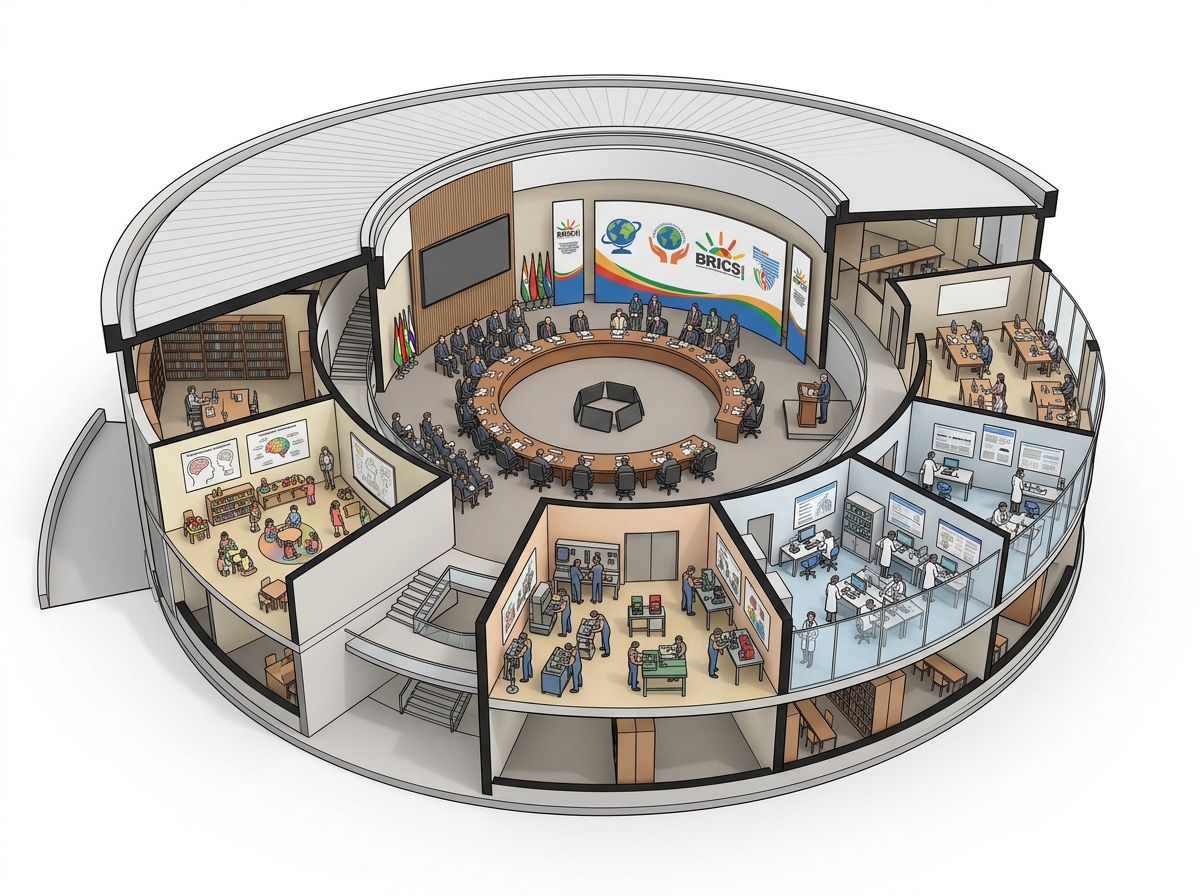 BRICS Education MinistersECCE prioritySkill developmentResearch innovationAcademic leadership
Subject Relevance — Where This Topic Fits
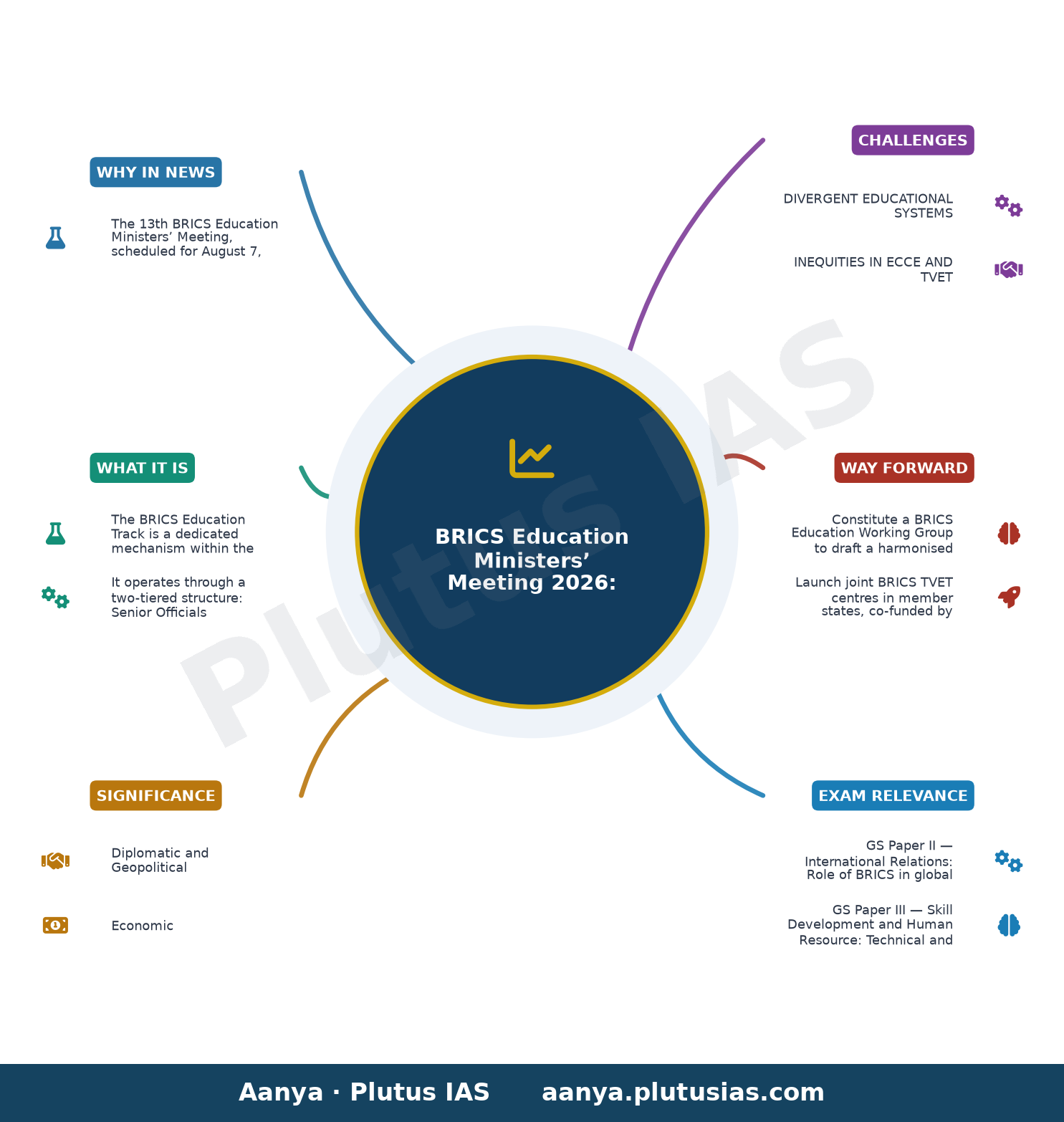
- GS Paper II — International Relations: Role of BRICS in global governance, India’s presidency, multilateral cooperation in education | GS Paper III — Skill Development and Human Resource: Technical and Vocational Education and Training (TVET), Early Childhood Care and Education (ECCE), mutual recognition of qualifications
- Prelims: BRICS Education Track, ECCE, TVET, Mutual Recognition of Qualifications, BRICS Guiding Principles on Traditional Knowledge Systems, India’s BRICS Chairship 2026
- Essay: The evolving architecture of global education governance: Challenges and opportunities for India, Bridging the skill divide: The role of multilateral platforms in shaping future-ready human capital
Quick Revision: The BRICS Education Track is a multilateral mechanism advancing cooperative education policies, with India’s 2026 chairship focusing on ECCE, TVET, mutual recognition of qualifications, and integration of traditional knowledge systems to foster inclusive and resilient education systems.
Why is this in the news?
The 13th BRICS Education Ministers’ Meeting, scheduled for August 7, 2026, in Bhubaneswar, Odisha, under India’s chairship, is a significant multilateral platform where education ministers from BRICS and invited countries will deliberate on critical priorities such as early childhood care and education (ECCE), skill development, research and innovation, mutual recognition of qualifications, and academic leadership. This meeting follows the 3rd BRICS Senior Officials Meeting held on August 5, 2026, and underscores India’s proactive role in advancing cooperative frameworks within the BRICS bloc to foster inclusive and resilient education systems.
Background
- India assumed the BRICS Chairship in 2026, with a thematic focus on ‘Inclusive Growth and Shared Future,’ encompassing education as a critical pillar for sustainable development.
- The BRICS Education Track operates under a structured mechanism, including Senior Officials Meetings and Education Ministers’ Meetings, to align policies and promote collaborative initiatives.
- Mutual recognition of qualifications and academic leadership are pivotal for facilitating student mobility and fostering academic exchanges among BRICS member states.
- The BRICS Guiding Principles on Traditional and Indigenous Knowledge Systems aim to integrate indigenous wisdom into formal education and research frameworks.
What is the BRICS Education Track?
- The BRICS Education Track is a dedicated mechanism within the BRICS framework, established to facilitate cooperation among member states in education policy, research, and institutional capacity-building.
- It operates through a two-tiered structure: Senior Officials Meetings (SOMs) and Education Ministers’ Meetings, ensuring systematic deliberation and consensus-building on priority areas.
- The Track addresses thematic pillars such as Early Childhood Care and Education (ECCE), Technical and Vocational Education and Training (TVET), research and innovation, and academic leadership.
- Mutual recognition of qualifications is a core objective, aimed at enhancing student mobility and facilitating seamless academic transitions across BRICS countries.
- The BRICS Guiding Principles on Traditional and Indigenous Knowledge Systems seek to integrate indigenous knowledge into modern education and research, promoting cultural preservation and innovation.
- Collaborative research initiatives under the Track focus on addressing global challenges such as climate change, public health, and sustainable development through joint academic and scientific endeavours.
- The Track also emphasizes institutional mechanisms to strengthen governance, exchange best practices, and build capacity in education systems across member states.
- India’s chairship in 2026 has prioritized inclusive and future-ready education systems, aligning the BRICS agenda with global Sustainable Development Goals (SDGs), particularly SDG 4 (Quality Education).
Key Features
| Feature | Significance |
|---|---|
| Early Childhood Care and Education (ECCE) | Lays the foundation for cognitive, social, and emotional development; aligns with Sustainable Development Goal 4 (SDG 4) targets on inclusive and equitable quality education from birth to age 5. |
| Technical and Vocational Education and Training (TVET) | Addresses skill gaps in emerging sectors; enhances employability and aligns with the ‘Skill India’ initiative under India’s G20 presidency, reinforcing BRICS’ focus on workforce readiness. |
| Mutual Recognition of Qualifications | Facilitates academic mobility and professional mobility among BRICS nations; reduces barriers to cross-border employment and research collaboration. |
| Research and Innovation Collaboration | Promotes joint projects in STEM, climate science, and digital technologies; leverages collective expertise to address global challenges such as pandemics and climate change. |
| Academic Leadership and Governance | Strengthens institutional frameworks for educational policy implementation; fosters shared best practices in governance, quality assurance, and institutional autonomy. |
| Traditional and Indigenous Knowledge Systems | Integrates indigenous knowledge with modern education; preserves cultural heritage while promoting sustainable development and biodiversity conservation. |
Why it Matters
Diplomatic and Geopolitical
- Reinforces India’s leadership in BRICS by hosting the 2026 chairship; enhances soft power through educational diplomacy and multilateral cooperation.
- Strengthens South-South cooperation, particularly with Global South nations like Ethiopia and Iran, fostering solidarity beyond traditional alliances.
- Provides a platform for India to showcase its educational reforms, such as the National Education Policy (NEP) 2020, to BRICS partners.
Economic
- Enhances human capital development, which is critical for economic growth and innovation in BRICS economies.
- Facilitates cross-border labour mobility, particularly in sectors like IT, healthcare, and engineering, boosting economic integration.
- Promotes joint ventures in vocational training and research, creating new economic opportunities and reducing dependency on Western education systems.
Social and Educational
- Advances inclusive education by prioritising ECCE and skill development for marginalised communities, aligning with SDG 4.5.
- Encourages the exchange of best practices in inclusive education, digital learning, and teacher training among BRICS nations.
- Supports the preservation and integration of traditional knowledge systems, promoting cultural sustainability and ethical innovation.
Institutional and Governance
- Strengthens institutional mechanisms for educational cooperation, such as joint accreditation and quality assurance frameworks.
- Encourages the development of shared digital platforms for academic mobility and research collaboration.
- Fosters academic leadership through capacity-building initiatives and peer learning among BRICS member states.
Challenges
1. DIVERGENT EDUCATIONAL SYSTEMS
- Variations in curriculum standards, assessment methods, and governance frameworks across BRICS nations hinder seamless mutual recognition of qualifications.
- Differences in language of instruction and certification processes create bureaucratic and logistical barriers to academic mobility.
UPSC Link: GS II: Global Groupings
2. INEQUITIES IN ECCE AND TVET
- Limited access to quality ECCE in rural and marginalised communities across BRICS nations, particularly in Africa and South Asia.
- TVET systems often lack industry alignment, leading to skill mismatches and low employability despite training programmes.
UPSC Link: GS II: Social Sector Services
3. POLITICAL AND GEOPOLITICAL TENSIONS
- Historical and contemporary geopolitical rivalries among BRICS members (e.g., China-India border disputes) may impede consensus on sensitive issues like mutual recognition or research collaborations.
- Divergent foreign policy priorities could dilute the focus on educational cooperation, particularly in areas requiring long-term commitment.
UPSC Link: GS II: International Relations
4. FUNDING AND RESOURCE CONSTRAINTS
- Limited financial resources for joint research projects, student exchanges, and capacity-building initiatives among BRICS nations.
- Dependence on external funding (e.g., World Bank, UNESCO) for large-scale educational programmes risks undermining sovereignty and long-term sustainability.
UPSC Link: GS III: Government Budgeting
5. DIGITAL DIVIDE AND TECHNOLOGICAL GAPS
- Unequal access to digital infrastructure (e.g., internet connectivity, e-learning platforms) across BRICS nations exacerbates educational inequalities.
- Cybersecurity risks and data sovereignty concerns may hinder cross-border digital collaborations in education and research.
UPSC Link: GS III: Science and Technology
Challenges — UPSC Perspective
| Issue | Concern |
|---|---|
| Curriculum Standardisation | Lack of harmonised curricula complicates mutual recognition of qualifications and academic mobility. |
| Language Barriers | Differences in official languages and mediums of instruction impede collaboration and exchange programmes. |
| Industry-Academia Linkages | Weak ties between vocational training providers and industries reduce the employability of TVET graduates. |
| Funding Disparities | Unequal financial contributions from member states limit the scope of joint educational initiatives. |
| Data Privacy and Security | Cross-border data sharing in digital education raises concerns over cybersecurity and compliance with national laws. |
| Policy Coordination | Divergent national priorities and bureaucratic delays hinder timely implementation of BRICS educational agreements. |
Way Forward
- Constitute a BRICS Education Working Group to draft a harmonised framework for mutual recognition of qualifications, aligned with the UNESCO Global Convention on the Recognition of Qualifications.
- Launch joint BRICS TVET centres in member states, co-funded by governments and industry, to align training programmes with labour market demands.
- Develop a shared digital platform for academic mobility, featuring multilingual interfaces and secure data-sharing protocols to address digital divide concerns.
- Establish a BRICS Research and Innovation Fund to finance collaborative projects in priority areas such as climate science, AI, and public health.
- Organise annual BRICS Education Summits to review progress, share best practices, and adapt strategies to emerging challenges.
- Strengthen ECCE through targeted funding and capacity-building programmes, with a focus on rural and tribal communities in member states.
- Promote the integration of traditional knowledge systems into school curricula, supported by digital archives and teacher training programmes.
UPSC Value Addition
Keywords for Mains Answer-Writing
BRICS Education Ministers’ Meeting 2026 · Early Childhood Care and Education (ECCE) · Technical and Vocational Education and Training (TVET) · Mutual Recognition of Qualifications · Research and Innovation in Education · BRICS Education Track · Academic Leadership in BRICS · Inclusive and Resilient Education Systems · Mutual Recognition of Qualifications Framework · BRICS Guiding Principles on Traditional and Indigenous Knowledge Systems · India’s BRICS Chairship 2026 · Skill Development and Education Policy
Concept Flow
BRICS member states face shared challenges in education → Hosting of 13th BRICS Education Ministers’ Meeting in India → Deliberations on ECCE, TVET, mutual recognition, and research collaboration → Adoption of BRICS Education Ministers’ Declaration → Strengthening of institutional mechanisms and academic mobility → Enhanced human capital development and economic integration → Progress towards SDG 4 and inclusive growth → Long-term geopolitical and diplomatic benefits for BRICS bloc.
Prelims Practice Questions
Q1. Consider the following statements regarding the 13th BRICS Education Ministers’ meeting held in Bhubaneswar, Odisha:
1. The meeting deliberated on Early Childhood Care and Education (ECCE) as one of the key priorities.
2. The BRICS Education Ministers’ Declaration included provisions for mutual recognition of qualifications among member countries.
3. The meeting was chaired by the Prime Minister of India.
4. The discussions also covered the BRICS’ Guiding Principles on Traditional and Indigenous Knowledge Systems.
How many of the above statements are correct?
- Only one
- Only two
- Only three
- All four
Answer: Only three — Statements 1, 2, and 4 are correct as they align with the official deliberations of the meeting. Statement 3 is incorrect because the meeting was attended by the Union Education Minister, not the Prime Minister.
Q2. Assertion (A): The BRICS Education Track aims to strengthen academic and research collaborations among member countries.
Reason (R): The BRICS Education Ministers’ Declaration includes provisions for mutual recognition of qualifications and academic leadership.
Options:
A. Both A and R are true, and R is the correct explanation of A.
B. Both A and R are true, but R is not the correct explanation of A.
C. A is true, but R is false.
D. A is false, but R is true.
Answer: ? — Both the Assertion (A) and Reason (R) are true. The BRICS Education Track indeed aims to strengthen academic and research collaborations (A). The Reason (R) correctly explains this aim by citing the inclusion of mutual recognition of qualifications and academic leadership in the Declaration.
Q3. Match the following priority areas discussed in the 13th BRICS Education Ministers’ meeting with their respective descriptions:
Column I (Priority Area)
A. Early Childhood Care and Education (ECCE)
B. Technical and Vocational Education and Training (TVET)
C. Mutual Recognition of Qualifications
D. BRICS’ Guiding Principles on Traditional and Indigenous Knowledge Systems
Column II (Description)
1. Framework to facilitate the acceptance of academic credentials across BRICS member countries.
2. Focus on foundational learning and holistic development in the early years of a child.
3. Emphasis on skill-based education to enhance employability and economic growth.
4. Integration of indigenous knowledge systems into educational frameworks to promote cultural preservation.
Options:
A. A-2, B-3, C-1, D-4
B. A-1, B-2, C-3, D-4
C. A-3, B-1, C-4, D-2
D. A-4, B-2, C-1, D-3
Answer: ? — The correct matching is: A-2 (ECCE focuses on foundational learning), B-3 (TVET emphasizes skill-based education), C-1 (Mutual Recognition of Qualifications facilitates credential acceptance), and D-4 (Guiding Principles integrate indigenous knowledge systems).
Mains Practice Question
✍ The 13th BRICS Education Ministers’ meeting in Bhubaneswar underscored the need for inclusive, resilient, and future-ready education systems through enhanced cooperation among member countries. Critically examine the significance of the BRICS Education Track in addressing global educational challenges, with particular reference to Early Childhood Care and Education (ECCE), Technical and Vocational Education and Training (TVET), and mutual recognition of qualifications. (15 Marks)
Approach: MODEL-ANSWER SKELETON:
1. **Introduction (2 Marks)**
– Define the BRICS Education Track and its role in fostering multilateral educational cooperation.
– Contextualize the meeting’s focus on inclusive, resilient, and future-ready education systems.
2. **Early Childhood Care and Education (ECCE) (3 Marks)**
– Explain the importance of ECCE in cognitive, social, and emotional development (cite UNESCO/UNICEF frameworks).
– Discuss how BRICS collaboration can improve access, quality, and equity in ECCE across member countries.
– Highlight India’s initiatives (e.g., National Education Policy 2020, Poshan Track) as a model for other BRICS nations.
3. **Technical and Vocational Education and Training (TVET) (4 Marks)**
– Define TVET and its role in addressing skill gaps and employability (refer to ILO and World Bank reports).
– Analyze how BRICS can leverage TVET to align education with labor market demands and technological advancements.
– Cite examples of successful TVET models (e.g., Germany’s dual system, India’s Skill India Mission).
– Discuss challenges such as outdated curricula, lack of industry linkages, and gender disparities.
4. **Mutual Recognition of Qualifications (3 Marks)**
– Explain the significance of mutual recognition in facilitating academic mobility and workforce integration.
– Reference the proposed BRICS framework and its alignment with the Global Convention on the Recognition of Qualifications (UNESCO).
– Discuss potential benefits (e.g., student exchanges, research collaborations) and challenges (e.g., varying accreditation standards).
5. **Critical Evaluation and Way Forward (3 Marks)**
– Assess the effectiveness of the BRICS Education Track in achieving its stated goals.
– Highlight the need for stronger institutional mechanisms, data-driven policymaking, and private sector involvement.
– Conclude with actionable recommendations for India’s BRICS Chairship 2026 to enhance educational cooperation.
Source: The Hindu
Generated by AanyaAi for educational purpose.

- यूपीएससी/पीसीएस के लिए दूरसंचार विनिर्माण में निवेश: ग्वालियर टीएमजेड के अवसर - September 23, 2026
- Bengaluru Investor Meet: ₹5,500 Cr Investment Proposed for Gwalior Telecom Manufacturing Zone - September 23, 2026
- एल नीनो: दुनिया के सामने जलवायु अनुकूलन की चुनौती - September 23, 2026

No Comments