


06 Oct Cabinet Approves ₹10,000 Cr SME Growth Fund: Key for UPSC & PCS
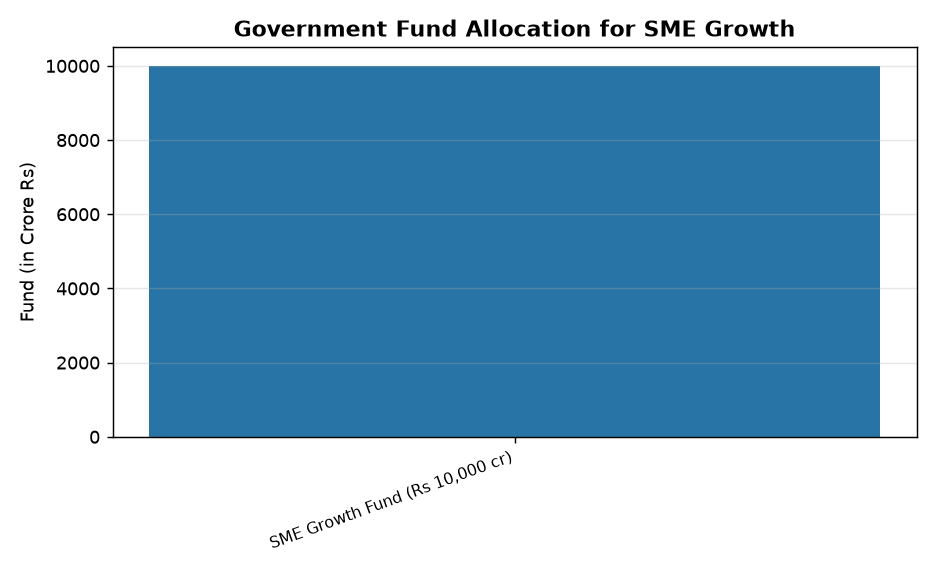
✎ The SME Growth Fund (SGF) is a ₹10,000 crore government-backed Alternative Investment Fund (AIF) under SEBI regulations, designed to provide long-term equity capital to high-potential SMEs, enabling them to scale operations…
Subject Relevance — Where This Topic Fits
- GS Paper III — Indian Economy: Issues relating to growth and development, Inclusive growth and issues arising from it, Government Budgeting
- Prelims: SME Growth Fund (SGF), Alternative Investment Fund (AIF), direct equity investment, Union Budget 2026-27, fiscal policy for MSMEs, capital infusion in SMEs, strategic value chains
- Essay: The role of institutional finance in fostering indigenous enterprise and national competitiveness, Balancing fiscal prudence with growth-oriented capital deployment in emerging economies
Quick Revision: The SME Growth Fund (SGF) is a ₹10,000 crore government-backed Alternative Investment Fund (AIF) under SEBI regulations, designed to provide long-term equity capital to high-potential SMEs, enabling them to scale operations, adopt advanced technologies, and integrate into global value chains.
Why is this in the news?
The Union Cabinet’s approval of a ₹10,000 crore SME Growth Fund (SGF) for direct equity investments in Small and Medium Enterprises (SMEs) marks a significant policy intervention to address the capital constraints faced by high-potential but capital-starved Indian enterprises. This initiative, announced in the Union Budget 2026-27 and formalised through an Alternative Investment Fund (AIF) framework, seeks to transform select SMEs into globally competitive ‘champion enterprises’ by providing long-term growth capital, thereby enhancing India’s manufacturing and innovation capabilities.
Background
- The SME sector contributes approximately 45% to India’s manufacturing output and 40% to exports, yet faces persistent challenges in accessing long-term, risk-tolerant capital due to perceived high risk by traditional financiers.
- India’s SMEs, particularly those in technology, innovation, and strategic manufacturing sectors, often struggle to scale operations due to limited access to equity financing, which is critical for R&D, technology adoption, and market expansion.
- The Union Budget 2026-27 introduced the SME Growth Fund as part of a broader strategy to revitalise the MSME sector, aligning with the government’s ‘Make in India’ and ‘Atmanirbhar Bharat’ initiatives to enhance domestic value addition and reduce import dependence.
- Globally, countries like Germany (Mittelstand model) and South Korea (chaebols) have leveraged long-term capital infusion to create globally competitive SMEs, underscoring the potential of such policy instruments.
- The fund’s structure as an Alternative Investment Fund (AIF) under the SEBI (Alternative Investment Funds) Regulations, 2012, allows for professional fund management while ensuring regulatory oversight and investor protection.
- Prior to this, initiatives like the Credit Guarantee Fund Trust for Micro and Small Enterprises (CGTMSE) and the Fund of Funds for Startups (FFS) have addressed credit gaps, but equity financing remained a critical unmet need for scaling SMEs.
What is the SME Growth Fund (SGF)?
- The SME Growth Fund is a ₹10,000 crore government-backed Alternative Investment Fund (AIF) designed to provide long-term equity capital to high-potential Small and Medium Enterprises (SMEs) in India.
- The fund will operate under the SEBI (Alternative Investment Funds) Regulations, 2012, ensuring compliance with regulatory norms for fund structuring, disclosures, and investor protection.
- The SGF will make direct equity investments in SMEs across manufacturing, services, technology, innovation-driven sectors, and strategic value chains, with a focus on creating ‘future champions’ that can compete globally.
- Investments will be growth-oriented, enabling SMEs to scale operations, invest in advanced technologies, expand manufacturing capacity, and integrate into global value chains.
- The fund will prioritise sectors identified under the Production-Linked Incentive (PLI) schemes and other strategic industries to align with national priorities such as self-reliance and export competitiveness.
- The government’s commitment of ₹10,000 crore will be deployed over multiple tranches, with professional fund managers selecting investee SMEs based on rigorous due diligence and growth potential.
- The SGF aims to address the ‘equity gap’ in SME financing, where traditional lenders are often reluctant to provide risk capital, thereby unlocking the sector’s potential as an engine of employment and economic growth.
- The initiative complements existing schemes like the CGTMSE and FFS by focusing specifically on equity financing, which is critical for scaling innovation-driven enterprises.
Key Features
| Feature | Significance |
|---|---|
| Allocation of Rs 10,000 crore | Provides long-term equity capital to SMEs, addressing the critical gap in growth-stage financing for expansion and innovation. |
| Direct equity investments | Enables SMEs to scale operations without incurring debt, preserving financial flexibility and encouraging risk-taking. |
| Focus on manufacturing, services, and technology sectors | Aligns with India’s industrial policy priorities, particularly the push for self-reliance (Atmanirbhar Bharat) and global competitiveness. |
| Integration into global value chains | Facilitates SMEs’ participation in international trade, enhancing export potential and supply chain resilience. |
| Government commitment via Alternative Investment Fund (AIF) | Leverages private capital through a structured fund, ensuring scalability and professional fund management. |
| Announcement in Union Budget 2026-27 | Demonstrates continuity in policy intent and fiscal prioritisation of SME growth. |
Why it Matters
Economic Growth and Employment
- SMEs contribute ~40% to India’s GDP and employ ~110 million workers; targeted funding can amplify their role in economic expansion and job creation.
- Facilitates technological upgradation, improving productivity and global market access for SMEs.
- Reduces dependency on debt financing, mitigating financial stress during economic downturns.
Industrial Policy and Self-Reliance
- Supports the Atmanirbhar Bharat initiative by strengthening domestic manufacturing and innovation ecosystems.
- Encourages indigenous development of strategic sectors, reducing import dependence in critical value chains.
- Promotes the creation of ‘future champions’—high-growth SMEs that can compete globally.
Financial Sector Development
- Stimulates the Alternative Investment Fund (AIF) ecosystem, diversifying capital sources for SMEs beyond traditional banking.
- Encourages private sector participation in equity financing, reducing the burden on public sector institutions.
- Enhances financial inclusion for high-potential but capital-constrained SMEs.
Global Competitiveness
- Enables SMEs to invest in R&D, adopt advanced manufacturing techniques, and meet international quality standards.
- Facilitates integration into global supply chains, particularly in sectors like electronics, pharmaceuticals, and engineering.
- Strengthens India’s position in global trade by fostering a robust SME base.
Challenges
1. Access to Equity Capital
- Indian SMEs face significant challenges in accessing equity financing due to risk aversion among investors and lack of collateral.
- Traditional banking systems are ill-equipped to evaluate high-growth, early-stage SMEs, leading to underfunding.
- The Rs 10,000 crore allocation, while substantial, may be insufficient to address the scale of demand across diverse sectors.
UPSC Link: GS3: Financial Inclusion and Capital Markets
2. Regulatory and Compliance Burden
- SMEs often struggle with complex regulatory frameworks, including tax compliance, labour laws, and environmental clearances.
- The fund’s effectiveness may be constrained by bureaucratic delays in approvals and disbursements.
- Stringent KYC and due diligence requirements for AIF investments could exclude viable but informal SMEs.
UPSC Link: GS2: Government Policies and Interventions
3. Scalability and Exit Mechanisms
- Ensuring the fund’s investments yield sustainable returns requires robust exit strategies, such as IPOs or strategic buyouts.
- The success of the fund depends on the ability of SMEs to scale, which is hindered by infrastructure gaps, skilled labour shortages, and market access barriers.
- Lack of a vibrant secondary market for SME equity could limit liquidity and investor confidence.
UPSC Link: GS3: Investment Models and Startup Ecosystem
4. Sectoral and Regional Disparities
- Fund allocation may not address regional imbalances, with SMEs in tier-2/3 cities and aspirational districts facing greater challenges.
- Certain sectors (e.g., agriculture-based, traditional crafts) may lack the scalability or technological readiness to benefit from equity investments.
- The fund’s impact could be uneven across manufacturing, services, and technology, depending on investor appetite.
UPSC Link: GS3: Inclusive Growth and Regional Development
5. Monitoring and Impact Assessment
- Tracking the fund’s utilisation and impact requires transparent reporting mechanisms and independent audits.
- Ensuring funds reach deserving SMEs without leakage or misallocation demands robust governance structures.
- Long-term success metrics (e.g., job creation, export growth) must be defined and measured to evaluate the fund’s efficacy.
UPSC Link: GS4: Ethics and Governance in Public Finance
Challenges — UPSC Perspective
| Issue | Concern |
|---|---|
| Equity financing gap | High-risk perception among investors limits SME access to growth capital. |
| Regulatory complexity | Compliance burdens deter SMEs from formalising operations or scaling up. |
| Infrastructure deficits | Poor logistics, power, and digital connectivity hinder SME competitiveness. |
| Skilled labour shortage | Limited availability of technical and managerial talent constrains SME expansion. |
| Market access barriers | SMEs struggle to penetrate global supply chains due to lack of branding or certification. |
| Exit strategy risks | Uncertainty in realising returns may discourage private investors from participating. |
Government Initiatives — Must-Memorise for Prelims
- SME Growth Fund (SGF)
- Alternative Investment Fund (AIF) framework under the SGF
Way Forward
- Establish a transparent and time-bound disbursement mechanism for the Rs 10,000 crore fund, prioritising SMEs with high growth potential and scalability.
- Strengthen the AIF ecosystem by incentivising private sector participation through tax benefits or guarantees.
- Simplify regulatory compliance for SMEs, particularly in labour laws, environmental clearances, and tax filings, to reduce operational friction.
- Develop sector-specific sub-funds within the SGF to address disparities between manufacturing, services, and technology sectors.
- Invest in SME-focused incubation centres and R&D hubs to enhance innovation capacity and global competitiveness.
- Create a dedicated portal for SMEs to access funding, mentorship, and market linkages, integrating with existing schemes like the Udyam Registration.
- Implement a robust monitoring and evaluation framework with quarterly progress reports and third-party audits to ensure accountability.
- Expand digital infrastructure (e.g., e-commerce platforms, cloud-based accounting tools) to enable SMEs to scale operations efficiently.
UPSC Value Addition
Keywords for Mains Answer-Writing
SME Growth Fund (SGF) · Alternative Investment Fund (AIF) · Union Budget 2026-27 · equity investments in SMEs · direct equity financing · promotion of manufacturing and services · strategic value chains · long-term capital for SMEs · MSME sector development · financial inclusion of SMEs · alternative investment instruments · capital market reforms · entrepreneurship ecosystem · industrial policy · institutional finance for SMEs
Concept Flow
Identification of SME financing gap in India’s growth trajectory → Government announces Rs 10,000 crore SME Growth Fund in Union Budget 2026-27 → Cabinet approves fund structure and allocation → Establishment of Alternative Investment Fund (AIF) under SGF framework → Fund mobilises private capital and invests in high-potential SMEs → SMEs scale operations, adopt technology, and integrate into global value chains → Enhanced GDP contribution, employment generation, and export growth → Reinvestment of returns into the fund for sustainable growth cycle
Prelims Practice Questions
Q1. Consider the following statements regarding the SME Growth Fund (SGF):
1. The SGF is a government-backed fund established under the Alternative Investment Fund (AIF) framework.
2. The fund provides direct equity investments to Small and Medium Enterprises (SMEs) to promote their growth.
3. The SGF was announced in the Union Budget 2025-26 and approved by the Cabinet in October 2026.
4. The fund aims to support SMEs in scaling operations, investing in technology, and expanding into international markets.
How many of the above statements are correct?
- Only one
- Only two
- Only three
- All four
Answer: Only three — Statements 1, 2, and 4 are correct. Statement 3 is incorrect as the fund was announced in the Union Budget 2026-27, not 2025-26.
Q2. Assertion (A): The SME Growth Fund (SGF) is designed to provide long-term capital to SMEs through direct equity investments.
Reason (R): The fund is established under the Alternative Investment Fund (AIF) framework to catalyse growth-oriented capital for Indian SMEs.
Options:
A. Both A and R are true, and R is the correct explanation of A.
B. Both A and R are true, but R is not the correct explanation of A.
C. A is true, but R is false.
D. A is false, but R is true.
- A
- B
- C
- D
Answer: A — Both A and R are true, and R correctly explains A, as the AIF framework is the mechanism through which the SGF provides long-term capital via equity investments.
Q3. Which of the following is NOT a stated objective of the SME Growth Fund (SGF)?
A. Providing long-term capital to SMEs.
B. Enabling SMEs to scale operations and invest in technology.
C. Directly disbursing loans to SMEs under the Pradhan Mantri Mudra Yojana.
D. Supporting SMEs in integrating into global value chains.
- A
- B
- C
- D
Answer: C — Option C is incorrect as the SGF focuses on direct equity investments, not loan disbursement under the Pradhan Mantri Mudra Yojana.
Mains Practice Question
✍ The Union Cabinet has approved the establishment of the SME Growth Fund (SGF) with a commitment of ₹10,000 crore to promote Small and Medium Enterprises (SMEs) through direct equity investments. Critically examine the significance of this initiative for India’s industrial policy and entrepreneurship ecosystem. Also, discuss the challenges that may impede its effective implementation. (15 Marks)
Approach: MODEL-ANSWER SKELETON:
1. **Introduction (2 marks)**: Define SMEs and their role in India’s economy (e.g., contribution to GDP, employment, and exports). Briefly introduce the SME Growth Fund (SGF) and its objectives.
2. **Significance of the SGF (6 marks)**:
– **Industrial Policy**: Aligns with the National Manufacturing Policy (2011) and Atmanirbhar Bharat Abhiyan by fostering self-reliance and innovation.
– **Entrepreneurship Ecosystem**: Addresses the funding gap for high-growth SMEs, particularly in technology and strategic sectors (e.g., semiconductors, clean energy).
– **Alternative Financing**: Reduces dependence on traditional debt financing, promoting equity culture and risk capital.
– **Global Integration**: Supports SMEs in integrating into global value chains, enhancing export competitiveness.
– **Institutional Framework**: Operates under the Alternative Investment Fund (AIF) framework, leveraging private capital and professional management.
3. **Challenges to Implementation (6 marks)**:
– **Fund Management**: Ensuring disciplined deployment of ₹10,000 crore without delays or misallocation.
– **Selection Criteria**: Balancing risk and reward in equity investments; avoiding crony capitalism or sectoral biases.
– **Regulatory Hurdles**: Compliance with SEBI regulations for AIFs and ensuring transparency in fund operations.
– **Market Perception**: Building investor confidence in SME equity as a viable asset class.
– **Geographical Disparities**: Ensuring equitable access for SMEs across states, particularly in tier-2/3 cities.
4. **Conclusion (1 mark)**: Summarise the transformative potential of the SGF while acknowledging the need for robust governance and monitoring mechanisms.
Source: orissapost.com
Generated by AanyaAi for educational purpose.
Related guides on our sites
- How to prepare for GS paper 1 for UPSC CSE mains exam
- Best economics optional coaching for upsc
- Best economics optional teacher for upsc
- Best UPSC coaching for IFOS exam

- क्या शांतिपूर्ण असहमति भारत में कमजोर हो रही है? जानिए संवैधानिक अधिकार - October 7, 2026
- Lok Sabha Speaker on Strengthening Democracy Through Dialogue and Inclusion - October 6, 2026
- बेंगलुरु में पांच पुलिस आयुक्तालयों के गठन को कैबिनेट की मंजूरी, पूर्व अधिकारियों ने व्यक्त की चिंता - October 6, 2026

No Comments