


24 Jul Cabinet Approves ₹3,030 Crore ‘Bhavya Rasayan’ Chemical Park Scheme for 2026-31
Subject Relevance — Where This Topic Fits
- GS Paper II — Government Policies and Interventions for Development in various sectors | GS Paper III — Industrial Policy, Investment Models, and Infrastructure Development | GS Paper III — Role of Public Sector, MSMEs, and Industrial Corridors in Economic Growth
- Prelims: BHARAT GRAND CHEMICAL Scheme, Chemical Parks, PLI Scheme for Chemicals, Make in India 2.0, Petrochemical Value Chain, CETP (Common Effluent Treatment Plant), TSDF (Treatment, Storage, and Disposal Facility), Challenge Route Funding, Import Substitution, Export Competitiveness
- Essay: India’s Journey Towards Self-Reliance: From Atmanirbhar Bharat to Developed Nation by 2047, Balancing Industrial Growth and Environmental Sustainability: The Case of India’s Chemical Sector
Why is this in the news?
This scheme, announced in the Union Budget 2026-27, aims to establish three dedicated chemical parks across India with a total financial outlay of ₹3,030 crore over five years (2026-27 to 2030-31). The initiative is designed to enhance the competitiveness of India’s chemical and petrochemical industries by creating shared infrastructure, reducing logistics costs, and fostering sustainable growth, thereby contributing to India’s goal of becoming a developed nation by 2047.
Background
- The chemical and petrochemical sector in India is a critical enabler for multiple industries, including agriculture, pharmaceuticals, textiles, construction, automotive, and electronics, contributing significantly to GDP and employment.
- India’s chemical industry, valued at approximately USD 180 billion in 2025, remains fragmented with limited large-scale integrated manufacturing hubs, leading to inefficiencies in raw material sourcing, production, and distribution.
- Global chemical demand is projected to grow at a CAGR of 5.4% till 2030, with India’s share in global chemical exports currently below 3%, indicating untapped potential for export-led growth.
- The government’s ‘Make in India’ and ‘Atmanirbhar Bharat’ initiatives have underscored the need for self-reliance in critical sectors, including chemicals, to reduce import dependence and enhance domestic value addition.
- Existing chemical parks in India, such as those in Gujarat and Maharashtra, have demonstrated the efficacy of shared infrastructure in reducing costs and improving environmental compliance, but coverage remains inadequate for national-scale impact.
- The scheme aligns with the broader ‘National Industrial Corridor Programme’ and ‘National Infrastructure Pipeline’, aiming to integrate industrial development with sustainable urban and logistics infrastructure.
About
- The scheme is designed to create a competitive, sustainable, and globally integrated chemical manufacturing ecosystem by providing shared infrastructure and utilities tailored to the needs of the chemical and petrochemical industries.
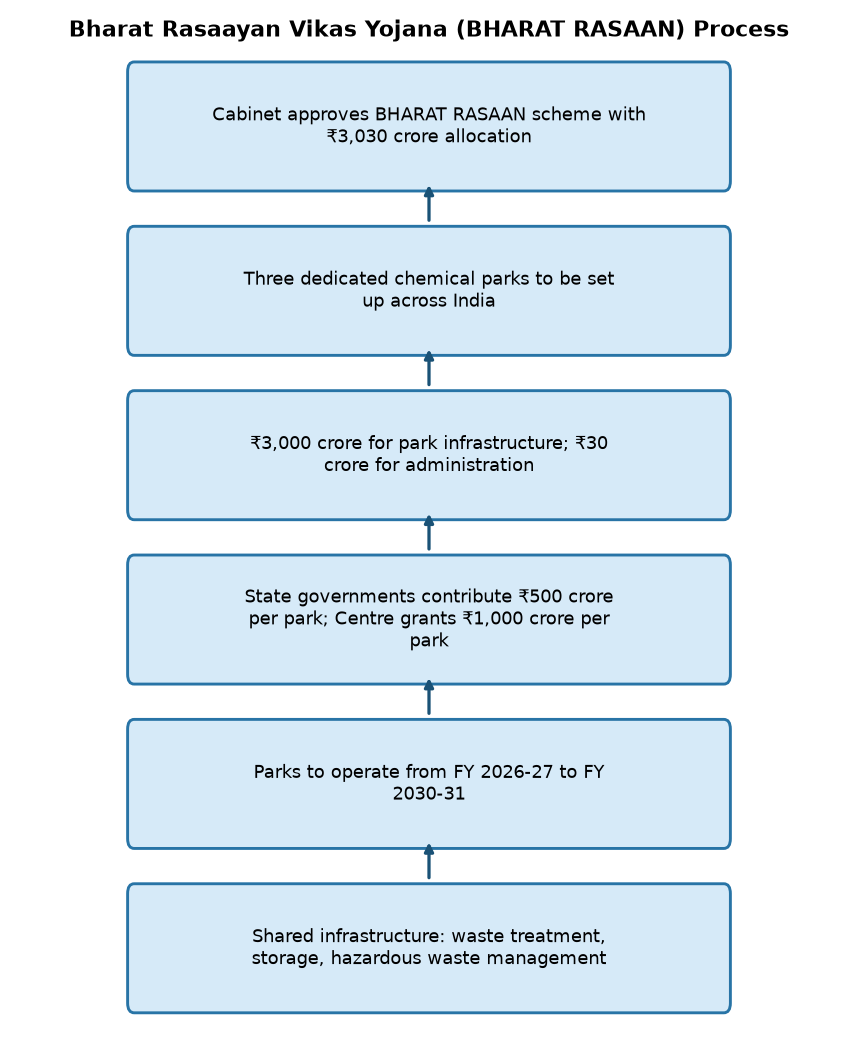
- Financial Outlay: The scheme has a total outlay of ₹3,030 crore, with ₹3,000 crore allocated for the development of internal infrastructure and utilities within the parks, and ₹30 crore earmarked for administrative expenses over the five-year period.
- Funding Mechanism: The central government will provide a grant of up to ₹1,000 crore per park, subject to the state government contributing a minimum of ₹500 crore per park, ensuring shared responsibility and commitment.
- Geographical Spread: Each chemical park will cover a contiguous land area of at least 8 square kilometres (2,000 acres), ensuring sufficient space for integrated manufacturing, logistics, and environmental management facilities.
- Core Infrastructure: The parks will feature shared facilities such as Common Effluent Treatment Plants (CETPs), Treatment, Storage, and Disposal Facilities (TSDFs), water supply and distribution systems, solvent recovery and distillation units, steam generation and distribution networks, interconnected pipeline networks, and logistics and warehousing hubs.
- Sustainability Focus: The scheme mandates the integration of eco-friendly technologies, including hazardous waste management infrastructure, to ensure compliance with environmental regulations and promote sustainable industrial practices.
- Competitiveness Enhancement: By reducing logistics costs, improving resource efficiency, and enabling seamless integration with global value chains, the scheme aims to enhance the cost competitiveness of Indian chemical manufacturers and boost exports.
- Employment Generation: The establishment of large-scale chemical parks is expected to create significant direct and indirect employment opportunities, particularly in rural and semi-urban areas, thereby contributing to inclusive economic growth.
Key Features
| Feature | Significance |
|---|---|
| Financial Outlay (₹3,030 crore) | Ensures dedicated infrastructure funding with 99% allocation for core facilities, reducing fiscal burden on private investors. |
| State Contribution (₹500 crore per park) | Enhances cooperative federalism by mandating state-level investment, ensuring ownership and commitment. |
| Central Grant (₹1,000 crore per park) | Provides performance-linked financial support to states, incentivizing efficient project execution. |
| Land Requirement (8 sq km minimum) | Facilitates economies of scale in chemical manufacturing, reducing per-unit production costs through shared infrastructure. |
| Shared Waste Management Infrastructure (CETP, TSDF) | Ensures regulatory compliance with centralized hazardous waste treatment, lowering pollution risks and operational costs. |
| Integrated Pipeline Network | Optimizes logistics by enabling direct material transport between units, reducing transportation losses and delays. |
| Performance-Based Funding Mechanism | Introduces competitive selection criteria, ensuring only viable and high-impact projects receive central support. |
| Five-Year Implementation Period (2026-2031) | Provides a structured timeline for development, allowing phased rollout and monitoring of outcomes. |
Why it Matters
Economic Growth and Industrialisation
- Strengthens the chemical and petrochemical sector, a critical input for agriculture, pharmaceuticals, textiles, and automotive industries, thereby enhancing backward and forward linkages.
- Promotes import substitution by boosting domestic production capacity, reducing reliance on foreign chemical imports.
- Attracts foreign direct investment (FDI) and domestic private capital through shared infrastructure and policy incentives, fostering industrial clusters.
- Enhances global competitiveness of Indian chemical manufacturers by reducing production costs and improving supply chain efficiency.
Employment Generation
- Direct employment in chemical parks through manufacturing, logistics, and ancillary services, estimated at 50,000–75,000 jobs per park.
- Indirect employment in supporting sectors such as transportation, warehousing, and waste management, amplifying socio-economic impact.
- Skilling initiatives under the scheme will align workforce capabilities with industry demands, particularly in hazardous waste management and green chemistry.
Sustainable Development and Environmental Compliance
- Centralized waste management systems (CETP, TSDF) ensure adherence to environmental norms, reducing pollution and health hazards.
- Promotes circular economy principles through solvent recovery, distillation, and steam networks, minimizing resource wastage.
- Encourages adoption of green chemistry practices by integrating eco-friendly infrastructure, aligning with India’s Net-Zero commitments.
Regional Development and Balanced Growth
- Concentrates industrial activity in strategically selected regions, reducing regional disparities and promoting inclusive growth.
- Leverages existing industrial corridors (e.g., Delhi-Mumbai Industrial Corridor) to integrate chemical parks with broader economic hubs.
- Supports the ‘Viksit Bharat 2047’ vision by creating self-sustaining industrial ecosystems in lagging regions.
Strategic Autonomy and Supply Chain Resilience
- Reduces vulnerability to global supply chain disruptions by enhancing domestic production of critical chemicals.
- Strengthens India’s position in global chemical value chains, particularly in high-demand sectors like agrochemicals and pharmaceuticals.
- Mitigates geopolitical risks associated with reliance on imported chemical intermediates.
Challenges
1. Land Acquisition and Clearances
- Complexity in acquiring contiguous land parcels of 8 sq km, especially in densely populated or ecologically sensitive areas.
- Delays in obtaining environmental clearances and forest/wildlife permissions under the Forest (Conservation) Act, 1980 and Environmental Impact Assessment (EIA) Notification, 2006.
UPSC Link: GS-III: Land Reforms
2. Regulatory and Compliance Burden
- Stringent environmental regulations require continuous monitoring and reporting, increasing operational costs for SMEs.
- Overlapping jurisdictions of central and state authorities may lead to procedural delays in project approvals.
UPSC Link: GS-II: Centre-State Relations
3. Infrastructure Bottlenecks
- Inadequate last-mile connectivity (roads, railways, ports) to chemical parks may hinder logistics efficiency.
- Power supply reliability remains a concern in industrial clusters, necessitating dedicated energy infrastructure.
UPSC Link: GS-III: Infrastructure
4. Skilling and Labour Challenges
- Shortage of skilled workforce in hazardous waste management, green chemistry, and advanced chemical engineering.
- Resistance from local communities due to perceived health risks from chemical industries, requiring robust stakeholder engagement.
UPSC Link: GS-IV: Human Resource Development
5. Financial Viability and Private Investment
- High initial capital expenditure may deter private participation despite central grants, necessitating innovative financing models (e.g., viability gap funding).
- Revenue generation from shared infrastructure may take 3–5 years, requiring patient capital.
UPSC Link: GS-III: Investment Models
6. Technology Adoption and Innovation
- Limited adoption of Industry 4.0 technologies (AI, IoT) in chemical manufacturing due to high costs and lack of awareness.
- Need for R&D collaboration between industry and institutions (e.g., CSIR, IITs) to develop cost-effective green technologies.
UPSC Link: GS-III: Science & Technology
Challenges — UPSC Perspective
| Issue | Concern |
|---|---|
| Land Fragmentation | Contiguous land parcels of 8 sq km are scarce, particularly in industrialized states with high population density. |
| Environmental Clearances | Delays in obtaining NOCs under EIA 2006 and Forest Conservation Act 1980 can stall project timelines. |
| Logistics Costs | Poor connectivity to ports and highways increases transportation costs, negating cost advantages of shared infrastructure. |
| Waste Management Compliance | Stringent norms for hazardous waste disposal require high-capacity CETPs and TSDFs, increasing capital and operational costs. |
| Skilled Labour Shortage | Lack of trained professionals in chemical engineering and waste management delays project commissioning. |
| Private Sector Participation | Risk-averse investors may hesitate due to long gestation periods and regulatory uncertainties. |
| Regulatory Overlap | Dual oversight by central and state agencies creates duplication and delays in approvals. |
| Technology Gaps | Limited adoption of automation and green chemistry increases production costs and environmental footprint. |
Way Forward
- Establish a dedicated ‘Chemical Parks Authority’ under the Ministry of Chemicals and Fertilizers for single-window clearances and real-time monitoring of projects.
- Introduce viability gap funding (VGF) for private investors to bridge the funding gap in initial years, ensuring financial sustainability.
- Launch a national skilling program in partnership with AICTE and industry bodies (e.g., CII) to train 10,000+ professionals annually in hazardous waste management and green chemistry.
- Develop a ‘Green Chemistry Innovation Fund’ to subsidize R&D in low-cost, eco-friendly chemical processes for MSMEs.
- Strengthen last-mile connectivity by integrating chemical parks with dedicated freight corridors (DFCs) and port-led development initiatives (e.g., Sagarmala).
- Implement a performance-linked incentive (PLI) scheme for chemical manufacturers adopting Industry 4.0 technologies in their operations.
- Conduct periodic environmental audits and third-party impact assessments to ensure compliance and build public trust.
- Foster public-private partnerships (PPPs) for shared infrastructure (e.g., CETPs, logistics hubs) to reduce capital expenditure burdens on states.
UPSC Value Addition
Keywords for Mains Answer-Writing
Blavatnik School of Government · Industrial Corridors · Chemical Parks · Make in India · Petrochemicals · Import Substitution · Export Promotion · Sustainable Industrialisation · Infrastructure Development · Public-Private Partnership · Atmanirbhar Bharat · Logistics Cost Reduction · Waste Management · Circular Economy · Ease of Doing Business · Chemical and Petrochemical Industry · Union Budget 2026-27 · Infrastructure Finance · State Government Contributions · Competitive Federalism
Concept Flow
Budget Announcement (2026-27) → Cabinet Approval of Scheme → State Contribution Commitment (₹500 crore/park) → Central Grant Release (₹1,000 crore/park) → Land Acquisition & Clearances → Infrastructure Development → Private Sector Onboarding → Operationalization of Parks → Supply Chain Integration → Employment Generation & Export Growth → Contribution to ‘Viksit Bharat 2047’
Prelims Practice Questions
Q1. Which of the following is NOT a stated objective of the ‘Bhavya Rasayan’ scheme approved by the Union Cabinet in July 2026?
- A. Establishment of three dedicated chemical parks in India
- B. Reduction in logistics and management costs for the chemical industry
- C. Promotion of agricultural productivity through chemical inputs
- D. Enhancement of global competitiveness of the Indian chemical industry
Answer: C. Promotion of agricultural productivity through chemical inputs — The scheme focuses on infrastructure development, cost reduction, and export promotion in the chemical sector. Agricultural productivity is not a stated objective, though the chemical industry serves agriculture.
Q2. Under the ‘Bhavya Rasayan’ scheme, the central government will provide financial assistance to each chemical park after the concerned state government contributes a minimum of:
- A. ₹200 crore
- B. ₹300 crore
- C. ₹500 crore
- D. ₹1,000 crore
Answer: C. ₹500 crore — The central government will provide up to ₹1,000 crore per park, but only after the state government contributes a minimum of ₹500 crore.
Q3. Which of the following infrastructure facilities is explicitly mentioned as part of the shared infrastructure in the ‘Bhavya Rasayan’ scheme?
- A. National Highways
- B. Common Effluent Treatment Plants (CETP)
- C. Metro Rail Systems
- D. International Airports
Answer: B. Common Effluent Treatment Plants (CETP) — The scheme specifies shared infrastructure such as Common Effluent Treatment Plants (CETP), Treatment Storage and Disposal Facilities (TSDF), and logistics hubs to support the chemical industry.
Mains Practice Question
✍ Critically evaluate the significance of the ‘Bhavya Rasayan’ scheme in achieving India’s goal of becoming a global manufacturing hub for chemicals and petrochemicals. How does the scheme address challenges such as high logistics costs, environmental sustainability, and import substitution in the sector?
Approach: Begin by outlining the core objectives of the ‘Bhavya Rasayan’ scheme, including the establishment of dedicated chemical parks with shared infrastructure. Discuss how the scheme aims to reduce logistics costs through integrated logistics and pipeline networks, and enhance competitiveness via economies of scale. Address environmental sustainability through centralized waste management systems like CETP and TSDF, ensuring compliance with environmental norms. Examine the scheme’s role in import substitution by boosting domestic production capacity and integrating India into global value chains, thereby reducing reliance on imports. Conclude by assessing the scheme’s potential to align with India’s broader industrial and sustainability goals, such as ‘Make in India’ and ‘Atmanirbhar Bharat’, while acknowledging implementation challenges like land acquisition and inter-state coordination.
Source: PIB (Press Information Bureau)
Generated by AanyaAi for educational purpose.


No Comments