


24 Jul RBI to Auction ₹24,000 Crore Treasury Bills: Key Details for UPSC & PCS
Subject Relevance — Where This Topic Fits
- GS Paper III — Indian Economy: Issues Relating to Planning, Mobilisation of Resources, Growth, Development and Employment | GS Paper III — Money and Banking: Role of Central Bank, Monetary Policy Instruments
- Prelims: Treasury Bills (T-Bills), Cash Management Bills, Ways and Means Advances (WMA), Non-competitive Bidding, Retail Direct Portal, E-Kuber System, Public Debt Office, Monetary Policy Framework
- Essay: Role of Government Securities in Fiscal Consolidation, Monetary Policy Transmission Mechanism in India
Quick Revision: Treasury Bills are short-term, zero-coupon government securities issued at a discount to face value, with maturities of 91, 182, or 364 days, and are auctioned by the RBI using a multiple price method to ensure efficient price discovery and allocation.
Why is this in the news?
The Reserve Bank of India (RBI) has announced the auction of 91-day, 182-day, and 364-day Treasury Bills (T-Bills) for a notified amount of ₹24,000 crore on July 29, 2026. This auction is a routine instrument of the Government of India’s short-term borrowing programme and serves as a key tool for liquidity management by the RBI. The auction’s structure, including competitive and non-competitive bidding, and its alignment with the RBI’s Core Banking Solution (E-Kuber system), highlights the evolving mechanisms of government securities auctions in India.
Background
- Treasury Bills are short-term government securities with maturities of less than one year, issued by the Government of India to meet its short-term funding requirements.
- The issuance of T-Bills is governed by the General Notification F.No.4(2)-B(W&M)/2018 dated March 26, 2018, and subsequent amendments, which outline the terms and conditions for participation and allocation.
- The RBI conducts these auctions on behalf of the Government of India to ensure efficient price discovery and allocation of government securities.
- T-Bills are a critical component of the Indian debt market and are used by the RBI for liquidity management, particularly in the context of the Liquidity Adjustment Facility (LAF) and Open Market Operations (OMOs).
- The auction mechanism has evolved to include retail participation through the Retail Direct Portal, enhancing financial inclusion and broadening the investor base.
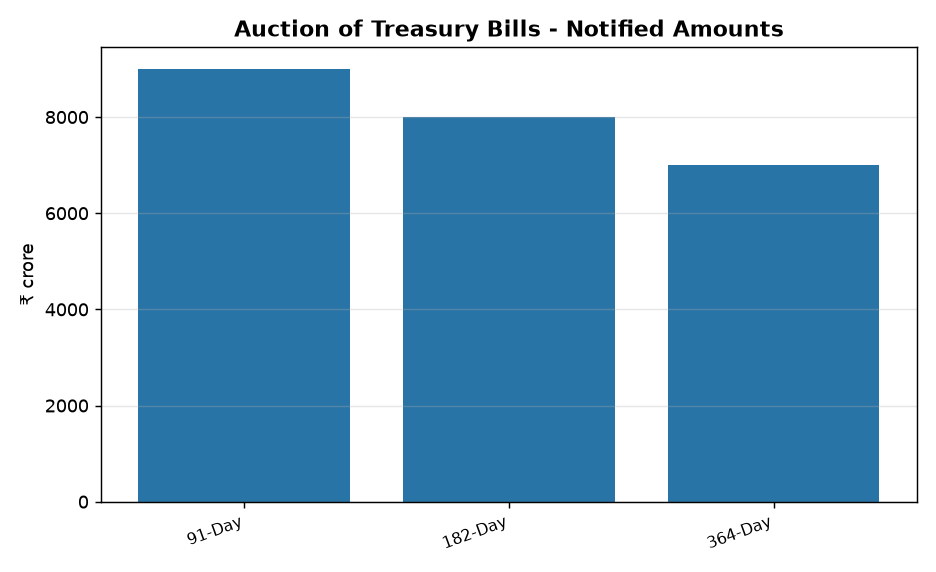
- The notified amounts for the 91-day, 182-day, and 364-day T-Bills (₹9,000 crore, ₹8,000 crore, and ₹7,000 crore respectively) reflect the Government’s short-term borrowing strategy and market appetite.
What are Treasury Bills (T-Bills)?
- Treasury Bills are zero-coupon securities issued by the Government of India, meaning they are issued at a discount to their face value and redeemed at par on maturity.
- They are issued with maturities of 91 days, 182 days, and 364 days, making them the shortest-term government securities available in India.
- T-Bills are issued through auctions conducted by the RBI on behalf of the Government of India.
- The auction uses a multiple price method, where successful bidders pay the price they bid, ensuring efficient price discovery and allocation.
- T-Bills are eligible for inclusion in the Statutory Liquidity Ratio (SLR) requirements of banks, making them attractive to institutional investors such as banks, mutual funds, and insurance companies.
- Retail investors can participate in T-Bill auctions through the non-competitive bidding route, with a maximum allocation capped at 5% of the notified amount.
- The Retail Direct Portal, launched by the RBI, allows individual investors to participate in government securities auctions directly, reducing reliance on intermediaries.
- T-Bills are highly liquid instruments and are traded in the secondary market, providing a benchmark for short-term interest rates in India.
Key Features
| Feature | Significance |
|---|---|
| Notified Amounts | The auction covers ₹9,000 crore for 91-day, ₹8,000 crore for 182-day, and ₹7,000 crore for 364-day Treasury Bills, aggregating ₹24,000 crore. This reflects the Government of India’s short-term borrowing strategy to meet liquidity requirements and manage fiscal deficits. |
| Auction Mechanism | The auction employs a price-based multiple price method, ensuring competitive bidding while maintaining transparency. This method determines the yield at which each bid is accepted, influencing market interest rates. |
| Non-Competitive Bidding | Allows retail investors, state governments, and designated entities to participate without competitive bidding. Retail investors are capped at 5% of the notified amount, promoting financial inclusion and accessibility to government securities. |
| Settlement Date | Successful bids are settled on July 30, 2026, ensuring timely liquidity infusion into the system. This aligns with the RBI’s liquidity management framework to maintain stability in the money market. |
| Electronic Bidding Platform | Bids must be submitted via the RBI’s Core Banking Solution (E-Kuber system) between 10:30 AM and 11:30 AM. This digitization reduces operational risks and enhances efficiency in government securities auctions. |
Why it Matters
Monetary Policy Transmission
- The auction results influence short-term interest rates, which are critical for the transmission of monetary policy. The RBI uses these rates to signal its monetary stance, impacting broader economic activity.
- Yields on Treasury Bills serve as benchmarks for pricing corporate debt, loans, and other financial instruments, thereby affecting credit availability and cost across the economy.
Fiscal Management
- Treasury Bills are a primary instrument for the Government of India to finance its fiscal deficit through short-term borrowings. The auction ensures efficient mobilization of resources to meet expenditure commitments.
- The RBI acts as the government’s debt manager, conducting auctions to ensure that borrowing is conducted at optimal costs while maintaining market stability.
Market Development
- Regular auctions of Treasury Bills enhance the depth and liquidity of the government securities market, fostering investor confidence and participation.
- The inclusion of retail investors through the Retail Direct portal democratizes access to government securities, promoting financial literacy and savings culture.
Liquidity Management
- The RBI uses Treasury Bill auctions to absorb or inject liquidity into the banking system, aligning with its liquidity adjustment facility (LAF) operations.
- Short-term Treasury Bills help the RBI manage liquidity surpluses or deficits, ensuring stability in the money market and preventing excessive volatility.
Challenges
1. Interest Rate Volatility
- Fluctuations in global or domestic economic conditions can lead to volatility in Treasury Bill yields, complicating fiscal and monetary policy planning.
- Sudden spikes in yields may increase the cost of government borrowing, exacerbating fiscal pressures.
UPSC Link: Monetary Policy Framework (RBI Act, 1934)
2. Liquidity Constraints
- Inadequate participation from primary dealers or institutional investors may lead to undersubscription, undermining the auction’s objectives.
- Liquidity crunches in the banking system can limit the RBI’s ability to conduct smooth auctions, affecting market stability.
UPSC Link: Liquidity Adjustment Facility (LAF)
3. Retail Investor Participation
- Limited awareness among retail investors about the benefits and processes of participating in Treasury Bill auctions may restrict their inclusion.
- Technical barriers, such as digital literacy or access to the E-Kuber platform, can deter participation from smaller investors.
UPSC Link: Financial Inclusion (RBI Guidelines)
4. Global Spillover Effects
- External factors, such as changes in US Federal Reserve policy or global risk sentiment, can influence domestic Treasury Bill yields, complicating domestic monetary management.
- Capital flow reversals due to global economic uncertainty may reduce demand for Indian government securities, impacting auction outcomes.
UPSC Link: Capital Account Convertibility (FEMA, 1999)
Challenges — UPSC Perspective
| Issue | Concern |
|---|---|
| Undersubscription Risk | Insufficient bids may lead to incomplete borrowing targets, forcing the government to rely on alternative sources or accept higher costs. |
| Yield Spikes | Sudden increases in Treasury Bill yields can raise the cost of short-term borrowing, straining fiscal resources. |
| Technical Glitches | System failures in the E-Kuber platform may disrupt bidding processes, delaying settlements and causing market disruptions. |
| Regulatory Compliance | Adherence to RBI’s auction guidelines and settlement timelines requires robust institutional mechanisms, posing challenges for smaller participants. |
| Macroeconomic Uncertainty | Geopolitical tensions or global economic slowdowns can reduce investor appetite for government securities, affecting auction outcomes. |
Way Forward
- Enhance digital literacy and awareness campaigns to increase retail investor participation in Treasury Bill auctions through the Retail Direct portal.
- Strengthen the E-Kuber platform’s robustness to minimize technical disruptions during auction timings.
- Monitor global economic trends and adjust auction schedules to mitigate spillover effects on domestic yields.
- Collaborate with primary dealers to ensure adequate participation and prevent undersubscription risks.
- Integrate Treasury Bill auctions with broader liquidity management frameworks to align with RBI’s monetary policy objectives.
- Expand financial inclusion initiatives to include Tier-2 and Tier-3 cities, ensuring wider access to government securities.
- Conduct periodic reviews of auction mechanisms to incorporate feedback from market participants and improve efficiency.
UPSC Value Addition
Keywords for Mains Answer-Writing
Treasury Bills (T-Bills) · Government Securities (G-Secs) · Money Market Instruments · Auction Mechanism · Non-Competitive Bidding · Retail Direct Scheme · Primary Market Operations · Liquidity Management · Yield Determination · Public Debt Management · E-Kuber System · Reserve Bank of India (RBI) · Fiscal Policy · Monetary Policy Interface
Concept Flow
Government of India’s fiscal deficit → Short-term borrowing requirement → Treasury Bill issuance → RBI conducts auction to mobilize funds → Competitive and non-competitive bidding → Auction results determine yields → Benchmark rates for financial markets → Yields influence monetary policy transmission → Impact on credit markets and inflation → RBI manages liquidity using auction proceeds → Alignment with LAF operations → Market stability maintained → Investor confidence and financial inclusion
Prelims Practice Questions
Q1. Consider the following statements regarding Treasury Bills (T-Bills) in India: 1. T-Bills are issued by the Government of India to meet short-term borrowing requirements. 2. T-Bills are zero-coupon securities and are issued at a discount to face value. 3. The auction for T-Bills is conducted by the Ministry of Finance, not the RBI. 4. Retail investors can participate in T-Bill auctions through the Retail Direct portal. Which of the above statements are correct?
- 1, 2 and 3 only
- 1, 2 and 4 only
- 2, 3 and 4 only
- 1, 2, 3 and 4
Answer: 1, 2 and 4 only — Statements 1, 2, and 4 are correct. T-Bills are issued by the Government of India to meet short-term borrowing needs, are zero-coupon securities issued at a discount, and retail investors can participate via the Retail Direct portal. Statement 3 is incorrect as the auction is conducted by the RBI, not the Ministry of Finance.
Q2. Which of the following is NOT a feature of the auction mechanism for Treasury Bills in India?
- Auctions are conducted using the multiple price method.
- Competitive bids are accepted from 10:30 AM to 11:30 AM.
- Non-competitive bids are restricted to a maximum of 5% of the notified amount for retail investors.
- The auction is conducted by the Securities and Exchange Board of India (SEBI).
Answer: The auction is conducted by the Securities and Exchange Board of India (SEBI). — The auction is conducted by the RBI, not SEBI. The other statements correctly describe the auction mechanism: multiple price method is used, competitive bids are accepted during 10:30 AM to 11:30 AM, and non-competitive bids for retail investors are restricted to 5% of the notified amount.
Mains Practice Question
✍ Examine the role of Treasury Bills (T-Bills) in India’s public debt management and monetary policy framework. How does the auction mechanism for T-Bills facilitate liquidity management and yield determination in the economy?
Approach: Begin by defining T-Bills as short-term government securities and their role in meeting fiscal deficits. Discuss the auction mechanism, including competitive and non-competitive bidding, and the use of the multiple price method. Explain how T-Bills serve as a tool for liquidity management by absorbing excess liquidity and influencing short-term interest rates. Conclude by linking T-Bill yields to broader monetary policy objectives, such as inflation control and transmission of policy rates.
Source: RBI
Generated by AanyaAi for educational purpose.


No Comments