


31 Jul Cabinet approves ₹84,084 Cr ‘Samudra Manthan’ for offshore energy exploration
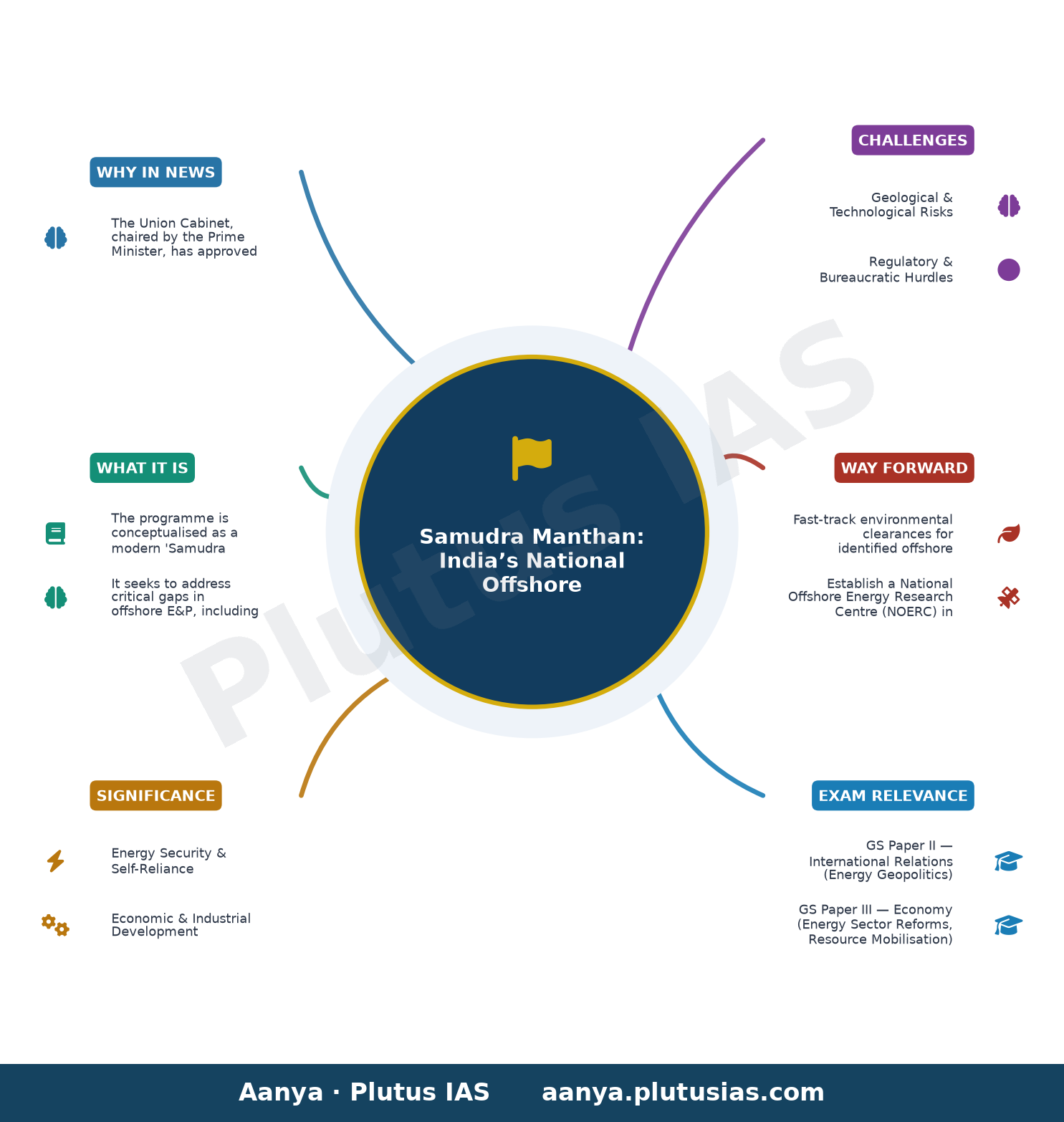
✎ The Union Cabinet, chaired by the Prime Minister, has approved 'Samudra Manthan'—the National Offshore Exploration Programme—with an outlay of ₹84,084 crore under the Ministry of Petroleum and Natural Gas.
 Offshore explorationHydrocarbon potentialSeismic dataDrilling operationsEnergy securityPublic investment
Subject Relevance — Where This Topic Fits
- GS Paper II — International Relations (Energy Geopolitics) | GS Paper III — Economy (Energy Sector Reforms, Resource Mobilisation)
- Prelims: Offshore Exploration, National Data Repository, Hydrocarbon Exploration Licensing Policy (HELP), Discovered Small Fields (DSF) Policy, Energy Security, Atmanirbharta in Energy, Deep-Water Drilling, Seismic Data Acquisition, Production Sharing Contracts (PSCs), Blue Economy, Maritime Zones Act, UNCLOS, Indian National Oil Companies (ONGC, OIL, GAIL), Make in India, PLI Schemes for Energy Equipment
- Essay: Energy Security as a Pillar of National Sovereignty and Economic Growth, India’s Maritime Vision: From Blue Economy to Blue Energy
Why is this in the news?
The Union Cabinet, chaired by the Prime Minister, has approved ‘Samudra Manthan’—the National Offshore Exploration Programme—with an outlay of ₹84,084 crore under the Ministry of Petroleum and Natural Gas. Announced as a modern equivalent of the mythological ‘Samudra Manthan’ during the 2025 Independence Day address, the scheme aims to unlock India’s vast offshore hydrocarbon potential to enhance energy security, accelerate domestic exploration and production, foster technological leadership, and contribute to the ‘Viksit Bharat’ vision by 2047. The programme is a strategic public investment initiative designed to catalyse a new phase of offshore exploration through high-quality seismic data acquisition, advanced drilling in deep and ultra-deep waters, and the development of shared infrastructure for offshore production and evacuation.
Background
- India’s hydrocarbon sector has historically relied on onshore and shallow-water fields, with offshore production contributing only ~15% of total crude output despite vast potential in the Exclusive Economic Zone (EEZ) and continental shelf.
- The Hydrocarbon Exploration Licensing Policy (HELP), introduced in 2016, replaced the erstwhile New Exploration Licensing Policy (NELP) to streamline exploration and production (E&P) activities through revenue-sharing contracts and open acreage licensing.
- The Discovered Small Fields (DSF) Policy, launched in 2016, aimed to monetise small, marginal, and stranded hydrocarbon discoveries through simplified bidding and fiscal incentives.
- The National Data Repository (NDR), operational since 2019, serves as a centralised platform for geoscientific data, enabling evidence-based decision-making in E&P activities.
- India’s energy import dependence exceeds 80%, making energy security a critical national priority, particularly in the context of geopolitical volatility and the global energy transition.
- The ‘Atmanirbhar Bharat’ initiative and ‘Make in India’ campaigns have emphasised reducing import dependence in critical sectors, including energy infrastructure and technology.
What is Samudra Manthan — National Offshore Exploration Programme?
- The programme is conceptualised as a modern ‘Samudra Manthan’—a metaphorical churning of the ocean—to extract India’s latent offshore energy resources, aligning with the Prime Minister’s vision for a ‘Viksit Bharat’ by 2047.
- It seeks to address critical gaps in offshore E&P, including limited high-resolution seismic data, technological constraints in deep and ultra-deep water drilling, and inadequate shared infrastructure for production and evacuation.
- Key components include large-scale acquisition, processing, and interpretation of high-quality seismic data; rapid exploration drilling in deep and ultra-deep waters; scientific drilling in underexplored basins; and development of shared infrastructure for offshore production and evacuation.
- The scheme integrates digital programme management, capacity building, technology adoption, stakeholder engagement, and international collaboration to create a globally competitive offshore E&P ecosystem in India.
- It is expected to unlock over 600 Million Metric Tonnes of Oil Equivalent (MMTOE) of hydrocarbon reserves, significantly boosting domestic production and reducing import dependence.
- The programme will generate substantial employment opportunities across the E&P value chain, including in manufacturing, services, and technology sectors, while promoting ‘Make in India’ and ‘Atmanirbhar Bharat’ initiatives.
- By fostering innovation and long-term investments in offshore technology, the scheme aims to position India as a leader in offshore energy exploration, contributing to both energy security and economic growth.
Key Features
| Feature | Significance |
|---|---|
| Central Sector Scheme under Ministry of Petroleum & Natural Gas | Ensures direct government oversight and alignment with national energy security objectives, bypassing state-level delays. |
| Financial Outlay of ₹84,084 crore (2026–2031) | Largest dedicated public investment in offshore exploration, signalling long-term commitment to reducing import dependence in hydrocarbons. |
| Seismic Data Acquisition & Analysis | High-resolution 3D/4D seismic surveys to map subsea geological structures, reducing exploration risks and improving discovery rates. |
| Deep & Ultra-Deep Water Drilling | Targeting frontier basins (e.g., KG-D6, Mumbai Offshore) with cutting-edge drilling rigs to unlock 600+ MTOE reserves. |
| Shared Infrastructure Development | Creation of common platforms for oil/gas extraction, processing, and evacuation to reduce per-unit costs and enhance efficiency. |
| Digital Programme Management & Capacity Building | AI-driven data analytics, skill development, and stakeholder integration to foster a competitive offshore ecosystem. |
Why it Matters
Energy Security & Self-Reliance
- Aims to reduce India’s import bill by accelerating domestic hydrocarbon production, aligning with the ‘Atmanirbhar Bharat’ and ‘Energy Transition’ goals.
- Targets 600+ million metric tonnes of oil equivalent (MTOE) reserves, potentially reducing import dependence by 10–15% over 15 years.
- Complements existing reforms like the Open Acreage Licensing Policy (OALP) and Discovered Small Fields (DSF) policy.
Economic & Industrial Development
- Expected to generate 500,000+ direct and indirect jobs in engineering, geosciences, logistics, and manufacturing sectors.
- Boosts ‘Make in India’ by promoting indigenous development of offshore technologies, rigs, and ancillary services.
- Long-term investment in R&D and infrastructure will attract global players, fostering a high-tech export-oriented industry.
Technological & Geopolitical Leverage
- Positions India as a leader in deep-water exploration, enhancing strategic autonomy in energy diplomacy.
- Facilitates technology transfer from global majors (e.g., ExxonMobil, TotalEnergies) while building domestic expertise.
- Strengthens India’s bargaining power in maritime disputes (e.g., South China Sea) through enhanced energy resource mapping.
Environmental & Sustainability Dimensions
- Incorporates best practices in carbon capture, methane flaring reduction, and eco-friendly drilling to align with India’s net-zero commitments.
- Promotes circular economy models via shared infrastructure, reducing waste and improving resource utilisation efficiency.
Challenges
1. Geological & Technological Risks
- High failure rates in deep-water drilling due to complex geological formations (e.g., fractured reservoirs, high-pressure zones).
- Dependence on imported advanced drilling rigs and seismic vessels, exposing the plan to global supply chain disruptions.
- Limited domestic expertise in ultra-deep water exploration, necessitating heavy reliance on foreign technical partners.
UPSC Link: GS3: Science & Tech (Technological challenges in energy)
2. Regulatory & Bureaucratic Hurdles
- Coordination challenges between central ministries (Petroleum, Environment, Shipping) and state governments for clearances.
- Delays in environmental impact assessments (EIAs) and wildlife clearances for offshore projects near ecologically sensitive zones.
- Complexity in land acquisition for onshore processing facilities and pipeline routes.
UPSC Link: GS2: Governance (Policy implementation)
3. Economic Viability & Market Dynamics
- Volatility in global oil prices may deter private sector participation despite government incentives.
- High capital expenditure (CAPEX) requirements for deep-water projects may strain public finances over the long term.
- Competition from cheaper renewables (solar/wind) could reduce the economic attractiveness of hydrocarbons in the energy mix.
UPSC Link: GS3: Economy (Investment climate)
4. Environmental & Social Opposition
- Potential resistance from coastal communities and environmental groups over pollution risks and marine ecosystem damage.
- Legal challenges under the Wildlife Protection Act and Coastal Regulation Zone (CRZ) norms for offshore projects.
- Need for robust disaster management plans to mitigate risks of oil spills (e.g., Deepwater Horizon incident).
UPSC Link: GS3: Environment (Sustainable development)
5. Human Capital & Skill Gaps
- Shortage of skilled geoscientists, engineers, and technicians trained in offshore exploration technologies.
- Brain drain to foreign energy firms due to better remuneration and career prospects abroad.
- Limited R&D infrastructure in Indian universities and research institutions for offshore energy technologies.
UPSC Link: GS3: Science & Tech (Skill development)
Challenges — UPSC Perspective
| Issue | Concern |
|---|---|
| Deep-water drilling complexity | High risks of dry wells and cost overruns due to unproven geological structures. |
| Environmental clearances | Delays in EIA approvals for projects near marine protected areas (e.g., Gulf of Mannar). |
| Global oil price volatility | Reduces investor confidence in long-term offshore projects with high sunk costs. |
| Technology transfer constraints | Over-reliance on foreign firms for critical drilling and seismic technologies. |
| Land acquisition challenges | Resistance from coastal communities over displacement and livelihood impacts. |
| Disaster preparedness gaps | Inadequate infrastructure for oil spill response in remote offshore locations. |
Way Forward
- Fast-track environmental clearances for identified offshore blocks through a single-window portal (e.g., PARIVESH 2.0).
- Establish a National Offshore Energy Research Centre (NOERC) in collaboration with IITs/ISRO to develop indigenous technologies.
- Incentivise private sector participation via production-linked incentives (PLI) and tax holidays for deep-water projects.
- Develop a dedicated fleet of ultra-deep-water drilling rigs through PPP models with global energy majors.
- Strengthen disaster management protocols, including real-time monitoring systems and rapid response teams for oil spills.
- Expand skill development programmes via collaborations with NITI Aayog, NSDC, and international energy agencies (e.g., IEA).
- Integrate offshore exploration with India’s hydrogen and ammonia export strategy to diversify energy revenue streams.
UPSC Value Addition
Keywords for Mains Answer-Writing
National Offshore Exploration Policy (NOEP), ‘Samudra Manthan’, offshore hydrocarbon exploration, energy security, strategic petroleum reserves, National Data Repository (NDR), Production Sharing Contracts (PSCs), Discovered Small Fields (DSF) policy, Make in India in energy sector, Atmanirbhar Bharat, deep-water exploration, seismic data acquisition, Integrated Oil and Gas Manufacturing and Services Ecosystem, PMO’s vision for energy independence, geopolitical implications of offshore exploration
Constitutional & Policy Linkages
- [‘Article 297 (Territorial waters and continental shelf)’, ‘Defines India’s maritime jurisdiction for resource exploitation.’]
- [‘Seventh Schedule (Union List, Entry 53)’, ‘Empowers Parliament to legislate on mineral and hydrocarbon resources.’]
- [‘Article 253 (International agreements)’, ‘Facilitates cross-border cooperation in offshore energy projects (e.g., Sri Lanka, Myanmar).’]
Concept Flow
India’s rising energy demand → High import dependence (~85% of oil, 55% of gas) → Vulnerability to geopolitical shocks → Launch of ‘Samudra Manthan’ to accelerate domestic production. → Policy reforms (OALP, DSF) → Limited success in onshore/ shallow-water basins → Focus shifts to deep/ultra-deep offshore basins (e.g., KG-D6, Mumbai Offshore). → Government approval of ₹84,084 crore scheme → Massive seismic data acquisition → Identification of high-potential reserves (600+ MTOE). → Shared infrastructure development → Reduced per-unit costs → Attracts private investment → Boosts ‘Make in India’ in offshore tech. → Skill development & R&D → Indigenous capabilities → Technology transfer → Global competitiveness in offshore energy sector. → Energy security gains → Reduced import bill → Fiscal space for social welfare → Contributes to ‘Viksit Bharat 2047’ vision.
Prelims Practice Questions
Q1. Consider the following statements regarding the National Offshore Exploration Policy (NOEP) ‘Samudra Manthan’:
1. The scheme is implemented by the Ministry of Petroleum and Natural Gas under the Central Sector Scheme framework.
2. The total outlay approved for the scheme is ₹84,084 crore for implementation up to the financial year 2030-31.
3. The policy aims to enhance India’s energy security by accelerating offshore exploration and production activities.
4. The scheme includes provisions for the development of shared infrastructure for offshore production and evacuation.
How many of the above statements are correct?
- Only one
- Only two
- Only three
- All
Answer: All — Statements 1, 2, and 3 are correct as per the official PIB release. Statement 4 is also correct as the scheme explicitly includes shared infrastructure development for offshore production and evacuation.
Q2. Assertion (A): The National Offshore Exploration Policy ‘Samudra Manthan’ is designed to leverage India’s vast offshore energy potential to bolster domestic exploration and production.
Reason (R): The policy includes measures such as large-scale seismic data acquisition, deep-water drilling, and the establishment of an integrated oil and gas manufacturing and services ecosystem.
- Both A and R are true, and R is the correct explanation of A
- Both A and R are true, but R is not the correct explanation of A
- A is true, but R is false
- A is false, but R is true
Answer: Both A and R are true, and R is the correct explanation of A — Both the assertion and reason are true. The assertion correctly states the objective of the policy, while the reason elaborates on the specific measures included to achieve this objective, making R the correct explanation of A.
Q3. Match the following components of the ‘Samudra Manthan’ policy with their corresponding objectives:
Column I (Component) | Column II (Objective)
———————————————–|————————————————–
1. Large-scale seismic data acquisition | A. Enhance domestic oil and gas production
2. Deep-water drilling | B. Strengthen energy security
3. Shared infrastructure for offshore production | C. Accelerate exploration in underexplored basins
4. Integrated oil and gas ecosystem | D. Foster technological leadership and innovation
- 1-A, 2-B, 3-C, 4-D
- 1-B, 2-C, 3-D, 4-A
- 1-C, 2-B, 3-A, 4-D
- 1-D, 2-C, 3-B, 4-A
Answer: 1-D, 2-C, 3-B, 4-A — 1-C: Large-scale seismic data acquisition is aimed at accelerating exploration in underexplored basins. 2-B: Deep-water drilling is part of the strategy to enhance energy security. 3-A: Shared infrastructure for offshore production is designed to boost domestic oil and gas production. 4-D: The integrated oil and gas ecosystem aims to foster technological leadership and innovation.
Mains Practice Question
✍ Critically examine the significance of the ‘Samudra Manthan’ (National Offshore Exploration Policy) in the context of India’s energy security and economic development. How does this policy align with the broader vision of ‘Atmanirbhartha’ in the energy sector? (15 Marks)
Approach: MODEL-ANSWER SKELETON:
1. **Introduction (2 Marks)**
– Briefly define ‘Samudra Manthan’ and its core objectives: accelerating offshore hydrocarbon exploration, enhancing domestic production, and fostering technological self-reliance.
– Contextualize within India’s energy security challenges: import dependence (~85% of crude oil), rising demand, and the need for long-term energy independence.
2. **Energy Security and Strategic Autonomy (4 Marks)**
– **Reduction in import dependence**: Highlight the potential to tap into India’s estimated 600 MMTOE offshore reserves, reducing reliance on imported hydrocarbons.
– **Strategic Petroleum Reserves (SPR)**: Link the policy to India’s existing SPR infrastructure (e.g., Visakhapatnam, Mangalore, Padur) and its role in mitigating supply disruptions.
– **Geopolitical implications**: Discuss how domestic production could reduce vulnerability to global oil price fluctuations and geopolitical pressures (e.g., supply chain disruptions in the Middle East).
3. **Economic Development and ‘Atmanirbhar Bharat’ (4 Marks)**
– **Boost to domestic industry**: Emphasize the policy’s focus on shared infrastructure, integrated manufacturing, and services ecosystem to promote ‘Make in India’ in the energy sector.
– **Employment generation**: Highlight the potential for large-scale job creation across the value chain (e.g., seismic surveys, drilling, infrastructure development).
– **Technological leapfrogging**: Discuss the policy’s role in advancing India’s capabilities in deep-water exploration, seismic data analysis, and offshore technologies, aligning with the ‘Atmanirbhar Bharat’ vision.
4. **Challenges and Critical Analysis (3 Marks)**
– **Environmental and regulatory hurdles**: Address concerns related to deep-water drilling (e.g., ecological risks, regulatory compliance under the Environment Protection Act, 1986).
– **Capital intensity and risk**: Highlight the high-risk, high-reward nature of offshore exploration and the need for private sector participation (e.g., Production Sharing Contracts, Discovered Small Fields policy).
– **Global competition**: Compare India’s offshore exploration capabilities with global leaders (e.g., Norway, Brazil) and the need for sustained investment in R&D and infrastructure.
5. **Conclusion (2 Marks)**
– Summarize the transformative potential of ‘Samudra Manthan’ in reshaping India’s energy landscape.
– Reiterate its alignment with ‘Atmanirbhartha’ by reducing import dependence, fostering indigenous innovation, and creating a globally competitive energy ecosystem.
– Conclude with a balanced view: While the policy is a strategic step forward, its success hinges on effective implementation, regulatory oversight, and sustained public-private partnerships.
Source: PIB (Press Information Bureau)
Generated by AanyaAi for educational purpose.

- UPSC Civil Services (Main) Examination 2026 — Sanskrit Literature Paper II: Question Paper | Plutus IAS - September 21, 2026
- चीनी राष्ट्रपति शी जिनपिंग अमेरिका दौरे पर, ट्रंप से मिलेंगे वार्ता हेतु - September 21, 2026
- Xi Jinping’s US Visit: Key Takeaways for UPSC & State PCS Aspirants - September 21, 2026

No Comments