


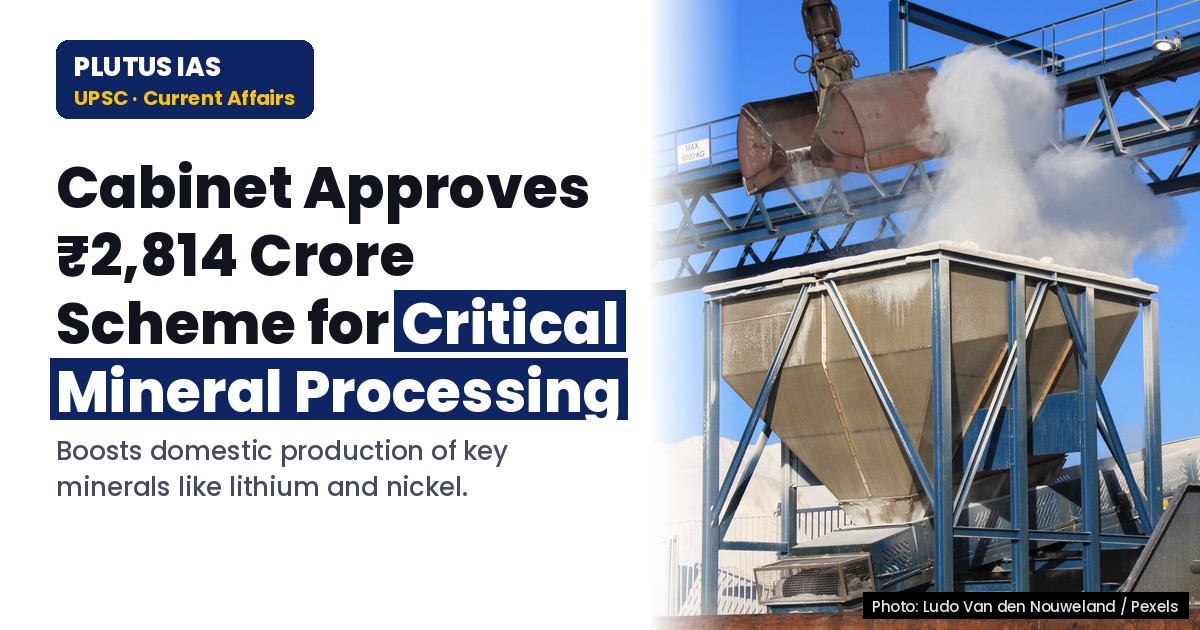
04 Nov Cabinet Approves Critical Mineral Processing Scheme
✎ The Capex Support Scheme provides Rs. 2,814 crore to promote domestic processing of critical minerals like lithium and nickel, aiming to enhance India's self-reliance in strategic industrial inputs.
Subject Relevance — Where This Topic Fits
- GS Paper III — Economy — Infrastructure: Energy, Ports, Roads, Airports, Railways etc. | GS Paper III — Economy — Investment Models | GS Paper III — Science and Technology — Indigenization of Technology and Developing New Technology
- Prelims: Critical Minerals, Lithium, Nickel, Capital Expenditure (Capex) Support Scheme, Mineral Security Partnership (MSP), Electric Vehicles (EVs), Renewable Energy Technologies, Strategic Minerals
- Essay: The Role of Critical Minerals in India’s Economic Growth and Strategic Autonomy, Balancing Economic Development with Environmental Sustainability in Resource Extraction
Quick Revision: The Capex Support Scheme provides Rs. 2,814 crore to promote domestic processing of critical minerals like lithium and nickel, aiming to enhance India’s self-reliance in strategic industrial inputs.
Why is this in the news?
The Union Cabinet has recently accorded its approval for a Capital Expenditure (Capex) Support Scheme, allocating an outlay of Rs. 2,814 crore. This scheme is specifically designed to promote the processing of critical minerals, with an initial focus on lithium and nickel. This strategic move aims to bolster India’s domestic capabilities in the value chain of these essential minerals, which are crucial for advanced technologies and the nation’s energy transition goals.
Background
- Critical minerals are elements that are essential for modern industrial economies, with a high risk of supply chain disruption due to geological scarcity, geopolitical factors, or concentrated processing capacities.
- Lithium and nickel are vital components in the manufacturing of rechargeable batteries, particularly for Electric Vehicles (EVs) and grid-scale energy storage systems, which are central to India’s clean energy transition.
- India is significantly dependent on imports for many critical minerals and their processed forms, leading to vulnerabilities in its strategic sectors and economic growth.
- The global demand for critical minerals is projected to surge dramatically in the coming decades, driven by the widespread adoption of renewable energy technologies and digital infrastructure.
- The government has been actively exploring avenues to secure critical mineral supplies, including participation in international initiatives like the Mineral Security Partnership (MSP) and domestic exploration efforts.
- Developing indigenous processing capabilities for critical minerals is crucial for enhancing India’s self-reliance, reducing import dependence, and fostering a robust domestic manufacturing ecosystem.
What is the Capex Support Scheme for Critical Mineral Processing?
- The Capex Support Scheme is a financial incentive mechanism designed to encourage investment in the processing of critical minerals within India.
- It provides capital expenditure support to eligible entities undertaking projects for the beneficiation, refining, and processing of identified critical minerals.
- The scheme’s initial phase targets lithium and nickel, recognizing their immediate strategic importance for India’s energy and industrial sectors.
- The objective is to reduce India’s reliance on imported processed critical minerals by fostering domestic value addition and technological advancement.
- By supporting domestic processing, the scheme aims to create a resilient supply chain, mitigate geopolitical risks, and ensure the availability of these essential materials for strategic industries.
- The scheme is expected to attract private sector investment, facilitate technology transfer, and create employment opportunities in the critical minerals sector.
- It aligns with broader national initiatives such as ‘Make in India’ and ‘Atmanirbhar Bharat’, promoting self-sufficiency and economic growth.
- The scheme is administered by the Ministry of Mines, which is responsible for the overall policy framework and implementation of mineral-related initiatives in India.
Key Features
| Feature | Significance |
|---|---|
| Scheme Name | Capital Expenditure Support Scheme to Promote Critical Mineral Processing |
| Approved Outlay | Rs. 2,814 Crore |
| Target Minerals | Lithium and Nickel |
| Objective | To enhance domestic processing capabilities for critical minerals, reducing import dependence. |
| Implementation Mechanism | Financial assistance for capital expenditure incurred by eligible entities in critical mineral processing. |
| Strategic Importance | Securing supply chains for advanced technologies and promoting self-reliance in critical mineral value addition. |
Why it Matters
Economic Significance
- Fosters domestic value addition in critical minerals, moving beyond raw material extraction to processing and manufacturing.
- Reduces import bills and strengthens the balance of payments by decreasing reliance on foreign processed minerals.
- Stimulates investment in advanced manufacturing and processing technologies, creating high-skill employment opportunities.
- Enhances India’s competitiveness in global supply chains for electric vehicles, renewable energy, and advanced electronics.
Strategic Significance
- Ensures a stable and secure supply of critical minerals essential for national security and strategic industries.
- Mitigates geopolitical risks associated with concentrated global supply chains of critical minerals.
- Positions India as a key player in the global critical mineral value chain, enhancing its strategic autonomy.
- Supports the ‘Atmanirbhar Bharat’ initiative by building indigenous capabilities in a vital sector.
Environmental Significance
- Facilitates the transition to a green economy by securing inputs for electric vehicles and renewable energy storage.
- Promotes sustainable mining and processing practices within the country, adhering to environmental regulations.
- Reduces the carbon footprint associated with long-distance transportation of processed critical minerals.
Technological Significance
- Drives research and development in advanced material science and processing techniques for critical minerals.
- Encourages technological innovation and indigenous development of efficient and environmentally friendly processing methods.
- Supports the growth of high-tech industries reliant on these minerals, such as battery manufacturing and semiconductor fabrication.
Challenges
1. Technological Gaps
- Lack of advanced processing technologies for complex critical mineral ores.
- High capital intensity and specialized expertise required for setting up processing facilities.
UPSC Link: Science & Technology: Indigenization of technology
2. Environmental and Social Concerns
- Potential environmental impacts of mineral processing, including waste generation and pollution.
- Challenges in obtaining social license to operate and addressing local community concerns.
UPSC Link: Environment: Environmental impact assessment
3. Supply Chain Vulnerabilities
- Reliance on a few countries for raw critical mineral imports, exposing India to supply disruptions.
- Price volatility in global critical mineral markets affecting project viability.
UPSC Link: Economy: Supply chain management
4. Infrastructure Deficiencies
- Inadequate infrastructure for transportation, power, and water, crucial for large-scale processing units.
- Need for specialized logistics to handle hazardous materials involved in processing.
UPSC Link: Infrastructure: Energy, Ports, Roads
5. Financial Viability
- Long gestation periods and high upfront costs for critical mineral processing projects.
- Competition from established global players with economies of scale.
UPSC Link: Economy: Investment models
Challenges — UPSC Perspective
| Issue | Concern |
|---|---|
| Resource Availability | While India has some critical mineral reserves, the quantity and quality of economically viable deposits for domestic processing remain a concern. |
| Skill Development | Shortage of skilled personnel in advanced mineral processing, metallurgy, and chemical engineering required for specialized operations. |
| Regulatory Framework | Need for a streamlined and predictable regulatory environment to attract and sustain investments in this capital-intensive sector. |
| Global Competition | Facing competition from countries with well-established critical mineral processing industries and lower production costs. |
| Market Access | Ensuring domestic processed critical minerals can compete effectively in global markets and meet international quality standards. |
| Waste Management | Developing sustainable and efficient methods for managing by-products and waste generated during critical mineral processing. |
Government Initiatives — Must-Memorise for Prelims
- National Mineral Policy, 2019
- Mines and Minerals (Development and Regulation) Act, 1957 (as amended)
Way Forward
- Invest in advanced research and development for indigenous, cost-effective, and environmentally friendly critical mineral processing technologies.
- Establish strategic partnerships with mineral-rich nations to secure long-term raw material supply agreements and technology transfer.
- Develop a robust skill development ecosystem to train a specialized workforce in critical mineral exploration, mining, and processing.
- Streamline regulatory approvals and provide fiscal incentives to attract both domestic and foreign investment in critical mineral processing facilities.
- Promote circular economy principles in critical mineral value chains, focusing on recycling and urban mining to augment supply.
- Implement stringent environmental safeguards and promote best practices to ensure sustainable and responsible critical mineral processing.
- Foster collaboration between industry, academia, and government to create an integrated ecosystem for critical mineral development.
UPSC Value Addition
Keywords for Mains Answer-Writing
Critical minerals · Lithium processing · Nickel processing · Capital expenditure support · Strategic autonomy · Electric Vehicles (EVs) · Renewable energy storage · Mineral security · Value chain development · Make in India · Circular economy · Economic diversification
Constitutional & Policy Linkages
- {‘article’: ‘Article 297’, ‘note’: ‘Ownership of minerals in territorial waters’}
- {‘article’: ‘Seventh Schedule, List I (Union List), Entry 54’, ‘note’: ‘Regulation of mines and mineral development’}
Concept Flow
Global demand for critical minerals rises. → India identifies critical minerals for strategic autonomy. → Cabinet approves Capex Support Scheme. → Financial aid provided for lithium, nickel processing. → Domestic processing capacity for critical minerals increases. → Reduced import dependence, enhanced economic security.
Prelims Practice Questions
Q1. Consider the following statements regarding critical minerals:
1. Critical minerals are essential for economic development and national security.
2. India is largely self-sufficient in the domestic production of critical minerals like Lithium and Nickel.
3. The Capex Support Scheme aims to promote upstream mining activities for critical minerals.
- Only one
- Only two
- Only three
- None
Answer: Only one — Statement 1 is correct: Critical minerals are vital for various advanced technologies and strategic sectors. Statement 2 is incorrect: India is significantly dependent on imports for several critical minerals, including Lithium and Nickel. Statement 3 is incorrect: The scheme focuses on downstream processing of critical minerals, not primarily upstream mining.
Q2. Which of the following sectors are primarily dependent on critical minerals like Lithium and Nickel?
1. Electric Vehicle (EV) batteries
2. Renewable energy storage systems
3. Aerospace components
4. Defence manufacturing
- 1 and 2 only
- 2 and 3 only
- 1, 2 and 4 only
- 1, 2, 3 and 4
Answer: 1, 2, 3 and 4 — Lithium and Nickel are crucial for EV batteries and renewable energy storage. They are also increasingly important in high-performance alloys for aerospace and defence applications, making all four sectors dependent.
Mains Practice Question
✍ Examine the strategic significance of critical minerals for India’s economic growth and national security. Discuss how government initiatives, such as the recently approved Capex Support Scheme for critical mineral processing, contribute to achieving self-reliance in this sector. (15 Marks)
Approach: MODEL-ANSWER SKELETON:
1. **Introduction**: Define critical minerals and their importance for modern economies.
2. **Strategic Significance (Economic Growth)**:
* Role in Electric Vehicles (EVs), renewable energy (solar, wind), energy storage.
* Impact on high-tech manufacturing, electronics, digital infrastructure.
* Contribution to ‘Make in India’ and industrial diversification.
* Reducing import dependence and strengthening supply chains.
3. **Strategic Significance (National Security)**:
* Ensuring material security for defence and aerospace sectors.
* Mitigating geopolitical risks associated with concentrated global supply.
* Achieving technological sovereignty and strategic autonomy.
* Preventing supply disruptions in critical industries.
4. **Government Initiatives (Capex Support Scheme)**:
* **Objective**: Promote downstream processing of critical minerals (e.g., Lithium, Nickel).
* **Mechanism**: Provide financial assistance for capital expenditure in processing units.
* **Expected Outcomes**: Enhance domestic value addition, create employment, attract investment.
* **Contribution to Self-Reliance**: Reduce reliance on processed imports, develop indigenous capabilities, foster a robust domestic ecosystem.
5. **Other Related Initiatives (Brief Mention)**:
* Amendment to Mines and Minerals (Development and Regulation) Act, 1957.
* Identification of critical mineral blocks for auction.
* Efforts towards international collaborations for mineral sourcing.
6. **Challenges (Briefly)**:
* Technological gaps in processing.
* Environmental concerns.
* High capital intensity.
7. **Conclusion**: Summarise the imperative for a comprehensive strategy to secure critical mineral supply and processing for India’s future.
Source: PIB (Press Information Bureau)
Generated by AanyaAi for educational purpose.
Related guides on our sites
- Current affairs for upsc 2026
- Best PSIR optional coaching for upsc
- Best economics optional coaching for upsc
- Best PSIR optional teacher for upsc

- RBI New Rule: Compensation for Online Fraud Victims - November 8, 2026
- सेबी के नए निपटान विनियम, 2026: मुख्य प्रावधान और प्रभाव - November 8, 2026
- NCST Seeks Report on Nisha Bhagat’s Death in Jharkhand - November 8, 2026

No Comments