


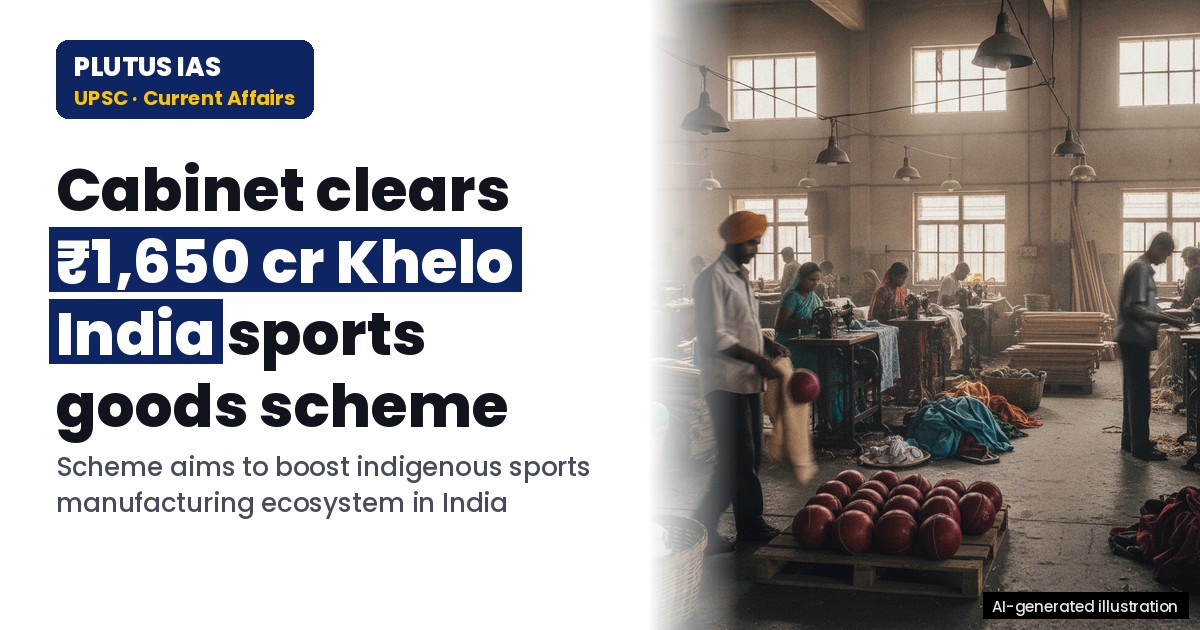
28 Oct Cabinet Approves Khelo India Sports Goods Scheme: Boosting Indigenous Manufacturing
✎ KISGMS is a PLI-based scheme under Khelo India to boost domestic sports goods manufacturing, reduce import dependence, and enhance global competitiveness through financial incentives, technology upgradation, and skill development.
Subject Relevance — Where This Topic Fits
- GS Paper III — Industry and Infrastructure (Industrial Policy, Make in India, PLI Schemes) | GS Paper III — Employment and Skill Development | GS Paper III — Technology Upgradation and Innovation
- Prelims: Khelo India programme, Production Linked Incentive (PLI) Scheme, Sports Goods Export Promotion Council, Make in India, Atmanirbhar Bharat
- Essay: Industrialisation and self-reliance in the era of globalisation, Balancing domestic manufacturing with global quality standards
Quick Revision: KISGMS is a PLI-based scheme under Khelo India to boost domestic sports goods manufacturing, reduce import dependence, and enhance global competitiveness through financial incentives, technology upgradation, and skill development.
Why is this in the news?
The Union Cabinet’s approval of the Khelo India Sports Goods Manufacturing Scheme (KISGMS) signifies a strategic intervention to enhance domestic manufacturing capacity in the sports goods sector, aligning with the broader objectives of Atmanirbhar Bharat and the Khelo India initiative. This scheme is designed to position India as a globally competitive hub for sports goods production, thereby reducing import dependence and fostering employment generation in allied sectors.
Background
- The sports goods manufacturing sector in India has historically been characterised by a high degree of import dependence, particularly for high-value items such as cricket bats, footballs, and protective gear.
- The Government of India’s ‘Make in India’ initiative, launched in 2014, sought to promote domestic manufacturing across sectors, including sports goods, by incentivising investment and technological upgradation.
- The Khelo India programme, introduced in 2018, serves as the overarching framework for sports development in India, encompassing talent identification, infrastructure creation, and grassroots engagement.
- India’s share in global sports goods exports remains marginal, despite possessing significant raw material resources (e.g., leather, wood, and synthetic fibres) and a skilled workforce.
- The COVID-19 pandemic exposed vulnerabilities in global supply chains, prompting renewed emphasis on domestic production and resilience in critical sectors, including sports goods.
- The Production Linked Incentive (PLI) Scheme, operational since 2021, has been a key instrument for incentivising domestic manufacturing in identified sectors, and KISGMS aligns with this policy architecture.
What is the Khelo India Sports Goods Manufacturing Scheme (KISGMS)?
- KISGMS is a sub-scheme under the broader Khelo India initiative, aimed at fostering a globally competitive sports goods manufacturing ecosystem in India by providing financial incentives to domestic manufacturers.
- The scheme seeks to incentivise the production of high-quality sports goods through a Production Linked Incentive (PLI) mechanism, wherein manufacturers receive subsidies based on incremental sales and value addition.
- KISGMS targets both large-scale manufacturers and Micro, Small, and Medium Enterprises (MSMEs), with special provisions for units located in aspirational districts and tribal areas to promote inclusive growth.
- The scheme includes provisions for technology upgradation, skill development, and research and development (R&D) to enhance product quality and cost competitiveness in the global market.
- Financial outlay for KISGMS is structured to cover incentives for a period of five years, with a focus on achieving measurable outcomes such as increased production, employment generation, and export growth.
- The scheme is administered by the Ministry of Youth Affairs and Sports in collaboration with the Ministry of Commerce and Industry, the Sports Goods Export Promotion Council (SGEPC), and other stakeholders.
- KISGMS aligns with India’s commitment to the United Nations Sustainable Development Goals (SDGs), particularly SDG 8 (Decent Work and Economic Growth) and SDG 9 (Industry, Innovation, and Infrastructure).
- The scheme incorporates a monitoring and evaluation framework to assess its impact on domestic manufacturing, employment, and export performance, ensuring transparency and accountability.
Key Features
| Feature | Significance |
|---|---|
| Objective of global competitiveness | Aims to position India as a leading manufacturer of sports goods by enhancing quality, innovation, and cost-efficiency to compete with global markets. |
| Financial outlay and duration | The scheme is approved with a specified financial allocation for a defined period, ensuring sustained funding for infrastructure and capacity-building. |
| Focus on MSMEs and startups | Encourages participation of Micro, Small, and Medium Enterprises (MSMEs) and startups in the sports goods manufacturing ecosystem, fostering entrepreneurship. |
| Integration with Khelo India Mission | Aligns with the broader Khelo India initiative to promote sports culture, talent identification, and infrastructure development, creating a holistic ecosystem. |
| Quality certification and standards | Mandates adherence to national and international quality standards (e.g., BIS, ISO) to ensure global market acceptance of Indian-manufactured sports goods. |
Why it Matters
Economic Growth and Employment
- Boosts domestic manufacturing, reducing import dependency and enhancing India’s share in the global sports goods market, estimated at over $40 billion annually.
- Creates direct and indirect employment opportunities in manufacturing, design, logistics, and ancillary sectors, particularly in tier-2 and tier-3 cities.
- Enhances export potential, contributing to India’s trade balance and foreign exchange reserves through increased global sales of sports goods.
Strategic Autonomy and Supply Chain Resilience
- Reduces reliance on imports for sports equipment, mitigating supply chain disruptions and ensuring self-sufficiency in critical sectors like sports and fitness.
- Strengthens India’s position in global supply chains, particularly in high-demand segments such as cricket, football, and athletics equipment.
- Supports the vision of ‘Atmanirbhar Bharat’ by fostering indigenous innovation and reducing foreign exchange outflow on sports goods imports.
Social and Cultural Impact
- Promotes sports culture and physical fitness by ensuring affordable, high-quality sports equipment for domestic use, aligning with the Khelo India initiative.
- Encourages youth participation in sports by improving access to equipment, thereby supporting talent identification and grassroots development.
- Contributes to public health outcomes by facilitating wider participation in sports activities, reducing lifestyle diseases.
Industrial and Technological Upgradation
- Drives technological adoption in manufacturing processes, including automation, 3D printing, and sustainable materials, enhancing product quality and innovation.
- Facilitates collaboration between industry, academia, and research institutions to develop indigenous technologies and materials for sports goods.
- Promotes circular economy practices, such as recycling and upcycling of materials, to reduce environmental impact and improve sustainability.
Challenges
1. Quality and Standardisation
- Ensuring consistent quality across manufacturers to meet international standards (e.g., FIFA, ICC, or Olympic specifications) remains a challenge.
- Lack of widespread awareness among small manufacturers about certification processes and compliance requirements.
- Risk of counterfeit or substandard products entering the market, undermining consumer trust and export potential.
UPSC Link: GS3: Industrial Policy
2. Infrastructure and Supply Chain Bottlenecks
- Inadequate logistics infrastructure in manufacturing hubs, leading to delays and increased costs in raw material procurement and distribution.
- Dependence on imported raw materials (e.g., synthetic leather, carbon fiber) for high-end sports goods, exposing manufacturers to global price volatility.
- Limited access to advanced manufacturing technologies and skilled labor in rural and semi-urban areas.
UPSC Link: GS3: Infrastructure
3. Market Competition and Branding
- Competing with established global brands (e.g., Adidas, Nike, Puma) that dominate the sports goods market with strong brand loyalty and marketing.
- Limited domestic branding and marketing capabilities, making it difficult to establish Indian sports goods in international markets.
- Price sensitivity in domestic markets, where affordability often outweighs quality considerations.
UPSC Link: GS3: Industrial Policy
4. Policy Implementation and Monitoring
- Ensuring effective implementation of the scheme across diverse geographies and manufacturer segments, including MSMEs and large enterprises.
- Monitoring and evaluation mechanisms to assess the scheme’s impact on employment, export growth, and quality improvement over time.
- Coordination challenges between central, state, and local governments, as well as between industry associations and regulatory bodies.
UPSC Link: GS2: Governance
5. Environmental and Ethical Concerns
- Balancing industrial growth with environmental sustainability, particularly in waste management and carbon footprint reduction in manufacturing processes.
- Addressing ethical labor practices, including fair wages and safe working conditions, in the sports goods manufacturing sector.
UPSC Link: GS3: Environment
6. Talent and Innovation Ecosystem
- Insufficient collaboration between sports goods manufacturers and research institutions to drive innovation in product design and materials.
- Limited focus on R&D in indigenous materials and technologies, leading to over-reliance on imported solutions.
UPSC Link: GS3: Science & Technology
Challenges — UPSC Perspective
| Issue | Concern |
|---|---|
| Quality certification | High costs and complexity of obtaining international certifications deter small manufacturers from entering the global market. |
| Raw material dependency | Over-reliance on imported raw materials increases production costs and exposes manufacturers to global supply chain disruptions. |
| Brand recognition | Domestic manufacturers lack the marketing and branding infrastructure to compete with established global brands. |
| Skilled labor shortage | Limited availability of trained workers in advanced manufacturing processes hinders quality and scalability. |
| Logistics inefficiencies | Poor infrastructure in manufacturing hubs leads to delays, increased costs, and reduced competitiveness. |
| Regulatory compliance | Complex and evolving regulatory frameworks require continuous adaptation, posing challenges for compliance. |
Government Initiatives — Must-Memorise for Prelims
- Khelo India Scheme
- National Sports Development Fund (NSDF)
Way Forward
- Establish dedicated testing and certification centers across manufacturing hubs to streamline quality assurance and reduce compliance costs for MSMEs.
- Launch targeted skill development programs in collaboration with industry associations to address the shortage of trained labor in sports goods manufacturing.
- Create a national-level branding initiative to promote Indian-made sports goods globally, leveraging platforms like ‘Make in India’ and ‘Atmanirbhar Bharat’.
- Develop a robust raw material supply chain by incentivizing domestic production of high-quality inputs (e.g., synthetic leather, carbon fiber) and reducing import dependency.
- Strengthen public-private partnerships (PPPs) to set up advanced manufacturing facilities, particularly in tier-2 and tier-3 cities.
- Introduce a mentorship program pairing established manufacturers with startups to foster innovation, technology transfer, and market access.
- Implement a real-time monitoring system to track the scheme’s progress, including employment generation, export growth, and quality improvements.
- Promote sustainable manufacturing practices through incentives for recycling, upcycling, and the use of eco-friendly materials in sports goods production.
UPSC Value Addition
Keywords for Mains Answer-Writing
Khelo India Sports Goods Manufacturing Scheme · sports manufacturing ecosystem · Make in India · PLI scheme · sports goods industry · global competitiveness · sports infrastructure · manufacturing sector · export promotion · Atmanirbhar Bharat · sports diplomacy · industrial policy · MSMEs in sports · sports economy · self-reliance in sports goods
Concept Flow
Identification of import dependency in sports goods → Policy formulation under Khelo India Mission → Approval of Khelo India Sports Goods Manufacturing Scheme → Financial allocation and infrastructure development → Integration with MSMEs and startups → Focus on quality certification and innovation → Enhanced domestic manufacturing → Increased employment and export potential → Strengthened supply chain resilience → Global competitiveness of Indian sports goods → Contribution to ‘Atmanirbhar Bharat’ and public health outcomes
Prelims Practice Questions
Q1. Consider the following statements regarding the Khelo India Sports Goods Manufacturing Scheme:
1. It is a sub-scheme under the Khelo India Mission.
2. The scheme aims to enhance the global competitiveness of India’s sports goods manufacturing sector.
3. It provides financial incentives to MSMEs for setting up manufacturing units in sports goods.
4. The scheme is implemented by the Ministry of Youth Affairs and Sports exclusively.
How many of the above statements are correct?
- Only one
- Only two
- Only three
- All four
Answer: Only three — Statements 1, 2, and 3 are correct as the scheme is a sub-scheme under Khelo India Mission, aims to boost global competitiveness, and targets MSMEs. Statement 4 is incorrect as the scheme involves multiple ministries, including the Ministry of Commerce and Industry.
Q2. Which of the following is NOT a stated objective of the Khelo India Sports Goods Manufacturing Scheme?
A. To reduce import dependence in sports goods.
B. To promote indigenous design and innovation in sports equipment.
C. To establish India as a global hub for sports goods manufacturing.
D. To provide direct financial assistance to athletes for training.
- A
- B
- C
- D
Answer: D — The scheme focuses on manufacturing and ecosystem development, not direct financial assistance to athletes. Objectives A, B, and C are explicitly stated in the scheme’s framework.
Q3. Assertion (A): The Khelo India Sports Goods Manufacturing Scheme aligns with the broader objectives of the Production-Linked Incentive (PLI) scheme.
Reason (R): The PLI scheme aims to boost domestic manufacturing and reduce import dependence across sectors, including sports goods.
In the context of the above two statements, which one of the following is correct?
- Both A and R are true, and R is the correct explanation of A.
- Both A and R are true, but R is not the correct explanation of A.
- A is true but R is false.
- A is false but R is true.
Answer: Both A and R are true, and R is the correct explanation of A. — Both statements are correct. The Khelo India Sports Goods Manufacturing Scheme complements the PLI scheme by incentivizing domestic manufacturing in sports goods, thereby reducing import dependence and enhancing global competitiveness.
Mains Practice Question
✍ Evaluate the potential of the Khelo India Sports Goods Manufacturing Scheme to transform India into a global hub for sports goods manufacturing. In your answer, critically analyse the scheme’s alignment with existing industrial and sports policies, and discuss the challenges it may face in achieving its objectives. (15 Marks)
Approach: MODEL-ANSWER SKELETON:
1. **Introduction (2 Marks)**
– Briefly outline the Khelo India Sports Goods Manufacturing Scheme: its objectives, target beneficiaries (MSMEs, startups, and established manufacturers), and financial outlays.
– Contextualise within the broader framework of ‘Make in India’, ‘Atmanirbhar Bharat’, and the Production-Linked Incentive (PLI) scheme.
2. **Alignment with Industrial and Sports Policies (5 Marks)**
– **Industrial Policy Alignment**:
– Link to the PLI scheme for sports goods (sector-specific PLI announced in 2021 for 14 sectors, including sports goods).
– Role of the Ministry of Commerce and Industry in implementation and coordination.
– Support for MSMEs: Credit Guarantee Scheme, cluster-based development under the Ministry of MSME.
– **Sports Policy Alignment**:
– Integration with the Khelo India Mission’s broader goals of promoting sports at the grassroots and elite levels.
– Potential to reduce import dependence on sports goods (e.g., cricket bats, footballs, hockey sticks) and enhance self-reliance.
– Synergy with the National Sports Development Fund (NSDF) for infrastructure and athlete support.
3. **Challenges and Constraints (5 Marks)**
– **Market Competition**: Global dominance of established manufacturers (e.g., China, Vietnam) in sports goods, requiring significant cost and quality competitiveness.
– **Technology and Innovation**: Need for R&D investment in indigenous design, materials science, and manufacturing processes to match global standards.
– **Supply Chain and Infrastructure**: Dependence on imported raw materials (e.g., leather, synthetic fibres) and underdeveloped ancillary industries.
– **Skilled Workforce**: Shortage of skilled labour in precision manufacturing and quality control in sports goods.
– **Policy Coordination**: Ensuring seamless coordination among multiple ministries (Youth Affairs and Sports, Commerce and Industry, MSME, and Finance).
4. **Way Forward and Conclusion (3 Marks)**
– **Short-term Measures**: Focus on niche segments (e.g., handcrafted sports goods, eco-friendly materials) to build a brand identity.
– **Long-term Strategies**: Strengthen R&D through partnerships with institutions like the Sports Authority of India (SAI) and IITs; incentivize FDI in sports goods manufacturing.
– **Monitoring and Evaluation**: Establish a robust monitoring mechanism to track progress against targets (e.g., export growth, reduction in import bills).
**Key Terms to Include**: PLI scheme, MSMEs, Khelo India Mission, Atmanirbhar Bharat, NSDF, supply chain resilience, global value chains.
Source: PIB (Press Information Bureau)
Generated by AanyaAi for educational purpose.
Related guides on our sites
- Best PSIR optional coaching for upsc
- Best PSIR optional teacher for upsc
- Best teacher of PSIR optional for upsc
- Best PSIR optional coaching in delhi for UPSC

- Cabinet Approves Khelo India Sports Goods Scheme: Boosting Indigenous Manufacturing - October 28, 2026
- कैबिनेट ने ग्राम स्वराज योजना को 2026-31 तक दी मंजूरी, जानें मुख्य बिंदु - October 28, 2026
- Thoothukudi Mega Shipyard: Union Minister Sonowal’s Seoul Meet Boosts India’s Maritime Ambitions - October 28, 2026

No Comments