


31 Jul Cabinet Approves ₹3.15 Lakh Crore for PM-KISAN Scheme (2026-31)
✎ PM-KISAN is a 100% centrally funded, Aadhaar-integrated Direct Benefit Transfer scheme providing ₹6,000/year to land-holding farmer families, extended till 2031 with a ₹3.15 lakh crore outlay, aimed at boosting agricultural…
Subject Relevance — Where This Topic Fits
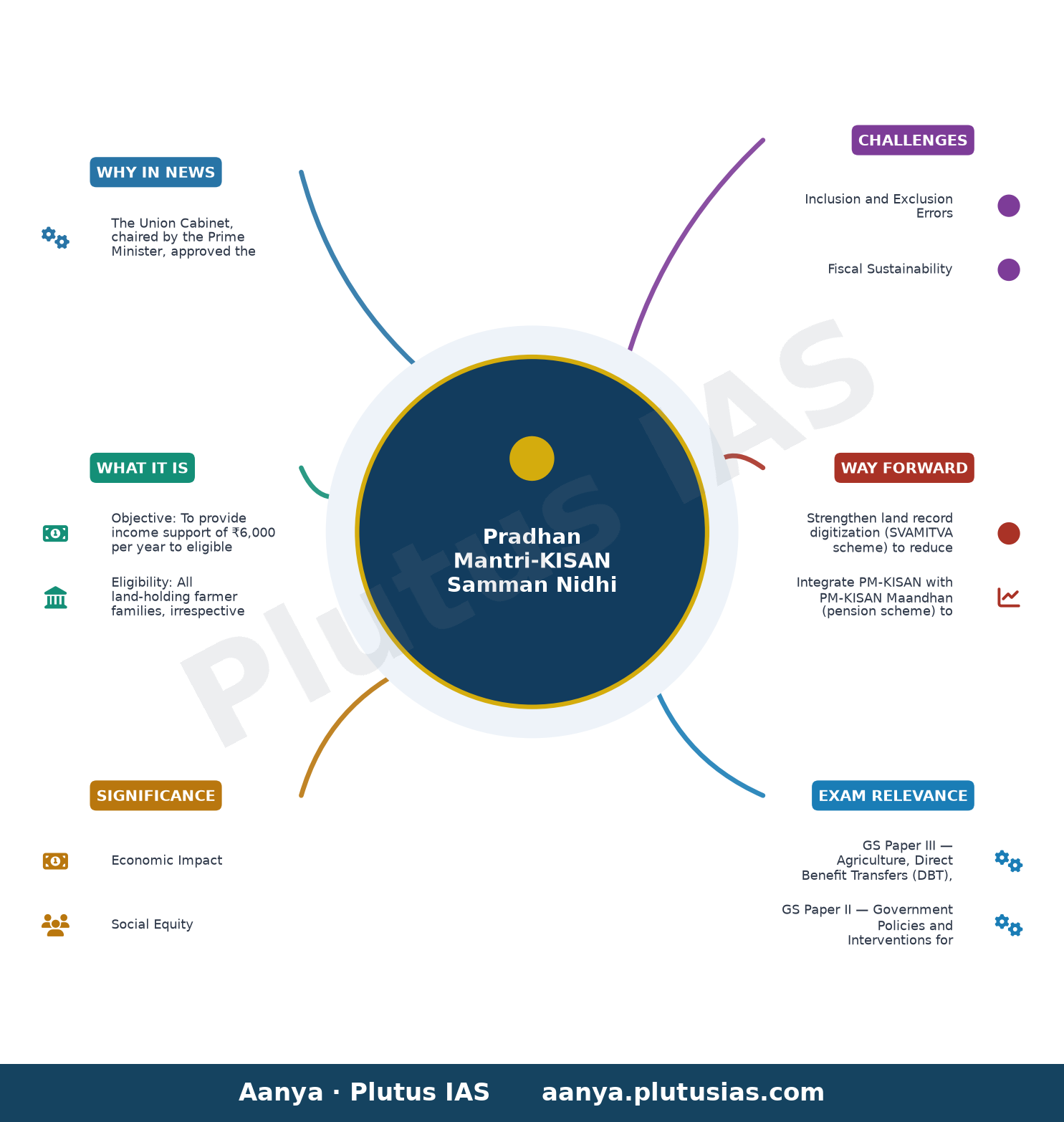
- GS Paper III — Agriculture, Direct Benefit Transfers (DBT), and Rural Development | GS Paper II — Government Policies and Interventions for Development
- Prelims: Pradhan Mantri-KISAN Samman Nidhi (PM-KISAN), Direct Benefit Transfer (DBT), Aadhaar-enabled Payment System (AePS), Kisan Credit Card (KCC), Minimum Support Price (MSP), Minimum Income Support Scheme
- Essay: The Role of Direct Benefit Transfers in India’s Welfare Architecture, Agrarian Distress and Policy Interventions: A Case Study of PM-KISAN
Quick Revision: PM-KISAN is a 100% centrally funded, Aadhaar-integrated Direct Benefit Transfer scheme providing ₹6,000/year to land-holding farmer families, extended till 2031 with a ₹3.15 lakh crore outlay, aimed at boosting agricultural productivity and rural economic resilience.
Why is this in the news?
The Union Cabinet, chaired by the Prime Minister, approved the extension of the Pradhan Mantri-KISAN Samman Nidhi (PM-KISAN) scheme for the five-year period from 2026-27 to 2030-31, with a total financial outlay of ₹3.15 lakh crore. This decision underscores the government’s sustained commitment to augmenting farmer incomes through direct financial assistance, leveraging the Direct Benefit Transfer (DBT) mechanism, and reinforcing the scheme’s role in agricultural productivity and rural economic stability.
Background
- Launched in February 2019, PM-KISAN is a Central Sector Scheme under the Ministry of Agriculture and Farmers’ Welfare, designed to provide income support to land-holding farmer families across India.
- The scheme operates on a 100% Central Government-funded model, with no state share in the financial burden, ensuring uniform implementation nationwide.
- PM-KISAN is a flagship component of the government’s broader strategy to double farmers’ income by 2022 (later extended to 2024), aligning with the objectives of the Doubling Farmers’ Income (DFI) report.
- The scheme is a critical pillar of India’s digital governance framework, integrating Aadhaar-based authentication, geo-tagging of land records, and Direct Benefit Transfer (DBT) to minimise leakages and ensure transparency.
- Since its inception, PM-KISAN has disbursed over ₹4.47 lakh crore to farmers’ bank accounts.
- The scheme has been pivotal during crises such as the COVID-19 pandemic, with ₹1.71 lakh crore disbursed to support farmers’ livelihoods during lockdowns.
What is the Pradhan Mantri-KISAN Samman Nidhi (PM-KISAN) Scheme?
- Objective: To provide income support of ₹6,000 per year to eligible land-holding farmer families in three equal instalments, directly into their bank accounts, to enhance their purchasing power and agricultural investments.
- Eligibility: All land-holding farmer families, irrespective of farm size, subject to exclusion criteria such as high-income taxpayers, institutional landholders, and retired pensioners with a monthly pension exceeding ₹10,000.
- Financial Architecture: The scheme is 100% centrally funded, with no state contribution, ensuring uniformity and reducing fiscal federalism complexities. The total outlay for 2026-31 is ₹3.15 lakh crore.
- Operational Mechanism: Utilises the Direct Benefit Transfer (DBT) platform, integrated with Aadhaar for beneficiary identification, geo-tagging of land records, and Aadhaar-enabled Payment System (AePS) for seamless fund disbursement.
- Digital Governance: Employs a robust digital ecosystem, including the PM-KISAN portal, Common Service Centres (CSCs), and state agriculture departments for real-time monitoring, grievance redressal, and data validation.
- Inclusivity: Actively promotes gender inclusion, with approximately 25% of beneficiaries being women farmers, who have collectively received over ₹1.06 lakh crore under the scheme.
- Impact on Agricultural Productivity: Facilitates timely investment in inputs such as seeds, fertilisers, and irrigation, reducing dependency on informal credit and enhancing farm output.
- Policy Synergy: Aligns with other agricultural schemes such as the Kisan Credit Card (KCC), PM-KISAN Maan Dhan Yojana (for old-age pension), and Soil Health Cards to create a comprehensive support system for farmers.
Key Features
| Feature | Significance |
|---|---|
| Direct Benefit Transfer (DBT) | Eliminates intermediaries, ensures timely and transparent transfer of ₹6,000 annually to eligible farmers’ bank accounts, reducing leakages and corruption. |
| Aadhaar-based Authentication | Prevents duplication and ensures beneficiary identification, enhancing inclusivity and reducing exclusion errors. |
| Three Equal Instalments | Provides staggered financial support (₹2,000 per instalment) aligned with agricultural cycles, aiding liquidity management for farmers. |
| Digital Verification System | Facilitates real-time validation of land records and farmer eligibility, improving administrative efficiency and accountability. |
| Gender Inclusivity | Approximately 25% of beneficiaries are women farmers, promoting gender equity in agricultural welfare schemes. |
Why it Matters
Economic Impact
- Enhances farm-level liquidity, enabling investment in high-yield inputs (seeds, fertilizers, irrigation) and reducing reliance on informal credit markets.
- Boosts rural demand and consumption, creating multiplier effects for allied sectors such as agri-inputs, rural retail, and logistics.
- Supports food security by stabilizing agricultural production through timely input procurement and risk mitigation against price volatility.
Social Equity
- Provides income support to marginal and small farmers, who constitute ~86% of India’s farming households, thereby reducing agrarian distress.
- Promotes inclusive growth by prioritizing landless farmers and tenant cultivators in beneficiary identification processes.
- Empowers women farmers by ensuring direct financial access, contributing to household decision-making autonomy.
Administrative Efficiency
- Demonstrates the scalability of DBT systems in welfare delivery, with over ₹4.47 lakh crore disbursed across 23 instalments with minimal leakages.
- Sets a precedent for technology-driven governance, integrating land records, Aadhaar, and banking infrastructure for seamless service delivery.
- Reduces administrative burden on field officials by automating beneficiary verification and fund disbursement.
Policy Continuity
- Ensures long-term policy stability for farmers, fostering confidence in agricultural investments and rural entrepreneurship.
- Aligns with the government’s vision of ‘Atmanirbhar Bharat’ by strengthening domestic agricultural productivity and reducing import dependency.
Challenges
1. Inclusion and Exclusion Errors
- Risk of exclusion of genuine farmers due to outdated or incomplete land records, particularly in states with poor digitization of land records.
- Potential inclusion of ineligible beneficiaries if Aadhaar seeding is not rigorously enforced, leading to fiscal leakage.
UPSC Link: GS3: Agricultural Marketing & Issues
2. Fiscal Sustainability
- Long-term financial viability of the scheme amid competing demands on the Union budget, especially in scenarios of fiscal consolidation.
- Dependence on DBT infrastructure (Aadhaar, banking networks) may face bottlenecks during peak disbursement periods.
UPSC Link: GS3: Public Distribution System
3. Productivity vs. Income Support Trade-off
- Income support may not directly translate to productivity gains unless complemented by access to credit, extension services, and market linkages.
- Risk of creating a dependency culture among farmers, reducing incentives for innovation and risk-taking in agriculture.
UPSC Link: GS3: Farm Subsidies & MSP
4. Climate Resilience
- Limited scope for climate-adaptive agriculture within the scheme’s current framework, as funds are not earmarked for climate-smart practices.
- Increased frequency of extreme weather events (droughts, floods) may erode the efficacy of fixed income support in mitigating farmer distress.
UPSC Link: GS3: Climate Change & Agriculture
5. Regional Disparities
- Uneven disbursement across states due to variations in land record digitization, banking penetration, and administrative capacity.
- States with higher landholding fragmentation may face challenges in beneficiary identification and fund utilization.
UPSC Link: GS1: Regional Disparities
Challenges — UPSC Perspective
| Issue | Concern |
|---|---|
| Land Record Digitization | Incomplete or outdated records exclude eligible farmers or include ineligible beneficiaries. |
| Aadhaar Linking Gaps | Failure to seed Aadhaar with land records leads to authentication failures and payment delays. |
| Banking Infrastructure | Poor rural banking penetration in remote areas delays fund disbursement to farmers. |
| Climate Vulnerability | Fixed income support does not account for yield losses due to extreme weather events. |
| Fiscal Strain | Sustained high outlays (₹3.15 lakh crore) may crowd out other agricultural or welfare schemes. |
| Monitoring Gaps | Lack of real-time data on fund utilization and impact limits evidence-based policy refinement. |
Way Forward
- Strengthen land record digitization (SVAMITVA scheme) to reduce exclusion errors and improve beneficiary identification accuracy.
- Integrate PM-KISAN with PM-KISAN Maandhan (pension scheme) to provide a safety net for elderly farmers and reduce intergenerational poverty.
- Expand climate-resilient agriculture components within PM-KISAN by linking disbursements to adoption of drought/flood-resistant seeds and micro-irrigation.
- Enhance convergence with agricultural extension services (e.g., Kisan Credit Cards, Soil Health Cards) to ensure income support translates to productivity gains.
- Establish a real-time monitoring dashboard (similar to PM-KISAN’s public dashboard) to track fund utilization, beneficiary feedback, and regional disparities.
- Rationalize fiscal outlays by exploring co-sharing models with state governments for scheme administration and monitoring.
- Promote farmer producer organizations (FPOs) to aggregate demand for inputs and outputs, ensuring economies of scale for beneficiaries.
- Conduct periodic impact assessments by independent agencies (e.g., NITI Aayog, ICAR) to evaluate long-term effects on farm income, productivity, and rural employment.
UPSC Value Addition
Keywords for Mains Answer-Writing
Pradhan Mantri Kisan Samman Nidhi (PM-KISAN) · Direct Benefit Transfer (DBT) · Agrarian distress alleviation · Income support schemes for farmers · Agricultural productivity enhancement · Rural economy strengthening · Digital India and welfare delivery · Farmers’ welfare measures · Agricultural investment and credit · Sustainable agriculture · Government expenditure on welfare schemes · Agricultural subsidies and direct transfers · Kisan credit and financial inclusion · Agricultural policy and farmer-centric governance
Constitutional & Policy Linkages
- Article 39(b): Directive Principle of State Policy mandating equitable distribution of resources, including agricultural income support.
Concept Flow
Policy Announcement (2019) → Direct Benefit Transfer Mechanism → Aadhaar-based Authentication → Farmer Eligibility Verification → Instalment Disbursement → Agricultural Investment → Productivity Enhancement → Rural Income Growth → Economic Multiplier Effects.
Prelims Practice Questions
Q1. Consider the following statements regarding the Pradhan Mantri Kisan Samman Nidhi (PM-KISAN) scheme:
1. It provides direct income support of ₹6,000 per year to eligible landholding farmer families in three equal instalments.
2. The scheme is implemented through the Direct Benefit Transfer (DBT) mechanism.
3. The financial outlay approved for the scheme from 2026-27 to 2030-31 is ₹3.15 lakh crore.
4. The scheme excludes women farmers from its ambit.
How many of the above statements are correct?
- Only one
- Only two
- Only three
- All four
Answer: Only three — Statements 1, 2, and 3 are correct. Statement 4 is incorrect as the scheme includes women farmers, with over 25% of beneficiaries being women.
Q2. Assertion (A): The PM-KISAN scheme utilises Aadhaar-based authentication for beneficiary identification.
Reason (R): Aadhaar authentication ensures transparency and reduces leakages in welfare delivery.
Options:
A. Both A and R are true, and R is the correct explanation of A.
B. Both A and R are true, but R is not the correct explanation of A.
C. A is true, but R is false.
D. A is false, but R is true.
Answer: ? — Both A and R are true, and R correctly explains A. Aadhaar-based authentication is a key feature of PM-KISAN, ensuring transparency and minimising leakages in welfare delivery.
Q3. Match the following columns related to the PM-KISAN scheme:
Column I (Feature) Column II (Description)
1. Financial outlay (2026-31) A. ₹6,000 per year
2. Mode of transfer B. ₹3.15 lakh crore
3. Annual support per farmer family C. Direct Benefit Transfer (DBT)
4. Percentage of women beneficiaries D. 25%
Options:
A. 1-B, 2-C, 3-A, 4-D
B. 1-A, 2-B, 3-C, 4-D
C. 1-D, 2-A, 3-B, 3-C
D. 1-C, 2-B, 3-A, 4-D
Answer: ? — Correct match: 1-B (₹3.15 lakh crore financial outlay for 2026-31), 2-C (DBT mode of transfer), 3-A (₹6,000 annual support), 4-D (25% women beneficiaries).
Mains Practice Question
✍ The Pradhan Mantri Kisan Samman Nidhi (PM-KISAN) scheme represents a paradigm shift in India’s agricultural policy by institutionalising direct income support for farmers. Critically examine the scheme’s design, its impact on agricultural productivity and rural economy, and the challenges in its implementation. Also, assess whether the scheme aligns with the broader objectives of sustainable agriculture and farmer welfare in India. (15 Marks)
Approach: MODEL-ANSWER SKELETON:
1. **Scheme Design and Features** (3 Marks)
– Objective: Provide income support to landholding farmer families via DBT.
– Financial architecture: ₹6,000/year in three instalments; total outlay ₹3.15 lakh crore for 2026-31.
– Targeting: Aadhaar-based authentication, digital verification, and exclusion of higher-income farmers.
– Institutional mechanism: Central sector scheme, implemented by the Ministry of Agriculture and Farmers’ Welfare.
2. **Impact on Agricultural Productivity and Rural Economy** (4 Marks)
– **Productivity gains**: Evidence from independent evaluations (NITI Aayog’s DMEO) indicates 85% beneficiaries reported improved agricultural income and reduced dependence on informal credit.
– **Investment in inputs**: Support enabled timely purchase of seeds, fertilisers, and machinery, enhancing production capacity.
– **Rural economy**: Strengthened economic stability of rural households; contributed to ~21.18% increase in foodgrain production (2020-21 to 2025-26).
– **Gender inclusion**: 25% of beneficiaries are women, promoting gender-sensitive welfare.
3. **Challenges in Implementation** (4 Marks)
– **Exclusion errors**: Incomplete land records and Aadhaar seeding gaps led to exclusion of eligible farmers.
– **Leakages**: Despite DBT, minor leakages persist due to identity fraud or bank account issues.
– **Sustainability concerns**: Long-term fiscal burden; need for convergence with other schemes (e.g., PM-KISAN Maandhan).
– **Regional disparities**: Uneven coverage across states due to varying landholding patterns and administrative capacity.
4. **Alignment with Sustainable Agriculture and Farmer Welfare** (4 Marks)
– **Sustainability**: While PM-KISAN provides income support, it does not directly incentivise sustainable practices (e.g., organic farming, water conservation).
– **Farmer welfare**: Enhances resilience against price volatility and climate shocks; however, lacks linkage to crop insurance or market access.
– **Complementarity**: Must be integrated with schemes like PM-KISAN Maandhan (pension), Soil Health Cards, and PM-AASHA for holistic welfare.
– **Policy coherence**: Aligns with SDG 2 (Zero Hunger) and SDG 1 (No Poverty), but requires strengthening of agricultural extension services for long-term impact.
**Balanced Conclusion**: PM-KISAN is a transformative scheme that addresses immediate income distress and boosts productivity. However, its long-term success hinges on addressing implementation gaps, integrating sustainability measures, and ensuring convergence with other welfare initiatives.
Source: PIB (Press Information Bureau)
Generated by AanyaAi for educational purpose.

- पशुपालन विभाग ‘विशेष अभियान 6’ में करेगा शामिल, जानिए लक्ष्य और तैयारी - September 16, 2026
- UPSC Alert: DAHD’s Success in Special Campaign 5.0 & Special Campaign 6.0 Prep - September 16, 2026
- पीएम विश्वकर्मा योजना के तीन वर्ष: 30 लाख कारीगरों को मिला लाभ, जानें प्रमुख उपलब्धियां - September 16, 2026

No Comments