


24 Jul Cabinet Approves ₹3,030 Crore ‘Bhavya Rasayan’ Chemical Park Scheme
Subject Relevance — Where This Topic Fits
- GS Paper III — Indian Economy and Issues Relating to Planning, Mobilisation of Resources, Growth, Development and Employment | GS Paper III — Effects of Liberalisation on the Economy, Changes in Industrial Policy and their Effects on Industrial Growth
- Prelims: Chemical and Petrochemical Industry, Make in India, PLI Scheme, Special Economic Zones (SEZs), Ease of Doing Business, Logistics Costs in India, Waste Management Infrastructure, Atmanirbhar Bharat
- Essay: The Role of Industrial Parks in India’s Economic Transformation, Self-Reliance through Industrialisation: Challenges and Opportunities
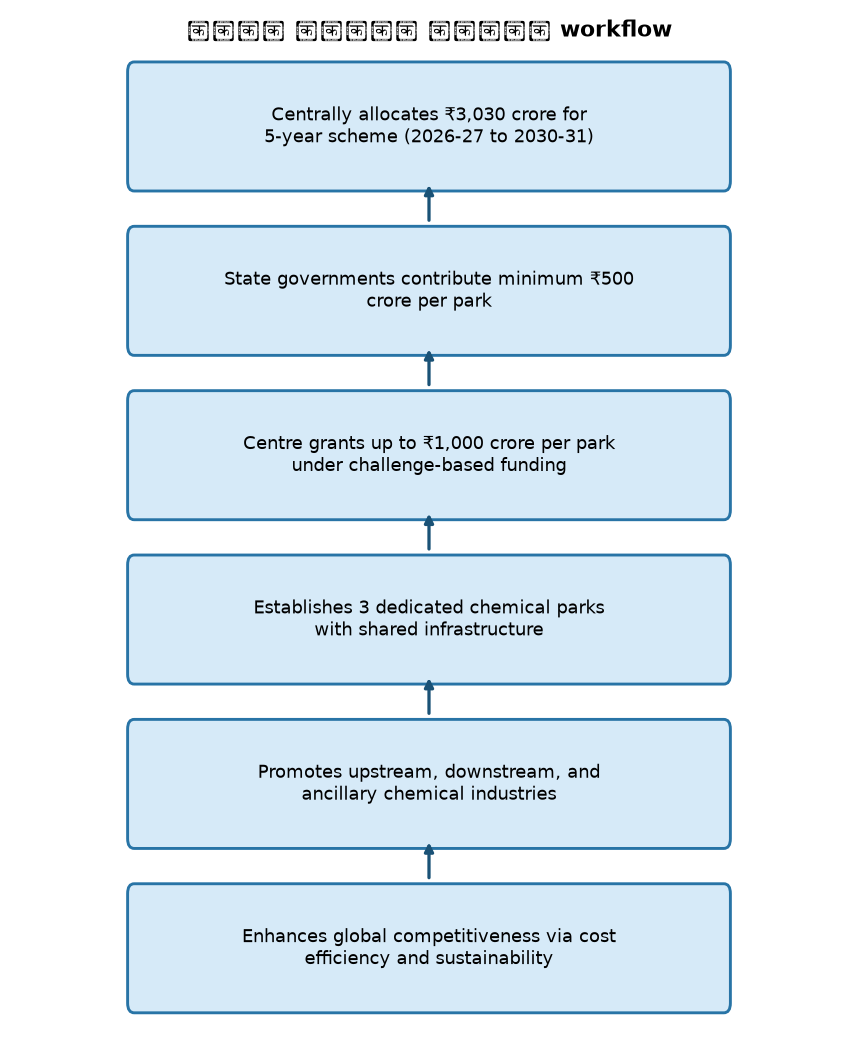
Quick Revision: The BHARAT Chemicals Scheme is a ₹3,030-crore initiative to establish three dedicated chemical parks with shared infrastructure, aiming to reduce logistics costs, enhance environmental compliance, and integrate India’s chemical industry into global value chains.
Why is this in the news?
On 24 July 2026, the Union Cabinet, chaired by the Prime Minister, approved the ‘BHARAT’ Scheme—officially titled the ‘Bharat Industrial Development Scheme for Chemicals (BHARAT Rasayan)’—to establish three dedicated chemical parks across India. This scheme, announced in the Union Budget 2026-27, aims to catalyse the growth of the chemical and petrochemical sector by providing shared infrastructure, reducing logistics costs, and enhancing global competitiveness. The initiative is pivotal for India’s industrial policy, aligning with the vision of ‘Viksit Bharat 2047’ and promoting self-reliance in critical chemical inputs.
Background
- The chemical and petrochemical industry is a foundational segment of India’s manufacturing ecosystem, supplying inputs to agriculture, pharmaceuticals, textiles, construction, automotive, and electronics sectors.
- India’s chemical industry, valued at approximately USD 200 billion in 2025, faces structural challenges such as high logistics costs, fragmented supply chains, and limited shared infrastructure for waste management and utilities.
- Global chemical demand is projected to grow at a CAGR of 4–5% till 2030, with India aiming to increase its share in global chemical exports from 2.5% to 5% by 2030.
- The Union Budget 2026-27 introduced the BHARAT Chemicals Scheme as part of a broader push to enhance domestic manufacturing competitiveness and reduce import dependence in strategic sectors.
- Existing industrial parks in India, such as those under the Petroleum, Chemicals and Petrochemical Investment Regions (PCPIRs) scheme, have demonstrated the efficacy of shared infrastructure in reducing costs and improving compliance.
- The scheme is aligned with the National Logistics Policy 2022, which targets a reduction in logistics costs from 13–14% of GDP to 8% by 2030.
What is the BHARAT Chemicals Scheme?
- Objective: To establish three dedicated chemical parks in India with shared infrastructure to enhance the competitiveness of the chemical and petrochemical industry by reducing costs, improving compliance, and integrating into global value chains.
- Financial Outlay: A total outlay of ₹3,030 crore, with ₹3,000 crore allocated for core infrastructure (including utilities, waste management, and logistics) and ₹30 crore for administrative expenses over five years (2026-27 to 2030-31).
- Funding Mechanism: The central government will provide a grant of up to ₹1,000 crore per park, subject to the state government contributing a minimum of ₹500 crore per park.
- Geographical Spread: Each chemical park will cover a contiguous land area of at least 8 square kilometres, ensuring economies of scale and efficient logistics.
- Core Infrastructure: The parks will feature shared facilities such as Common Effluent Treatment Plants (CETPs), Treatment, Storage, and Disposal Facilities (TSDFs), solvent recovery and distillation units, steam generation and distribution networks, interconnected pipeline systems, and integrated logistics and warehousing hubs.
- Environmental Compliance: The scheme mandates state-of-the-art environmental infrastructure, including hazardous waste management systems, to ensure compliance with environmental norms and promote sustainable industrial growth.
- Competitiveness Enhancement: By reducing upstream sourcing costs, downstream supply chain inefficiencies, and logistics overheads, the scheme aims to improve the global competitiveness of Indian chemical manufacturers.
- Employment Generation: The development of chemical parks is expected to create direct and indirect employment opportunities, particularly in rural and semi-urban areas, thereby supporting inclusive economic growth.
- Integration with Global Value Chains: The scheme seeks to integrate Indian chemical producers into global supply chains, enhancing export competitiveness and reducing import dependence in critical chemical inputs.
Key Features
| Feature | Significance |
|---|---|
| Financial Outlay (₹3,030 crore) | Ensures dedicated budgetary support for infrastructure development, reducing fiscal burden on private investors and enhancing project viability. |
| State Contribution (₹500 crore per park) | Demonstrates cooperative federalism by mandating state-level investment, ensuring local ownership and alignment with regional industrial policies. |
| Central Grant (₹1,000 crore per park) | Provides performance-linked funding to states, incentivizing efficient implementation and adherence to national industrial priorities. |
| Land Requirement (8 sq km per park) | Ensures economies of scale by enabling large-scale industrial clusters, reducing per-unit infrastructure costs and improving logistical efficiency. |
| Shared Infrastructure (CETP, TSDF, pipelines) | Lowers entry barriers for MSMEs by providing pre-built, cost-effective facilities, fostering inclusive growth in the chemical sector. |
| Performance-Based Financing | Introduces competitive mechanisms to allocate funds, ensuring transparency and optimal utilisation of public resources. |
| Sustainability Focus (Green Ecosystem) | Integrates environmental compliance into industrial planning, aligning with global standards and reducing regulatory risks for investors. |
Why it Matters
Economic Growth and Industrialisation
- Enhances domestic production capacity in critical sectors (pharma, agrochemicals, textiles) by reducing import dependency and improving supply chain resilience.
- Stimulates ancillary industries (logistics, packaging, engineering) through backward and forward linkages, creating multiplier effects in employment and GDP growth.
- Boosts India’s position in global value chains by integrating chemical manufacturing with export-oriented industries like electronics and automobiles.
- Supports the vision of a $5 trillion economy by 2027 by catalysing high-value industrial output and attracting FDI in sunrise sectors.
Strategic Autonomy and Self-Reliance
- Reduces reliance on imported chemicals (e.g., specialty chemicals, catalysts) by promoting domestic manufacturing of critical inputs.
- Strengthens India’s bargaining power in global trade negotiations by diversifying supply sources and reducing vulnerability to geopolitical disruptions.
- Aligns with the ‘Atmanirbhar Bharat’ initiative by fostering indigenous innovation and reducing dependence on foreign technology in high-tech chemicals.
Employment and Skill Development
- Generates direct and indirect employment across the chemical value chain, including high-skilled roles in R&D and low-skilled jobs in logistics and operations.
- Creates demand for vocational training in chemical engineering, environmental management, and industrial safety, addressing skill gaps in the labour market.
- Encourages entrepreneurship by lowering barriers to entry for startups in niche chemical segments (e.g., green chemicals, biopharmaceuticals).
Environmental Sustainability
- Integrates circular economy principles through shared waste management infrastructure (CETP, TSDF), reducing industrial pollution and promoting resource efficiency.
- Encourages adoption of cleaner technologies (e.g., solvent recovery, energy-efficient distillation) by providing cost-sharing mechanisms for SMEs.
- Aligns with India’s climate commitments under the Paris Agreement by mandating compliance with environmental norms and reducing carbon footprint of industrial processes.
Global Competitiveness
- Enhances cost competitiveness by reducing logistics costs through integrated pipeline networks and shared logistics hubs.
- Improves India’s attractiveness as a manufacturing hub by offering plug-and-play infrastructure, similar to global chemical parks in Germany or China.
- Facilitates technology transfer and collaboration with MNCs by providing state-of-the-art shared facilities, accelerating industrial upgrading.
Challenges
1. Land Acquisition and Regulatory Hurdles
- Complex land titling issues and delays in obtaining environmental clearances may stall project implementation, as seen in past industrial corridor projects.
- Coordination challenges between central and state governments could lead to delays in securing land parcels and securing necessary approvals.
UPSC Link: GS-III: Land Reforms, Environment Impact Assessment
2. Infrastructure Bottlenecks
- Inadequate last-mile connectivity (roads, railways, ports) in potential park locations may increase operational costs and reduce competitiveness.
- Dependence on shared utilities (e.g., water, power) could lead to supply disruptions if demand outstrips capacity during peak usage periods.
UPSC Link: GS-III: Infrastructure Development
3. Environmental Compliance and Sustainability Risks
- Risk of non-compliance with stringent environmental norms due to inadequate monitoring or enforcement mechanisms in industrial clusters.
- Potential for industrial accidents or pollution incidents if safety protocols are not strictly followed, leading to reputational damage and legal liabilities.
UPSC Link: GS-III: Environmental Pollution, Climate Change
4. Financing and Private Sector Participation
- Limited appetite among private investors for long-term commitments in greenfield chemical parks due to high capital intensity and uncertain ROI.
- Need for innovative financing models (e.g., viability gap funding, green bonds) to de-risk investments and attract private capital.
UPSC Link: GS-III: Financial Inclusion, Investment Models
5. Skill Gaps and Labour Productivity
- Shortage of skilled manpower in chemical engineering, process safety, and environmental management may hinder operational efficiency.
- Low labour productivity due to inadequate training and outdated industrial practices could erode cost advantages over global competitors.
UPSC Link: GS-III: Human Resource Development
6. Global Market Dynamics and Competition
- Intense competition from established chemical hubs in China, Germany, and the US could limit India’s export growth despite improved infrastructure.
- Fluctuations in global commodity prices (e.g., crude oil, natural gas) may impact input costs and profitability of domestic chemical manufacturers.
UPSC Link: GS-III: International Trade, Globalisation
Challenges — UPSC Perspective
| Issue | Concern |
|---|---|
| Land Acquisition | Delays in securing contiguous land parcels due to legal disputes or farmer protests. |
| Environmental Clearances | Protracted approval processes under the EIA 2006 framework leading to project timelines exceeding 3-5 years. |
| Infrastructure Gaps | Insufficient road and rail connectivity in potential park locations (e.g., Gujarat, Odisha, Tamil Nadu). |
| Private Investment | Reluctance of investors to commit capital in unproven greenfield projects without government guarantees. |
| Regulatory Compliance | Risk of penalties or shutdowns due to non-adherence to environmental norms, especially in hazardous chemical handling. |
| Global Competition | Price competitiveness challenges against subsidised chemical exports from China and the EU. |
Way Forward
- Establish a dedicated ‘Chemical Parks Authority’ under the Ministry of Chemicals and Fertilizers to streamline approvals and monitor implementation progress.
- Conduct pre-feasibility studies to identify optimal locations for parks, prioritising states with existing chemical industrial bases (e.g., Gujarat, Maharashtra, Tamil Nadu).
- Introduce performance-linked incentives for states, including additional central grants for timely completion of infrastructure milestones.
- Develop a ‘Green Chemical Certification’ framework to incentivize adoption of sustainable practices and enhance market access for compliant firms.
- Strengthen last-mile connectivity by integrating chemical parks with dedicated freight corridors and multimodal logistics hubs.
- Launch skill development programs in partnership with IITs and polytechnics to address manpower shortages in chemical engineering and safety management.
- Establish a ‘Chemical Export Promotion Council’ to facilitate market access and reduce trade barriers for domestic manufacturers.
- Implement a real-time monitoring system for environmental compliance using IoT and AI to pre-empt regulatory violations.
UPSC Value Addition
Keywords for Mains Answer-Writing
Chemical Parks · Production Linked Incentive (PLI) Schemes · Atmanirbhar Bharat · Supply Chain Resilience · Industrial Corridors · Waste Management Infrastructure · Logistics Cost Reduction · Circular Economy · Petrochemical Sector · Export Promotion · Import Substitution · Sustainable Industrial Development · Infrastructure Development · Public-Private Partnership (PPP) · Chemical and Petrochemical Industry · Ease of Doing Business
Concept Flow
Budget 2026-27 Announcement → Cabinet Approval (July 2026) → State Contribution (₹500 crore) → Central Grant (₹1,000 crore) → Land Acquisition & Clearances → Infrastructure Development (CETP, TSDF, pipelines) → Private Sector Onboarding → Operationalisation (2027-2031) → Industrial Output Growth → Export Expansion & Import Substitution → Economic Multiplier Effects (Employment, GDP) → Alignment with ‘Viksit Bharat 2047’
Prelims Practice Questions
Q1. Which of the following is NOT a stated objective of the ‘BHARAT’ (BHavyam Rasaayan) Scheme as per the PIB release dated 24 July 2026?
- A. Establishment of three dedicated chemical parks
- B. Allocation of ₹3,030 crore for infrastructure and administrative expenses
- C. Mandatory state government contribution of ₹500 crore per park
- D. Direct cash subsidies to chemical manufacturers for R&D
Answer: D. Direct cash subsidies to chemical manufacturers for R&D — The scheme focuses on infrastructure development and state contributions, not direct cash subsidies for R&D. Option D is incorrect as no such provision is mentioned.
Q2. The BHARAT Scheme aims to enhance India’s chemical industry by integrating it into global value chains. Which of the following is a key infrastructure component envisaged under the scheme to achieve this objective?
- A. Centralised Common Effluent Treatment Plants (CETP)
- B. Mandatory solar power plants in each park
- C. Direct port connectivity for all parks
- D. Subsidised electricity tariffs for chemical units
Answer: A. Centralised Common Effluent Treatment Plants (CETP) — The scheme explicitly mentions shared waste management infrastructure like CETP and TSDF as critical components to ensure environmental compliance and competitiveness.
Q3. Which of the following sectors is NOT directly mentioned as a beneficiary of the chemical industry’s growth under the BHARAT Scheme?
- A. Pharmaceuticals
- B. Textiles
- C. Automobiles
- D. Space Technology
Answer: D. Space Technology — The PIB release lists agriculture, textiles, pharmaceuticals, nutraceuticals, construction, automobiles, and electronics as beneficiary sectors, excluding space technology.
Mains Practice Question
✍ Evaluate the significance of the BHARAT (BHavyam Rasaayan) Scheme in achieving India’s goal of becoming a global manufacturing hub for chemicals and petrochemicals. Discuss its potential impact on supply chain resilience, export promotion, and environmental sustainability.
Approach: The answer must integrate the scheme’s objectives with broader industrial policy frameworks. Begin by outlining the scheme’s key features: establishment of three chemical parks with shared infrastructure (CETP, TSDF, logistics hubs), financial outlay of ₹3,030 crore, and state-government co-financing. Link these to supply chain resilience by reducing logistics costs and import dependence through import substitution. Discuss export promotion via integration into global value chains and the role of circular economy principles in ensuring environmental sustainability. Conclude by assessing alignment with Atmanirbhar Bharat and the 2047 vision for a developed India.
Source: PIB (Press Information Bureau)
Generated by AanyaAi for educational purpose.


No Comments