


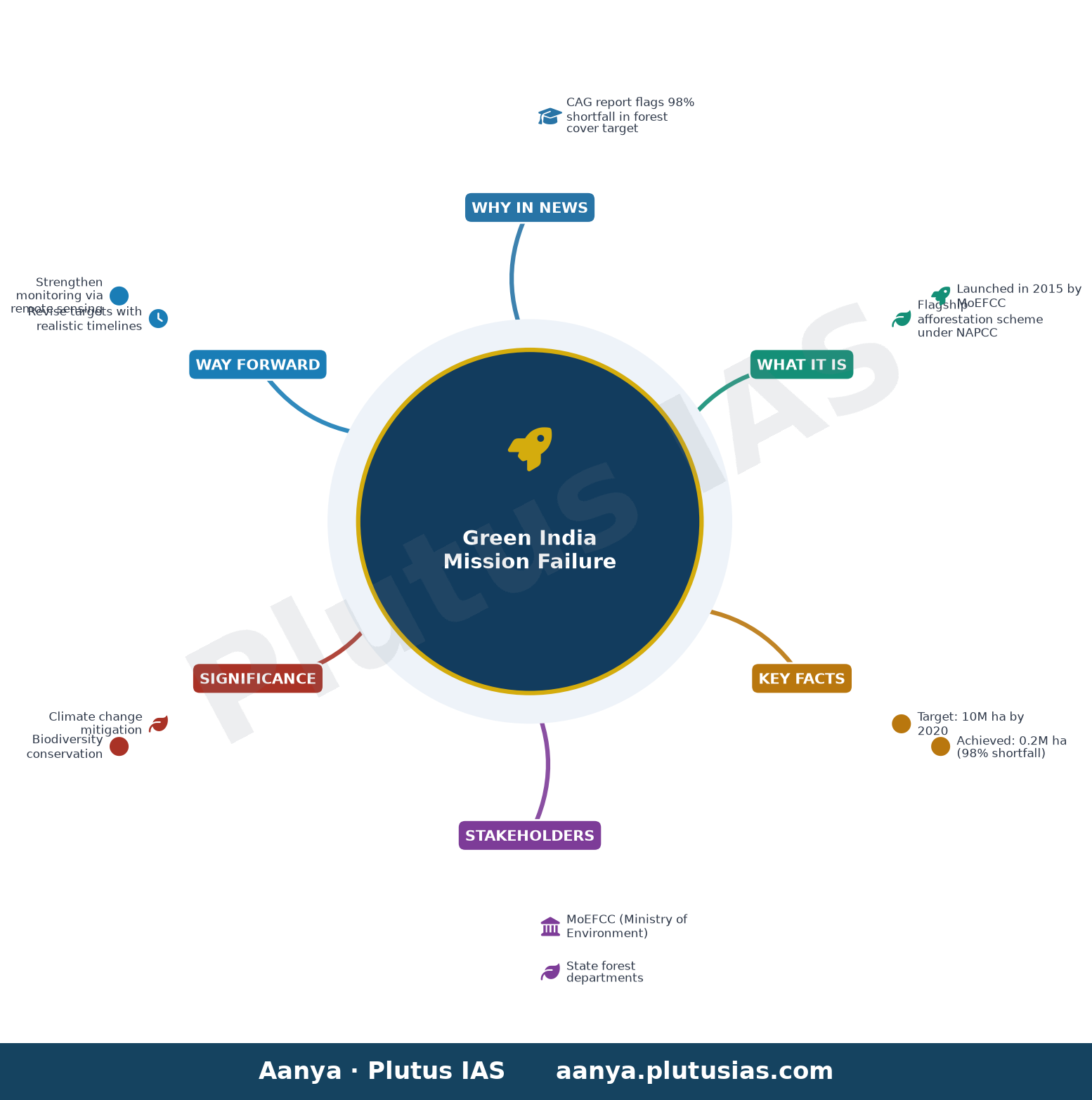
15 Aug CAG Report: Green India Mission Failed to Boost Forest Cover by 98%
✎ Green India Mission failed to meet 98% of its forest cover target due to poor implementation and fund utilization.
Relevance for UPSC & State PCS: Polity & Governance
The Comptroller and Auditor General (CAG) of India’s report on the Green India Mission (GIM) highlights a stark shortfall, revealing that the flagship afforestation programme achieved only 2% of its targeted forest cover increase between 2015 and 2021. According to the audit, while the mission aimed to enhance 5 million hectares of forest and non-forest areas, it managed to cover just 99,777 hectares—a mere 1.99% of the goal. This failure underscores systemic inefficiencies in implementation, including delayed fund disbursements, poor monitoring mechanisms, and inadequate convergence with state-level forestry initiatives. The CAG’s findings, drawn from audits of 13 states, point to a broader governance deficit where ambitious targets often collide with ground-level execution challenges, raising questions about the mission’s design and oversight.
For UPSC and State PCS aspirants, this report is a critical case study in public policy evaluation, particularly in understanding the gaps between policy intent and on-ground outcomes. The Green India Mission, launched under the National Action Plan on Climate Change (NAPCC), was envisaged as a transformative step toward combating climate change and enhancing ecological resilience. However, the CAG’s audit exposes the pitfalls of top-down planning without robust institutional frameworks for accountability. Aspirants should note how such failures reflect deeper issues in India’s forest governance, such as the lack of inter-departmental coordination, insufficient technical capacity at the grassroots, and the over-reliance on compensatory afforestation rather than holistic ecosystem restoration. These insights are vital for framing answers in governance and environmental policy sections of the mains examination.
The report also highlights the role of financial mismanagement, with delays in fund utilization and under-spending of allocated budgets. The CAG noted that only 56% of the total funds released were utilised, further exacerbating the mission’s ineffectiveness. This raises broader questions about fiscal federalism and the Centre-state dynamics in implementing centrally sponsored schemes. For State PCS aspirants, especially those preparing for forest service examinations or state administrative roles, the audit serves as a cautionary tale about the importance of financial prudence and adaptive governance. It also underscores the need for states to tailor national missions to local ecological and socio-economic contexts, rather than adopting a one-size-fits-all approach.
From a broader UPSC perspective, the CAG’s findings on the Green India Mission tie into larger themes of sustainable development, climate action, and the efficacy of flagship government programmes. The report’s emphasis on monitoring and evaluation mechanisms is particularly relevant for essays and answer-writing, where aspirants must critically assess the success of government initiatives. Additionally, the mission’s shortcomings reflect the challenges in India’s Nationally Determined Contributions (NDCs) under the Paris Agreement, making it a pertinent topic for discussions on India’s climate commitments
Source: ndtv.com
Practice Questions
Q1. According to the CAG report, by what percentage did the Green India Mission fall short of its target in increasing forest cover?
- 50%
- 75%
- 98%
- 100%
Answer
98% — The CAG report highlighted that the Green India Mission fell short by 98% in achieving its target of increasing forest cover, indicating a significant underperformance in the mission’s objectives.
Q2. Which constitutional body conducted the audit that revealed the shortfall in the Green India Mission’s performance?
- Planning Commission
- Comptroller and Auditor General (CAG)
- NITI Aayog
- Ministry of Environment, Forest and Climate Change
Answer
Comptroller and Auditor General (CAG) — The Comptroller and Auditor General (CAG) of India conducted the audit that exposed the 98% shortfall in the Green India Mission’s efforts to increase forest cover.
Generated by AanyaAi for educational purpose.

- Union Minister Launches India’s First PRAMAAN Certificates Under Forest Scheme - September 29, 2026
- पशुधन बीमा पोर्टल: किसानों को मिलेगी बीमा सुरक्षा, जानिए पूरी योजना - September 29, 2026
- UNICEF Report: 5 Crore Indian Students Lack School Sanitation Facilities - September 29, 2026

No Comments