


21 May Caste Census: Measuring Backwardness or Deepening Divides?
This article covers “Daily Current Affairs”
SYLLABUS MAPPING : GS Paper 1&2 : Society , Polity and Governance
FOR PRELIMS : Provisions / Articles , Apex court rulings, Important Cases
FOR MAINS : “The 95-year absence of a comprehensive caste census has fundamentally distorted India’s social justice architecture — reservations are allocated on the basis of colonial-era data, while the actual social and economic condition of OBCs remains unknown to policymakers.” Critically examine this argument and discuss how Census 2027’s caste enumeration can strengthen India’s affirmative action framework — and what risks it must guard against. (15 M)
Why in News?
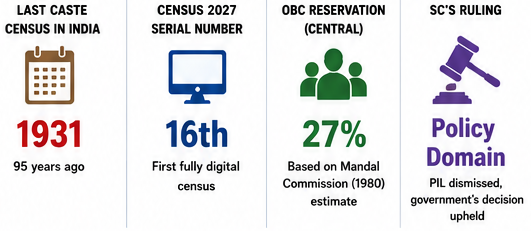
The Supreme Court on Wednesday, May 20, 2026, categorically dismissed a Public Interest Litigation (PIL) challenging the Central Government’s decision to include caste enumeration in Census 2027. A three-judge bench comprising Chief Justice of India Surya Kant, Justice Joymalya Bagchi, and Justice Vipul Pancholi held that the question of whether the census should be caste-based is “a policy matter that exclusively comes within the policy domain” of the government and is not within the court’s domain to decide. The petitioner, Sudhakar Gummula (appearing in person), had argued that there was a risk of caste data being misused by politicians and corporate entities. The CJI responded sharply: “Any government of the day must know how many people are backward and how many need welfare. This is a matter of policy.” The Cabinet Committee on Political Affairs had decided in April 2025 to include comprehensive caste enumeration in the second phase of Census 2027 — making it the first comprehensive caste census in India since 1931, and also the country’s first fully digital census.
What Is a Caste Census? — Definition and Scope

A caste census is the systematic enumeration of the population by caste identity as part of the national census exercise. Unlike a regular census (which counts population, literacy, occupation, housing etc.), a caste census specifically records each household’s and individual’s caste — enabling the government to generate caste-wise population data across occupational, educational, economic, and geographic dimensions. This data is foundational for evidence-based affirmative action, welfare targeting, and social policy.
Phase 1 (House Listing Operation): Housing conditions, assets, amenities (completed in first phase)
Phase 2 (Population Enumeration): Demographic + socio-economic + cultural + other details — including caste. This is where the caste data will be collected. Each individual will self-declare their caste, which will then be classified according to the government’s master list
Until 2011: Census counted only SCs and STs by caste — as explicitly mandated by Articles 341 and 342 of the Constitution
The gap: OBCs, General Category, and all other communities have never been counted in the census since Independence
Census 2027: For the first time since 1931, ALL castes — SC, ST, OBC, and General Category — will be enumerated
The Constitutional Framework — Articles Governing Caste and Reservations
“The President may by order appoint a Commission consisting of such persons as he thinks fit to investigate the conditions of socially and educationally backward classes within the territory of India and the difficulties under which they labour and to make recommendations as to the steps that should be taken by the Union or any State to remove such difficulties.”
This is the constitutional basis for the Kaka Kalelkar Commission (1953) and the Mandal Commission (1978). The article presupposes the need for data on backward classes — making a caste census not merely permissible but a necessary tool for fulfilling this constitutional obligation.
Article 15(4), inserted by the First Constitutional Amendment, 1951: Permits the State to make special provisions for the advancement of socially and educationally backward classes or for SCs and STs.
Article 15(5), inserted by the 93rd Amendment, 2005: Enables OBC reservation in educational institutions including private unaided institutions (upheld in Ashoka Kumar Thakur case, 2008).
Both provisions require identification of “backward classes” — which is impossible without reliable caste data. The existing OBC classification relies on surveys and commissions, not census data.
Enables the State to make provision for the reservation of appointments or posts in favour of any backward class of citizens which is not adequately represented in the services under the State. Critically, the term “inadequately represented” requires empirical data — caste census provides the denominator (population) against which representation in services can be measured.
The President (on advice of the Governor) specifies which castes/tribes are Scheduled Castes (Article 341) and Scheduled Tribes (Article 342) — exclusively Hindu, Sikh, and Buddhist communities (not Muslim or Christian). These Presidential notifications are the basis for SC/ST census enumeration — which is why SCs and STs have been counted in every census since 1951, while OBCs have not.
History of Caste Enumeration in India — From 1881 to 2027

The Mandal Commission and the 50% Cap — Critical Context
Understanding why accurate caste data matters requires understanding the Indra Sawhney constraint. In its 1992 landmark ruling, the Supreme Court imposed a ceiling of 50% on total reservations (SC 15% + ST 7.5% + OBC 27% = 49.5%). The Court allowed only extraordinary circumstances to justify exceeding this ceiling. Without reliable OBC population data, any legal challenge to reservation policies that claim under-representation is extremely difficult to mount — and any government attempt to increase OBC reservation beyond 27% immediately faces the 50% cap hurdle.
- The Mandal estimate problem:Mandal’s 52% OBC estimate is based on the 1931 census — now 95 years old. If Bihar’s 63% OBC+EBC figure is representative nationally, the current 27% reservation severely under-represents OBCs relative to their population share
- State-level reservation conflicts:Tamil Nadu (69% reservation), Maharashtra (52% with OBC increase), Andhra Pradesh, Karnataka, and Telangana have all passed reservation legislation exceeding the 50% cap — which courts have then either struck down or subjected to constant challenge. Without accurate caste population data, courts cannot properly assess the proportionality of these reservations
- The Supreme Court’s own position:In multiple rulings — including Indra Sawhney — the Court has said that decisions about reservation must be based on empirical data, not assumptions. Caste census data would supply exactly this empirical foundation, making reservation policy more legally defensible
- EWS reservation (103rd Amendment, 2022):The 10% Economically Weaker Sections (EWS) reservation was upheld by the SC in Janhit Abhiyan v. Union of India (2022) — pushing the effective total reservation ceiling to 59.5% in some contexts. This makes the OBC representation debate even more acute,
Arguments For and Against Caste Census
| Arguments FOR Caste Census | Arguments AGAINST Caste Census |
|---|---|
| Empirical foundation for policy: Without accurate caste data, welfare programmes (scholarships, housing, health, job creation) cannot be efficiently targeted. The government is allocating benefits based on 1931 data — around 95 years out of date. | Risk of political misuse: Caste data in the hands of political parties enables hyper-targeted caste mobilisation, feeds caste-based voting arithmetic, and incentivises politicians to deepen caste identities rather than bridge them. |
| Legal necessity for reservations: Courts require empirical quantifiable data to uphold reservations beyond the 50% ceiling. Without a caste census, states’ claims of “inadequate representation” cannot be legally verified, making reservation policies constitutionally vulnerable. | Data quality and classification problems: India has thousands of caste sub-groups with different regional names. Self-declaration without a validated master list can lead to unreliable data, as seen in issues during SECC 2011. |
| Identifying inter-generational poverty: Caste-linked poverty is distinct from general poverty. A caste census helps measure whether historically marginalised communities are progressing economically or whether poverty gaps persist despite reservations. | Reinforcing caste identity: Critics argue that formally asking citizens to identify by caste reinforces and ossifies caste as the primary social identity, contrary to the Constitutional aspiration of a casteless society. |
| Transparency and accountability: SECC 2011 data was collected but not fully published, making OBC welfare allocation opaque. A published caste census would make welfare distribution more evidence-based and auditable. | Privacy and misuse concerns: Combining caste data with personal and economic details could enable discrimination, targeted violence, or commercial profiling if misused. |
| Evidence from Bihar: Bihar’s 2023 caste survey found around 63% OBC + EBC population, much higher than the Mandal Commission’s 52% estimate. This suggests possible under-representation in current reservation structures. | Methodological challenges: Issues such as sub-caste disputes, caste mobility claims, mixed-caste heritage, and inter-caste marriages make classification highly contested and politically sensitive. |
The Census Act, 1948 — Legal Framework
- Section 3:The Central Government may declare by notification in the Official Gazette that a census shall be taken — the enabling provision for the Census 2027 exercise
- Section 8:Duties of the census officer — includes the power to call for particulars from every household or householder; the schedule of questions to be asked is a delegated legislation, not part of the Act itself — enabling the addition of caste questions through a subordinate instrument without amending the parent Act
- Section 15:Confidentiality — census data relating to individuals is strictly confidential; cannot be used for any purpose other than the purposes of the Census; this confidentiality is the primary statutory safeguard against misuse
- Section 11:Offences and penalties — failure to answer questions, giving false information, or obstructing census operations is a criminal offence
- The confidentiality gap:Petitioner Gummula’s concern about political misuse rests on the fact thataggregate caste data (not individual records) will be published— and it is this aggregate data that can be misused for political caste arithmetic, even though individual confidentiality is maintained
Practice Questions
1. Until the Census 2011, India’s national census had systematically enumerated only Scheduled Castes (SCs) and Scheduled Tribes (STs) by caste, while OBCs and other communities were not enumerated.
2. The Mandal Commission’s estimate that OBCs constitute approximately 52% of India’s population was based on extrapolation from the 1931 census data and state-level surveys, in the absence of post-Independence caste census data.
3. The Socio-Economic and Caste Census (SECC) 2011 collected caste data from approximately 24 crore households, but the OBC-specific caste data was officially published by the Central Government after extensive data cleaning.
4. In Indra Sawhney v. Union of India (1992), the Supreme Court upheld the 27% OBC reservation but imposed a ceiling of 50% on the total quantum of reservations and mandated the exclusion of the “creamy layer” from OBC benefits.
Which of the statements given above are correct?
Statement 1 is CORRECT.From India’s first post-Independence census (1951) onwards, the practice has been to enumerate only Scheduled Castes (SCs) and Scheduled Tribes (STs) by caste — as these categories are formally defined by Presidential notification under Articles 341 and 342 of the Constitution. OBCs, General Category, and all other communities were not enumerated by caste in any census between 1951 and 2011. Census 2027 will break this pattern by enumerating all castes comprehensively — the first such exercise since the colonial-era 1931 census.
Statement 2 is CORRECT.The Mandal Commission (1978–80), chaired by B.P. Mandal, faced a fundamental data problem: there had been no comprehensive caste census in India since 1931. In the absence of reliable contemporary data, the Commission estimated OBC population at approximately 52% of India’s total population by extrapolating from the 1931 census data, supplementing it with state-level surveys and village-level sampling exercises. This estimate — made nearly 50 years ago and based on data that was then already 50 years old — remains the primary basis for the current 27% OBC reservation in central government services and educational institutions.
Statement 3 is INCORRECT.The SECC 2011 did collect caste data from approximately 24 crore households across India — making it the most comprehensive caste data collection exercise since 1931. However, the OBC-specific caste data from SECC 2011 wasnever officially published by the Central Government. The SC/ST data was released, but the OBC caste data remained suppressed — reportedly due to data quality concerns and political sensitivities. This suppression of SECC 2011’s OBC data is one of the most criticised governance decisions in recent decades and is a key argument for why a fresh, robust caste census (Census 2027) is necessary.
Statement 4 is CORRECT.In the landmark Indra Sawhney v. Union of India (1992) — the “Mandal case” — a nine-judge constitution bench of the Supreme Court upheld the constitutional validity of 27% OBC reservation in central government services. The Court imposed two critical conditions: (1) a 50% ceiling on the total quantum of reservations (SC 15% + ST 7.5% + OBC 27% = 49.5% — within the cap); and (2) exclusion of the “creamy layer” — the relatively advanced and affluent sections among OBCs — from OBC reservation benefits. The creamy layer exclusion was a significant departure from SC/ST reservation principles (where no creamy layer exclusion applies).
Mains Questions

- India’s Youth Unemployment and Education Crisis - August 5, 2026
- India’s Sports Infrastructure and the 2036 Olympics Ambition - August 5, 2026
- Critical Minerals: The Foundation of Strategic Power - August 4, 2026

No Comments