


20 May UAPA vs Liberty: Supreme Court’s New Bail Battle
This article covers “Daily Current Affairs”
SYLLABUS MAPPING : GS Paper 2 : Polity and Governance
FOR PRELIMS : UAPA Provisions, Apex court rulings, Important Cases
FOR MAINS : “Anti-terror laws like UAPA serve a legitimate national security purpose, but India’s experience of UAPA implementation — with 96–98% eventual acquittal rates and years of pre-trial incarceration — reveals that they have become instruments of prolonged administrative detention masquerading as criminal prosecution.” Critically evaluate the design and implementation of UAPA in India, the safeguards available to the accused, and the reforms needed to balance security with liberty. (15 M)
Why in News?
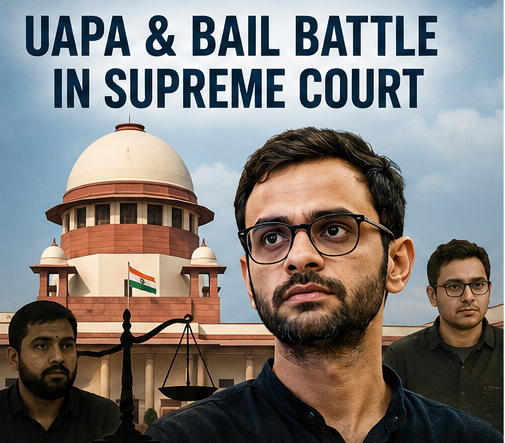
On Tuesday, May 19, 2026, the Delhi Police told the Supreme Court that the question of whether prolonged incarceration and delay of trial could override the statutory bail restrictions under the Unlawful Activities (Prevention) Act (UAPA), 1967 requires consideration by a larger Constitutional Bench — citing two conflicting judgments of coordinate Benches. The submission was made before a Bench of Justices Aravind Kumar and P.B. Varale in the bail petitions of Abdul Khalid Saifi and Tasleem Ahmed — accused in the 2020 Delhi riots larger conspiracy case. This came a day after a coordinate Bench of Justices B.V. Nagarathna and Ujjal Bhuyan (while granting bail to Syed Iftikhar Andrabi in a narco-terror case) had delivered a landmark judgment reiterating that “bail is the rule and jail is the exception even under UAPA” — and directly criticised the January 2026 Gulfisha Fatima ruling that had denied bail to Umar Khalid and Sharjeel Imam. On the same day, a Delhi court dismissed Umar Khalid’s 15-day interim bail plea to attend bereavement rituals and care for his ailing mother.
What Is UAPA? — Institutional Profile and Structure
The Unlawful Activities (Prevention) Act (UAPA), 1967 is India’s primary anti-terrorism and anti-secessionism statute. Originally enacted to curb secessionist movements, it was progressively expanded — particularly through the 2004 and 2019 amendments — to cover a wide range of activities deemed threatening to national integrity. The 2019 amendment controversially empowered the government to designate individuals (not just organisations) as terrorists — a power with no parallel in most democratic jurisdictions.

- Section 15: Defines “terrorist act” broadly — including acts threatening the economic security of India, electronic infrastructure, and monetary stability
- Section 35 (2019 Amendment): Empowers Central Government to designate an individual as a terrorist — without prior judicial determination; a form of executive punishment without trial
- Section 43D(5): The statutory bail bar — “if the Court is of the opinion that there are reasonable grounds for believing that the accusation against such person is prima facie true, shall not be released on bail or on his own bond.” Courts have interpreted “shall” as a mandatory prohibition, making bail extremely rare in UAPA cases
- Section 43D(2): Allows detention without charge sheet for 180 days (vs. 60 days under CrPC/BNSS) in UAPA cases — with a magistrate’s extension for a further 90 days on report of the investigating officer
- NIA jurisdiction: The National Investigation Agency (NIA) Act 2008 gives NIA special courts jurisdiction over UAPA cases — cases are tried by NIA courts with stringent procedural rules
- Presumption of guilt: Unlike ordinary criminal procedure (where guilt must be proved beyond reasonable doubt), Section 43D(5) creates a reverse presumption — the accused must show that the accusation is NOT prima facie true to get bail
The Constitutional Clash — Section 43D(5) vs. Articles 21 and 22

“Notwithstanding anything contained in the Code of Criminal Procedure, 1973, no person accused of an offence punishable under Chapters IV and VI of this Act shall, if in custody, be released on bail or on his own bond unless the Public Prosecutor has been given an opportunity of being heard on the application for such release: Provided that such accused person shall not be released on bail or on his own bond if the Court, on a perusal of the case diary or the report made under section 173 of the Code of Criminal Procedure, 1973, is of the opinion that there are reasonable grounds for believing that the accusation against such person is prima facie true.”
The ASG’s argument: The word “shall” in this provision is a mandatory injunction — it takes away the court’s ordinary discretion on bail; the presumption of innocence, which normally operates in the accused’s favour, is statutorily displaced by this provision in UAPA cases.
“No person shall be deprived of his life or personal liberty except according to procedure established by law.”
The Supreme Court’s position (Andrabi judgment, May 18, 2026): The constitutional guarantee of personal liberty under Article 21 cannot be overridden by a statutory restriction like Section 43D(5). “The statutory embargo of Section 43D(5) UAPA must remain a circumscribed restriction that operates subject to the guarantee of Articles 21 and 22 of the Constitution.” Prolonged pre-trial incarceration — especially when conviction rates are below 4% — amounts to punishment without trial, violating Article 21.
The Two Conflicting Judgments — The Core Problem
The legal controversy before the Supreme Court stems from two contradictory rulings by coordinate (equal-strength) Benches — each interpreting the interplay between Section 43D(5) and Article 21 differently. This creates a binding precedent problem: lower courts and NIA courts are bound by conflicting Supreme Court rulings, leading to arbitrary outcomes in bail decisions.

A three-judge bench of the Supreme Court held that prolonged incarceration and delay in trial can constitute a valid ground for granting bail even under UAPA. The court recognised the harshness of Section 43D(5) and held that constitutional courts are not entirely powerless even against the mandatory bail bar — when the delay becomes so unreasonable that continued incarceration violates Article 21, courts can grant bail. This is the higher-bench precedent — binding on all subsequent two-judge benches.
A bench of Justice B.V. Nagarathna and Justice Ujjal Bhuyan, while granting bail to narco-terror accused Syed Iftikhar Andrabi, reaffirmed KA Najeeb’s principle and sharply criticised two coordinate bench rulings that had narrowed it. The Court invoked the alarming NCRB data: UAPA conviction rates between 1.5–4% nationally (below 1% in J&K). “It means that at the end of the trial, there is 99% possibility of acquittal in such cases.” The court held that judicial discipline requires smaller benches to follow or refer — not dilute — larger bench precedents.
A coordinate two-judge bench denied bail to Umar Khalid and Sharjeel Imam in the 2020 Delhi riots case, characterising KA Najeeb’s pro-bail principle as a “narrow and exceptional departure” from the statutory norm — not a general principle. The Andrabi bench directly criticised this: “It is this hollowing out of the import of the observations in Najeeb that we are concerned with.” The Andrabi bench held the Gulfisha Fatima ruling had improperly narrowed a higher-bench precedent.
A separate two-judge bench in Gurwinder Singh similarly adopted a bail-restrictive interpretation of KA Najeeb, failing to follow the pro-bail principle. Both Gulfisha Fatima and Gurwinder Singh are two-judge coordinate bench decisions that departed from a three-judge bench precedent — creating the judicial precedent conflict that the Delhi Police is now using to argue for a larger bench reference.
The ASG’s Argument — Delhi Police’s Position Before Court
“Under UAPA’s statutory bail bar, the presumption of innocence of the accused takes a backseat. I am not opposing the interim plea, but the issue of statutory restrictions on bail under anti-terror laws requires consideration by a larger Bench in view of the two conflicting judgments.”
The ASG’s argument has a dual character — simultaneously defensible as a procedural request (resolving genuinely conflicting precedents) and strategically timed (placing a roadblock in the path of a bail-permissive ruling that could benefit Umar Khalid, Sharjeel Imam, and others accused in the Delhi riots case). Justice Aravind Kumar’s court asked ASG Raju whether his position was that the coordinate Bench had committed an error — to which Raju responded: “That is going to be my submission, provided I read the judgment.”
The Alarming Data — UAPA Conviction Rates
The Supreme Court’s Andrabi judgment highlighted deeply troubling NCRB statistics on UAPA conviction rates — data that transforms the bail question from a legal abstraction to a question of mass justice:
- A person charged under UAPA has a 96–98% statistical probability of eventual acquittal — yet Section 43D(5) routinely keeps them in pre-trial custody for 5–10+ years while their trial proceeds at a glacial pace
- The Supreme Court in Andrabi directly stated: “It means that at the end of the trial, there is 99% possibility of acquittal in such cases” — and questioned whether prolonged incarceration in such circumstances could be constitutionally justified
- Years of pre-trial imprisonment effectively function as punishment imposed by the executive (through police charge-sheeting) and the court (through Section 43D interpretation) — without any conviction by a court of law
- This directly violates the foundational principle of presumption of innocence — a right recognised under Article 21 and as a fundamental principle of criminal law worldwide
The Judicial Discipline Principle — What the SC Said
“A judgment rendered by a bench of lesser strength is bound by the law declared by the bench of greater strength. Judicial discipline mandates that such a binding precedent must either be followed or, in case of doubt, be referred to a larger bench. A smaller bench cannot dilute, circumvent or disregard the ratio of a larger bench.”
This principle — rooted in the doctrine of stare decisis (stand by what has been decided) — is central to the rule of law in a constitutional hierarchy. When a smaller bench disagrees with a larger bench, it has only one constitutionally permissible option: refer the case to the Chief Justice of India for allocation to a bench of equal or larger strength. It cannot effectively overrule or narrow a larger bench precedent while pretending to follow it — a phenomenon the Court described as “diluting” or “hollowing out” a binding precedent.
Practice Questions
1. Section 43D(5) of the UAPA mandates that no accused person shall be released on bail if the Court, on perusal of the case diary, is of the opinion that there are reasonable grounds to believe that the accusation is prima facie true — effectively creating a statutory reversal of the presumption of innocence.
2. In Union of India v. K.A. Najeeb (2021), a three-judge bench of the Supreme Court held that prolonged incarceration and unreasonable delay in trial can constitute valid grounds for granting bail in UAPA cases despite the restrictions under Section 43D(5).
3. The Supreme Court in the Andrabi judgment (May 2026) held that the NCRB data on UAPA conviction rates (1.5–4% nationally between 2019–2023) is irrelevant to the question of bail, since bail cannot be granted merely on statistical grounds.
4. The principle of judicial discipline as articulated by the Supreme Court requires that a bench of lesser strength cannot dilute, circumvent, or disregard the ratio of a larger bench — and if it disagrees, it must refer the matter to the Chief Justice of India for allocation to a bench of equal or higher strength.
Which of the statements given above are correct?
Statement 1 is CORRECT. Section 43D(5) of the UAPA uses the mandatory word “shall” — it provides that if the Court is of the opinion that there are reasonable grounds for believing that the accusation is prima facie true, the accused “shall not be released on bail or on his own bond.” This effectively reverses the ordinary presumption of innocence: in normal criminal procedure, the prosecution must prove guilt; under UAPA, the accused must show that the accusation is NOT prima facie true to overcome the bail bar. This is precisely the Additional Solicitor-General’s argument before the Supreme Court on May 19, 2026 — that under UAPA’s statutory bail bar, the presumption of innocence takes a “back seat.”
Statement 2 is CORRECT. This is the landmark KA Najeeb (Union of India v. K.A. Najeeb, 2021) ruling by a three-judge bench. The court held that while Section 43D(5) imposes stringent restrictions on bail, constitutional courts are not entirely powerless — when the delay in trial and prolonged incarceration become so extreme as to violate Article 21’s right to personal liberty, courts retain the power to grant bail notwithstanding the statutory bar. This ruling is the binding three-judge bench precedent that subsequent two-judge benches were required to follow.
Statement 3 is INCORRECT. This is precisely the opposite of what the Andrabi bench said. The Supreme Court in Andrabi (May 18, 2026) explicitly cited the NCRB data — showing 1.5–4% conviction rates nationally and below 1% in J&K — as directly relevant to the bail question. The court stated: “It means that at the end of the trial, there is 99% possibility of acquittal in such cases” — using this statistical reality to reinforce why prolonged pre-trial incarceration under UAPA, in the face of likely eventual acquittal, constitutes a disproportionate violation of Article 21.
Statement 4 is CORRECT. This is the judicial discipline principle articulated by Justice Ujjal Bhuyan in the Andrabi judgment. The court held: “A judgment rendered by a bench of lesser strength is bound by the law declared by the bench of greater strength. Judicial discipline mandates that such a binding precedent must either be followed or, in case of doubt, be referred to a larger bench. A smaller bench cannot dilute, circumvent or disregard the ratio of a larger bench.” This doctrine — rooted in stare decisis and the hierarchical structure of precedent in India — is what makes the Gulfisha Fatima and Gurwinder Singh two-judge bench rulings constitutionally problematic: they effectively narrowed a three-judge bench precedent without referring the matter to a larger bench.
Mains Questions

- India’s Youth Unemployment and Education Crisis - August 5, 2026
- India’s Sports Infrastructure and the 2036 Olympics Ambition - August 5, 2026
- Critical Minerals: The Foundation of Strategic Power - August 4, 2026

No Comments