


27 Sep CBN Rajasthan seizes 4Tn drugs in anti-trafficking ops: Key NDPS Act provisions for UPSC
✎ The Narcotic Drugs and Psychotropic Substances (NDPS) Act, 1985, is India’s primary legislation to combat drug trafficking, with stringent penalties and multi-agency enforcement mechanisms, including the Narcotics Control Bureau…
Subject Relevance — Where This Topic Fits
- GS Paper III — Internal Security, GS Paper III — Environment, Ecology, Biodiversity and Climate Change (Illicit Drug Trade and its Socio-Economic Impact) | GS Paper III — Economy (Illicit Trade and its Impact on Formal Economy)
- Prelims: Narcotics Control Bureau (NCB), Narcotic Drugs and Psychotropic Substances (NDPS) Act 1985, Opium Poppy, Cannabis, Drug Trafficking, Preventive Detention, Enforcement Directorate, Money Laundering Prevention Act 2002, Financial Intelligence Unit (FIU-IND)
- Essay: Illicit drug trade: A menace to societal fabric and national security, Balancing human rights and stringent enforcement in drug control policies
Quick Revision: The Narcotic Drugs and Psychotropic Substances (NDPS) Act, 1985, is India’s primary legislation to combat drug trafficking, with stringent penalties and multi-agency enforcement mechanisms, including the Narcotics Control Bureau (NCB), to address both supply and demand-side challenges.
Why is this in the news?
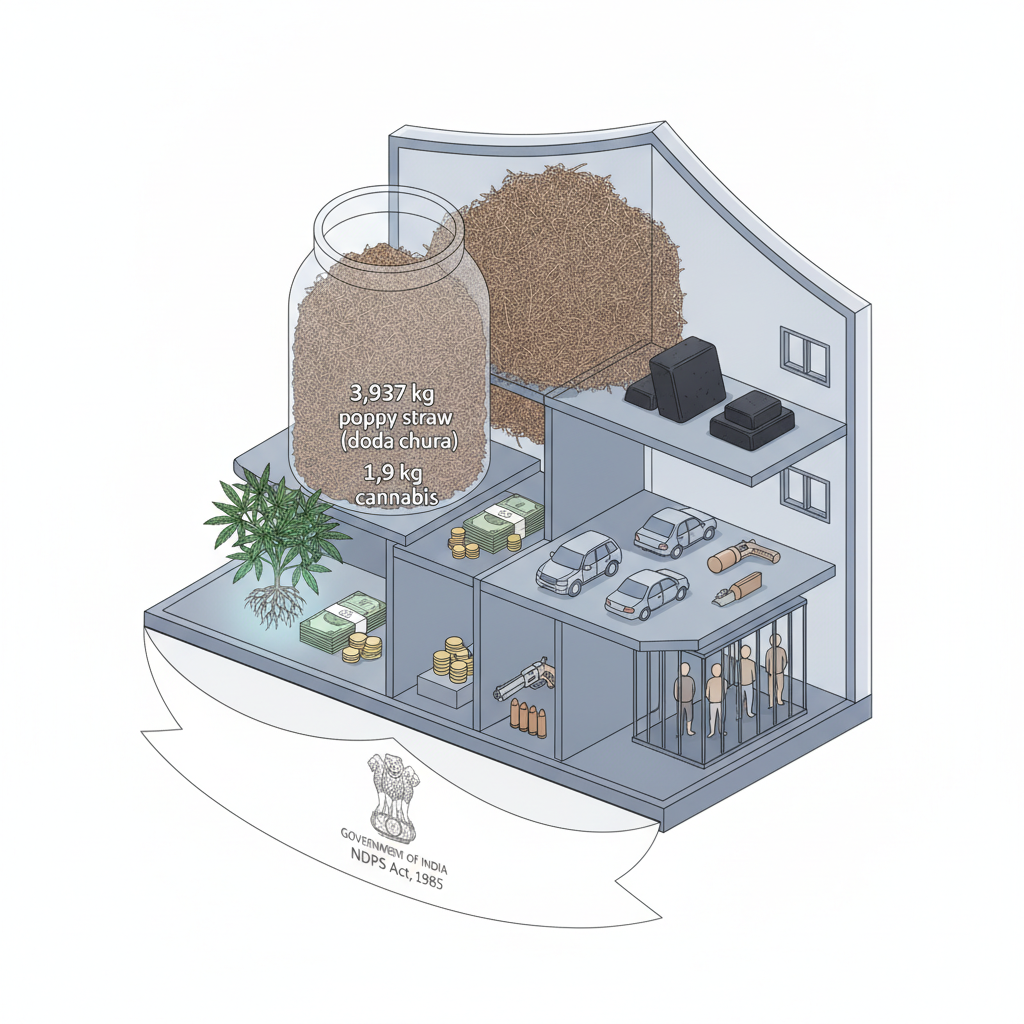
The Central Bureau of Narcotics (CBN) recently conducted intensive enforcement operations across Rajasthan, seizing approximately four tonnes of contraband substances including 3,937 kg of poppy straw (doda chura), 9.6 kg of opium, and 1.9 kg of hydroponic cannabis. The operations also led to the recovery of ₹18.42 lakh in cash, six vehicles, and one indigenous pistol with live cartridges, alongside the arrest of four individuals. These actions underscore the persistent challenges in combating drug trafficking and the operational efficacy of India’s drug control regime under the Narcotic Drugs and Psychotropic Substances (NDPS) Act, 1985.
Background
- The Narcotic Drugs and Psychotropic Substances (NDPS) Act, 1985, is the primary legislation governing the control and regulation of narcotic drugs and psychotropic substances in India, aiming to curb their illicit production, trafficking, and consumption.
- India is a signatory to the three major international drug control conventions: the Single Convention on Narcotic Drugs, 1961; the Convention on Psychotropic Substances, 1971; and the United Nations Convention Against Illicit Traffic in Narcotic Drugs and Psychotropic Substances, 1988, which necessitate robust domestic enforcement mechanisms.
- Rajasthan, due to its geographical proximity to international borders (particularly Pakistan) and porous terrain, serves as a transit route for drug trafficking networks operating between South-West Asia and other regions.
- The Central Bureau of Narcotics (CBN) functions under the Department of Revenue, Ministry of Finance, and is tasked with preventing the smuggling of narcotic drugs and psychotropic substances into India and inter-state trafficking.
- The NDPS Act provides for stringent penalties, including rigorous imprisonment and fines, for offences related to the production, possession, sale, purchase, transport, and consumption of prohibited substances.
- The ‘Nasha Mukt Bharat Abhiyaan’ (Drug-Free India Campaign), launched in 2020, is a multi-ministerial initiative aimed at reducing the demand for drugs through awareness, education, and community engagement, while simultaneously strengthening supply-side enforcement.
What is the Narcotic Drugs and Psychotropic Substances (NDPS) Act, 1985?
- Enacted in 1985 and amended multiple times (most recently in 2021), the NDPS Act is the principal legislation regulating narcotic drugs and psychotropic substances in India, replacing the Opium Act, 1857, and the Dangerous Drugs Act, 1930.
- The Act defines ‘narcotic drugs’ to include substances like opium, poppy straw, cannabis (hemp), coca leaf, and their derivatives, while ‘psychotropic substances’ include synthetic drugs like amphetamines and LSD.
- It prohibits the production, manufacture, possession, sale, purchase, transport, and consumption of narcotic drugs and psychotropic substances except under license for medical or scientific purposes.
- The Act classifies offences into three categories based on the quantity of the substance involved: small quantity, more than small but less than commercial quantity, and commercial quantity, with corresponding penalties ranging from rigorous imprisonment to death penalty in extreme cases.
- Under the Act, the burden of proof lies on the accused in certain cases, particularly regarding the knowledge or intent behind possession of prohibited substances.
- The Act empowers central and state agencies, including the Narcotics Control Bureau (NCB), Customs, Central Bureau of Investigation (CBI), and state police, to investigate, arrest, and prosecute offenders.
- The NDPS Act also mandates the forfeiture of property derived from drug trafficking and the proceeds of crime, aligning with provisions under the Prevention of Money Laundering Act, 2002.
- The Act provides for the establishment of special courts for the speedy trial of NDPS cases, with provisions for in-camera trials and protection of witnesses in sensitive cases.
Key Features
| Feature | Significance |
|---|---|
| Massive seizure of 3,937 kg Poppy Straw (Doda Chura) | Indicates large-scale illegal opium poppy cultivation and trafficking networks in Rajasthan, necessitating robust enforcement under NDPS Act. |
| Seizure of 9.6 kg Opium and 1.9 kg Hydroponic Cannabis | Highlights diversification of narcotic substances being smuggled, including synthetic and high-potency variants. |
| Recovery of ₹18.42 lakh in cash | Suggests financial trails linked to narcotics trade, requiring forensic audits and money-laundering investigations. |
| Seizure of firearms (1 pistol with 3 live cartridges) | Signals potential linkages between narcotics trafficking and organised crime, warranting inter-agency coordination (e.g., NIA, State Police). |
| Use of concealment methods (cement bags, air circulator boxes) | Demonstrates sophistication of smuggling techniques, necessitating advanced detection technologies and intelligence-led operations. |
Why it Matters
Legal and Institutional Framework
- The seizures were conducted under the Narcotic Drugs and Psychotropic Substances (NDPS) Act, 1985, reflecting strict adherence to India’s primary legislation governing narcotics control.
- The Central Bureau of Narcotics (CBN), operating under the Department of Revenue, Ministry of Finance, executed these operations, underscoring the Centre-State collaborative enforcement model.
- The involvement of multiple agencies (e.g., postal authorities for international parcel interception) highlights the need for multi-stakeholder coordination in combating cross-border narcotics trafficking.
Socio-Economic Implications
- Large-scale seizures of poppy straw suggest potential diversion of licit opium cultivation (under the Narcotic Drugs and Psychotropic Substances Act, 1985) for illicit purposes, necessitating stricter monitoring of cultivation and processing units.
- The recovery of substantial cash reserves points to the economic dimensions of the narcotics trade, including money laundering and financing of organised crime.
- The use of hydroponic cannabis indicates emerging trends in synthetic drug production, requiring proactive measures in drug policy adaptation.
National Security and Public Health
- The seizure of firearms alongside narcotics suggests linkages between drug trafficking and arms smuggling, posing dual threats to internal security.
- The scale of seizures underscores the public health challenge posed by substance abuse, aligning with India’s ‘Nasha Mukt Bharat Abhiyaan’ (Drug-Free India Campaign) and harm-reduction strategies.
Challenges
1. Sophistication of Smuggling Networks
- Smugglers employ advanced concealment techniques (e.g., cement bags, air circulator boxes) to evade detection, necessitating the deployment of AI-driven scanning, sniffer dogs, and behavioural profiling.
- The use of multiple transportation modes (trucks, cars, postal services) complicates interdiction efforts, requiring real-time intelligence sharing across agencies.
- The diversification of narcotic substances (e.g., hydroponic cannabis) demands continuous upskilling of enforcement personnel in detection and analysis.
UPSC Link: GS3: Internal Security Challenges
2. Inter-Agency Coordination Gaps
- Effective enforcement requires seamless coordination between CBN, State Police, NIA, Directorate of Revenue Intelligence (DRI), and postal authorities, which is often hindered by bureaucratic silos.
- Delayed intelligence sharing and jurisdictional overlaps can lead to operational inefficiencies, as seen in cases where suspects evade arrest by fleeing the scene.
- The lack of a unified national database for narcotics-related offences exacerbates challenges in tracking repeat offenders and inter-state trafficking networks.
UPSC Link: GS2: Centre-State Relations and Cooperative Federalism
3. Legal and Forensic Challenges
- Prosecuting cases under the NDPS Act requires meticulous documentation, forensic evidence, and expert testimony, which can be time-consuming and resource-intensive.
- The admissibility of digital evidence (e.g., intercepted communications, financial trails) in courts remains a grey area, necessitating updates to the Indian Evidence Act, 1872.
- The proliferation of synthetic drugs and new psychoactive substances (NPS) outpaces legislative amendments, creating legal loopholes exploitable by traffickers.
UPSC Link: GS2: Judiciary and Legal Reforms
4. Public Health and Demand-Side Reduction
- Despite enforcement successes, the demand for narcotics persists, driven by socio-economic factors such as unemployment, lack of education, and peer pressure.
- The lack of comprehensive de-addiction and rehabilitation infrastructure in Rajasthan (and other states) limits the effectiveness of supply-side interventions.
- Stigma associated with substance abuse discourages individuals from seeking help, necessitating community-based awareness campaigns and stigma reduction programs.
UPSC Link: GS2: Health and Governance
5. Cross-Border Trafficking and International Cooperation
- The interception of an international parcel containing hydroponic cannabis highlights the transnational nature of drug trafficking, requiring strengthened bilateral and multilateral cooperation (e.g., with the US, Afghanistan, and Southeast Asian countries).
- India’s porous borders, particularly with Nepal, Pakistan, and Bangladesh, facilitate the smuggling of narcotics, necessitating the deployment of advanced border surveillance technologies.
- The absence of extradition treaties or mutual legal assistance agreements with certain countries complicates the prosecution of foreign nationals involved in trafficking.
UPSC Link: GS2: International Relations and Organised Crime
Challenges — UPSC Perspective
| Issue | Concern |
|---|---|
| Concealment Techniques | Advanced smuggling methods (e.g., cement bags, air circulator boxes) evade traditional detection, necessitating AI-driven scanning and behavioural profiling. |
| Inter-Agency Coordination | Bureaucratic silos and jurisdictional overlaps hinder seamless intelligence sharing and operational efficiency. |
| Prosecution Under NDPS Act | Time-consuming forensic processes and legal ambiguities delay justice, creating loopholes for traffickers. |
| Synthetic Drug Proliferation | Emerging trends in hydroponic cannabis and NPS outpace legislative amendments, requiring proactive policy updates. |
| Demand-Side Reduction | Persistent socio-economic factors and lack of rehabilitation infrastructure limit the effectiveness of enforcement-led interventions. |
| Cross-Border Trafficking | Porous borders and limited international cooperation facilitate smuggling, necessitating advanced surveillance and bilateral agreements. |
Way Forward
- Strengthen inter-agency coordination by operationalising the ‘Narcotics Coordination Mechanism’ under the Narcotics Control Bureau (NCB) for real-time intelligence sharing.
- Deploy AI-driven scanning technologies and sniffer dogs at high-risk transit points (e.g., highways, airports, postal hubs) to detect concealed narcotics.
- Amend the NDPS Act, 1985 to include provisions for synthetic drugs and new psychoactive substances (NPS), aligning with global best practices.
- Establish dedicated ‘Drug Demand Reduction Cells’ in states like Rajasthan to integrate enforcement with de-addiction and rehabilitation services.
- Enhance bilateral and multilateral cooperation with neighbouring countries (e.g., Nepal, Afghanistan) to curb cross-border trafficking through joint operations.
- Invest in forensic infrastructure and capacity-building for law enforcement agencies to expedite prosecutions under the NDPS Act.
- Launch community-based awareness campaigns to reduce stigma and promote early intervention for substance abuse, targeting youth and vulnerable populations.
- Develop a national database for narcotics-related offences to track repeat offenders and inter-state trafficking networks, leveraging blockchain for data integrity.
UPSC Value Addition
Keywords for Mains Answer-Writing
Narcotic Drugs and Psychotropic Substances Act, 1985 · Central Bureau of Narcotics (CBN) · Illicit drug trafficking · NDPS enforcement mechanisms · Drug interdiction operations · Seizure of contraband substances · Narcotic substances classification · Preventive enforcement and awareness initiatives · NDPS Act penalties and procedures · Institutional mechanisms for drug control
Constitutional & Policy Linkages
- [‘Article 21: Right to Life and Personal Liberty (Protection from substance abuse).’]
- [‘Article 47: Directive Principle of State Policy (Prohibition of intoxicating drugs).’]
Concept Flow
Illegal cultivation and processing of opium poppy → Diversion to illicit markets → Smuggling via concealment in commercial consignments → Interception by CBN in Rajasthan → Seizure under NDPS Act, 1985 → Investigation to trace supply chains and financiers → Prosecution and rehabilitation of offenders → Policy review to address emerging threats (e.g., synthetic drugs).
Prelims Practice Questions
Q1. Consider the following statements regarding the Narcotic Drugs and Psychotropic Substances (NDPS) Act, 1985:
1. The Act classifies narcotic drugs into three schedules based on their potential for abuse and therapeutic value.
2. The Act empowers the Central Bureau of Narcotics (CBN) to conduct raids and seizures under its provisions.
3. The Act provides for the death penalty for repeat offenders involved in drug trafficking.
4. The Act mandates the establishment of special courts exclusively for NDPS cases.
How many of the above statements are correct?
- Only one
- Only two
- Only three
- All
Answer: Only three — Statements 2 and 3 are correct. The NDPS Act empowers agencies like CBN to conduct enforcement actions (Statement 2). The Act provides for the death penalty for repeat offenders under Section 31A (Statement 3). Statements 1 and 4 are incorrect as the Act classifies drugs into four schedules, and special courts are not mandated under the Act.
Q2. Assertion (A): The Central Bureau of Narcotics (CBN) operates under the administrative control of the Ministry of Finance, Department of Revenue.
Reason (R): The CBN is tasked with the enforcement of the Narcotic Drugs and Psychotropic Substances (NDPS) Act, 1985, and prevention of drug trafficking in India.
Options:
A. Both A and R are true, and R is the correct explanation of A.
B. Both A and R are true, but R is not the correct explanation of A.
C. A is true, but R is false.
D. A is false, but R is true.
Answer: ? — Both Assertion (A) and Reason (R) are true, and Reason (R) correctly explains Assertion (A). The CBN functions under the Ministry of Finance, Department of Revenue, and is responsible for enforcing the NDPS Act and preventing drug trafficking.
Q3. Match the following substances with their corresponding classification under the Narcotic Drugs and Psychotropic Substances (NDPS) Act, 1985:
Column I (Substance) | Column II (Schedule)
———————|——————-
A. Poppy straw (Doda chura) | 1. Schedule I
B. Opium | 2. Schedule II
C. Cannabis (Marijuana) | 3. Schedule III
D. Cocaine | 4. Schedule IV
- A-1, B-2, C-3, D-4
- A-2, B-1, C-4, D-3
- A-1, B-2, C-4, D-3
- A-2, B-1, C-3, D-4
Answer: A-1, B-2, C-3, D-4 — Poppy straw (Doda chura) and Opium are classified under Schedule I (high potential for abuse and no accepted medical use). Cannabis (Marijuana) is classified under Schedule I in the NDPS Act. Cocaine is classified under Schedule II (high potential for abuse but accepted medical use).
Mains Practice Question
✍ The Central Bureau of Narcotics (CBN) has intensified its enforcement operations against illicit drug trafficking in Rajasthan, resulting in the seizure of approximately 3,937 kg of poppy straw, 9.6 kg of opium, and 1.9 kg of hydropontic cannabis, alongside significant cash and vehicles. In this context, critically examine the legal and institutional framework governing drug control in India, with particular reference to the Narcotic Drugs and Psychotropic Substances (NDPS) Act, 1985. Also, analyse the role of the CBN in enforcing these provisions and suggest measures to enhance the efficacy of drug interdiction operations. (15 Marks)
Approach: MODEL-ANSWER SKELETON:
1. **Legal Framework under NDPS Act, 1985** (6 points):
– Classification of narcotic drugs and psychotropic substances into four schedules (I, II, III, IV) based on abuse potential and therapeutic value.
– Provisions for penalties: imprisonment ranging from 10 years to life imprisonment and fines; death penalty for repeat offenders under Section 31A.
– Special courts under Section 36 for speedy trial of NDPS cases.
– Powers of search, seizure, and arrest vested in officers under Section 41-43.
– Exemptions for medical and scientific use under Section 9.
– International obligations: India is a signatory to the 1961 Single Convention on Narcotic Drugs, 1971 Convention on Psychotropic Substances, and 1988 Convention against Illicit Traffic.
2. **Role of Central Bureau of Narcotics (CBN)** (4 points):
– Administrative control under the Ministry of Finance, Department of Revenue.
– Functions: interdiction of drug trafficking, coordination with state agencies, intelligence-based operations, and awareness campaigns.
– Powers under NDPS Act: conduct raids, seizures, and arrests; collaborate with international agencies like INCB.
– Limitations: resource constraints, cross-border challenges, and coordination gaps with state police forces.
3. **Measures to Enhance Efficacy** (5 points):
– Strengthening inter-agency coordination (CBN, Narcotics Control Bureau, state agencies, and customs).
– Leveraging technology: AI-driven analytics, drone surveillance, and blockchain for tracking drug supply chains.
– Community-based awareness programs to curb demand-side factors.
– Capacity building for enforcement officers and judges handling NDPS cases.
– Strengthening international cooperation under UN conventions to address transnational drug trafficking.
Balance of views: While the NDPS Act provides a robust legal framework, enforcement challenges persist due to resource constraints and evolving drug trafficking methods. The CBN’s role is pivotal but requires enhanced support to address the scale of the problem.
Source: PIB (Press Information Bureau)
Rajasthan PCS (RPSC / RAS) — State PCS Practice
Prelims: As per recent enforcement operations by the Rajasthan unit of CBN (Central Bureau of Narcotics), approximately how many tonnes of smuggled contraband were seized across Rajasthan?
- 1 tonne
- 2 tonnes
- 3 tonnes
- 4 tonnes
Answer: 4 tonnes — The Rajasthan unit of CBN seized approximately four tonnes of smuggled contraband during intensive enforcement operations across the state.
Mains: Discuss the significance of the recent enforcement operations conducted by the Rajasthan unit of the Central Bureau of Narcotics (CBN) in curbing drug trafficking and smuggling in the state. Analyze the impact of such operations on Rajasthan’s socio-economic landscape and suggest measures to strengthen border security and inter-state coordination to prevent future smuggling activities.
Generated by AanyaAi for educational purpose.
Related guides on our sites
- Current affairs for upsc 2026
- Best PSIR optional coaching for upsc
- Best PSIR optional teacher for upsc
- Best teacher of PSIR optional for upsc

- यूक्रेन का रोबोट सेना अभियान: युद्ध में मानव हानि कम करने की रणनीति - September 27, 2026
- Ukraine’s ‘Army of Robots’: A Game-Changer for UPSC Mains 2026 Polity & Governance - September 27, 2026
- रूस ने भारत-ब्राजील को दिया UNSC स्थायी सदस्यता का समर्थन, जर्मनी-जापान विरोध में - September 27, 2026

No Comments