


08 Aug Centre Reiterates Stand on Mekedatu Dam Project in Lok Sabha
✎ The Mekedatu dam dispute hinges on the interpretation of the Cauvery Water Disputes Tribunal’s final award and the Supreme Court’s 2018 judgment, which do not mandate prior consent from downstream states for upstream projects…
Subject Relevance — Where This Topic Fits
- GS Paper II — Federalism and Centre-State Relations | GS Paper II — Dispute Redressal Mechanisms | GS Paper III — Water Resources and their Management
- Prelims: Cauvery Water Disputes Tribunal (CWDT), Inter-State Water Disputes Act, 1956, Supreme Court’s Cauvery Water Management Scheme, Riparian Principle, River Cauvery Basin, Karnataka-Tamil Nadu Water Sharing, Mekedatu Project
- Essay: Federalism and the Challenges of Inter-State Water Sharing in India, Balancing Development Imperatives and Environmental Sustainability in Water Resource Projects
Quick Revision: The Mekedatu dam dispute hinges on the interpretation of the Cauvery Water Disputes Tribunal’s final award and the Supreme Court’s 2018 judgment, which do not mandate prior consent from downstream states for upstream projects, but require compliance with the regulated flow regime.
Why is this in the news?
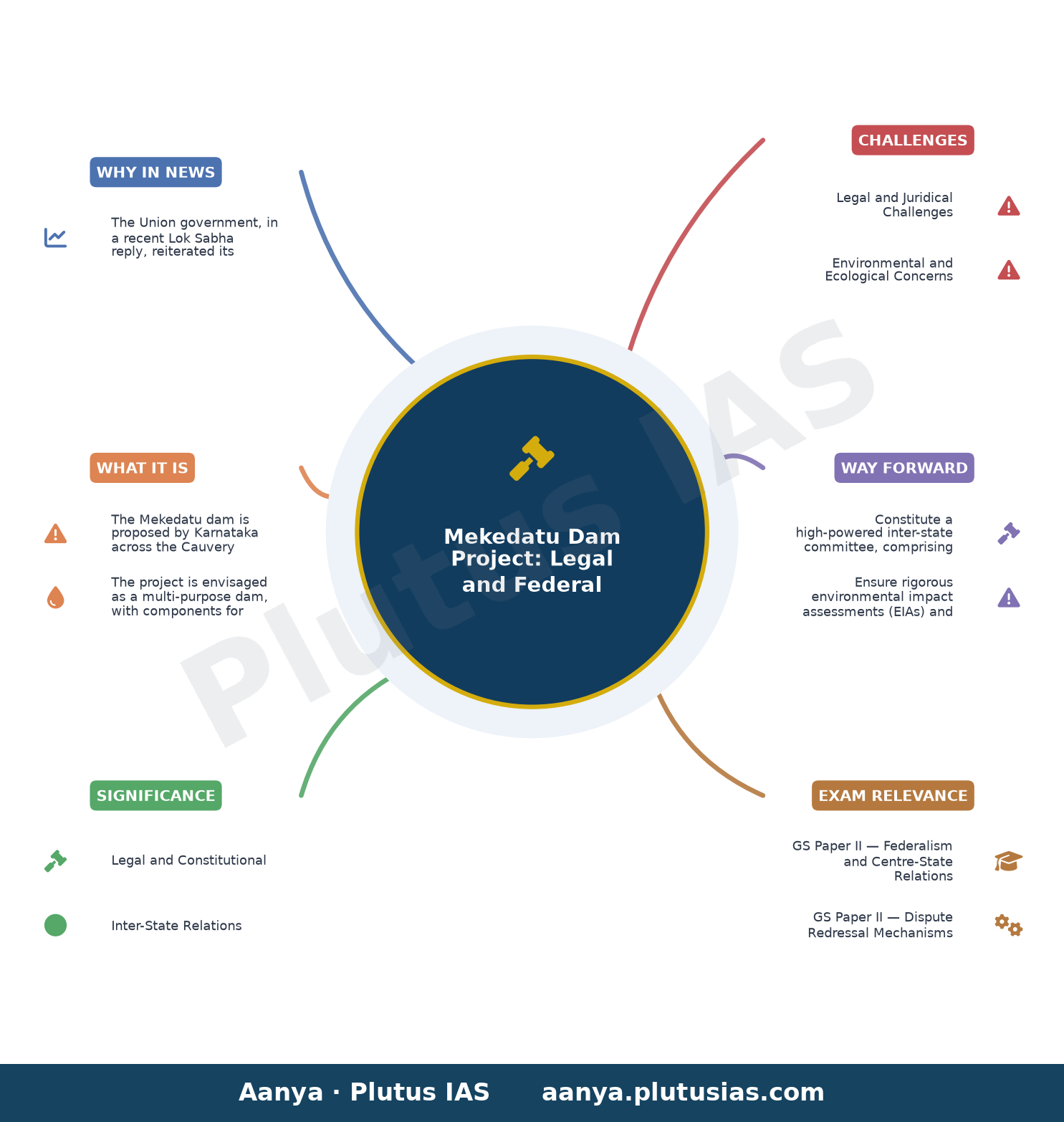
The Union government, in a recent Lok Sabha reply, reiterated its stance on the Mekedatu dam project, asserting that Karnataka is not legally required to seek consent from downstream riparian states—Tamil Nadu, Kerala, and Puducherry—before constructing the dam. This position, based on the Supreme Court’s 2018 judgment on the Cauvery dispute, has reignited the long-standing inter-state conflict over water sharing and project approvals, with Tamil Nadu opposing the project on grounds of potential violation of the Cauvery Water Disputes Tribunal’s final award.
Background
- The Cauvery river basin is a shared resource between Karnataka, Tamil Nadu, Kerala, and Puducherry, with historical disputes over water allocation dating back to the 19th century.
- The Cauvery Water Disputes Tribunal (CWDT), constituted under the Inter-State Water Disputes Act, 1956, delivered its final award in 2007, allocating specific water shares to each riparian state and prescribing regulated flow regimes.
- The Supreme Court, in its 2018 judgment on the Cauvery dispute, upheld the CWDT’s award while modifying certain aspects, including the creation of the Cauvery Water Management Scheme (CWMS) to oversee implementation.
- Karnataka’s proposal for the Mekedatu dam, located upstream in the Cauvery basin, aims to meet Bengaluru’s drinking water needs, but Tamil Nadu has raised concerns over its potential impact on downstream water availability and the regulated flow regime.
- Tamil Nadu’s Chief Minister has written to the Prime Minister, arguing that the project must be evaluated for consistency with the CWDT’s award, which prohibits upper riparian states from actions affecting scheduled deliveries to lower riparian states.
- The Union government’s stance, reiterated in Parliament, is that the Supreme Court’s judgment does not mandate prior consent from other riparian states for such projects, citing the CWDT’s award and the principle of federal autonomy.
What is the Mekedatu Dam Project?
- The Mekedatu dam is proposed by Karnataka across the Cauvery river, approximately 40 km from Bengaluru, to address the city’s growing drinking water and industrial needs.
- The project is envisaged as a multi-purpose dam, with components for drinking water supply, hydroelectric power generation, and flood control.
- Karnataka has justified the project as essential for sustainable urban development and to mitigate water scarcity in Bengaluru, which is a critical economic hub.
- The dam’s location is upstream of Tamil Nadu, raising concerns about reduced water flow and altered hydrological regimes in the Cauvery delta, a region heavily dependent on Cauvery waters for agriculture.
- The CWDT’s final award (2007) and the Supreme Court’s 2018 judgment govern water sharing between Karnataka and Tamil Nadu, with specific allocations and regulated flow schedules.
- The Supreme Court’s judgment clarified that while the CWDT’s award is binding, it does not explicitly require Karnataka to obtain consent from Tamil Nadu for structural interventions like the Mekedatu dam.
- Tamil Nadu’s opposition is rooted in the argument that the project could violate the CWDT’s award by altering the regulated flow regime and affecting scheduled deliveries to Tamil Nadu.
- The dispute highlights the broader challenge of balancing developmental needs with inter-state water-sharing obligations under India’s federal framework.
Key Features
| Feature | Significance |
|---|---|
| Mekedatu Project | A proposed dam across the Cauvery River in Karnataka, aimed at meeting Bengaluru’s drinking water needs and hydroelectric power generation. |
| Supreme Court Judgment (2018) | The Court upheld the Cauvery Water Disputes Tribunal’s final award, which regulates water sharing among riparian states and prohibits unilateral actions affecting downstream states. |
| Cauvery Water Disputes Tribunal Award | A legally binding mechanism for equitable water distribution among Karnataka, Tamil Nadu, Kerala, and Puducherry, ensuring scheduled deliveries to lower riparian states. |
| Union Government’s Stand | Asserts that Karnataka is not required to seek consent from other riparian states for the Mekedatu project, citing the 2018 Supreme Court judgment. |
| Tamil Nadu’s Objections | Argues that the project could disrupt the regulated flow regime and violate the Tribunal’s award by affecting downstream water availability. |
Why it Matters
Legal and Constitutional
- The dispute hinges on the interpretation of the Cauvery Water Disputes Tribunal’s final award and the Supreme Court’s 2018 judgment, which are legally binding on all riparian states.
- The Union government’s stance underscores the principle of federalism, where the Centre may intervene in inter-state river disputes to ensure compliance with judicial awards.
- The issue tests the balance between a state’s right to utilise its share of river water and the constitutional obligation to protect the rights of other riparian states.
Inter-State Relations
- The Mekedatu project exemplifies the broader challenge of managing transboundary river basins in India, where competing demands for water often lead to conflicts.
- The dispute highlights the need for cooperative federalism, where states must engage in dialogue and negotiation to resolve water-sharing issues amicably.
- The Centre’s reiteration of its stand may strain Centre-State relations, particularly with Tamil Nadu, which has historically been vocal about its water rights.
Environmental and Socio-Economic
- The project could impact the Cauvery delta, a region critical for agriculture and livelihoods, raising concerns about water availability for irrigation and drinking purposes.
- Environmental assessments and mitigation measures must be rigorously evaluated to ensure the project does not exacerbate ecological degradation or displace communities.
- The project’s potential to generate hydroelectric power could contribute to Karnataka’s energy security, but its feasibility must be balanced against downstream impacts.
Political and Administrative
- The Union government’s repeated stance in Parliament signals its commitment to supporting Karnataka’s developmental projects, even in the face of opposition from other states.
- The dispute also reflects the political dynamics between the Centre and states, particularly in a federal system where regional parties hold significant influence.
- Administrative delays and legal challenges could stall the project, necessitating swift resolution to avoid prolonged uncertainty.
Challenges
1. Legal and Juridical Challenges
- The Union government’s interpretation of the 2018 Supreme Court judgment may be contested in higher courts, leading to prolonged litigation.
- Tamil Nadu’s argument that the project violates the Tribunal’s award could gain traction if the judiciary re-examines the matter.
- The lack of a permanent tribunal or mechanism for resolving inter-state water disputes could exacerbate conflicts.
UPSC Link: GS Paper 2: Inter-State Relations and Disputes
2. Environmental and Ecological Concerns
- The project could alter the flow regime of the Cauvery, impacting aquatic ecosystems and biodiversity in the delta region.
- Inadequate environmental impact assessments (EIAs) or failure to address downstream concerns could lead to ecological degradation.
- Climate change-induced variability in rainfall patterns may further complicate water-sharing arrangements.
UPSC Link: GS Paper 3: Environmental Conservation and Climate Change
3. Political and Diplomatic Challenges
- The dispute could strain Centre-State relations, particularly with Tamil Nadu, where regional parties hold significant political influence.
- Inter-state tensions may escalate, requiring diplomatic intervention to prevent escalation into a broader conflict.
- Public sentiment and political pressure in both states could hinder constructive dialogue.
UPSC Link: GS Paper 2: Federalism and Centre-State Relations
4. Administrative and Implementation Challenges
- Delays in obtaining clearances from environmental and water regulatory authorities could stall the project indefinitely.
- Coordination between Karnataka and the Centre may face bureaucratic hurdles, delaying decision-making.
- Lack of a robust grievance redressal mechanism for affected stakeholders could lead to protests and legal challenges.
UPSC Link: GS Paper 2: Governance and Public Policy
5. Economic and Financial Challenges
- The project’s high cost and uncertain returns may deter private investment, necessitating substantial public funding.
- Potential revenue losses for Tamil Nadu due to reduced water availability could strain its agricultural economy.
- Opportunity costs of diverting resources to the project may divert attention from other developmental priorities.
UPSC Link: GS Paper 3: Economic Development and Resource Allocation
Challenges — UPSC Perspective
| Issue | Concern |
|---|---|
| Legal Interpretation | Disagreement over the applicability of the 2018 Supreme Court judgment and the Cauvery Water Disputes Tribunal’s award. |
| Environmental Impact | Potential disruption of the Cauvery’s flow regime, affecting ecosystems and downstream water availability. |
| Political Fallout | Risk of escalating Centre-State tensions and inter-state conflicts, particularly with Tamil Nadu. |
| Implementation Delays | Bureaucratic hurdles, legal challenges, and public opposition could delay or derail the project. |
| Economic Viability | High costs, uncertain returns, and opportunity costs may undermine the project’s feasibility. |
| Public Sentiment | Protests from farmers, environmentalists, and political parties could hinder project execution. |
Way Forward
- Constitute a high-powered inter-state committee, comprising representatives from Karnataka, Tamil Nadu, Kerala, and Puducherry, to assess the project’s impact and propose mitigation measures.
- Ensure rigorous environmental impact assessments (EIAs) and public consultations to address downstream concerns and ecological risks.
- Explore alternative water resource management strategies, such as rainwater harvesting, groundwater recharge, and wastewater recycling, to reduce dependence on the Cauvery.
- Strengthen the Cauvery Management Authority to monitor water flows, enforce the Tribunal’s award, and resolve disputes in a timely manner.
- Promote dialogue and negotiations between Karnataka and Tamil Nadu to build trust and foster cooperative federalism.
- Encourage Karnataka to adopt water-efficient technologies and practices to minimise the project’s downstream impact.
- Develop a transparent grievance redressal mechanism for affected stakeholders, including farmers and local communities.
- Consider a phased implementation of the project, with regular reviews to assess its impact and adjust strategies as needed.
UPSC Value Addition
Keywords for Mains Answer-Writing
Inter-State Water Disputes Act, 1956 · Cauvery Water Disputes Tribunal (CWDT) Award · Riparian Rights · Mekedatu Project · Cauvery River Basin · Supreme Court Judgment on Cauvery (2018) · Federalism and Water Governance · Inter-State River Water Disputes (Amendment) Act, 2019 · Union-State Relations in Water Resources · Environmental Impact Assessment (EIA) of Dams · Karnataka-Tamil Nadu Water Sharing · Doctrine of Prior Appropriation · Scheduled Deliveries in Water Awards · Constitutional Provisions on Water (Entry 17, State List) · Judicial Review of Water Disputes
Constitutional & Policy Linkages
- Article 262: Adjudication of disputes relating to inter-state rivers and river valleys.
Concept Flow
Karnataka proposes the Mekedatu dam to meet Bengaluru’s water needs → Tamil Nadu raises objections citing potential downstream impact → Union government asserts Karnataka’s right to proceed without consent → Tamil Nadu challenges the legal interpretation in courts → Supreme Court’s 2018 judgment cited by both sides → Centre reaffirms its stand in Parliament → Political and legal tensions escalate → Need for inter-state dialogue and alternative solutions emerges.
Prelims Practice Questions
Q1. Consider the following statements regarding the Mekedatu Project and the Cauvery Water Disputes Tribunal (CWDT) Award:
1. The CWDT Award of 2007 established a regulated flow regime for the Cauvery River.
2. The Supreme Court, in its 2018 judgment, held that Karnataka does not require the consent of other riparian states (Tamil Nadu, Kerala, Puducherry) to construct structures across the Cauvery.
3. The CWDT Award explicitly prohibits any upper riparian state from taking actions that may affect scheduled deliveries to lower riparian states.
4. The Mekedatu Project is solely intended for hydroelectric power generation and does not address drinking water needs of Bengaluru.
How many of the above statements are correct?
- Only one
- Only two
- Only three
- All four
Answer: Only three — Statements 1, 2, and 3 are correct as per the CWDT Award and the Supreme Court judgment. Statement 4 is incorrect because the project is primarily aimed at meeting Bengaluru’s drinking water needs.
Q2. Assertion (A): The Union government’s stand on the Mekedatu Project aligns with the Supreme Court’s interpretation of the CWDT Award.
Reason (R): The Supreme Court, in its 2018 judgment, clarified that the CWDT Award does not mandate prior consent from other riparian states for Karnataka to construct structures across the Cauvery.
In the context of the above two statements, which of the following is correct?
- Both A and R are true, and R is the correct explanation of A.
- Both A and R are true, but R is NOT the correct explanation of A.
- A is true, but R is false.
- A is false, but R is true.
Answer: Both A and R are true, and R is the correct explanation of A. — Both the assertion and reason are true. The Supreme Court’s 2018 judgment explicitly states that Karnataka does not require consent from other riparian states to construct structures, which justifies the Union government’s stand.
Q3. Match the following provisions/concepts with their respective legal or institutional frameworks:
Column I (Provision/Concept)
A. Scheduled Deliveries
B. Inter-State Water Disputes Act, 1956
C. Riparian Rights
D. Environmental Impact Assessment (EIA) of Dams
Column II (Framework)
1. CWDT Award
2. Union-State Relations
3. National Green Tribunal Act, 2010
4. Common Law Doctrine
- A-1, B-2, C-4, D-3; A-2, B-1, C-4, D-3; A-1, B-3, C-2, D-4; A-4, B-2, C-1, D-3
- answer_string_list_indexes_in_options_array_above_is_0
- answer_index_in_options_array_above_is_0
- explain_match_pairs_only_in_explain_field
- format_match
Answer: A-1, B-2, C-4, D-3; A-2, B-1, C-4, D-3; A-1, B-3, C-2, D-4; A-4, B-2, C-1, D-3 —
Mains Practice Question
✍ Critically examine the constitutional and legal framework governing inter-state river water disputes in India, with particular reference to the Mekedatu Project dispute between Karnataka and Tamil Nadu. Also, analyse the implications of the Supreme Court’s 2018 judgment on the Cauvery dispute for the federal balance in water governance. (15 Marks)
Approach: MODEL-ANSWER SKELETON:
1. **Constitutional Framework** (3 marks):
– Entry 17 (Water, that is to say, water supplies, irrigation and canals, drainage and embankments, water storage and water power) in the State List (7th Schedule).
– Entry 56 (Regulation and development under the control of the Union) in the Union List, enabling Parliament to legislate on inter-state rivers.
– Constitutional provisions on federalism (Art. 262 – Adjudication of disputes relating to waters of inter-state rivers; Art. 263 – Inter-State Councils).
– Role of the Inter-State Water Disputes Act, 1956, and its 2019 amendment (constitution of a single tribunal with a time-bound resolution mechanism).
2. **Legal Framework and Key Instruments** (4 marks):
– Cauvery Water Disputes Tribunal (CWDT) Award (2007) and its key provisions: regulated flow regime, scheduled deliveries to Tamil Nadu, Kerala, and Puducherry.
– Supreme Court’s 2018 judgment on the Cauvery dispute: interpretation of the CWDT Award, emphasis on the doctrine of prior appropriation, and the absence of a requirement for prior consent from other riparian states for construction of structures.
– Inter-State River Water Disputes (Amendment) Act, 2019: provisions for a single tribunal, time-bound resolution, and appellate mechanism.
3. **Analysis of the Mekedatu Project Dispute** (4 marks):
– Karnataka’s justification: meeting Bengaluru’s drinking water needs and flood mitigation.
– Tamil Nadu’s concerns: impact on scheduled deliveries, drinking water availability in the Cauvery delta, and environmental degradation.
– Legal arguments: CWDT Award’s prohibition on actions affecting scheduled deliveries (Art. 5.2 of the Award) and the Supreme Court’s interpretation of the Award.
– Federal tensions: Union government’s support for Karnataka vs. Tamil Nadu’s demand for prior consultation.
4. **Implications of the Supreme Court’s 2018 Judgment** (3 marks):
– Strengthening the upper riparian state’s autonomy in water management.
– Potential dilution of the lower riparian state’s rights under the CWDT Award.
– Impact on the federal balance: centralisation vs. state autonomy in water governance.
– Need for a relook at the CWDT Award or legislative reforms to address contemporary challenges.
5. **Conclusion** (1 mark):
– The Mekedatu dispute exemplifies the tension between state autonomy and inter-state equity in water governance.
– A balanced approach requires adherence to the CWDT Award while accommodating developmental needs, possibly through negotiated settlements or legislative amendments.
Source: The Hindu
Generated by AanyaAi for educational purpose.

- मुस्लिम महिलाओं को विरासत में समान अधिकार: सुप्रीम कोर्ट ने केंद्र से पूछा जवाब - September 23, 2026
- Supreme Court Questions Muslim Women’s Inheritance Rights Under Personal Law - September 23, 2026
- सुप्रीम कोर्ट ने पटना हाईकोर्ट के बलात्कार फैसले पर लिया स्वतः संज्ञान - September 23, 2026

No Comments