


23 Sep HEADS AI Project to Tackle India’s Mental Healthcare Crisis: Key Facts for UPSC
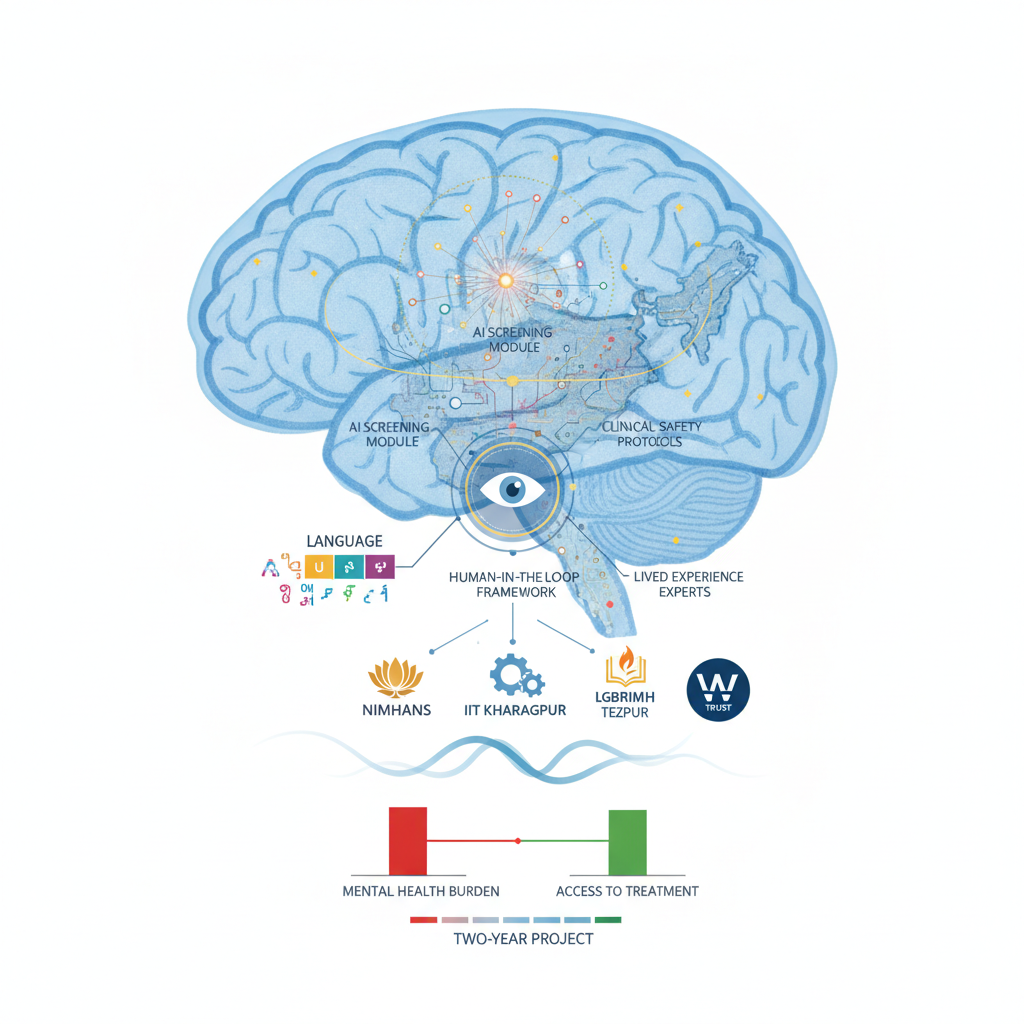
✎ HEADS is a governance-driven AI initiative integrating human oversight, linguistic inclusivity, and ethical safeguards to address India’s mental healthcare deficit through early, multilingual depression screening.
Subject Relevance — Where This Topic Fits
- GS Paper II — Governance, Transparency and Accountability (Digital Public Infrastructure) | GS Paper III — Science and Technology (AI applications in healthcare) | GS Paper IV — Ethics and Integrity in Governance (Human-in-the-loop frameworks)
- Prelims: AI in healthcare, NIMHANS, Wellcome Trust, depression screening tools, multilingual AI models, Human-in-the-loop (HITL) framework, LGBRIMH Tezpur, IIT Kharagpur
- Essay: The intersection of artificial intelligence and public health: Opportunities and ethical dilemmas, Bridging the digital divide in healthcare: Language, accessibility, and equity
Quick Revision: HEADS is a governance-driven AI initiative integrating human oversight, linguistic inclusivity, and ethical safeguards to address India’s mental healthcare deficit through early, multilingual depression screening.
Why is this in the news?
The HEADS (Human-in-the-loop Evaluation of Assisted Depression Screening) initiative has been formally launched by NIMHANS in collaboration with IIT Kharagpur and LGBRIMH Tezpur, supported by the Wellcome Trust. This two-year project addresses India’s critical mental healthcare gap by developing AI-assisted tools for early depression screening, with a focus on linguistic inclusivity and ethical governance through a human-in-the-loop framework. The initiative is significant for its emphasis on regional languages, participatory design involving lived experience experts, and integration of clinical safety protocols in AI deployment.
Background
- India bears a substantial burden of mental health disorders, with only about one in five individuals affected by depression receiving timely, appropriate treatment.
- The treatment gap is exacerbated by a shortage of mental health professionals—approximately 0.3 psychiatrists per 100,000 population—far below the WHO-recommended norm of 1 per 100,000.
- Existing digital mental health tools, including AI-based screening applications, predominantly rely on English-language datasets, rendering them ineffective in India’s multilingual and socio-culturally diverse context.
- The Government of India’s National Mental Health Programme (NMHP) and the Mental Healthcare Act, 2017, mandate accessible mental healthcare, but implementation challenges persist due to resource constraints and linguistic barriers.
- The Wellcome Trust, a global charitable foundation, has historically funded research in global health challenges, including mental health, with a focus on equitable and context-sensitive solutions.
- Collaborative models between premier institutions (NIMHANS, IITs) and regional mental health institutes (LGBRIMH) reflect a governance approach to leveraging technological innovation for public health delivery.
What is the HEADS Initiative?
- A two-year collaborative research project titled ‘Human-in-the-loop Evaluation of Assisted Depression Screening’ (HEADS), launched by NIMHANS, IIT Kharagpur, and LGBRIMH Tezpur, with funding from the Wellcome Trust.
- Aims to develop and evaluate AI-assisted tools for the early identification and screening of depression, with a focus on scalability and clinical utility in resource-constrained settings.
- Prioritises linguistic inclusivity by developing AI models trained on Kannada, Assamese, Hindi, Bengali, and English, addressing the underrepresentation of Indian languages in mental health AI research.
- Operates under a ‘human-in-the-loop’ governance framework, wherein AI tools function as decision-support systems for clinicians rather than autonomous diagnostic entities, ensuring ethical oversight and clinical safety.
- Incorporates a 15-member panel of Lived Experience Experts—individuals with personal experience of mental health conditions—who participate in all phases of the project, including design, consent protocols, language evaluation, bias audits, and system stress-testing.
- Will conduct approximately 4,500 clinical interviews across NIMHANS and LGBRIMH sites over 24 months, generating a multilingual dataset for AI model training and validation.
- IIT Kharagpur leads the technical development, including AI model architecture, system integration, and safety protocols, while NIMHANS and LGBRIMH provide clinical expertise and domain validation.
- Aligns with global best practices in digital mental health, including the WHO’s mhGAP guidelines and principles of participatory design in healthcare innovation.
Key Features
| Feature | Significance |
|---|---|
| AI-assisted screening for depression | Enables early identification of depression, addressing India’s substantial treatment gap by leveraging artificial intelligence in clinical settings. |
| Multilingual focus (Kannada, Assamese, Hindi, Bengali, English) | Ensures cultural and linguistic inclusivity, addressing the underrepresentation of regional languages in mental health AI research. |
| Human-in-the-loop framework | AI acts as a decision-aid for clinicians, preserving professional judgment while enhancing diagnostic accuracy and reducing human error. |
| Lived Experience Experts panel | Integrates patient perspectives into AI development, ensuring ethical design, bias mitigation, and alignment with real-world clinical needs. |
| Two-year clinical evaluation (4,500 interviews) | Provides robust empirical validation of AI tools across diverse linguistic and clinical contexts, ensuring reliability and scalability. |
Why it Matters
Public Health Impact
- Addresses India’s mental healthcare gap, where only ~20% of depression cases receive timely care, by improving early screening and accessibility.
- Reduces diagnostic delays through AI-assisted tools, particularly in underserved linguistic and regional populations.
- Enhances mental health outcomes by integrating patient-reported experiences into AI model training and evaluation.
Technological Innovation
- Pioneers AI systems tailored for Indian languages, overcoming the limitation of English-centric mental health AI tools.
- Demonstrates the feasibility of human-in-the-loop AI in clinical decision-making, setting a precedent for ethical AI deployment in healthcare.
- Advances AI safety and bias mitigation through structured audits by Lived Experience Experts, ensuring equitable outcomes.
Policy and Governance
- Aligns with the National Mental Health Policy (2014) and the Mental Healthcare Act (2017), which emphasize equitable access to mental healthcare.
- Supports the Ayushman Bharat Digital Mission (ABDM) by integrating AI-driven tools into digital health infrastructure.
- Provides a model for public-private-academic collaborations in healthcare innovation, leveraging international funding (Wellcome Trust) for domestic impact.
Challenges
1. Linguistic and Cultural Diversity
- AI models trained on English datasets struggle to interpret emotional expressions in regional languages, necessitating language-specific datasets.
- Cultural nuances in mental health expression (e.g., idioms, metaphors) may be misinterpreted by AI, requiring expert validation.
- Limited availability of annotated clinical datasets in regional languages poses a barrier to AI training and validation.
UPSC Link: GS Paper 2: Governance, Issues relating to development and management of Social Sector/Services
2. Ethical and Bias Concerns
- Risk of algorithmic bias if AI models are not audited for stigmatising language or cultural insensitivity by Lived Experience Experts.
- Ensuring informed consent and data privacy for patients, particularly in sensitive mental health contexts.
- Balancing AI assistance with clinician autonomy to avoid over-reliance on automated tools.
UPSC Link: GS Paper 4: Ethics, Integrity and Aptitude
3. Scalability and Implementation
- Translating pilot-scale AI tools into scalable solutions requires robust infrastructure and training for healthcare workers.
- Integration with existing digital health systems (e.g., ABDM) must address interoperability and data security challenges.
- Sustaining funding and long-term evaluation beyond the two-year study period.
UPSC Link: GS Paper 2: Governance, Government policies and interventions for development in various sectors
4. Clinical Validation and Standardisation
- Ensuring AI tools meet clinical standards for accuracy, sensitivity, and specificity across diverse patient populations.
- Addressing variability in clinical practices and diagnostic criteria across different healthcare settings.
- Standardising AI outputs to align with existing mental health assessment frameworks (e.g., PHQ-9, GAD-7).
UPSC Link: GS Paper 3: Technology, Economic Development, Bio-technology
Challenges — UPSC Perspective
| Issue | Concern |
|---|---|
| Data scarcity in regional languages | Lack of annotated clinical datasets for AI training in languages like Assamese, Bengali, and Kannada. |
| Cultural misinterpretation by AI | Risk of AI misclassifying emotional expressions due to cultural or linguistic differences. |
| Ethical oversight in AI deployment | Need for robust frameworks to audit AI tools for bias, stigmatisation, and patient safety. |
| Integration with existing healthcare systems | Challenges in embedding AI tools within digital health infrastructure like ABDM. |
| Long-term sustainability of AI models | Ensuring models remain accurate and relevant beyond the study period. |
| Patient privacy and consent | Safeguarding sensitive mental health data in AI-driven screening processes. |
Way Forward
- Establish a national repository of multilingual mental health datasets to support AI training and validation.
- Develop standardised protocols for AI-assisted mental health screening, aligned with existing clinical frameworks.
- Expand the Lived Experience Experts panel to include diverse linguistic and regional backgrounds for comprehensive audits.
- Integrate HEADS outcomes with the Ayushman Bharat Digital Mission for scalable deployment.
- Conduct pilot studies in rural and semi-urban healthcare centres to assess real-world applicability.
- Formulate ethical guidelines for AI in mental health, including bias mitigation and patient consent frameworks.
- Collaborate with state governments to incorporate AI tools into existing mental health programmes.
- Promote public awareness campaigns to reduce stigma and encourage early help-seeking behaviours.
UPSC Value Addition
Keywords for Mains Answer-Writing
Mental Healthcare in India · AI in Healthcare · National Mental Health Policy 2014 · Digital Health Initiatives in India · Human-in-the-loop AI Systems · Lived Experience Experts in Mental Health · Multilingual AI Models · NIMHANS · IIT Kharagpur · Wellcome Trust · Depression Screening Tools · Ethical AI in Healthcare
Constitutional & Policy Linkages
- Article 21: Right to Health (interpreted to include mental health as part of life and personal liberty).
Concept Flow
Limited access to mental healthcare in India → High treatment gap (~80% untreated depression cases) → Need for scalable screening tools → AI-assisted depression screening proposed → Multilingual and culturally sensitive AI development → Human-in-the-loop framework ensures ethical deployment → Clinical validation through 4,500 interviews → Integration with digital health systems → Policy alignment with Mental Healthcare Act (2017) → Improved early diagnosis and equitable care.
Prelims Practice Questions
Q1. Consider the following statements regarding the HEADS project:
1. HEADS is a collaborative initiative led by NIMHANS, IIT Kharagpur, and LGBRIMH Tezpur.
2. The project aims to develop AI-assisted tools for early identification of depression exclusively in English.
3. The project incorporates a ‘human-in-the-loop’ framework to ensure clinical oversight.
4. The project is funded by the Wellcome Trust and will run for a duration of 24 months.
How many of the above statements are correct?
- Only one
- Only two
- Only three
- All
Answer: Only three — Statements 1, 3, and 4 are correct. Statement 2 is incorrect as the project focuses on multilingual AI tools including Kannada, Assamese, Hindi, Bengali, and English.
Q2. Assertion (A): The HEADS project emphasizes the inclusion of Lived Experience Experts in shaping its design and protocols.
Reason (R): Lived Experience Experts are individuals who have survived mental health conditions and their involvement ensures the AI tools are culturally sensitive and ethically robust.
Options:
A. Both A and R are true, and R is the correct explanation of A.
B. Both A and R are true, but R is NOT the correct explanation of A.
C. A is true, but R is false.
D. A is false, but R is true.
- A
- B
- C
- D
Answer: A — Both Assertion (A) and Reason (R) are true, and R correctly explains A as the involvement of Lived Experience Experts is a key feature of the project to ensure cultural sensitivity and ethical robustness.
Q3. Match the following institutions with their roles in the HEADS project:
Column I (Institution) | Column II (Role)
1. NIMHANS | A. Core engineering and AI-safety compliance
2. IIT Kharagpur | B. Clinical interviews and mental health expertise
3. LGBRIMH Tezpur | C. Collaboration and project leadership
4. Wellcome Trust | D. Funding and international collaboration
Options:
A. 1-B, 2-A, 3-C, 4-D
B. 1-C, 2-A, 3-B, 4-D
C. 1-B, 2-D, 3-A, 4-C
D. 1-A, 2-B, 3-D, 4-C
- A
- B
- C
- D
Answer: A — Correct match: 1-B (NIMHANS leads clinical interviews and mental health expertise), 2-A (IIT Kharagpur handles core engineering and AI-safety), 3-C (LGBRIMH collaborates and supports project activities), 4-D (Wellcome Trust provides funding).
Mains Practice Question
✍ Critically examine the role of AI in bridging the mental healthcare gap in India, with particular reference to the HEADS project. How does the ‘human-in-the-loop’ framework address ethical and cultural challenges in mental health AI deployment? (15 Marks)
Approach: MODEL-ANSWER SKELETON:
1. **Context and Need**: Define the mental healthcare gap in India (e.g., WHO estimates 75-85% treatment gap for mental disorders) and cite the National Mental Health Policy 2014 and Mental Healthcare Act 2017.
2. **AI in Mental Health**: Explain the potential of AI in early screening and intervention, citing examples like chatbots or predictive models. Highlight limitations such as bias in datasets and lack of cultural sensitivity.
3. **HEADS Project**: Describe the project’s objectives, institutions involved (NIMHANS, IIT Kharagpur, LGBRIMH Tezpur), funding (Wellcome Trust), and duration (24 months). Emphasise its multilingual focus (Kannada, Assamese, Hindi, Bengali, English) and inclusion of Lived Experience Experts.
4. **Human-in-the-loop Framework**: Define the framework and its ethical rationale—AI as a decision-aid, not a replacement for clinicians. Discuss how it mitigates risks like algorithmic bias, stigmatisation, and misdiagnosis.
5. **Cultural and Ethical Challenges**: Analyse challenges such as linguistic diversity, stigma in mental health discourse, and the need for context-aware AI. Reference the project’s embedded 15-member panel of Lived Experience Experts as a model for participatory AI development.
6. **Critique and Way Forward**: Acknowledge limitations (e.g., scalability, data privacy, regulatory oversight) and suggest measures like standardised ethical guidelines, inter-institutional collaboration, and integration with existing public health systems (e.g., Ayushman Bharat Digital Mission). Conclude with the transformative potential of AI when ethically designed and human-centred.
Source: The Hindu
Generated by AanyaAi for educational purpose.
Related guides on our sites
- Best PSIR optional coaching for upsc
- Best PSIR optional teacher for upsc
- Best teacher of PSIR optional for upsc
- Best PSIR optional coaching in delhi for UPSC

- छत्तीसगढ़: ताड़ोकी-रावघाट रेल खंड पूरा, दूरस्थ क्षेत्रों को मिलेगा बड़ा लाभ - September 24, 2026
- छत्तीसगढ़ में नई रेल लाइन: ताड़ोकी-रावघाट खंड पूरा, परिवहन क्रांति - September 24, 2026
- यूपी में शुरू हुई ‘भारत टैक्सी’, सारथियों को मिलेगा मालिकाना हक - September 24, 2026

No Comments