


08 Aug Centre to Launch Comprehensive Economic Health Survey of Himachal Pradesh in August 2026
✎ The Himachal Pradesh Economic Health Survey, conducted by the NSO, is a multi-survey coordinated exercise to generate granular socio-economic data that will directly inform employment generation, agricultural reforms, social…
Subject Relevance — Where This Topic Fits
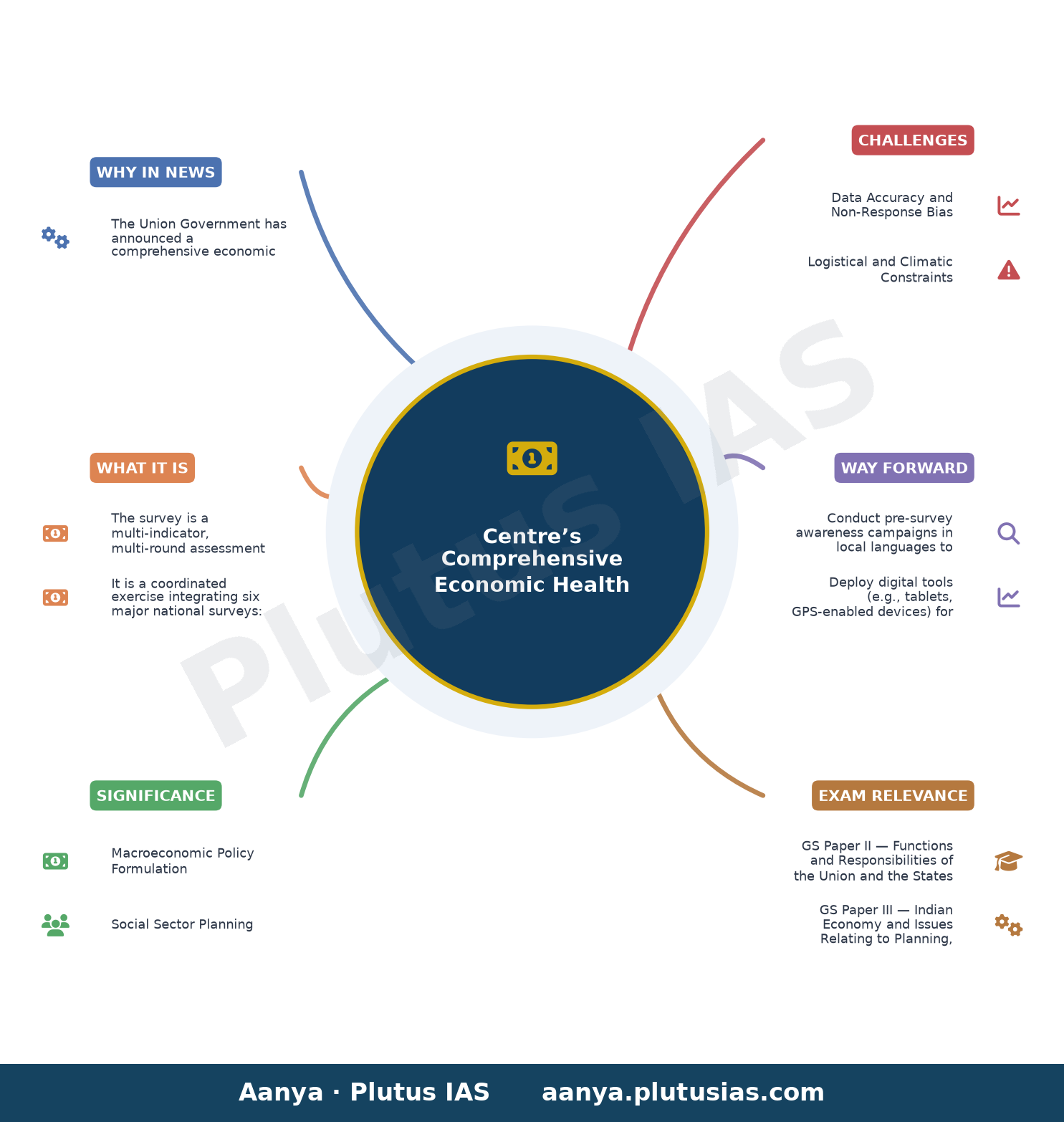
- GS Paper II — Functions and Responsibilities of the Union and the States | GS Paper III — Indian Economy and Issues Relating to Planning, Mobilisation of Resources, Growth, Development and Employment
- Prelims: National Statistical Office (NSO), Periodic Labour Force Survey (PLFS), All-India Debt and Investment Survey, Consumer Price Index (CPI), Migration Survey, Himachal Pradesh economy, State-specific socio-economic indicators
- Essay: The Role of Data-Driven Governance in India’s Development Trajectory, Balancing Economic Growth and Social Equity: Lessons from State-Level Surveys
Quick Revision: The Himachal Pradesh Economic Health Survey, conducted by the NSO, is a multi-survey coordinated exercise to generate granular socio-economic data that will directly inform employment generation, agricultural reforms, social security schemes, and resource allocation in the state.
Why is this in the news?
The Union Government has announced a comprehensive economic health survey of Himachal Pradesh to assess the state’s socio-economic conditions, including income, employment, debt, investment, agriculture, migration, and inflation. Conducted by the National Statistical Office (NSO), this survey is part of a coordinated national effort involving multiple flagship surveys such as the Periodic Labour Force Survey (PLFS), All-India Debt and Investment Survey, and Migration Survey. The findings will directly inform future policy formulation, budgetary allocations, and development schemes, making it a critical exercise for understanding regional economic dynamics and addressing structural challenges in a Himalayan state.
Background
- Himachal Pradesh, a predominantly mountainous state in the Himalayas, has a unique economic profile characterised by high dependence on agriculture, horticulture, and tourism, alongside significant hydroelectric power generation.
- The state faces structural challenges such as seasonal unemployment, out-migration from rural and border areas, and vulnerability to climate-induced agricultural disruptions.
- The National Statistical Office (NSO), under the Ministry of Statistics and Programme Implementation (MoSPI), is the nodal agency responsible for conducting large-scale socio-economic surveys in India.
- The survey is aligned with the Union Government’s commitment to evidence-based policymaking, as outlined in the National Statistical Commission’s recommendations and the Sustainable Development Goals (SDGs) framework.
- Himachal Pradesh has historically been a focus of central schemes such as the Pradhan Mantri Gram Sadak Yojana (PMGSY) and the Mahatma Gandhi National Rural Employment Guarantee Scheme (MGNREGS), necessitating accurate data for targeted implementation.
- The survey follows a multi-round methodology, ensuring data triangulation across rural and urban households, agricultural holdings, and industrial clusters.
What is the Himachal Pradesh Economic Health Survey and How Will It Be Conducted?
- The survey is a multi-indicator, multi-round assessment of Himachal Pradesh’s socio-economic landscape, covering 11 districts and representative rural and urban clusters.
- It is a coordinated exercise integrating six major national surveys: National Household Income Survey, Periodic Labour Force Survey (PLFS), All-India Debt and Investment Survey, Migration Survey, Situation Assessment of Agricultural Households, and Consumer Price Index (CPI) Survey.
- The National Statistical Office (NSO) will deploy trained enumerators to collect primary data through structured questionnaires, ensuring standardised data collection protocols and quality control mechanisms.
- Key data points include household income, employment status, debt levels, savings and investment patterns, agricultural productivity, cost of cultivation, and consumption expenditure.
- Migration surveys will focus on border districts such as Kinnaur, Lahaul-Spiti, and Sirmaur, examining push-pull factors behind out-migration, including employment opportunities, education, and climate vulnerability.
- The survey will also assess the impact of hydroelectric projects and tourism on local livelihoods, particularly in districts like Kullu, Shimla, and Solan.
- Data will be disaggregated by caste, gender, and occupational categories to identify structural inequalities and inform inclusive policy design.
- The survey adheres to the Collection of Statistics Act, 2008, ensuring confidentiality, anonymisation, and adherence to ethical data collection standards.
Key Features
| Feature | Significance |
|---|---|
| National Statistical Office (NSO) Teams | Conducts on-ground data collection in rural and urban areas to ensure empirical basis for policy formulation. |
| Household Income Survey | Assesses real income levels to inform fiscal policies and budgetary allocations. |
| Periodic Labour Force Survey (PLFS) | Provides granular data on employment, unemployment, and underemployment trends. |
| Agricultural Household Situation Assessment Survey | Evaluates farm incomes, input costs, and livelihood dependencies for agricultural sector planning. |
| Migration Survey | Maps out-migration trends, causes, and economic impacts on source regions. |
| Consumer Price Index (CPI) Survey | Tracks inflation dynamics to calibrate monetary and social welfare policies. |
Why it Matters
Macroeconomic Policy Formulation
- Data-driven policy design for resource allocation across sectors such as agriculture, industry, and services.
- Enables evidence-based fiscal stimulus or austerity measures in response to economic shocks.
- Facilitates alignment of state-level development plans with national objectives under the 73rd and 74th Constitutional Amendments.
Social Sector Planning
- Identifies vulnerable groups for targeted welfare interventions under schemes like MGNREGA or PM-KISAN.
- Informs design of employment guarantee schemes and skill development programs in high-migration districts.
- Supports poverty alleviation strategies by quantifying income disparities and regional variations.
Agrarian Economy Analysis
- Provides insights into farm distress, input costs, and profitability to guide agricultural reforms.
- Helps assess the impact of climate change on crop yields and rural livelihoods.
- Informs pricing policies for Minimum Support Price (MSP) and procurement mechanisms.
Labour Market Dynamics
- Reveals structural unemployment and skill mismatches for policy interventions.
- Guides vocational training programs to align workforce skills with industry demands.
- Supports formulation of labour laws and social security frameworks.
Inflation and Price Stability
- Tracks regional price variations to inform monetary policy and inflation targeting.
- Enables adjustment of subsidies and welfare transfers based on actual cost-of-living data.
- Supports food security policies by identifying inflation hotspots in essential commodities.
Challenges
1. Data Accuracy and Non-Response Bias
- Risk of incomplete or inaccurate responses due to respondent fatigue or mistrust.
- Need for rigorous sampling techniques to ensure representativeness across diverse geographical and socio-economic strata.
- Potential underreporting of sensitive data such as income or debt levels.
UPSC Link: GS Paper 3: Economic Survey
2. Logistical and Climatic Constraints
- Difficulty in accessing remote and hilly terrains in Himachal Pradesh during monsoon.
- High operational costs for deploying survey teams across scattered rural settlements.
- Time-sensitive nature of surveys requiring coordination with agricultural cycles.
UPSC Link: GS Paper 1: Geographical Features
3. Policy Implementation Gaps
- Disconnect between data collection and actual policy execution due to bureaucratic delays.
- Lack of inter-departmental coordination leading to fragmented policy responses.
- Inadequate mechanisms for periodic review and updating of policies based on survey findings.
UPSC Link: GS Paper 2: Governance
4. Socio-Economic Diversity
- Heterogeneity in economic structures across districts (e.g., industrial vs. agrarian regions).
- Cultural and linguistic barriers affecting survey participation in tribal and remote areas.
- Need for disaggregated data to avoid one-size-fits-all policy approaches.
UPSC Link: GS Paper 1: Social Issues
5. Technology and Digital Divide
- Limited digital literacy among respondents in rural areas complicating data collection.
- Dependence on traditional methods (e.g., paper-based surveys) may slow down data processing.
- Potential for digital solutions (e.g., mobile apps) to improve efficiency but requiring capacity building.
UPSC Link: GS Paper 3: Science & Technology
Challenges — UPSC Perspective
| Issue | Concern |
|---|---|
| Remote Terrain Accessibility | Monsoon-induced roadblocks and logistical delays in hilly districts. |
| Data Privacy and Confidentiality | Ensuring respondent anonymity while maintaining data utility for policy. |
| Survey Fatigue | Overlapping national surveys may lead to respondent resistance or incomplete data. |
| Language and Cultural Barriers | Need for multilingual survey instruments and local enumerator training. |
| Agricultural Seasonality | Timing conflicts with peak farming activities affecting data reliability. |
| Inter-State Migration Data Gaps | Lack of real-time tracking of seasonal labour migration patterns. |
Way Forward
- Conduct pre-survey awareness campaigns in local languages to enhance participation and trust.
- Deploy digital tools (e.g., tablets, GPS-enabled devices) for real-time data validation and geotagging.
- Establish a state-level coordination committee with district collectors for logistical support.
- Integrate survey findings with existing databases (e.g., Socio-Economic Caste Census) for cross-verification.
- Publish preliminary findings within 3 months to inform immediate policy adjustments.
- Train enumerators in cultural sensitivity and ethical data collection practices.
- Leverage local self-government institutions (Panchayats) for community engagement and feedback.
- Develop a feedback mechanism for respondents to report discrepancies or grievances.
UPSC Value Addition
Keywords for Mains Answer-Writing
National Statistical Office (NSO) · Periodic Labour Force Survey (PLFS) · All-India Debt and Investment Survey · Migration Survey · Consumer Price Index (CPI) · Himachal Pradesh economic survey · State-level economic assessment · Employment and unemployment data · Agrarian distress and rural economy · Fiscal federalism and data-driven policymaking · Social sector indicators · Structural transformation of the economy
Constitutional & Policy Linkages
- Article 243G: Powers and responsibilities of Panchayats in economic planning.
- Article 243W: Functions of Municipalities in urban economic development.
- Seventh Schedule: State List (Entry 41: State Public Works)
- Seventh Schedule: Concurrent List (Entry 20: Economic and Social Planning)
Concept Flow
National Statistical Office (NSO) initiates survey → Data collection on income, employment, migration → Aggregation and analysis of micro-level data → Identification of economic and social trends → Policy formulation for targeted interventions → Implementation of schemes (e.g., MGNREGA, PM-KISAN) → Monitoring and evaluation of outcomes → Feedback loop for policy refinement.
Prelims Practice Questions
Q1. Consider the following statements regarding the National Statistical Office (NSO) in India:
1. The NSO conducts the Periodic Labour Force Survey (PLFS) to measure employment and unemployment.
2. The NSO is mandated to conduct the All-India Debt and Investment Survey.
3. The NSO is responsible for compiling the Consumer Price Index (CPI) at the national level.
4. The NSO operates under the Ministry of Finance, Government of India.
How many of the above statements are correct?
- Only one
- Only two
- Only three
- All four
Answer: Only three — Statements 1, 2, and 3 are correct as the NSO conducts PLFS, All-India Debt and Investment Survey, and compiles CPI. Statement 4 is incorrect as the NSO functions under the Ministry of Statistics and Programme Implementation.
Q2. Assertion (A): The Consumer Price Index (CPI) is a key indicator for measuring inflation in India.
Reason (R): The CPI is compiled by the National Statistical Office (NSO) using data from selected urban and rural markets.
Options:
A. Both A and R are true, and R is the correct explanation of A.
B. Both A and R are true, but R is not the correct explanation of A.
C. A is true, but R is false.
D. A is false, but R is true.
- A
- B
- C
- D
Answer: A — Both A and R are true. The CPI is indeed a key inflation measure, and the NSO compiles it using market data. R correctly explains A.
Mains Practice Question
✍ The Government of India has initiated a comprehensive economic health survey in Himachal Pradesh, encompassing multiple macroeconomic and social indicators. Critically analyse the significance of such surveys for evidence-based policymaking in India. Also, examine the challenges in ensuring data reliability and representativeness in state-level surveys. (15 Marks)
Approach: MODEL-ANSWER SKELETON:
1. **Introduction (2 marks)**: Define the National Statistical Office (NSO) and its role in conducting macroeconomic surveys. Briefly introduce the Himachal Pradesh survey as a case study.
2. **Significance of Surveys for Evidence-Based Policymaking (5 marks)**:
– **Data-Driven Governance**: Surveys like PLFS, All-India Debt and Investment Survey, and Migration Survey provide critical data on employment, debt, investment, and migration trends.
– **Policy Formulation**: Data on income, employment, and inflation (CPI) informs budgetary allocations, employment generation schemes, and social sector interventions.
– **Fiscal Federalism**: State-level surveys enable the Centre to design targeted schemes under Article 282 (grants-in-aid) and Article 275 (special grants).
– **Monitoring SDGs**: Surveys align with Sustainable Development Goals (SDGs), particularly SDG 8 (Decent Work and Economic Growth) and SDG 1 (No Poverty).
3. **Challenges in Data Reliability and Representativeness (5 marks)**:
– **Sampling Errors**: Ensuring representative samples in diverse terrains (e.g., Himachal’s rural and urban areas) is challenging due to geographical dispersion.
– **Non-Response Bias**: Low participation rates in surveys, especially in remote areas, can skew results.
– **Data Tampering**: Instances of falsified data (e.g., past controversies in NSSO surveys) undermine credibility.
– **Technological Gaps**: Limited digital infrastructure in rural areas may hinder real-time data collection.
– **Cultural and Linguistic Barriers**: Ensuring accurate translation and comprehension of survey questions across linguistic groups.
4. **Way Forward (3 marks)**:
– **Capacity Building**: Strengthening NSO’s regional offices and training enumerators.
– **Use of Technology**: Leveraging GIS, mobile apps, and AI for real-time data validation.
– **Transparency**: Publishing raw data and methodology to enhance accountability.
– **Stakeholder Engagement**: Involving local governments and communities to improve participation.
Source: amarujala.com
Generated by AanyaAi for educational purpose.


No Comments