


09 Aug Centre to Launch Comprehensive Economic Survey of Himachal Pradesh in August 2026
✎ The Himachal Pradesh Economic Health Survey, conducted by the NSO, is a comprehensive data-gathering exercise to assess household income, employment, debt, investment, agriculture, migration, and inflation, aimed at informing…
Subject Relevance — Where This Topic Fits
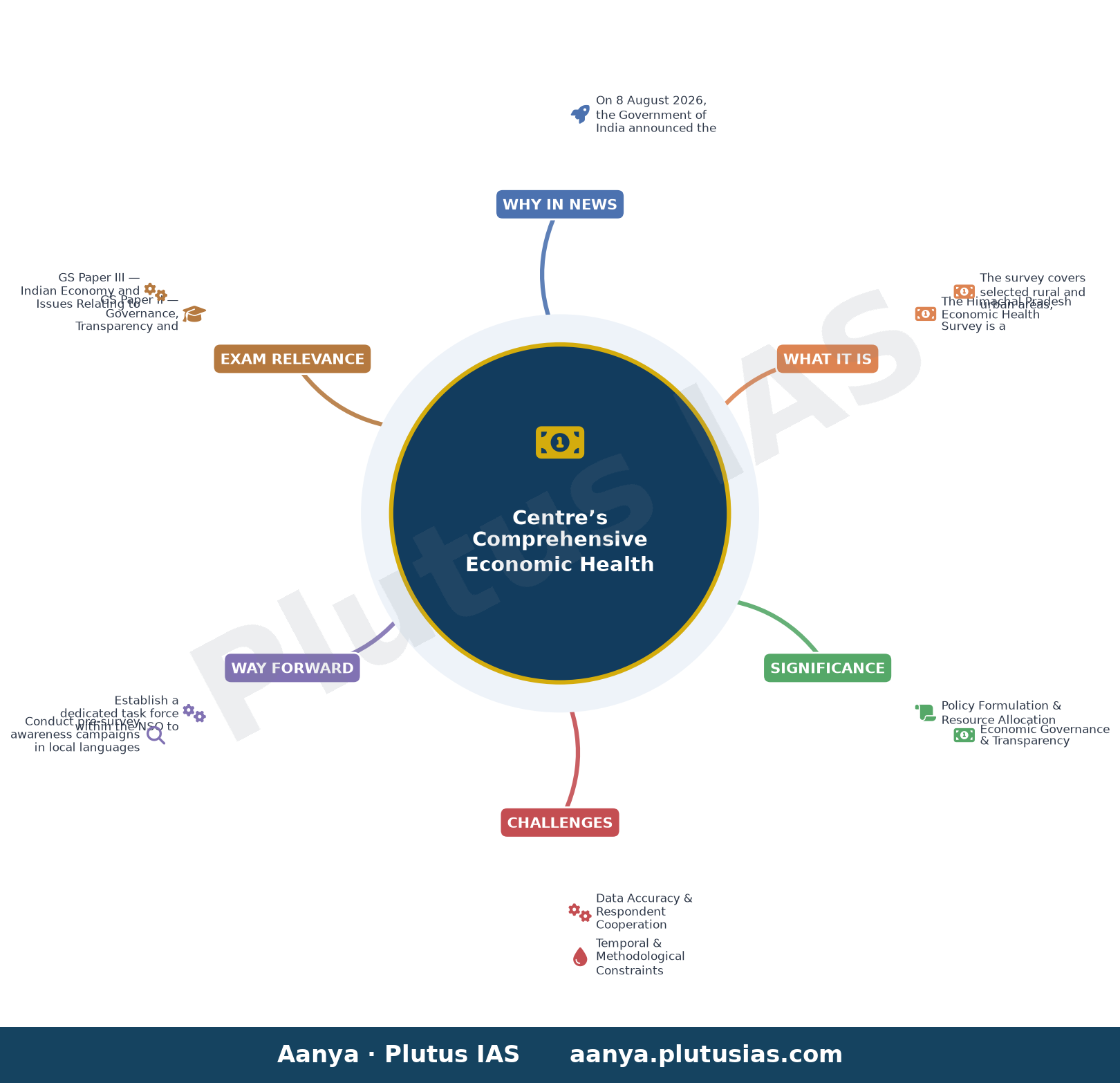
- GS Paper II — Governance, Transparency and Accountability | GS Paper III — Indian Economy and Issues Relating to Planning, Mobilization of Resources, Growth, Development and Employment
- Prelims: National Statistical Office (NSO), Periodic Labour Force Survey (PLFS), All India Debt and Investment Survey, Consumer Price Index (CPI), Migration Survey, Agricultural Household Survey
- Essay: Economic surveys as instruments of evidence-based policymaking, The role of data in reducing regional disparities and promoting inclusive growth
Quick Revision: The Himachal Pradesh Economic Health Survey, conducted by the NSO, is a comprehensive data-gathering exercise to assess household income, employment, debt, investment, agriculture, migration, and inflation, aimed at informing evidence-based policymaking and resource allocation in the state.
Why is this in the news?
On 8 August 2026, the Government of India announced the launch of a comprehensive economic health survey of Himachal Pradesh by the National Statistical Office (NSO). The survey aims to assess the socio-economic conditions of households across selected rural and urban areas, focusing on income, employment, debt, investment, agriculture, migration, and inflation. The findings will inform future government policies, budgetary allocations, and development schemes, thereby directly influencing governance and resource distribution in the state.
Background
- Himachal Pradesh, a predominantly mountainous state in northern India, faces unique socio-economic challenges such as seasonal migration, limited industrial diversification, and vulnerability to climate-induced agricultural disruptions.
- The state’s economy is characterized by a significant reliance on agriculture, horticulture, and tourism, with a growing but still limited industrial base.
- Periodic economic surveys are conducted by the National Statistical Office (NSO) under the Ministry of Statistics and Programme Implementation (MoSPI) to provide granular data for evidence-based policymaking.
- The current initiative follows the government’s emphasis on ‘minimum government, maximum governance’ and the use of real-time data to align public expenditure with developmental priorities.
- The survey is part of a coordinated national effort in August 2026, including the National Household Income Survey, Periodic Labour Force Survey, All India Debt and Investment Survey, Migration Survey, Agricultural Household Survey, and Consumer Price Index Survey.
- Accurate and reliable data collection is critical for designing targeted welfare schemes, employment generation programs, and infrastructure development in hilly and border regions.
What is the Himachal Pradesh Economic Health Survey?
- The Himachal Pradesh Economic Health Survey is a multi-dimensional data collection exercise conducted by the National Statistical Office (NSO) to assess the socio-economic conditions of households in the state.
- The survey covers selected rural and urban areas, collecting detailed information on household income, employment status, debt levels, savings, investment patterns, agricultural activities, migration trends, and inflation perceptions.
- The survey includes specialized modules such as the Agricultural Household Survey, which examines farm income, cost of cultivation, and livelihood diversification among agricultural families.
- Another key component is the Migration Survey, which studies the patterns and drivers of out-migration from districts like Nahan, Paonta Sahib, and Nalagarh, and its impact on local economies.
- The survey also incorporates the All India Debt and Investment Survey to capture household liabilities and investment behavior, providing insights into financial inclusion and indebtedness.
- Data from the survey will be used to calibrate policies in employment generation, agricultural reforms, social security, rural development, and investment promotion.
- The survey adheres to strict confidentiality protocols, ensuring that individual responses are not disclosed, thereby maintaining respondent trust and data integrity.
- The findings will feed into national and state-level policy frameworks, including the formulation of the Union Budget and the State Annual Plan.
Key Features
| Feature | Significance |
|---|---|
| National Statistical Office (NSO) survey teams | Conduct ground-level data collection in rural and urban Himachal Pradesh to ensure empirical accuracy in socio-economic assessments. |
| Multi-topic survey integration | Simultaneous conduct of six national surveys (e.g., National Household Income Survey, Periodic Labour Force Survey) to provide a holistic economic snapshot. |
| Income, employment, and debt metrics | Capture real-time data on household income, employment status, savings, investment, and debt levels for policy calibration. |
| Agricultural livelihood assessment | Evaluate income, cost structures, and sustainability of farm households to inform agricultural policy and rural development. |
| Migration pattern analysis | Study labour migration trends from industrial and border districts to assess socio-economic impacts on origin regions. |
| Data confidentiality assurance | NSO’s commitment to maintaining confidentiality of survey responses to encourage accurate and unbiased data provision. |
Why it Matters
Policy Formulation & Resource Allocation
- Provides empirical basis for designing employment generation schemes, agricultural reforms, and social security interventions in Himachal Pradesh.
- Enables evidence-based budgetary allocations for rural and urban development, ensuring optimal utilisation of fiscal resources.
- Facilitates targeted interventions in sectors with identified gaps (e.g., debt burden, migration-induced labour shortages).
Economic Governance & Transparency
- Enhances transparency in economic decision-making by replacing anecdotal assessments with verifiable data.
- Strengthens accountability of state and central agencies in addressing regional disparities and developmental deficits.
- Supports long-term economic planning by identifying structural bottlenecks in Himachal’s growth trajectory.
Socio-Economic Development
- Informs strategies for poverty alleviation, skill development, and inclusive growth by mapping employment and income distribution.
- Highlights regional variations in economic health, enabling geographically tailored policy responses.
- Contributes to the Sustainable Development Goals (SDGs) by providing disaggregated data on poverty, inequality, and livelihoods.
Data-Driven Governance
- Aligns with the government’s push for ‘minimum government, maximum governance’ by reducing reliance on subjective assessments.
- Supports the ‘Data Empowerment and Protection Architecture’ (DEPA) framework for citizen-centric policy design.
- Enhances the credibility of India’s statistical systems, reinforcing global confidence in domestic data.
Challenges
1. Data Accuracy & Respondent Cooperation
- Risk of underreporting or misreporting due to respondent fatigue or distrust of survey teams.
- Challenges in accessing remote or conflict-prone areas (e.g., border districts) for comprehensive coverage.
- Need for rigorous training of enumerators to ensure standardised data collection across diverse socio-economic contexts.
UPSC Link: Statistical Systems in India
2. Temporal & Methodological Constraints
- Simultaneous conduct of multiple surveys may strain administrative and logistical capacities.
- Seasonal variations (e.g., agricultural cycles) could skew data if not accounted for in survey timing.
- Integration of micro-level data with macroeconomic indicators requires robust analytical frameworks.
UPSC Link: Data Collection Methodologies
3. Policy Implementation Gaps
- Risk of data being used for political optics rather than genuine developmental outcomes.
- Delays in translating survey findings into actionable policies due to bureaucratic inertia.
- Lack of institutional mechanisms to monitor the impact of policies derived from survey data.
UPSC Link: Governance Challenges
4. Regional Disparities in Economic Health
- Himachal’s diverse topography (e.g., tribal areas, industrial hubs) complicates uniform policy design.
- Climate vulnerability (e.g., glacial retreat, flash floods) may distort economic indicators without contextual adjustments.
- Migration-induced demographic shifts in hill districts require dynamic policy responses.
UPSC Link: Regional Development Inequalities
5. Technological & Infrastructure Barriers
- Digital divide in rural areas may hinder real-time data transmission and analysis.
- Limited internet penetration in remote locations could delay survey completion.
- Need for advanced data analytics tools to process large-scale, multi-dimensional datasets.
UPSC Link: Digital Divide in India
Challenges — UPSC Perspective
| Issue | Concern |
|---|---|
| Respondent reluctance | Underreporting of income, debt, or migration due to fear of scrutiny or social stigma. |
| Logistical constraints | Difficulty in accessing geographically isolated or conflict-affected areas for data collection. |
| Data integration challenges | Mismatches between micro-level survey data and macroeconomic aggregates (e.g., GDP estimates). |
| Policy translation gaps | Risk of survey data being archived without translating findings into implementable policies. |
| Seasonal biases | Agricultural data skewed by timing of surveys (e.g., pre- or post-harvest periods). |
| Enumerator bias | Variations in data collection quality due to inadequate training or local biases of survey teams. |
Way Forward
- Establish a dedicated task force within the NSO to oversee the integration and analysis of multi-topic survey data for Himachal Pradesh.
- Conduct pre-survey awareness campaigns in local languages to build trust and encourage full participation from households.
- Deploy mobile data collection units equipped with offline capabilities to ensure coverage in remote and connectivity-deficient areas.
- Develop a real-time dashboard for policymakers to visualise survey findings and prioritise interventions based on identified gaps.
- Strengthen grievance redressal mechanisms for respondents to report discrepancies or coercion during data collection.
- Collaborate with academic institutions and think tanks to validate survey findings and propose evidence-based policy recommendations.
- Integrate survey data with existing welfare schemes (e.g., PM-KISAN, MGNREGA) to assess their impact and identify areas for reform.
- Publish a public report summarising key findings and policy implications within six months of survey completion.
UPSC Value Addition
Keywords for Mains Answer-Writing
National Statistical Office (NSO) · Periodic Labour Force Survey (PLFS) · All-India Debt and Investment Survey · Consumer Price Index (CPI) · migration survey · agricultural household survey · economic policy formulation · data-driven governance · Himachal Pradesh economic survey · employment and unemployment trends · rural and urban economic assessment · government policy design
Concept Flow
Central government initiates comprehensive survey → NSO teams collect multi-dimensional data → Data undergoes statistical analysis → Findings inform policy formulation → Policies are implemented → Impact assessed via follow-up surveys → Feedback loop refines future surveys.
Prelims Practice Questions
Q1. Consider the following statements regarding the Periodic Labour Force Survey (PLFS) conducted by the National Statistical Office (NSO):
1. It provides estimates of employment and unemployment on a quarterly basis.
2. It is conducted only in rural areas to assess agricultural employment.
3. The survey includes data on migrant workers and their socio-economic conditions.
4. It is the sole source of data for the calculation of the Consumer Price Index (CPI).
How many of the above statements are correct?
- Only one
- Only two
- Only three
- All
Answer: Only three — Statements 1 and 3 are correct. The PLFS provides quarterly estimates of employment and unemployment and includes data on migrant workers. Statement 2 is incorrect as the survey covers both rural and urban areas. Statement 4 is incorrect as the CPI is calculated using data from multiple sources, not solely the PLFS.
Q2. Assertion (A): The National Statistical Office (NSO) conducts the All-India Debt and Investment Survey to assess the financial health of households.
Reason (R): The survey collects data on household savings, investments, and liabilities to inform economic policy formulation.
Options:
A. Both A and R are true, and R is the correct explanation of A.
B. Both A and R are true, but R is not the correct explanation of A.
C. A is true, but R is false.
D. A is false, but R is true.
Answer: ? — Both Assertion (A) and Reason (R) are true, and Reason (R) correctly explains Assertion (A). The All-India Debt and Investment Survey is specifically designed to assess household financial health, including savings, investments, and liabilities, to guide economic policies.
Q3. Match the following surveys conducted by the National Statistical Office (NSO) with their primary objectives:
Column I (Survey) | Column II (Objective)
1. Periodic Labour Force Survey (PLFS) | A. Assess household financial health
2. All-India Debt and Investment Survey | B. Provide estimates of employment and unemployment
3. Migration Survey | C. Study demographic and socio-economic aspects of migration
4. Agricultural Household Survey | D. Assess the socio-economic status of agricultural households
Options:
A. 1-B, 2-A, 3-C, 4-D
B. 1-A, 2-B, 3-C, 4-D
C. 1-C, 2-A, 3-B, 4-D
D. 1-D, 2-B, 3-A, 4-C
Answer: ? — The correct matches are: 1-B (PLFS provides employment and unemployment estimates), 2-A (All-India Debt and Investment Survey assesses household financial health), 3-C (Migration Survey studies demographic and socio-economic aspects of migration), and 4-D (Agricultural Household Survey assesses the socio-economic status of agricultural households).
Mains Practice Question
✍ The National Statistical Office (NSO) conducts a series of large-scale surveys to assess the economic and social fabric of Indian states. Critically examine the role of these surveys in informing public policy, with particular reference to the Himachal Pradesh Economic Health Survey. (15 Marks)
Approach: MODEL-ANSWER SKELETON:
I. Introduction (2 marks): Define the NSO and its mandate; briefly introduce the Himachal Pradesh Economic Health Survey as a contemporary example of NSO’s data-driven governance role.
II. Key Surveys and Their Objectives (3 marks):
– Periodic Labour Force Survey (PLFS): Tracks employment, unemployment, and labour force participation.
– All-India Debt and Investment Survey: Measures household savings, investments, and liabilities.
– Migration Survey: Studies demographic and socio-economic aspects of internal migration.
– Agricultural Household Survey: Assesses the socio-economic status of agricultural households.
– Consumer Price Index (CPI) Survey: Measures inflation and price trends.
III. Policy Relevance of NSO Surveys (5 marks):
– Evidence-based policy formulation: Surveys provide granular data on income, employment, and migration, enabling targeted interventions (e.g., MGNREGA, PM-KISAN).
– Resource allocation: Data on regional disparities (e.g., Himachal Pradesh’s rural-urban divide) informs budgetary allocations for development schemes.
– Monitoring and evaluation: Surveys help assess the impact of existing policies (e.g., agricultural reforms, employment generation programs).
– Inter-sectoral coordination: Data from multiple surveys (e.g., PLFS and migration survey) facilitates integrated policy design (e.g., skill development for migrant workers).
IV. Challenges and Limitations (3 marks):
– Data gaps: Underrepresentation of informal sectors and marginalized groups (e.g., tribal communities in Himachal Pradesh).
– Timeliness: Delays in survey completion and data dissemination can hinder real-time policy adjustments.
– Methodological constraints: Sampling biases or non-response errors may affect data reliability.
– Ethical concerns: Ensuring data privacy and confidentiality while collecting sensitive information (e.g., household debt).
V. Conclusion (2 marks): Reiterate the indispensable role of NSO surveys in shaping inclusive and evidence-based policies, while acknowledging the need for continuous methodological improvements and stakeholder collaboration.
Key Thinkers/Frameworks: Amartya Sen’s capability approach (linking data to human development), World Bank’s data-driven governance models.
Contemporary Context: Reference to the Himachal Pradesh Economic Health Survey (2026) as a case study for state-level policy design.
Source: amarujala.com
Generated by AanyaAi for educational purpose.

- महाराष्ट्र में त्योहार जुलूसों पर बॉम्बे हाईकोर्ट का बड़ा फैसला: पटाखे, लेजर और संगीत पर रोक - September 24, 2026
- Bombay HC Bans Firecrackers, Music in Maharashtra Processions: Key UPSC Analysis - September 24, 2026
- तमिलनाडु में महिला कर्मचारियों के लिए सवैतनिक माहवारी अवकाश नीति पर HC का आदेश - September 24, 2026

No Comments