


08 Aug Centre to Launch Comprehensive Economic Survey of Himachal Pradesh in August 2026
✎ The Himachal Pradesh Economic Health Survey is a multi-dimensional exercise by the NSO to collect micro-level data on income, employment, debt, investment, agriculture, migration, and inflation, which will directly inform central…
Subject Relevance — Where This Topic Fits
- GS Paper III — Indian Economy and Issues Relating to Planning, Mobilisation of Resources, Growth, Development and Employment | GS Paper II — Functions and Responsibilities of the Union and the States, Issues and Challenges Pertaining to the Federal Structure
- Prelims: National Statistical Office (NSO), Periodic Labour Force Survey (PLFS), All-India Debt and Investment Survey, Consumer Price Index (CPI), Migration Survey, Himachal Pradesh economy characteristics
- Essay: Role of data-driven policymaking in inclusive development, Federalism and centre-state collaboration in economic governance
Quick Revision: The Himachal Pradesh Economic Health Survey is a multi-dimensional exercise by the NSO to collect micro-level data on income, employment, debt, investment, agriculture, migration, and inflation, which will directly inform central and state policies for inclusive development.
Why is this in the news?
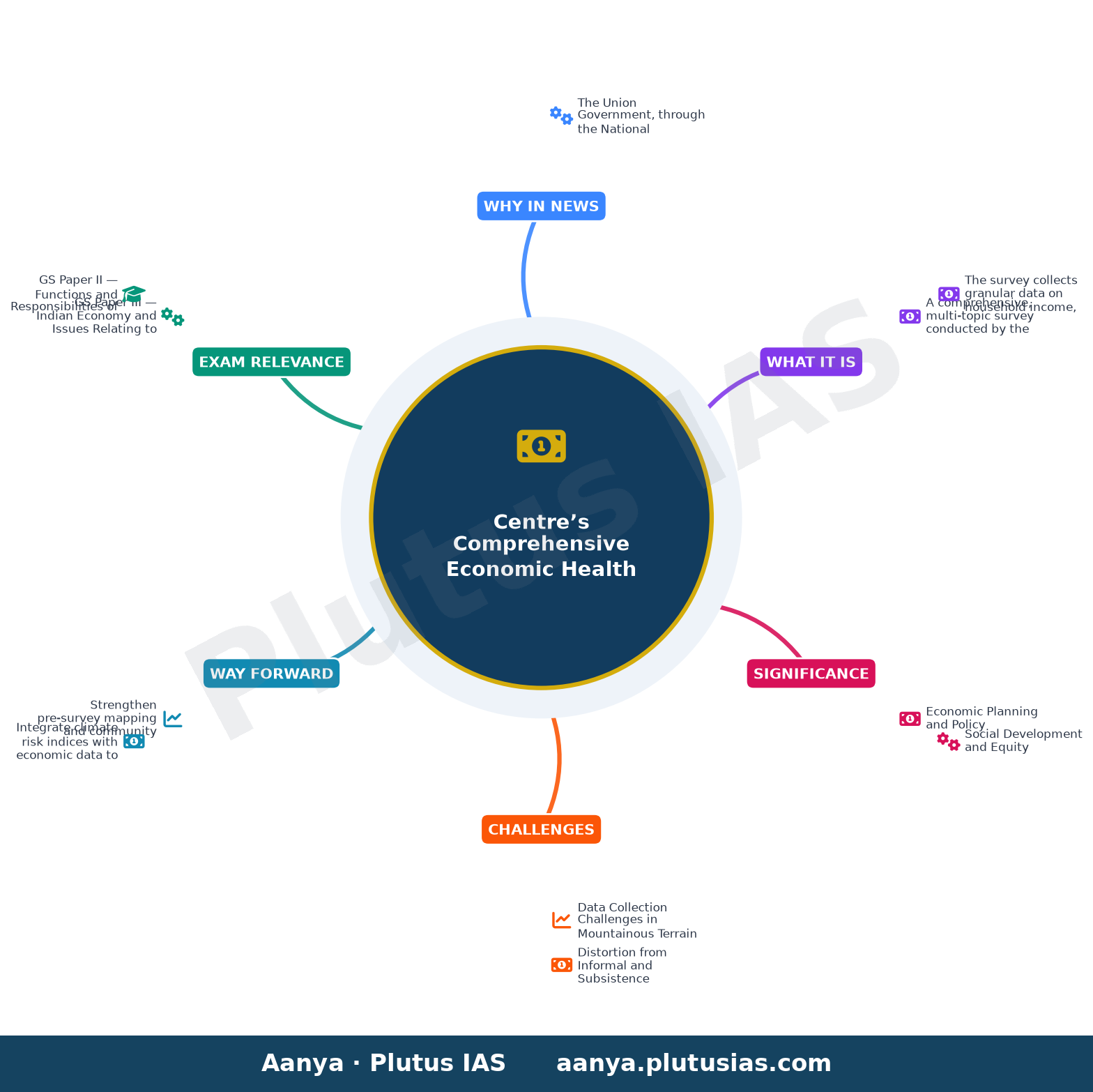
The Union Government, through the National Statistical Office (NSO), is initiating a comprehensive economic health survey in Himachal Pradesh commencing this month. This multi-dimensional survey aims to assess the socio-economic conditions of households across rural and urban areas, focusing on income, employment, debt, investment, agriculture, migration, and inflation. The findings are expected to inform future policy formulation, budgetary allocations, and development schemes, making it a critical exercise for aspirants preparing for the UPSC Civil Services Examination, particularly in understanding the interface between data collection, policy design, and federal governance.
Background
- Himachal Pradesh is a Himalayan state with a predominantly agrarian and tourism-dependent economy, marked by high out-migration and seasonal employment patterns.
- The state’s economy faces structural challenges such as limited industrialisation, vulnerability to climate change impacts on agriculture, and high dependence on central transfers.
- The National Statistical Office (NSO), under the Ministry of Statistics and Programme Implementation (MoSPI), conducts periodic large-scale surveys to assess socio-economic indicators across Indian states.
- The survey aligns with the government’s commitment to evidence-based policymaking, as outlined in the National Statistical Commission’s recommendations.
- Himachal Pradesh has been a focus area for several welfare schemes, including the Pradhan Mantri Kisan Samman Nidhi (PM-KISAN) and the Mahatma Gandhi National Rural Employment Guarantee Scheme (MGNREGS), necessitating accurate data for effective implementation.
- The survey is part of a coordinated national effort involving multiple surveys such as the Periodic Labour Force Survey (PLFS), All-India Debt and Investment Survey, and Consumer Price Index (CPI) surveys.
What is the Himachal Pradesh Economic Health Survey?
- A comprehensive, multi-topic survey conducted by the National Statistical Office (NSO) to assess the socio-economic conditions of households in Himachal Pradesh, covering both rural and urban areas.
- The survey collects granular data on household income, employment status, unemployment rates, savings, investment patterns, and debt levels to provide a holistic economic profile.
- It includes specialised modules on agriculture, such as farm income, cost of cultivation, and livelihood diversification, reflecting the state’s agrarian economy.
- Migration surveys in industrial and border areas (e.g., Nahan, Paonta Sahib, Nalagarh) aim to analyse trends in out-migration, including causes such as employment, education, and economic distress, and their impact on local economies.
- The survey incorporates the Consumer Price Index (CPI) to measure inflation trends, particularly in rural and urban Himachal Pradesh, aiding in the formulation of price stabilisation policies.
- Data collection involves direct household interviews, ensuring micro-level insights that are aggregated to inform macroeconomic and social sector policies.
- The survey’s findings will guide resource allocation, policy prioritisation, and development planning for Himachal Pradesh, including employment generation, agricultural reforms, and social security enhancements.
- All data collected is confidential and used solely for statistical purposes, in compliance with the provisions of the Collection of Statistics Act, 2008, and the National Statistical Commission’s guidelines.
Key Features
| Feature | Significance |
|---|---|
| National Statistical Office (NSO) survey teams | Conduct ground-level data collection on income, employment, debt, investment, agriculture, migration, and inflation across rural and urban Himachal Pradesh. |
| Comprehensive multi-survey approach | Integrates six national surveys (e.g., National Household Income Survey, Periodic Labour Force Survey) to provide a holistic economic and social assessment. |
| Data on agricultural households | Analyses income, cost of cultivation, and livelihood sources to identify vulnerabilities in the agrarian economy. |
| Migration survey in industrial and border regions | Tracks employment, education, and socio-economic push-pull factors driving out-migration from districts like Nahan, Paonta Sahib, and Nalagarh. |
| Policy-relevant data dissemination | Ensures evidence-based formulation of employment generation, agricultural reforms, social security, rural development, and investment policies. |
Why it Matters
Economic Planning and Policy
- Provides empirical basis for resource allocation and budgetary prioritisation in Himachal Pradesh’s development plans.
- Enables targeted interventions in sectors facing structural challenges such as debt burden, unemployment, and agrarian distress.
- Facilitates alignment of state policies with national socio-economic objectives through standardised data collection.
Social Development and Equity
- Highlights disparities in income distribution, employment opportunities, and access to livelihoods across geographical and demographic segments.
- Identifies vulnerable groups (e.g., small and marginal farmers, migrant labourers) for inclusion in social security and welfare schemes.
- Supports gender-sensitive policy design by capturing employment and migration patterns of women and marginalised communities.
Macroeconomic Stability and Governance
- Supports inflation targeting and monetary policy calibration by providing accurate consumer price index (CPI) data.
- Enhances fiscal federalism by enabling evidence-based fiscal transfers from the Union to the state government.
- Strengthens transparency and accountability in governance through credible, verifiable data collection.
Challenges
1. Data Collection Challenges in Mountainous Terrain
- Geographical inaccessibility in remote Himalayan regions may hinder uniform coverage and lead to sampling bias.
- Seasonal migration and nomadic populations complicate accurate enumeration of households and income sources.
- Language diversity and low digital literacy in rural areas may reduce response rates and data reliability.
UPSC Link: GS Paper 2: Governance
2. Distortion from Informal and Subsistence Economies
- High prevalence of informal and subsistence-based livelihoods (e.g., traditional crafts, subsistence farming) complicates income estimation.
- Underreporting of earnings due to lack of formal documentation may skew poverty and inequality metrics.
- Barter transactions and in-kind payments are difficult to quantify, leading to gaps in economic assessment.
UPSC Link: GS Paper 3: Indian Economy
3. Policy Implementation Gaps
- Even with robust data, translating findings into actionable policies faces bureaucratic inertia and resource constraints.
- Lack of inter-departmental coordination may result in fragmented policy responses rather than integrated solutions.
- Political economy considerations may dilute evidence-based recommendations to align with electoral priorities.
UPSC Link: GS Paper 2: Governance
4. Climate Change and Economic Vulnerability
- Increasing frequency of extreme weather events (e.g., cloudbursts, landslides) disrupts agricultural cycles and livelihoods.
- Dependence on rain-fed agriculture and hydroelectric power makes the state highly susceptible to climate-induced economic shocks.
- Migration pressures intensify due to loss of arable land and water scarcity, exacerbating demographic imbalances.
UPSC Link: GS Paper 3: Environment
5. Debt and Financial Stress in Rural Economy
- High indebtedness among farmers and rural households, often from informal sources, constrains investment and consumption.
- Lack of access to formal credit institutions in remote areas perpetuates reliance on exploitative lending practices.
- Debt servicing burdens reduce disposable income, dampening local demand and economic growth.
UPSC Link: GS Paper 3: Indian Economy
Challenges — UPSC Perspective
| Issue | Concern |
|---|---|
| Geographical inaccessibility | Risk of incomplete or biased data due to difficult terrain in Himalayan districts. |
| Informal economy dominance | Underestimation of income and employment, leading to inaccurate poverty assessments. |
| Seasonal migration patterns | Difficulty in tracking households and assessing their economic status across time and space. |
| Climate vulnerability | Increased risk of data obsolescence due to rapidly changing environmental conditions. |
| Data utilisation gaps | Risk of policy paralysis despite robust data, due to weak implementation mechanisms. |
Way Forward
- Strengthen pre-survey mapping and community engagement to improve response rates in remote and tribal areas.
- Integrate climate risk indices with economic data to assess long-term vulnerabilities and resilience.
- Establish a state-level data analytics cell to process and disseminate survey findings for policy formulation.
- Promote formalisation of the rural economy through digital payment infrastructure and financial inclusion initiatives.
- Develop a feedback mechanism for surveyed households to validate data accuracy and address grievances.
- Align survey findings with existing schemes such as PM-KISAN and MGNREGS for targeted beneficiary identification.
- Conduct periodic follow-up surveys to track progress on policy interventions and economic outcomes.
- Enhance coordination between NSO, state agencies, and local governance bodies for seamless data utilisation.
UPSC Value Addition
Keywords for Mains Answer-Writing
National Statistical Office (NSO) · Periodic Labour Force Survey (PLFS) · Household Income Survey · Economic Health Survey · Migration Survey · Agricultural Household Survey · Consumer Price Index (CPI) · Debt and Investment Survey · Policy formulation · Data-driven governance · Himachal Pradesh economy · Employment and unemployment trends
Concept Flow
Initiation of multi-survey campaign by NSO → Ground-level data collection on income, employment, debt, and migration → Analysis of agricultural and industrial trends → Identification of socio-economic vulnerabilities → Formulation of evidence-based policies → Implementation and periodic review of schemes → Outcome assessment and feedback loop.
Prelims Practice Questions
Q1. Consider the following statements regarding the National Statistical Office (NSO) in India: 1. NSO conducts the Periodic Labour Force Survey (PLFS) to measure employment and unemployment. 2. NSO is responsible for the compilation of the Consumer Price Index (CPI). 3. NSO operates under the Ministry of Statistics and Programme Implementation. 4. NSO conducts the Household Income Survey exclusively for urban areas. How many of the above statements are correct?
- Only one
- Only two
- Only three
- All
Answer: Only three — Statements 1, 2, and 3 are correct. Statement 4 is incorrect as the Household Income Survey covers both rural and urban areas.
Q2. Assertion (A): The National Statistical Office (NSO) surveys are designed to inform policy formulation and resource allocation. Reason (R): The surveys collect data on income, employment, migration, and investment, which are critical for evidence-based policymaking.
- Both A and R are true, and R is the correct explanation of A
- Both A and R are true, but R is not the correct explanation of A
- A is true, but R is false
- A is false, but R is true
Answer: Both A and R are true, and R is the correct explanation of A — Both the assertion and reason are true, and the reason correctly explains the assertion. NSO surveys provide the empirical basis for policy formulation and resource allocation.
Q3. Match the following surveys conducted by the National Statistical Office (NSO) with their primary objectives: Column I (Survey) 1. Periodic Labour Force Survey (PLFS) 2. Household Income Survey 3. Agricultural Household Survey 4. Migration Survey Column II (Objective) A. Measure employment and unemployment B. Assess income levels and consumption patterns C. Study income, consumption, and indebtedness of agricultural households D. Examine trends in migration due to employment, education, and other factors
- 1-A, 2-B, 3-C, 4-D
- 1-B, 2-A, 3-C, 4-D
- 1-A, 2-C, 3-B, 4-D
- 1-D, 2-B, 3-A, 4-C
Answer: 1-A, 2-B, 3-C, 4-D — The correct matches are: 1-A (PLFS measures employment and unemployment), 2-B (Household Income Survey assesses income levels and consumption patterns), 3-C (Agricultural Household Survey studies income, consumption, and indebtedness of agricultural households), and 4-D (Migration Survey examines trends in migration due to employment, education, and other factors).
Mains Practice Question
✍ The National Statistical Office (NSO) is conducting a comprehensive economic health survey in Himachal Pradesh to assess the socio-economic conditions of the state. Critically examine the significance of such surveys in policy formulation and governance. Also, discuss the potential challenges in ensuring the reliability and validity of the data collected. (15 Marks)
Approach: MODEL-ANSWER SKELETON:
1. **Introduction (2 Marks)**: Define the National Statistical Office (NSO) and its role in data collection. Briefly introduce the Himachal Pradesh economic health survey and its objectives.
2. **Significance of NSO Surveys (5 Marks)**:
– **Evidence-Based Policymaking**: Explain how surveys like PLFS, Household Income Survey, and Migration Survey provide empirical data for designing policies in employment, poverty alleviation, and migration management.
– **Resource Allocation**: Discuss how data from these surveys helps in targeted allocation of resources under schemes like MGNREGA, PM-KISAN, and other welfare programs.
– **Monitoring and Evaluation**: Highlight the role of surveys in monitoring the progress of government schemes and evaluating their impact.
– **Regional Disparities**: Emphasize the importance of state-specific surveys in addressing regional disparities and local economic challenges.
3. **Challenges in Data Collection (5 Marks)**:
– **Sampling Errors and Coverage Bias**: Discuss issues like underrepresentation of marginalized groups or remote areas.
– **Non-Response and Data Quality**: Explain how non-response rates and respondent fatigue can affect data reliability.
– **Temporal Relevance**: Highlight the need for timely data collection to ensure relevance in a dynamic socio-economic environment.
– **Political and Administrative Interference**: Discuss the potential for data manipulation or suppression to serve political interests.
4. **Measures to Enhance Data Reliability (3 Marks)**:
– **Use of Technology**: Mention the role of digital tools, GIS mapping, and real-time data collection in improving accuracy.
– **Capacity Building**: Discuss the need for training enumerators and ensuring their impartiality.
– **Transparency and Accountability**: Emphasize the importance of publishing raw data and allowing independent verification.
5. **Conclusion (2 Marks)**: Summarize the critical role of NSO surveys in governance and suggest ways to strengthen their credibility and utility.
Source: amarujala.com
Generated by AanyaAi for educational purpose.

- बिहार सरकार का बड़ा फैसला: कारोबार शुरू करने में होगी आसानी, जानिए कैसे मिलेगा फायदा - September 23, 2026
- Bihar Launches Single Window Portal for 62 Business Services: UPSC & PCS Guide - September 23, 2026
- ग्रीनलैंड समझौता: अमेरिका को मिले अतिरिक्त रक्षा क्षेत्र, जानिए पूरा मामला - September 23, 2026

No Comments