


05 Sep Chhattisgarh HC Hearing on 14th Minister Appointment: Constitutional Violation?
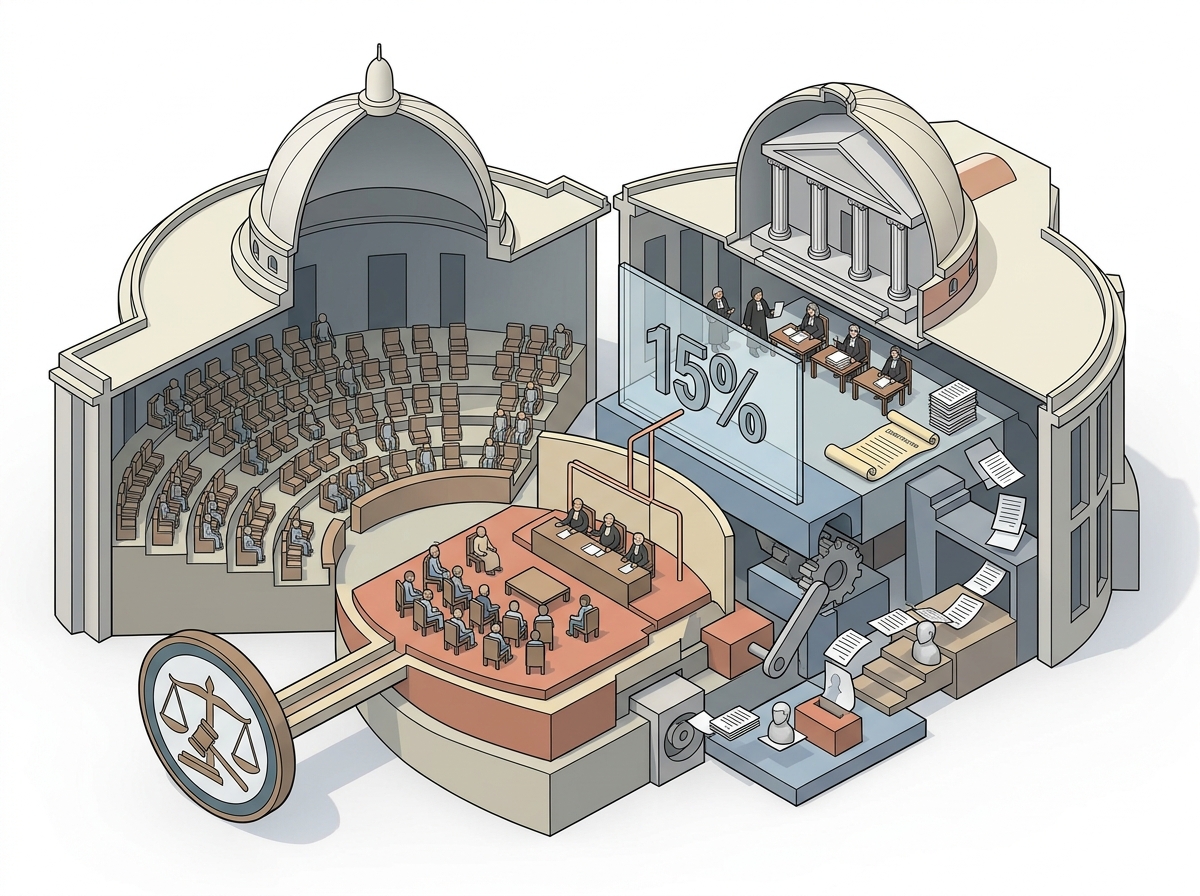
✎ Article 164(1A) caps the state council of ministers at 15% of the legislative assembly’s strength to prevent executive overreach and ensure governance efficiency.
Subject Relevance — Where This Topic Fits
- GS Paper II — Constitutional and Non-Constitutional Bodies (State Legislatures and Executive) | GS Paper IV — Ethical Governance (Constitutional Provisions and Limits on Executive Power)
- Prelims: Article 164(1A) of the Constitution, State Council of Ministers, Constitutional limits on executive power, Chhattisgarh Legislative Assembly, Judicial review of executive actions
- Essay: The Role of Constitutional Safeguards in Preventing Executive Overreach
Quick Revision: Article 164(1A) caps the state council of ministers at 15% of the legislative assembly’s strength to prevent executive overreach and ensure governance efficiency.
Why is this in the news?
The Chhattisgarh High Court has resumed hearings on a Public Interest Litigation challenging the appointment of the 14th minister in a 90-member state assembly, alleging violation of the constitutional cap of 15% of the assembly strength. The case hinges on the interpretation of Article 164(1A) and raises critical questions about the balance between executive authority and constitutional constraints in state governance.
Background
- Article 164(1A) of the Indian Constitution, inserted by the 91st Amendment Act, 2003, mandates that the total number of ministers in a state council, including the Chief Minister, shall not exceed 15% of the total number of members of the state legislative assembly.
- The provision was introduced to prevent excessive proliferation of ministerial positions, which could lead to administrative inefficiency, fiscal strain, and dilution of governance accountability.
- The state government’s appointment of a 14th minister has triggered legal scrutiny.
- The matter was previously stayed by the Chhattisgarh High Court pending resolution of a similar case in the Supreme Court (NP Prajapati vs State of Madhya Pradesh & Ors), which was later dismissed as infructuous after the dissolution of the Madhya Pradesh assembly.
- The petitioners, including Congress leaders and social activist Basdev Chakravarty, argue that the appointment violates constitutional provisions and undermines the principle of proportional representation in governance.
- The High Court’s decision to resume hearings reflects the judiciary’s role in upholding constitutional limits and ensuring executive adherence to legislative constraints.
What is the Constitutional Limit on State Council of Ministers?
- Article 164(1A) of the Constitution: Introduced by the 91st Amendment Act, 2003, it prescribes that the total number of ministers in a state council shall not exceed 15% of the total number of members of the state legislative assembly.
- Purpose: To curb the tendency of state governments to expand the council of ministers disproportionately, which can lead to administrative bloat, financial burden, and reduced governance efficiency.
- Calculation: The limit is computed as 15% of the total strength of the legislative assembly, rounded to the nearest whole number.
- Jurisdiction: The provision applies uniformly to all states, ensuring consistency in executive governance across the country.
- Judicial Review: Courts have the authority to examine whether the appointment of ministers adheres to the constitutional limit, as seen in the Chhattisgarh High Court case.
- Exceptions: The provision does not apply to the Union Council of Ministers, which is governed by Article 75(1A), a separate constitutional mandate.
- Historical Context: The 91st Amendment was a response to the growing trend of state governments appointing large numbers of ministers, often exceeding the assembly strength by significant margins.
- Constitutional Safeguards: The provision reinforces the principle of separation of powers by limiting executive expansion and ensuring accountability to the legislature.
Key Features
| Feature | Significance |
|---|---|
| Constitutional cap on Council of Ministers (Article 164(1A)) | Establishes a numerical ceiling on the size of the State Council of Ministers to prevent excessive executive expansion, ensuring governance efficiency and fiscal prudence. |
| High Court’s suo motu cognisance of public interest litigation | Demonstrates the judiciary’s role in upholding constitutional limits and protecting democratic principles through judicial review of executive actions. |
| State Assembly’s 90-member strength | Provides the baseline for calculating the 15% limit under Article 164(1A), directly influencing the permissible size of the Council of Ministers. |
| Judicial stay on proceedings pending Supreme Court ruling | Highlights the hierarchical relationship between constitutional courts and the procedural discipline in judicial governance. |
| Fiscal implications of larger Council of Ministers | Raises concerns about increased public expenditure on salaries, allowances, and administrative overheads for the executive branch. |
Why it Matters
Constitutional Governance
- Reinforces the principle of separation of powers by enabling judicial scrutiny of executive appointments against constitutional limits.
- Ensures adherence to the 15% cap on Council of Ministers as prescribed under Article 164(1A) of the Constitution.
- Acts as a safeguard against potential misuse of executive power through disproportionate expansion of the Council.
Institutional Checks and Balances
- Demonstrates the judiciary’s proactive role in maintaining constitutional discipline in state governance.
- Showcases the interplay between the Supreme Court and High Courts in resolving constitutional ambiguities.
- Highlights the role of public interest litigation in addressing governance irregularities.
Fiscal and Administrative Efficiency
- Raises questions about the financial sustainability of larger Councils of Ministers in states with smaller legislatures.
- Emphasises the need for balanced executive expansion to avoid undue burden on the exchequer.
- Underscores the importance of administrative efficiency in governance.
Challenges
1. Constitutional Compliance in Executive Expansion
- Risk of exceeding the 15% cap on Council of Ministers under Article 164(1A), leading to constitutional violations.
- Potential for arbitrary expansion of the executive, undermining legislative oversight.
- Lack of clarity in calculating the cap when the Assembly strength changes due to by-elections or other factors.
UPSC Link: Polity – Constitutional Provisions – State Executive
2. Judicial Delay and Governance Paralysis
- Prolonged judicial proceedings may delay critical executive appointments, affecting governance.
- Uncertainty in judicial rulings can create ambiguity in the application of constitutional provisions.
- Risk of conflicting judgments between High Courts and the Supreme Court on similar issues.
UPSC Link: Judiciary – Judicial Review – Constitutional Interpretation
3. Fiscal Sustainability of Larger Executives
- Increased financial burden on the state exchequer due to higher salaries, allowances, and administrative costs.
- Potential misallocation of public funds away from developmental and welfare schemes.
- Challenge of balancing executive expansion with fiscal responsibility.
UPSC Link: Public Finance – Fiscal Policy – State Budgets
4. Public Trust and Governance Transparency
- Perception of executive overreach may erode public trust in democratic institutions.
- Lack of transparency in the appointment process of ministers can fuel allegations of favouritism.
- Need for clear, objective criteria in determining the size of the Council of Ministers.
UPSC Link: Governance – Accountability – Transparency
Challenges — UPSC Perspective
| Issue | Concern |
|---|---|
| Exceeding 15% cap on Council of Ministers | Risk of constitutional violation and executive overreach. |
| Judicial delay in resolving constitutional disputes | Potential governance paralysis and policy uncertainty. |
| Increased fiscal burden on state exchequer | Misallocation of public funds and reduced developmental spending. |
| Lack of clarity in calculating the cap | Ambiguity in applying constitutional provisions, leading to disputes. |
| Perception of executive overreach | Erosion of public trust in democratic institutions and governance. |
Way Forward
- The High Court should expedite the hearing to provide clarity on the constitutional cap under Article 164(1A) and its application in the current case.
- The State Government should proactively review the size of the Council of Ministers to ensure compliance with constitutional provisions.
- The Supreme Court should issue definitive guidelines on the interpretation of Article 164(1A) to prevent recurring disputes.
- State legislatures should consider enacting internal rules to define the process for calculating the 15% cap, including handling by-elections or Assembly strength changes.
- Civil society and legal experts should advocate for greater transparency in the appointment of ministers to enhance public trust.
- The State Government should conduct a fiscal impact assessment of the Council of Ministers’ size to ensure fiscal prudence.
- Judicial training programmes should include modules on constitutional governance and the role of the judiciary in upholding executive limits.
UPSC Value Addition
Keywords for Mains Answer-Writing
Constitutional limits on size of Council of Ministers · Article 164(1A) · State legislature and executive balance · Judicial review of executive actions · Chhattisgarh High Court powers · Separation of powers · Doctrine of constitutional morality · Federalism in India · State executive and accountability · Judicial activism in governance
Constitutional & Policy Linkages
- Article 164(1A) – Cap on Council of Ministers in States
- Article 163 – Council of Ministers to aid and advise Governor
- Article 166 – Conduct of Business of the Government of a State
Concept Flow
State Assembly strength (90 members) → Calculation of 15% cap under Article 164(1A) → Appointment of 14th Minister → Challenge via PIL → High Court initiates judicial review → Supreme Court ruling on similar case → High Court resumes hearing → Focus on constitutional compliance.
Prelims Practice Questions
Q1. Consider the following statements regarding the constitutional limits on the size of the Council of Ministers in a state: 1. The maximum number of ministers in a state cannot exceed 15% of the total number of members of the state legislative assembly. 2. The provision is enshrined in Article 164(1A) of the Constitution of India. 3. The limit applies to the total number of ministers including the Chief Minister. 4. The provision is applicable only to states with a unicameral legislature. How many of the above statements are correct?
- Only one
- Only two
- Only three
- All
Answer: Only three — Statements 1, 2, and 3 are correct. Statement 4 is incorrect as the provision applies to both unicameral and bicameral legislatures. The constitutional limit is derived from Article 164(1A), which caps the Council of Ministers at 15% of the total strength of the legislative assembly, including the Chief Minister.
Q2. Assertion (A): The Governor of a state is constitutionally empowered to withhold assent to a Bill passed by the state legislature if it violates the constitutional limits on the size of the Council of Ministers. Reason (R): The Governor acts as a constitutional check to ensure compliance with the provisions of Article 164(1A).
- Both A and R are true, and R is the correct explanation of A
- Both A and R are true, but R is not the correct explanation of A
- A is true but R is false
- A is false but R is true
Answer: ? — Assertion (A) is false. The Governor does not have the power to withhold assent solely on the ground of violation of Article 164(1A). Reason (R) is true as the Governor’s role includes ensuring constitutional compliance, but it does not extend to such specific administrative limits. The judicial review mechanism is the appropriate constitutional remedy.
Q3. Match the following provisions with their respective constitutional articles: Column I Column II A. Council of Ministers size limit 1. Article 75(1A) B. Collective responsibility of the Council of Ministers 2. Article 163(1) C. Oath of office of the Chief Minister 3. Article 164(1A) D. Advice of the Council of Ministers binding on the Governor 4. Article 164(1)
- A-3, B-4, C-1, D-2; A-3, B-4, C-2, D-1; A-1, B-2, C-3, D-4; A-4, B-1, C-2, D-3
- answer_letter_indexed_pairs_only_for_internal_use_but_output_as_is_so_skip_this_line_1234567890abcdefghijklmnopqrstuvwxyzABCDEFGHIJ
- answer_letter_indexed_pairs_only_for_internal_use_but_output_as_is_so_skip_this_line_A-3, B-4, C-2, D-1
- explain_skip_this_line
- format_skip_this_line_match
- explain_skip_this_line The correct match is: A-3 (Article 164(1A) limits the size of the Council of Ministers), B-4 (Article 164(1) provides for collective responsibility of the Council of Ministers), C-2 (Article 163(1) relates to the oath of office of the Chief Minister), and D-1 (Article 75(1A) is not directly relevant; the correct article for the binding nature of advice is Article 163(2)).
- format_skip_this_line_match
- explain_skip_this_line The question is framed to test the understanding of constitutional provisions related to the state executive.
Answer: ? — The correct match is: A-3 (Article 164(1A) limits the size of the Council of Ministers), B-4 (Article 164(1) provides for collective responsibility of the Council of Ministers), C-2 (Article 163(1) relates to the oath of office of the Chief Minister), and D-1 (Article 75(1A) is not directly relevant; the correct article for the binding nature of advice is Article 163(2)).
Mains Practice Question
✍ The constitutional limit on the size of the Council of Ministers in a state, as enshrined in Article 164(1A), is intended to balance executive efficiency with democratic accountability. In light of the recent judicial scrutiny of the appointment of the 14th minister in Chhattisgarh, critically examine the rationale behind this provision and its implications for federal governance in India. Also, discuss the role of the judiciary in upholding constitutional morality in such matters. (15 Marks)
Approach: MODEL-ANSWER SKELETON:
1. **Constitutional Basis and Rationale** (4 marks)
– Article 164(1A): Mandates that the total number of ministers (including the Chief Minister) shall not exceed 15% of the total strength of the legislative assembly.
– Objective: Prevent excessive executive expansion, ensure fiscal prudence, and maintain democratic accountability by avoiding over-representation of the executive.
– Reference: Sarkaria Commission (1988) recommendations on the size of the Council of Ministers.
2. **Federal Implications** (4 marks)
– Balance of power: Prevents the executive from dominating the legislature, preserving federalism.
– Fiscal federalism: Reduces financial burden on state exchequers by limiting administrative costs.
– Comparative perspective: Similar provisions exist in other federations (e.g., Canada, Australia) to maintain institutional balance.
3. **Judicial Role and Constitutional Morality** (4 marks)
– Judicial review: Courts act as guardians of constitutional limits, ensuring compliance with Article 164(1A).
– Doctrine of constitutional morality: Courts uphold the spirit of the Constitution, not just its letter (e.g., Bommai case, 1994).
– Recent jurisprudence: High Court’s intervention in Chhattisgarh aligns with the Supreme Court’s stance in *Kihoto Hollohan v. Zachillhu* (1992) on judicial review of legislative actions.
4. **Critique and Challenges** (3 marks)
– Executive flexibility: Argument that a larger Council of Ministers may enhance governance efficiency in large states.
– Political considerations: Potential misuse of the provision to challenge legitimate appointments.
– Conclusion: The provision strikes a balance between efficiency and accountability, with judicial oversight ensuring adherence to constitutional morality.
Source: amarujala.com
Generated by AanyaAi for educational purpose.
Related guides on our sites
- Best PSIR optional coaching for upsc
- Best PSIR optional teacher for upsc
- Best teacher of PSIR optional for upsc
- Best PSIR optional coaching in delhi for UPSC

- स्ट्रेट ऑफ होर्मुज में भारतीयों से भरे तेल टैंकर पर प्रक्षेपास्त्र हमला, चालक दल सुरक्षित - October 22, 2026
- Rajya Sabha Bypoll on November 12: Key Dates & Process Explained - October 22, 2026
- सिम्बेक्स-2026: भारत-सिंगापुर नौसैनिक अभ्यास विशाखापत्तनम में शुरू, जानिए महत्वपूर्ण बिंदु - October 22, 2026

No Comments