


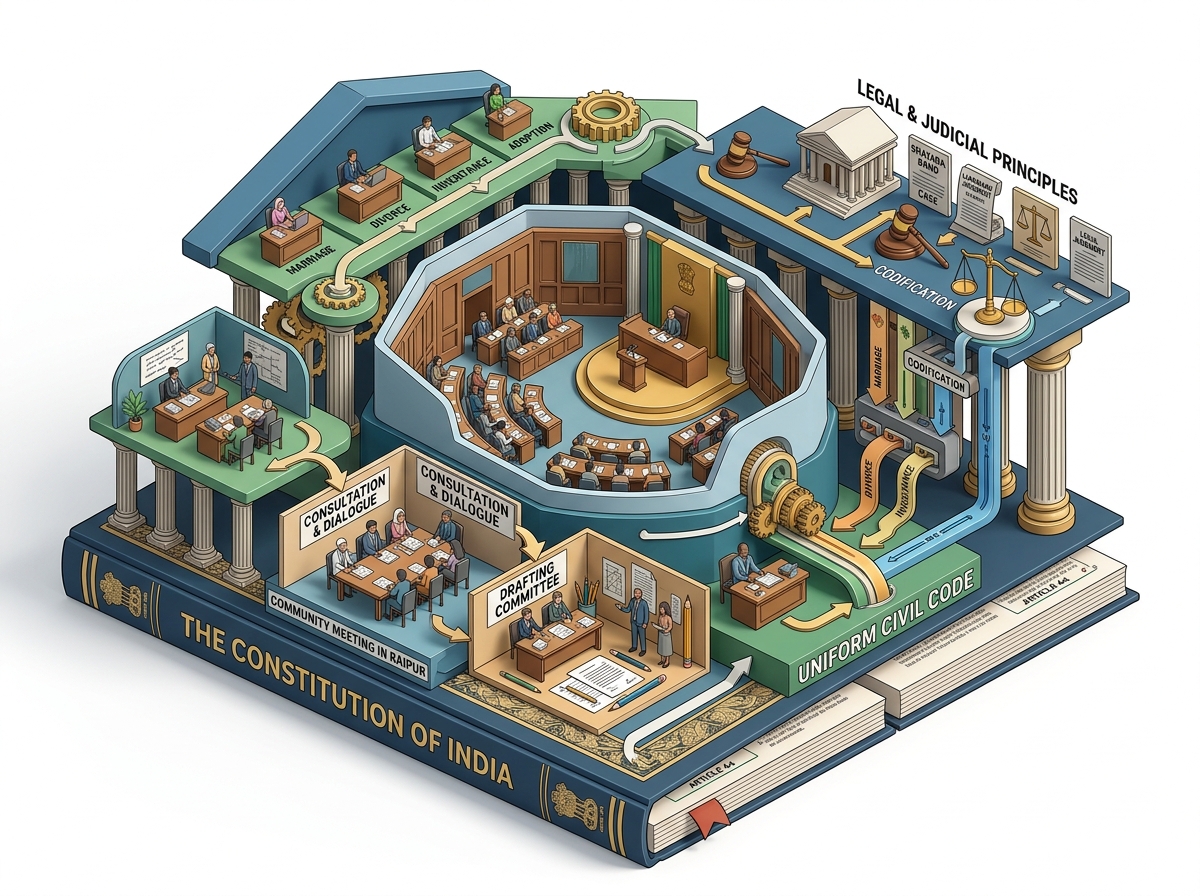
01 Sep Chhattisgarh Muslim Community Meeting on UCC: Key Updates for UPSC & State PCS
✎ The Uniform Civil Code is a constitutional directive (Article 44) aimed at replacing diverse religious personal laws with a single secular legal framework to ensure equality, justice, and national integration, with implementation…
Subject Relevance — Where This Topic Fits
- GS Paper II — Fundamental Rights, Constitutional Provisions, and Governance | GS Paper IV — Ethics, Integrity, and Aptitude (Stakeholder Consultation)
- Prelims: Uniform Civil Code (UCC), Article 44, Directive Principles of State Policy (DPSP), Personal Laws (Hindu, Muslim, Christian), All India Muslim Personal Law Board (AIMPLB), Wakf Act, 1995, State-level committees on UCC, Right to Equality (Article 14), Freedom of Religion (Article 25), Judicial review of personal laws
- Essay: Ethical governance through inclusive policy-making: Balancing uniformity and cultural pluralism, The role of constitutional morality in reforming personal laws in a diverse society
Quick Revision: The Uniform Civil Code is a constitutional directive (Article 44) aimed at replacing diverse religious personal laws with a single secular legal framework to ensure equality, justice, and national integration, with implementation being a state subject.
Why is this in the news?
Chhattisgarh has initiated a consultative process on the Uniform Civil Code (UCC) by convening a meeting of the Muslim community in Raipur on 1 September 2026. This gathering aims to collect written submissions from stakeholders to inform the drafting of a uniform civil code. The meeting underscores the state’s commitment to constitutional governance while engaging diverse religious and social groups in a structured dialogue on personal law reform.
Background
- The concept of a Uniform Civil Code (UCC) is enshrined in Article 44 of the Indian Constitution, which is a Directive Principle of State Policy (DPSP) and directs the State to endeavour to secure for citizens a uniform civil code throughout the territory of India.
- The Supreme Court of India, in landmark judgments such as *Shayara Bano v. Union of India* (2017) and *Joseph Shine v. Union of India* (2018), has repeatedly emphasised the need for a UCC to ensure gender justice and equality, while affirming the constitutional validity of personal laws subject to fundamental rights.
- Several states, including Uttarakhand (2024), Assam (2023), and Gujarat (2023), have constituted expert committees to study and recommend the implementation of a UCC, reflecting a growing trend toward codification and reform of personal laws.
- Personal laws in India govern matters such as marriage, divorce, inheritance, and adoption and are currently governed by religious-specific codes: the Hindu Marriage Act, 1955; the Muslim Personal Law (Shariat) Application Act, 1937; and the Indian Succession Act, 1925, among others.
- The All India Muslim Personal Law Board (AIMPLB) and other religious bodies have historically opposed the UCC, citing concerns over cultural autonomy and the protection of minority rights, while proponents argue that it promotes gender equality and national integration.
- The Chhattisgarh government’s initiative follows the establishment of a five-member committee, chaired by a former Chief Justice, tasked with drafting a UCC for the state, thereby operationalising the constitutional directive in a federal framework.
What is the Uniform Civil Code (UCC)?
- The UCC is a proposed legal framework that seeks to replace multiple personal laws based on religion, caste, and faith with a single set of secular laws applicable to all citizens, irrespective of their religious affiliation.
- It is envisaged under Article 44 of the Constitution, which, though not enforceable by courts, guides state policy toward ensuring uniformity in civil matters such as marriage, divorce, inheritance, and adoption.
- The UCC does not seek to interfere with religious practices per se but aims to regulate secular aspects of personal life that have legal implications, thereby ensuring equality before the law (Article 14) and non-discrimination (Article 15).
- The Supreme Court has, in multiple judgments, highlighted the conflict between personal laws and fundamental rights, particularly Articles 14, 15, and 21, which guarantee equality, non-discrimination, and the right to life and liberty, respectively.
- The UCC is distinct from criminal laws, which are already uniform across India under the Indian Penal Code (IPC), 1860, and the Code of Criminal Procedure (CrPC), 1973.
- The implementation of a UCC is a state subject under the Constitution, allowing state governments to initiate reforms through legislative or executive processes, as seen in Uttarakhand’s UCC draft (2024).
- The UCC is often debated in the context of gender justice, as many personal laws, particularly those governing Muslim marriages and inheritance, have been criticised for perpetuating gender inequality.
- The process of drafting a UCC involves extensive consultations with stakeholders, including religious communities, legal experts, and civil society, to ensure that the proposed laws are equitable and constitutionally sound.
- The UCC is not a new concept; the first attempt to codify personal laws was made during the colonial era with the Hindu Code Bills (1955–1956), which reformed Hindu personal laws but left other communities untouched.
Key Features
| Feature | Significance |
|---|---|
| Formation of a 5-member committee under a former Chief Justice | Ensures a structured, judicially guided process for UCC formulation in Chhattisgarh, enhancing legal credibility and procedural rigour. |
| Public consultation mechanism (Raipur meeting) | Provides a democratic platform for stakeholder engagement, ensuring diverse perspectives—particularly from the Muslim community—are incorporated into policy formulation. |
| Written submission of suggestions in duplicate | Formalises the process of collecting structured inputs, reducing ambiguity and facilitating systematic analysis by the committee. |
| Involvement of state-level institutions (e.g., Chhattisgarh State Waqf Board) | Leverages existing administrative and community networks to gather ground-level insights and ensure inclusivity in the consultation process. |
| Scheduled submission to UCC committee by 4 PM | Ensures timely compilation and review of inputs, aligning with the state’s procedural timeline for UCC implementation. |
Why it Matters
Constitutional and Legal
- The UCC initiative in Chhattisgarh operationalises the constitutional directive under Article 44, which exhorts the State to endeavour to secure a Uniform Civil Code for all citizens, irrespective of religion.
- The process underscores the balance between uniformity in civil laws and the protection of minority rights, as envisaged under Articles 25–28 of the Constitution.
- The committee’s formation reflects adherence to the principle of separation of powers, with the judiciary guiding the executive in a policy domain traditionally governed by personal laws.
Administrative and Governance
- The initiative demonstrates a state-led approach to social reform, aligning with the concurrent nature of subjects like marriage, divorce, and inheritance under the Seventh Schedule.
- The use of existing state institutions (e.g., Waqf Board) for community outreach exemplifies efficient governance by leveraging local networks.
Societal and Inclusive
- The public consultation in Raipur highlights the state’s commitment to participatory policymaking, ensuring that marginalised communities have a voice in shaping laws that directly affect them.
- The focus on the Muslim community’s inputs addresses historical concerns about the erosion of religious personal laws, while framing the debate within a broader discourse on gender justice and uniformity.
Challenges
1. Balancing Uniformity with Pluralism
- The primary challenge lies in reconciling the objective of a Uniform Civil Code with the constitutional guarantee of religious freedom (Article 25) and cultural autonomy.
- Personal laws, deeply embedded in religious traditions, may resist uniform codification, raising concerns about cultural erosion or imposition of majoritarian norms.
- The committee must navigate these tensions without compromising the principles of justice, equality, and non-discrimination enshrined in the Constitution.
UPSC Link: Article 25, Article 44
2. Ensuring Inclusive Representation
- The consultation process risks excluding voices from less organised or economically weaker sections of the Muslim community, leading to a skewed representation of interests.
- Language barriers, lack of awareness, or logistical constraints may prevent marginalised groups from participating effectively in the Raipur meeting.
UPSC Link: Article 14, Article 15
3. Legal and Procedural Rigour
- The committee’s recommendations must withstand judicial scrutiny, particularly under the doctrine of reasonable classification and the test of constitutional validity (Article 14).
- Ambiguities in the drafting of the UCC could lead to litigation, delays, or unintended consequences in its implementation.
UPSC Link: Article 14, Doctrine of Reasonable Classification
4. Implementation and Enforcement
- Even if a UCC is drafted, its enforcement may face resistance from communities accustomed to personal laws, requiring extensive awareness campaigns and stakeholder engagement.
- The state must ensure that the UCC does not inadvertently discriminate against any group, particularly women, in matters like inheritance, marriage, or divorce.
UPSC Link: Article 15(3), Article 39(d)
5. Political and Social Polarisation
- The UCC initiative may become a subject of political contestation, with narratives framing it as either a progressive reform or an infringement on religious freedoms.
- The state must ensure that the process remains apolitical, focusing on legal and constitutional merits rather than electoral gains or partisan agendas.
UPSC Link: Article 14, Article 25
Challenges — UPSC Perspective
| Issue | Concern |
|---|---|
| Cultural Resistance | Risk of alienating communities whose personal laws are deeply tied to religious identity and tradition. |
| Legal Ambiguities | Potential for the UCC to be challenged in courts on grounds of violating fundamental rights or constitutional principles. |
| Implementation Gaps | Lack of clarity on how the UCC will be enforced, particularly in rural or tribal areas with limited administrative reach. |
| Gender Justice Paradox | While aiming for uniformity, the UCC must ensure it does not dilute existing protections for women under personal laws. |
| Administrative Overload | The committee may face challenges in processing voluminous inputs within the stipulated timeline, leading to delays or superficial analysis. |
Way Forward
- Constitute a sub-committee to systematically analyse the written submissions received from the Muslim community and other stakeholders in Raipur.
- Organise regional consultations across Chhattisgarh to ensure inclusive participation, particularly in districts with significant minority populations.
- Engage legal experts to draft a model UCC framework that aligns with constitutional principles while addressing community concerns.
- Conduct gender-impact assessments to evaluate how the proposed UCC provisions affect women’s rights across religious communities.
- Establish a grievance redressal mechanism for stakeholders to address ambiguities or objections during the drafting phase.
- Collaborate with civil society organisations to disseminate information about the UCC process and its objectives through multilingual outreach programmes.
- Ensure transparency by publishing the committee’s interim reports and inviting public feedback before finalising the draft UCC.
- Align the UCC draft with existing central laws (e.g., Hindu Succession Act, 1956) to maintain consistency and avoid legal conflicts.
UPSC Value Addition
Keywords for Mains Answer-Writing
Uniform Civil Code · personal laws · Article 44 · Directive Principles of State Policy · constitutional morality · minority rights · gender justice · pluralism in India · governance of religious institutions · legal pluralism · public participation in law-making · federalism and uniformity · judicial review of personal laws · right to equality · secularism in India
Constitutional & Policy Linkages
- Article 44 (Directive Principle of State Policy: Uniform Civil Code)
- Article 25 (Freedom of Religion)
- Article 14 (Right to Equality)
- Article 15 (Prohibition of Discrimination)
- Article 26 (Freedom to Manage Religious Affairs)
Concept Flow
State Government announces UCC initiative in Chhattisgarh → Formation of a 5-member committee under a former Chief Justice → Public consultation mechanism (Raipur meeting) → Collection of written submissions from stakeholders → Compilation and analysis of inputs by the committee → Drafting of UCC framework → Legal scrutiny and public feedback → Finalisation and implementation of UCC → Enforcement and monitoring through state institutions
Prelims Practice Questions
Q1. Consider the following statements regarding the Uniform Civil Code (UCC) in India:
1. The UCC is explicitly mentioned in Part IV of the Constitution under Directive Principles of State Policy.
2. The Supreme Court has, in several judgments, directed the Union Government to implement the UCC.
3. The UCC is intended to replace all religious personal laws in India.
How many of the above statements are correct?
- Only one
- Only two
- All three
- None
Answer: Only two — Statement 1 is correct as Article 44 is part of the Directive Principles of State Policy (DPSP) in Part IV of the Constitution. Statement 2 is incorrect; the Supreme Court has expressed the desirability of UCC but has not directed its implementation. Statement 3 is incorrect; the UCC is not intended to replace all religious personal laws but to provide a common set of rules for all citizens.
Q2. Assertion (A): The Uniform Civil Code (UCC) aims to promote gender justice by ensuring equal rights to women in matters of marriage, divorce, and inheritance.
Reason (R): Personal laws in India are often based on religious scriptures, which may not always guarantee gender equality.
In the context of the above two statements, which one of the following is correct?
- Both A and R are true, and R is the correct explanation of A.
- Both A and R are true, but R is not the correct explanation of A.
- A is true, but R is false.
- A is false, but R is true.
Answer: Both A and R are true, and R is the correct explanation of A. — The UCC is intended to promote gender justice by providing a uniform legal framework for all citizens, addressing disparities in personal laws. Personal laws in India are indeed based on religious scriptures, which often lack gender equality. Thus, both statements are true, and R correctly explains A.
Q3. Match the following provisions with their respective constitutional articles:
Column I (Provision) | Column II (Article)
— | —
1. Uniform Civil Code | A. Article 25
2. Freedom of religion | B. Article 44
3. Right to equality | C. Article 14
4. Cultural and educational rights of minorities | D. Article 30
Select the correct match:
- 1-B, 2-A, 3-C, 4-D
- 1-A, 2-B, 3-C, 4-D
- 1-C, 2-B, 3-A, 4-D
- 1-D, 2-A, 3-C, 4-B
Answer: 1-B, 2-A, 3-C, 4-D — Article 44 mandates the state to endeavour to secure a Uniform Civil Code for citizens. Article 25 guarantees freedom of religion. Article 14 ensures equality before the law. Article 30 protects the cultural and educational rights of minorities.
Mains Practice Question
✍ The debate surrounding the implementation of the Uniform Civil Code (UCC) in India reflects a tension between constitutional morality and cultural pluralism. Critically examine the legal, social, and political dimensions of this debate, with reference to recent judicial observations and public consultations. (15 Marks)
Approach: MODEL-ANSWER SKELETON:
1. **Constitutional Basis and Judicial Observations**:
– Article 44 (DPSP) and its non-justiciable nature.
– Supreme Court observations in cases like *Shayara Bano v. Union of India* (2017), *Joseph Shine v. Union of India* (2018), and *Re: Uniform Civil Code* (2023) emphasizing the need for UCC to promote gender justice and constitutional morality.
– Contrast with the protection of religious freedom under Articles 25 and 26.
2. **Legal Dimensions**:
– Role of personal laws in India’s legal pluralism.
– Challenges in harmonizing diverse religious laws (Hindu, Muslim, Christian, Parsi) without infringing on minority rights.
– Judicial review of personal laws under the right to equality (Article 14) and the right against discrimination (Article 15).
3. **Social Dimensions**:
– Gender justice and women’s rights in personal laws (e.g., triple talaq, polygamy, inheritance).
– Public consultations and stakeholder engagement (e.g., the recent meeting in Raipur by the Chhattisgarh UCC Committee to gather suggestions from the Muslim community).
– Resistance from conservative sections of society and minority groups fearing erosion of cultural identity.
4. **Political Dimensions**:
– Federalism and uniformity: Role of states in implementing UCC (e.g., Goa’s Uniform Civil Code).
– Political narratives and electoral implications of UCC.
– Need for consensus-building and inclusive dialogue.
5. **Balancing Pluralism and Uniformity**:
– Arguments for UCC: Promoting national integration, gender equality, and secularism.
– Arguments against UCC: Potential infringement on minority rights, cultural autonomy, and the risk of majoritarian imposition.
– Conclusion: UCC should be implemented through a consultative, gradual, and rights-based approach, ensuring minimal disruption to existing social structures.
Source: amarujala.com
Chhattisgarh PCS (CGPSC) — State PCS Practice
Prelims: As per recent news reports, a meeting of the Chhattisgarh Muslim community is being organized in Raipur to discuss the Uniform Civil Code (UCC). Which of the following is the primary objective of this meeting?
- A. To oppose the implementation of UCC in Chhattisgarh
- B. To deliberate on the UCC and formulate a strategy for community representation
- C. To demand immediate implementation of UCC in the state
- D. To organize a statewide protest against the UCC
Answer: B. To deliberate on the UCC and formulate a strategy for community representation — The meeting aims to gather intellectuals and community leaders to discuss the UCC and strategize their approach.
Mains: Discuss the significance of the Uniform Civil Code (UCC) in the context of Chhattisgarh’s socio-cultural diversity, particularly focusing on the concerns and aspirations of the Muslim community. Suggest a balanced approach that aligns with constitutional values and state-specific needs.
Generated by AanyaAi for educational purpose.
Related guides on our sites
- Current affairs for upsc 2026
- Best PSIR optional coaching for upsc
- Best PSIR optional teacher for upsc
- Best teacher of PSIR optional for upsc

- UPSC Alert: 40-Day ‘Khet Bachao Abhiyan’ Launch by Union Minister - October 22, 2026
- भारत ने बताया UN रिपोर्ट में दाऊद इब्राहिम को ‘भारत-आधारित’ बताना ‘गलत’ - October 22, 2026
- GRAP Stage I activated in Delhi-NCR amid rising AQI: Key actions for aspirants - October 22, 2026

No Comments