


11 Aug Chhattisgarh Warns: AI-Generated Objectionable Images Are Cyber Crime
✎ AI-generated deepfakes that violate privacy or disseminate obscene content constitute cyber crimes under Sections 66D, 66E, 67, and 67A of the IT Act, 2000, and are cognisable offences requiring immediate legal recourse.
Subject Relevance — Where This Topic Fits
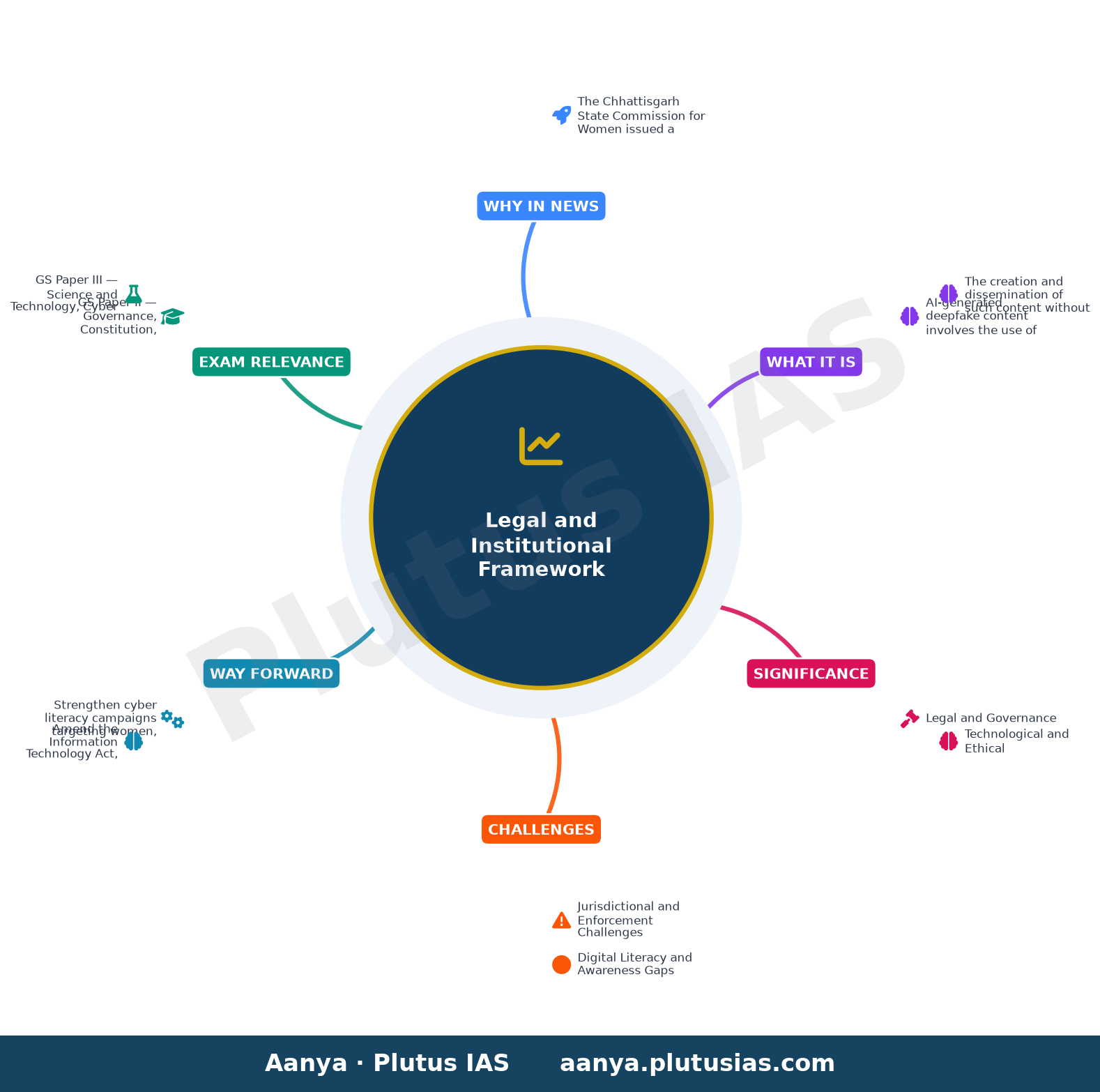
- GS Paper II — Governance, Constitution, Polity, Social Justice and International Relations | GS Paper III — Science and Technology, Cyber Security
- Prelims: Deepfake technology, Information Technology Act, 2000, Cybercrimes against women, Section 67 and 67A of IT Act, National Cyber Crime Reporting Portal, Digital Personal Data Protection Act, 2023
- Essay: Ethical implications of artificial intelligence in governance, Balancing technological innovation with individual privacy rights
Quick Revision: AI-generated deepfakes that violate privacy or disseminate obscene content constitute cyber crimes under Sections 66D, 66E, 67, and 67A of the IT Act, 2000, and are cognisable offences requiring immediate legal recourse.
Why is this in the news?
The Chhattisgarh State Commission for Women issued a public advisory highlighting the criminal liability under existing cyber laws for the creation and dissemination of AI-generated deepfake content involving women. This follows a complaint during a public hearing where a woman alleged that her morphed, objectionable photographs were fabricated using AI and circulated on social media. The incident underscores the growing misuse of generative AI technologies for cyber harassment and the need for robust legal enforcement and institutional vigilance.
Background
- The proliferation of generative AI tools has significantly lowered the barriers to creating hyper-realistic synthetic media, including deepfakes, which can be weaponised for harassment, defamation, and psychological harm.
- Section 67 and 67A of the Information Technology Act, 2000, criminalise the publication and transmission of obscene and sexually explicit material in electronic form, respectively, with stringent penalties including imprisonment and fines.
- The National Cyber Crime Reporting Portal (www.cybercrime.gov.in) provides a centralised platform for reporting cyber offences, including those involving deepfakes and AI-generated content.
- The Digital Personal Data Protection Act, 2023, introduces obligations on data fiduciaries and rights of data principals, including provisions that may apply to the misuse of personal images in digital form.
- The proliferation of social media platforms has amplified the reach and impact of such cyber offences, necessitating coordinated action between law enforcement, digital platforms, and civil society.
What constitutes a cyber crime involving AI-generated deepfakes?
- AI-generated deepfake content involves the use of artificial intelligence, particularly generative adversarial networks (GANs) and diffusion models, to create or alter media—such as images, videos, or audio—in a manner that misrepresents an individual’s identity or actions.
- The creation and dissemination of such content without consent may violate multiple provisions of the Information Technology Act, 2000, including Section 67 (publishing obscene material), Section 67A (publishing sexually explicit material), and Section 66D (cheating by impersonation using computer resources).
- Section 66E of the IT Act criminalises the violation of privacy by capturing, publishing, or transmitting the image of a person’s private parts without consent, which can extend to AI-generated morphed images.
- The Indian Penal Code, 1860, contains provisions such as Section 509 (word, gesture, or act intended to insult the modesty of a woman) and Section 354C (voyeurism), which may apply to deepfake-related offences.
- The legal framework is complemented by the Information Technology (Intermediary Guidelines and Digital Media Ethics Code) Rules, 2021, which impose due diligence obligations on social media intermediaries to remove unlawful content expeditiously upon notification.
- Victims of such cyber crimes can file First Information Reports (FIRs) at local police stations or through the National Cyber Crime Reporting Portal, which facilitates online registration and tracking of complaints.
- Institutional mechanisms such as State Women’s Commissions and the National Commission for Women play a pivotal role in sensitising stakeholders, monitoring complaints, and advocating for systemic reforms.
- The misuse of AI for deepfakes raises ethical concerns regarding consent, autonomy, and the potential erosion of trust in digital media, necessitating a multi-stakeholder approach involving technologists, policymakers, and civil society.
Key Features
| Feature | Significance |
|---|---|
| AI-generated objectionable imagery | Demonstrates the misuse of emerging technologies to create non-consensual, harmful visual content, escalating cybercrimes against women. |
| Social media dissemination | Amplifies the reach and impact of such content, causing reputational harm, psychological distress, and potential legal consequences for victims. |
| State Women’s Commission’s advisory | Highlights the institutional role in addressing gender-based cyber threats and promoting legal awareness among stakeholders. |
| Filing of FIR under cyber laws | Provides a legal recourse for victims, ensuring accountability and deterrence against perpetrators of digital abuse. |
Why it Matters
Legal and Governance
- Reinforces the application of existing cyber laws (e.g., Information Technology Act, 2000) to emerging digital crimes, ensuring legal frameworks remain relevant.
- Demonstrates the role of quasi-judicial bodies like State Women’s Commissions in addressing gender-specific cyber threats through public awareness and grievance redressal.
Technological and Ethical
- Underscores the dual-use nature of AI, where generative technologies can be weaponised for harassment despite their intended benign applications.
- Raises ethical concerns regarding consent, privacy, and the unregulated proliferation of AI-generated content in digital ecosystems.
Societal and Psychological
- Highlights the vulnerability of women to digital harassment, compounded by the anonymity and scalability of social media platforms.
- Emphasises the need for mental health and legal support systems for victims of cyber abuse, given the lasting psychological impacts.
Challenges
1. Jurisdictional and Enforcement Challenges
- Cross-border nature of cybercrimes complicates investigation and prosecution, as perpetrators may operate from jurisdictions with differing legal frameworks.
- Rapid evolution of AI tools outpaces regulatory updates, creating gaps in deterrence and enforcement mechanisms.
UPSC Link: GS3: Cyber Security
2. Digital Literacy and Awareness Gaps
- Limited public awareness about the legal recourse available for cyber harassment, leading to underreporting and delayed action.
- Inadequate digital literacy among women, particularly in rural and semi-urban areas, exacerbates vulnerability to online exploitation.
UPSC Link: GS2: Governance
3. Ethical and Regulatory Void
- Absence of comprehensive regulations governing AI-generated content, including deepfakes and non-consensual imagery, leaves victims without clear protections.
- Ethical dilemmas in balancing innovation with safeguards against misuse, particularly in the absence of global consensus on AI governance.
UPSC Link: GS3: Science & Tech
4. Psychological and Social Stigma
- Victims often face secondary victimisation, including societal blame or dismissal of their complaints, discouraging them from seeking justice.
- Fear of reputational damage or retaliation may prevent victims from reporting cyber abuse, perpetuating a culture of silence.
UPSC Link: GS1: Social Issues
Challenges — UPSC Perspective
| Issue | Concern |
|---|---|
| Cross-border cybercrime | Difficulty in tracing perpetrators and coordinating international legal action due to differing cyber laws. |
| AI tool proliferation | Rapid advancement of generative AI tools outpaces regulatory frameworks, enabling misuse before laws can be updated. |
| Underreporting of cases | Lack of awareness and stigma discourages victims from filing complaints, leading to underrepresentation of cyber abuse cases. |
| Enforcement delays | Overburdened cybercrime units and lengthy legal processes delay justice, eroding victim confidence in the system. |
| Ethical governance gaps | Absence of global or national standards for AI-generated content regulation creates ambiguity in legal accountability. |
Way Forward
- Strengthen cyber literacy campaigns targeting women, particularly in rural and semi-urban areas, to enhance awareness of legal rights and reporting mechanisms.
- Amend the Information Technology Act, 2000, to explicitly criminalise the creation and dissemination of AI-generated non-consensual imagery, with stringent penalties.
- Establish dedicated cybercrime units within State Women’s Commissions to handle gender-specific digital harassment cases with sensitivity and efficiency.
- Promote collaboration between law enforcement agencies, social media platforms, and AI developers to develop proactive detection and mitigation tools for cyber abuse.
- Introduce mandatory digital ethics education in school curricula to foster responsible AI usage and awareness of cyber safety from an early age.
- Create a national helpline and online portal for reporting cyber harassment, ensuring anonymity and providing psychological support alongside legal guidance.
- Encourage social media platforms to implement AI-driven content moderation systems to proactively identify and remove non-consensual or harmful imagery.
UPSC Value Addition
Keywords for Mains Answer-Writing
Cyber Crimes against Women (Prevention) Act, 2018 · Artificial Intelligence (AI) and Deepfakes · Section 67C of the Information Technology Act, 2000 · Cyber Security Policy of India 2023 · National Commission for Women (NCW) · Digital Personal Data Protection Act, 2023 · Deepfake Technology Regulation · Cyber Harassment and Online Abuse · Women’s Rights in Digital Spaces · Legal Framework for Cyber Crimes
Concept Flow
Emergence of AI tools enabling non-consensual imagery generation → Rapid dissemination via social media platforms → Victimisation of women and amplification of harm → Legal recourse sought under cyber laws → Institutional intervention by State Women’s Commission → Awareness and advisory issued → Need for regulatory and ethical reforms highlighted.
Prelims Practice Questions
Q1. Consider the following statements regarding the legal framework to address cyber crimes involving women in India:
1. Section 67C of the Information Technology Act, 2000 specifically criminalises the publication of obscene material in electronic form.
2. The Cyber Crimes against Women (Prevention) Act, 2018 is a central legislation enacted to address cyber harassment and abuse of women.
3. The Digital Personal Data Protection Act, 2023 mandates the removal of non-consensual intimate images from digital platforms within 24 hours of reporting.
How many of the above statements are correct?
- Only one
- Only two
- All three
- None
Answer: Only two — Statement 1 is correct as Section 67C of the IT Act, 2000 criminalises publishing or transmitting obscene material in electronic form. Statement 2 is incorrect as there is no central legislation titled ‘Cyber Crimes against Women (Prevention) Act, 2018’; relevant provisions exist under the IT Act and IPC. Statement 3 is incorrect as the Digital Personal Data Protection Act, 2023 does not specify a 24-hour removal mandate for non-consensual images.
Q2. Assertion (A): Deepfake technology can be used to create and disseminate non-consensual, sexually explicit images of individuals, leading to severe psychological and reputational harm.
Reason (R): The Information Technology (Intermediary Guidelines and Digital Media Ethics Code) Rules, 2021 require social media platforms to remove such content within 24 hours of being reported.
- Both A and R are true, and R is the correct explanation of A
- Both A and R are true, but R is NOT the correct explanation of A
- A is true but R is false
- A is false but R is true
Answer: A is true but R is false — Assertion (A) is true as deepfake technology can indeed be misused to create and spread non-consensual explicit content. Reason (R) is true as the IT Rules, 2021 mandate removal of certain categories of content within 24 hours, but this does not directly explain the harm caused by deepfakes, hence R is not the correct explanation of A.
Mains Practice Question
✍ The proliferation of deepfake technology has exacerbated the vulnerability of women to cyber harassment and reputational harm through the creation and dissemination of non-consensual, sexually explicit images. In this context, critically examine the adequacy of India’s legal and institutional framework to address such cyber crimes. Also, discuss the role of intermediaries and the challenges in enforcement. (15 Marks)
Approach: Introduction: Define deepfake technology and its misuse potential against women; state the context of the news report from Chhattisgarh. Legal Framework Analysis: 1. Information Technology Act, 2000: Sections 66E (violation of privacy), 67 and 67C (publishing obscene material), and 67A (publishing sexually explicit material). 2. Indian Penal Code, 1860: Sections 354C (voyeurism), 354D (stalking), 509 (word, gesture or act intended to insult the modesty of a woman). 3. Protection of Women from Domestic Violence Act, 2005: Relevance in cyber contexts. 4. Digital Personal Data Protection Act, 2023: Provisions on data fiduciaries and obligations regarding personal data, though not specifically addressing non-consensual imagery. Institutional Mechanisms: 1. Role of National Commission for Women (NCW) and State Women’s Commissions: Functions under the National Commission for Women Act, 1990; advisory and recommending powers. 2. Cyber Crime Cells and Cyber Appellate Tribunals: Jurisdiction and limitations. Role of Intermediaries: 1. IT Rules, 2021: Due diligence obligations under Rule 3(1)(b) and Rule 4(4); removal timelines and grievance redressal mechanisms. 2. Challenges: Jurisdictional issues, cross-border nature of platforms, underreporting, and lack of awareness among victims. Enforcement Challenges: 1. Technological limitations in detecting deepfakes. 2. Low conviction rates due to evidentiary hurdles and anonymity of perpetrators. 3. Need for specialised training for law enforcement and judiciary. Way Forward: 1. Proposed amendments to the IT Act to explicitly criminalise deepfake creation and dissemination. 2. Strengthening institutional capacity for faster redressal and victim support. 3. Public awareness campaigns and digital literacy initiatives.
Source: amarujala.com
Generated by AanyaAi for educational purpose.

- गुजरात ATS ने EEZ में 526 किलो नशीली दवाओं की जब्ती कर इतिहास रचा - September 30, 2026
- CAQM Reviews Stubble Burning & Emission Control Strategies for UPSC - September 30, 2026
- ग्रीन एनर्जी कॉरिडोर-III: बीईएसएस सहित इंट्रा-स्टेट ट्रांसमिशन प्रणाली को मजबूत करेगी सरकार - September 30, 2026

No Comments