


12 Aug Chhattisgarh Warns: AI-Generated Obscene Images on Social Media is Cyber Crime
✎ AI-generated deepfakes that create or disseminate objectionable images of women constitute cybercrimes, and victims may seek redress through FIRs, supported by the NCW and State Women’s Commissions.
Subject Relevance — Where This Topic Fits
- GS Paper II — Governance, Constitution and Polity (Cyber Laws and Digital Governance) | GS Paper III — Science and Technology (Emerging Technologies and Ethical Concerns)
- Prelims: Deepfake technology, Information Technology (Intermediary Guidelines and Digital Media Ethics Code) Rules, 2021, Section 67 and 67A of the Information Technology Act, 2000, Cybercrimes against women, National Commission for Women (NCW), Chhattisgarh State Commission for Women
- Essay: Ethical dimensions of artificial intelligence in governance, Balancing technological innovation with individual privacy and dignity
Quick Revision: AI-generated deepfakes that create or disseminate objectionable images of women constitute cybercrimes, and victims may seek redress through FIRs, supported by the NCW and State Women’s Commissions.
Why is this in the news?
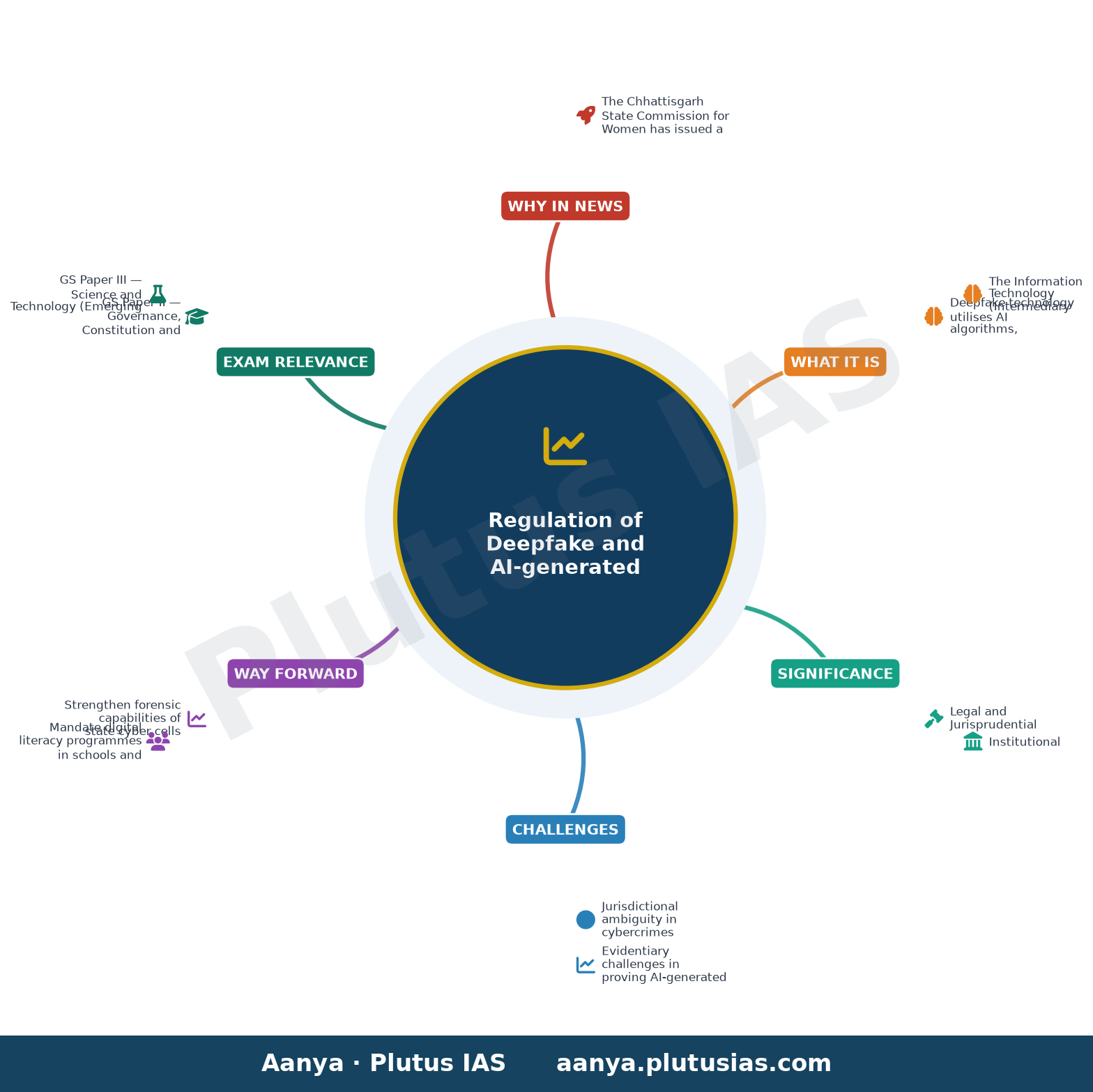
The Chhattisgarh State Commission for Women has issued a public advisory highlighting that the creation and dissemination of AI-generated objectionable images of women on social media constitutes a cybercrime under existing legal frameworks. This follows a complaint during a public hearing where a woman alleged that her AI-manipulated images were being circulated maliciously, underscoring the growing threat of deepfake technology in perpetuating gender-based cyber violence and the need for robust institutional and legal responses.
Background
- The proliferation of artificial intelligence (AI) and deepfake technologies has enabled the rapid generation of hyper-realistic images, audio, and video content, raising significant ethical, legal, and social concerns.
- Deepfakes exploit vulnerabilities in digital identity, often targeting women through non-consensual pornography, defamation, and harassment, thereby violating their right to privacy and dignity under Article 21 of the Constitution of India.
- The Information Technology (Intermediary Guidelines and Digital Media Ethics Code) Rules, 2021, mandate due diligence by social media intermediaries to prevent the spread of misinformation and non-consensual content, including deepfakes.
- Section 67 and 67A of the Information Technology Act, 2000, criminalise the publication and transmission of obscene material in electronic form, with enhanced penalties for content that is sexually explicit or defamatory.
- The advisory by the Chhattisgarh State Commission for Women aligns with broader national efforts to sensitise stakeholders, including law enforcement, judiciary, and digital platforms, on the legal and institutional mechanisms available to victims of AI-driven cyber abuse.
Deepfake Technology, Cybercrimes Against Women, and Legal Safeguards
- Deepfake technology utilises AI algorithms, particularly generative adversarial networks (GANs), to create or manipulate digital content that appears authentic, often indistinguishable from real media, thereby enabling malicious actors to fabricate narratives or images without consent.
- The Information Technology (Intermediary Guidelines and Digital Media Ethics Code) Rules, 2021, impose obligations on social media intermediaries to remove or disable access to content that violates the law within 24 hours of receiving a complaint, failing which they may lose their intermediary status.
- Victims of deepfake-based cybercrimes can file complaints with local law enforcement agencies, which are required to register First Information Reports (FIRs).
- The National Commission for Women (NCW) and State Women’s Commissions provide a grievance redressal mechanism, including public hearings, legal aid, and coordination with law enforcement, to address complaints of gender-based cyber violence.
- Digital platforms are increasingly deploying AI-driven content moderation tools to detect and remove deepfake content, though challenges persist in balancing automated detection with free expression and privacy rights.
- Preventive measures include digital literacy campaigns, awareness programmes on safe online practices, and the promotion of ethical AI development to mitigate risks of misuse.
- International frameworks, such as the Council of Europe’s Convention on Cybercrime (Budapest Convention), provide models for cross-border cooperation in investigating and prosecuting cybercrimes, including those involving deepfakes.
Key Features
| Feature | Significance |
|---|---|
| AI-generated objectionable imagery | Expands the scope of cybercrimes to include synthetic media, necessitating updated legal and institutional responses. |
| Chhattisgarh State Women’s Commission (CSWC) | Serves as a nodal agency for addressing gender-based cyber offences and providing redressal mechanisms. |
| Jan Sunwai (Public Hearing) mechanism | Facilitates direct citizen engagement with state institutions for grievance redressal and evidence collection. |
| FIR registration under cyber laws | Enables immediate legal recourse for victims of AI-driven image-based abuse. |
| Public awareness campaigns by CSWC | Aims to educate women on digital rights and legal protections against online harassment. |
Why it Matters
Legal and Jurisprudential
- Establishes precedent for prosecuting AI-generated deepfakes under existing cybercrime statutes, particularly Section 67C of the Information Technology Act, 2000.
Institutional
- Demonstrates the proactive role of state women’s commissions in addressing emerging digital threats to gender safety.
Societal
- Highlights the vulnerability of women to technologically mediated harassment, necessitating gender-sensitive digital governance.
Technological
- Underscores the dual-use nature of AI, where generative models can be weaponised for malicious purposes without adequate safeguards.
Challenges
1. Jurisdictional ambiguity in cybercrimes
- Overlap between state police and central agencies (e.g., CERT-In) in investigating AI-generated content may delay justice.
- Cross-border nature of digital platforms complicates enforcement of domestic laws.
UPSC Link: GS-III: Cyber Security
2. Evidentiary challenges in proving AI-generated content
- Forensic verification of deepfakes requires advanced tools and expertise, often unavailable at district levels.
- Chain of custody issues arise when digital evidence is altered or deleted before investigation.
UPSC Link: GS-III: Science & Technology
3. Low digital literacy among victims
- Many women lack awareness of legal recourse or technical means to report such crimes.
- Fear of social stigma deters victims from filing complaints.
UPSC Link: GS-II: Governance
4. Regulatory gaps in AI governance
- Absence of a dedicated legal framework for AI-generated content in India’s cyber laws.
- Voluntary self-regulation by platforms (e.g., Meta, X) is insufficient to curb systemic abuse.
UPSC Link: GS-III: Technology & Ethics
Challenges — UPSC Perspective
| Issue | Concern |
|---|---|
| Prosecution delays | Lengthy legal processes deter victims from pursuing cases. |
| Platform accountability | Social media intermediaries often fail to act promptly on takedown requests. |
| Resource constraints | State agencies lack trained personnel for AI forensic analysis. |
| Victim protection | Anonymity and witness protection mechanisms are inadequate. |
| Inter-agency coordination | Lack of standardised protocols between police, courts, and CSWC. |
Way Forward
- Strengthen forensic capabilities of state cyber cells through partnerships with IITs/DRDO for AI-generated content analysis.
- Mandate digital literacy programmes in schools and colleges, with a focus on gender-sensitive cyber hygiene.
- Establish a state-level nodal authority to coordinate between police, women’s commissions, and social media platforms.
- Amend the IT Act to include specific provisions for AI-generated deepfakes, with stringent penalties.
- Launch a statewide helpline (e.g., 181) for reporting AI-based cybercrimes, integrated with CSWC’s Jan Sunwai mechanism.
- Encourage social media platforms to adopt proactive detection tools (e.g., hash-matching algorithms) for objectionable AI content.
- Conduct periodic audits of digital platforms’ compliance with India’s Intermediary Guidelines (2021) to ensure accountability.
UPSC Value Addition
Keywords for Mains Answer-Writing
Artificial Intelligence (AI) and Cyber Crimes · Cyber Security and Digital Rights · Women’s Rights and Legal Safeguards · Information Technology Act, 2000 · Section 67C of the IT Act · Deepfake Technology and Legal Framework · Digital Empowerment and Safeguards · Cyber Harassment and Legal Recourse · Constitutional Provisions on Dignity and Privacy · Artificial Intelligence and Ethical Governance
Constitutional & Policy Linkages
- Article 19(1)(a) (Freedom of Speech) – Balancing with Article 21 (Right to Privacy) in regulating harmful AI-generated content.
Concept Flow
Emergence of generative AI tools → Proliferation of deepfakes → Targeted harassment of women → Reporting to CSWC → Categorisation as cybercrime → Legal recourse under IT Act → Institutional redressal via Jan Sunwai.
Prelims Practice Questions
Q1. Consider the following statements regarding the legal framework addressing cyber crimes involving artificial intelligence (AI) in India:
1. Section 67C of the Information Technology Act, 2000, specifically criminalises the creation and dissemination of deepfake content without consent.
2. The Information Technology (Intermediary Guidelines and Digital Media Ethics Code) Rules, 2021, mandate social media platforms to remove deepfake content within 24 hours of receipt of a complaint.
3. The Supreme Court of India, in a recent judgment, has held that AI-generated content cannot be considered as ‘electronic record’ under the Indian Evidence Act, 1872.
How many of the above statements are correct?
- Only one
- Only two
- All three
- None
Answer: Only two — Statement 1 is incorrect: Section 67C deals with the preservation and retention of information by intermediaries, not the criminalisation of deepfake content. Statement 2 is correct: Rule 3(1)(b)(ii) of the IT Rules, 2021, requires intermediaries to remove content that violates any law, including deepfake content, within 24 hours of a complaint. Statement 3 is incorrect: The Supreme Court has not held that AI-generated content cannot be considered an ‘electronic record’; it remains admissible under the Indian Evidence Act.
Q2. Assertion (A): The Information Technology Act, 2000, read with the Indian Penal Code, 1860, provides comprehensive legal recourse for victims of cyber harassment, including those involving AI-generated content.
Reason (R): The IT Act, 2000, defines ‘computer resource’ broadly to include AI-generated data, and the IPC provides penal provisions for defamation, obscenity, and criminal intimidation.
Options:
A. Both A and R are true, and R is the correct explanation of A.
B. Both A and R are true, but R is not the correct explanation of A.
C. A is true, but R is false.
D. A is false, but R is true.
- A
- B
- C
- D
Answer: A — Both Assertion (A) and Reason (R) are true. The IT Act, 2000, defines ‘computer resource’ to include AI-generated data, and the IPC provides penal provisions for defamation (Section 499), obscenity (Section 292), and criminal intimidation (Section 503). However, R is not the correct explanation of A because the legal recourse for cyber harassment involving AI-generated content is not solely dependent on the broad definition of ‘computer resource’ but also on specific penal provisions and procedural safeguards.
Mains Practice Question
✍ The proliferation of artificial intelligence (AI)-generated deepfake content targeting women constitutes a grave violation of their dignity and privacy. Critically examine the adequacy of India’s legal and institutional framework to address this menace. Also, suggest measures to strengthen the regulatory and enforcement mechanisms. (15 Marks)
Approach: MODEL-ANSWER SKELETON:
1. **Introduction (2 marks)**: Define deepfake technology and its misuse, particularly against women. Highlight the constitutional significance of dignity (Article 21) and privacy (Puttaswamy judgment).
2. **Legal Framework Analysis (5 marks)**:
– **Information Technology Act, 2000**: Sections 66C (identity theft), 66E (violation of privacy), 67 (publishing obscene material), and 67A (publishing sexually explicit material).
– **Indian Penal Code, 1860**: Sections 292 (obscenity), 499 (defamation), 500 (punishment for defamation), and 509 (word, gesture, or act intended to insult the modesty of a woman).
– **Information Technology (Intermediary Guidelines and Digital Media Ethics Code) Rules, 2021**: Obligations of intermediaries to remove deepfake content within 24 hours of complaint (Rule 3(1)(b)(ii)).
– **Limits**: Lack of specific provisions criminalising deepfake creation/distribution; reliance on general penal laws; procedural delays in enforcement.
3. **Institutional Mechanisms (3 marks)**:
– Role of the National Commission for Women (NCW) and State Women’s Commissions in addressing cyber harassment.
– Cyber Crime Cells under State Police and the Cyber Crime Investigation Cell (CCIC) under the Ministry of Home Affairs.
– Limitations: Underreporting, lack of awareness, and slow redressal mechanisms.
4. **Judicial Precedents (2 marks)**:
– Supreme Court’s observations on privacy (Puttaswamy, 2017) and the need for a robust data protection regime.
– High Court judgments on cyber harassment (e.g., *State of Kerala v. Basheer*, 2020).
5. **Suggestions for Strengthening (3 marks)**:
– **Legislative**: Enact a dedicated statute or amend the IT Act to criminalise deepfake creation/distribution with stringent penalties.
– **Technological**: Mandate AI platforms to deploy watermarking or detection tools for deepfake content.
– **Institutional**: Establish dedicated cyber crime units for women and fast-track courts for digital crimes.
– **Awareness**: Conduct awareness campaigns on digital literacy and reporting mechanisms.
6. **Conclusion (1 mark)**: Emphasise the need for a multi-stakeholder approach involving government, judiciary, civil society, and technology platforms to address the menace effectively.
Source: amarujala.com
Generated by AanyaAi for educational purpose.


No Comments