


12 Nov CII Partnership Summit: ₹5.8 Lakh Cr Investments & Job Creation
✎ The CII Partnership Summit is a pivotal annual event facilitating investment, economic cooperation, and policy dialogue between India and global stakeholders.
Subject Relevance — Where This Topic Fits
- GS Paper III — Economy — Mobilization of Resources, Growth, Development and Employment | GS Paper III — Economy — Industrial Policy and its effects on Industrial Growth | GS Paper II — Governance — Government Policies and Interventions for Development in various sectors
- Prelims: CII Partnership Summit, Foreign Direct Investment (FDI), Memorandum of Understanding (MoU), Ease of Doing Business, Industrial Corridors, Special Economic Zones (SEZs)
- Essay: The role of investment in driving economic development and job creation., Public-private partnerships as catalysts for industrial growth and infrastructure development.
Quick Revision: The CII Partnership Summit is a pivotal annual event facilitating investment, economic cooperation, and policy dialogue between India and global stakeholders.
Why is this in the news?
The 31st CII Partnership Summit in Visakhapatnam witnessed the signing of numerous Memoranda of Understanding (MoUs) and the issuance of Government Orders (G.O.s), reflecting substantial investment commitments across various sectors. These commitments, totaling ₹5.8 lakh crore, are projected to generate over one lakh employment opportunities, underscoring the summit’s role in attracting capital and fostering economic expansion within the region.
Background
- The Confederation of Indian Industry (CII) is a non-governmental, not-for-profit organisation that plays a proactive role in India’s development journey.
- The CII Partnership Summit is an annual flagship event that brings together policymakers, business leaders, international organisations, and experts to deliberate on critical issues concerning economic growth and global partnerships.
- Such summits serve as crucial platforms for states to showcase their investment potential, highlight policy reforms, and attract domestic and foreign capital.
- Investment commitments, often formalised through MoUs, signify prospective capital infusion into various sectors, contributing to industrialisation and infrastructure development.
- The ‘Ease of Doing Business’ framework, implemented by both central and state governments, aims to simplify regulatory processes and create a conducive environment for investments.
- Government Orders (G.O.s) are official directives issued by state governments, often facilitating the implementation of policies, schemes, or investment projects.
What is the CII Partnership Summit?
- The CII Partnership Summit is an international conference organised annually by the Confederation of Indian Industry (CII) in partnership with the Department for Promotion of Industry and Internal Trade (DPIIT), Ministry of Commerce and Industry, Government of India, and a partner state.
- Its primary objective is to foster economic cooperation, attract investments, and promote trade relations between India and global partners.
- The summit provides a platform for dialogue among government officials, industry leaders, international delegates, and experts on contemporary economic and business issues.
- Key themes often include global economic trends, investment opportunities, policy reforms, technological advancements, and sustainable development.
- It facilitates business-to-business (B2B) and government-to-business (G2B) interactions, leading to the signing of MoUs and investment agreements.
- The event contributes to enhancing India’s image as an attractive investment destination and promotes regional economic development by showcasing the potential of host states.
- Sectors typically covered include manufacturing, renewable energy, infrastructure, information technology, automobiles, and chemicals, reflecting India’s diverse economic landscape.
Key Features
| Feature | Significance |
|---|---|
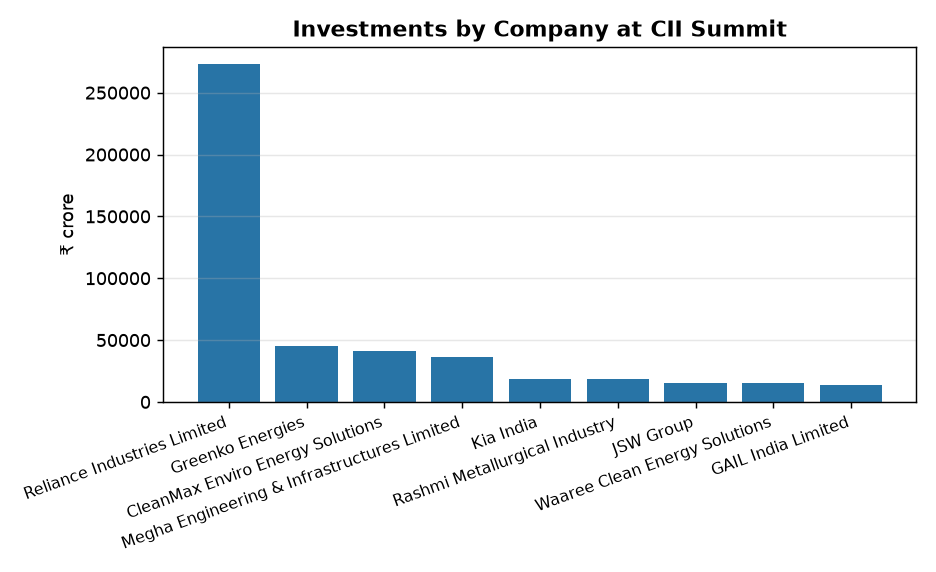
| Investment Commitments | ₹5.84 lakh crore pledged through 73 MoUs and 15 G.O.s, indicating substantial private sector confidence and potential for economic expansion. |
| Job Creation Potential | Projection of 1,07,693 new employment opportunities, addressing unemployment concerns and fostering inclusive growth. |
| Sectoral Diversification | Investments spread across general manufacturing, renewable energy, automotive, and chemicals/petrochemicals, promoting a balanced industrial ecosystem. |
| Key Investors | Major commitments from Reliance Industries Limited, Greenko Energies, CleanMax Enviro Energy Solutions, and Kia India, reflecting participation by prominent industrial entities. |
| Manufacturing Boost | General manufacturing sector attracting the largest share of investments (₹3.57 lakh crore), signifying a renewed focus on industrial production. |
| Renewable Energy Focus | Significant investment (₹1.65 lakh crore) in renewable energy, aligning with national sustainability goals and energy transition objectives. |
Why it Matters
Economic Development
- The substantial investment commitments are poised to stimulate economic growth by injecting capital into various sectors, leading to increased production, consumption, and overall economic activity.
- The projected job creation directly addresses unemployment, enhancing household incomes and consumer spending, which are critical drivers of economic expansion.
- Diversification of investments across multiple sectors reduces economic vulnerability by preventing over-reliance on a single industry, fostering a more resilient and stable economic structure.
Industrial Growth and Modernisation
- The focus on general manufacturing, including large-scale projects like RIL’s investment, signifies a push towards strengthening India’s industrial base and enhancing its manufacturing capabilities.
- Investments in the automotive sector, such as Kia India’s expansion, contribute to the modernisation of the manufacturing landscape, potentially integrating advanced technologies and processes.
- The significant allocation to renewable energy projects supports India’s transition towards a greener economy, promoting sustainable industrial practices and reducing carbon footprint.
Regional Development
- The concentration of investments in specific regions, such as Visakhapatnam and East Godavari district, is expected to spur localised economic development, infrastructure improvements, and urbanisation.
- Such large-scale industrial projects can lead to the development of ancillary industries and support services, creating a multiplier effect on regional economies.
- Increased industrial activity can attract skilled labour and professionals to these regions, fostering human capital development and improving living standards.
Challenges
1. Land Acquisition and Environmental Clearances
- Expeditious and transparent land acquisition processes are crucial to prevent project delays and cost overruns.
- Streamlining environmental impact assessment and clearance procedures while ensuring ecological sustainability is a persistent challenge.
UPSC Link: Environmental Impact Assessment; Land Reforms
2. Infrastructure Development
- Adequate development of supporting infrastructure, including roads, ports, power, and water supply, is essential to facilitate the proposed industrial expansion.
- Ensuring reliable and affordable power supply, especially for energy-intensive industries, remains a critical infrastructure requirement.
UPSC Link: Infrastructure: Energy, Ports, Roads
3. Skilled Workforce Availability
- Matching the skills of the local workforce with the demands of new industries requires robust vocational training and skill development programmes.
- Addressing potential skill gaps to ensure that the projected job creation translates into meaningful employment for the local population.
UPSC Link: Skill Development; Human Resource Development
4. Policy Implementation and Regulatory Stability
- Consistent and predictable policy frameworks are vital to maintain investor confidence and ensure the long-term viability of projects.
- Efficient and transparent regulatory mechanisms are necessary to facilitate business operations and resolve disputes effectively.
UPSC Link: Government Policies & Interventions; Investment Models
5. Financial Viability and Funding
- Ensuring the long-term financial viability of large-scale projects and securing adequate funding, including access to credit, is paramount.
- Mitigating risks associated with market fluctuations and ensuring sustainable returns on investment for participating companies.
UPSC Link: Indian Economy; Mobilisation of Resources
Challenges — UPSC Perspective
| Issue | Concern |
|---|---|
| Project Implementation Delays | Bureaucratic hurdles, inter-departmental coordination issues, and unforeseen contingencies can impede timely project completion. |
| Environmental Sustainability | Balancing industrial growth with environmental protection, particularly in sectors like manufacturing and energy, is crucial to prevent ecological degradation. |
| Inclusive Growth | Ensuring that the benefits of industrialisation are equitably distributed and do not exacerbate regional disparities or social inequalities. |
| Technological Integration | Adopting and integrating advanced technologies to enhance productivity and competitiveness, while also addressing potential job displacement concerns. |
| Market Volatility | Fluctuations in global and domestic markets, commodity prices, and consumer demand can impact the profitability and sustainability of investments. |
| Regulatory Compliance | Adhering to a complex web of national and state-level regulations, including labour laws, environmental norms, and taxation policies. |
Way Forward
- Expedite land acquisition and environmental clearance processes through single-window systems and time-bound approvals to ensure project commencement without undue delays.
- Invest proactively in robust infrastructure development, including power, water, logistics, and connectivity, to support the demands of new industrial units.
- Implement targeted skill development and vocational training programmes, in collaboration with industry, to create a workforce aligned with the specific needs of the investing sectors.
- Foster a stable and predictable policy environment, ensuring consistency in regulations and incentives to maintain investor confidence and attract further capital.
- Promote research and development and technological adoption to enhance industrial competitiveness and move towards higher value-added manufacturing.
- Establish effective grievance redressal mechanisms for investors and industries to promptly address operational challenges and regulatory issues.
- Develop robust monitoring and evaluation frameworks to track the progress of committed investments and assess their socio-economic and environmental impacts.
- Encourage local entrepreneurship and MSME participation as ancillary units to maximise the multiplier effect of large investments on regional economies.
UPSC Value Addition
Keywords for Mains Answer-Writing
Investment Promotion · Ease of Doing Business · Industrial Policy · Economic Growth · Employment Generation · Public-Private Partnership · Sectoral Development · Regional Development · Make in India · Foreign Direct Investment
Concept Flow
Investment Commitments (MoUs/G.O.s) → Capital Inflow & Project Initiation → Industrial Expansion & Production Growth → Job Creation & Income Generation → Economic Growth & Regional Development
Prelims Practice Questions
Q1. Consider the following statements regarding investment promotion in India:
1. State governments play a crucial role in attracting investments through policy incentives and infrastructure development.
2. The ‘Ease of Doing Business’ framework is primarily a central government initiative with limited impact at the state level.
3. Public-Private Partnerships (PPPs) are a common mechanism for funding large-scale infrastructure and industrial projects.
How many of the above statements are correct?
- Only one
- Only two
- Only three
- None
Answer: Only two — Statement 1 is correct: State governments actively compete to attract investments by offering various incentives, streamlining regulatory processes, and developing industrial infrastructure. Statement 2 is incorrect: The ‘Ease of Doing Business’ framework, while a central initiative, significantly influences state-level reforms and policies, as states are ranked based on their implementation. Statement 3 is correct: PPPs are widely utilized across various sectors to leverage private sector efficiency and capital for public projects.
Q2. Which of the following is NOT a primary objective of investment summits like the CII Partnership Summit?
- To facilitate Memorandum of Understanding (MoU) signings between investors and the government.
- To showcase the investment potential and policy environment of a state or region.
- To directly allocate central government funds to specific industrial projects.
- To promote networking opportunities among business leaders, policymakers, and potential investors.
Answer: To directly allocate central government funds to specific industrial projects. — Investment summits primarily aim to attract private and corporate investments, showcase opportunities, and facilitate agreements. Direct allocation of central government funds to specific industrial projects is typically handled through different governmental mechanisms and schemes, not directly through such summits.
Mains Practice Question
✍ Examine the significance of state-level investment summits in fostering economic growth and employment generation in India. Discuss the challenges faced by states in attracting and retaining large-scale investments. (15 Marks)
Approach: MODEL-ANSWER SKELETON:
1. **Introduction**: Briefly define state-level investment summits and their general purpose.
2. **Significance in Fostering Economic Growth**:
* **Capital Inflow**: Attracting domestic and foreign direct investment (FDI).
* **Industrial Development**: Promoting new industries and expanding existing ones.
* **Infrastructure Development**: Leading to investment in physical and social infrastructure.
* **Revenue Generation**: Increasing state tax revenues.
* **Technological Upgradation**: Facilitating transfer of technology and best practices.
3. **Significance in Employment Generation**:
* **Direct Employment**: Creation of jobs in new and expanding industrial units.
* **Indirect Employment**: Growth in ancillary industries, services, and supply chains.
* **Skill Development**: Demand for skilled labour leading to training initiatives.
4. **Challenges in Attracting and Retaining Investments**:
* **Infrastructure Deficiencies**: Gaps in power, roads, ports, and logistics.
* **Regulatory Hurdles**: Bureaucracy, complex clearances, and policy inconsistencies.
* **Land Acquisition Issues**: Difficulties and delays in acquiring land for projects.
* **Human Capital**: Shortage of skilled labour or mismatch with industry demands.
* **Inter-state Competition**: Intense competition among states for investments, potentially leading to ‘race to the bottom’ on incentives.
* **Political Stability and Governance**: Perceptions of instability or corruption.
* **Access to Finance**: Availability and cost of capital for businesses.
* **Environmental Clearances**: Delays and complexities in obtaining environmental approvals.
5. **Conclusion**: Summarize the dual role of summits and suggest measures for states to overcome challenges, emphasizing a holistic approach to investment promotion.
Source: The Hindu
Generated by AanyaAi for educational purpose.
Related guides on our sites
- Current affairs for upsc 2026
- Best PSIR optional coaching for upsc
- Best economics optional coaching for upsc
- Best PSIR optional teacher for upsc

- NAMASTE Scheme: Enhancing Sanitation Workers’ Livelihoods & Safety - November 14, 2026
- एमएसएमई का विशेष अभियान 6.0: स्वच्छता और लंबित मामलों का निपटारा - November 14, 2026
- Sea Vigil-26: Coastal Defence Drills Off Visakhapatnam - November 14, 2026

No Comments