


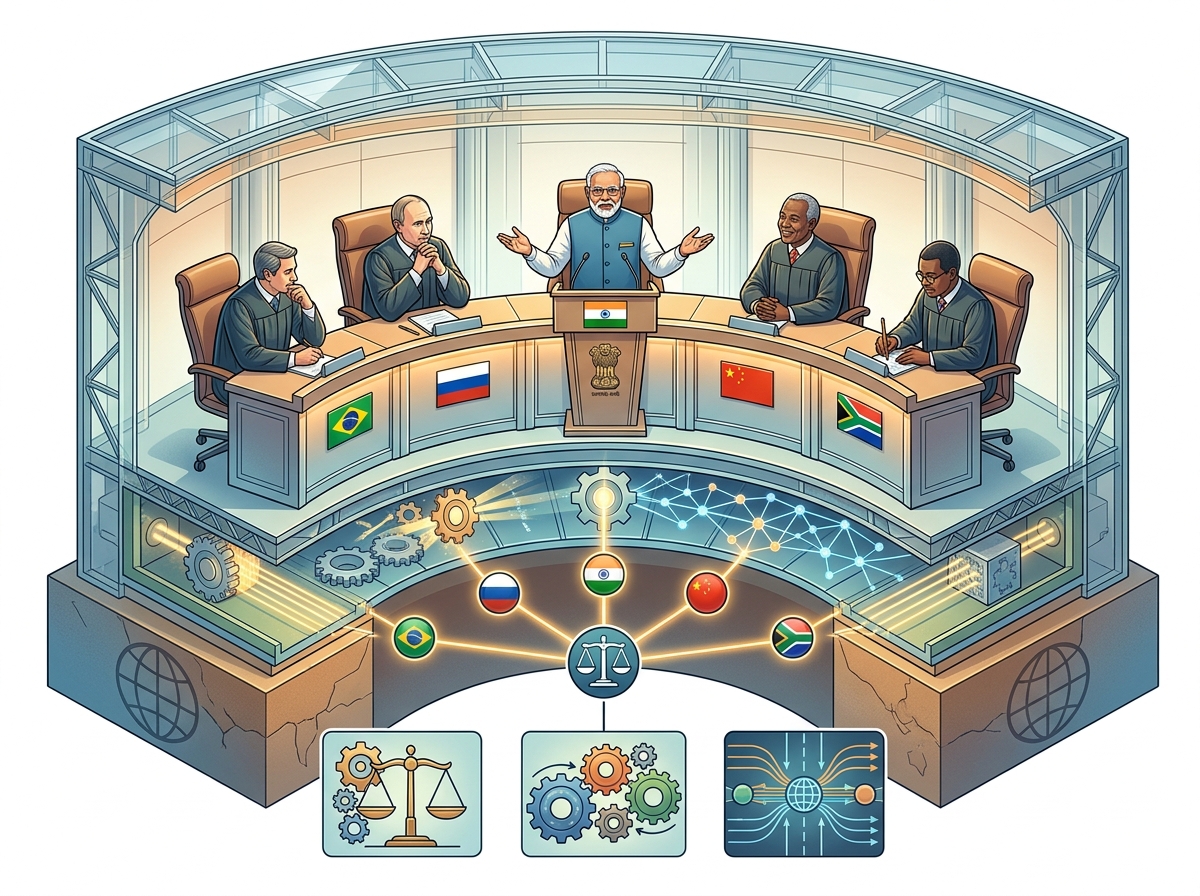
05 Sep CJI Surya Kant advocates healthy judicial discourse at BRICS Chief Justices’ Forum 2026
✎ The BRICS Chief Justices’ Forum institutionalises judicial pluralism by fostering deliberative mechanisms for cross-border dispute resolution, harmonisation of legal systems, and integration of emerging technologies like AI in…
Subject Relevance — Where This Topic Fits
- GS Paper II — International Organisations | GS Paper II — Bilateral, Regional and Global Groupings and Agreements involving India and/or affecting India’s interests | GS Paper II — India and its Neighbourhood- Relations | GS Paper IV — Ethics, Integrity and Aptitude (Global Governance Ethics)
- Prelims: BRICS Chief Justices’ Forum, Judicial pluralism, Cross-border commercial dispute resolution, Alternative Dispute Resolution (ADR), Rules-based international trade, Artificial Intelligence in judiciary, Multipolarity in international law
- Essay: The Role of Judiciary in Upholding Global Justice in a Multipolar World, Balancing Sovereignty and International Cooperation: Lessons from BRICS Judicial Dialogues
Quick Revision: The BRICS Chief Justices’ Forum institutionalises judicial pluralism by fostering deliberative mechanisms for cross-border dispute resolution, harmonisation of legal systems, and integration of emerging technologies like AI in justice delivery.
Why is this in the news?
The Chief Justice of India (CJI) Surya Kant’s address at the BRICS Chief Justices’ Forum in 2026 underscores the evolving role of judiciaries in pluralistic international groupings like BRICS. The emphasis on healthy disagreement, timely justice delivery, and judicial cooperation reflects a broader shift toward institutionalising deliberative mechanisms for resolving cross-border disputes, harmonising legal systems, and addressing global governance challenges in an era of geopolitical flux.
Background
- The BRICS grouping, comprising Brazil, Russia, India, China, and South Africa, has progressively expanded its agenda beyond economic cooperation to include institutional dialogues in governance, law, and justice.
- The BRICS Chief Justices’ Forum serves as a platform for judicial leaders to exchange best practices, address common challenges in justice delivery, and explore avenues for judicial cooperation in cross-border legal matters.
- The forum aligns with BRICS’ broader objective of fostering a multipolar world order, where international law and judicial pluralism play a pivotal role in mitigating conflicts and promoting equitable trade and commerce.
- The 2026 forum included participation from judicial leaders of BRICS member states, partner countries (e.g., Egypt, UAE, Indonesia), and observer nations, reflecting the grouping’s expanding institutional footprint.
- The event highlighted the intersection of judiciary with emerging technologies like AI, which is increasingly being integrated into judicial processes for efficiency and predictive justice.
- The forum’s discussions on alternative dispute resolution (ADR) mechanisms underscore their growing relevance in resolving commercial and civil disputes without protracted litigation, particularly in cross-border contexts.
What is the BRICS Chief Justices’ Forum?
- The BRICS Chief Justices’ Forum is an annual high-level judicial dialogue established to facilitate interaction among the heads of judiciary from BRICS member states and partner countries.
- Its primary objective is to promote judicial cooperation, exchange legal best practices, and address common challenges in justice delivery, including cross-border disputes and enforcement of foreign judgments.
- The forum operates under the broader BRICS framework but functions independently, focusing on legal pluralism, judicial independence, and the rule of law in a multipolar world.
- It provides a platform for discussing emerging issues such as the role of AI in judiciary, digital justice, and the harmonisation of legal systems to facilitate international trade and commerce.
- The forum also explores mechanisms for strengthening alternative dispute resolution (ADR) to reduce litigation backlogs and enhance efficiency in commercial dispute resolution.
- Participation includes not only BRICS member states but also partner countries and observer nations, reflecting the grouping’s inclusive approach to global governance.
- The forum’s deliberations are non-binding but serve as a soft-power tool for shaping global judicial norms and fostering mutual trust among legal systems.
- Recent editions have emphasised the judiciary’s role in promoting social equity, economic development, and the rule of law in the context of global instability and industrial transformation.
Key Features
| Feature | Significance |
|---|---|
| BRICS Chief Justices’ Forum | A multilateral judicial platform facilitating dialogue among the judiciaries of BRICS member states and partner countries, promoting legal cooperation and shared judicial best practices. |
| Healthy disagreement and deliberations | Emphasises the necessity of constructive dissent and structured debate in judicial forums to enhance legal reasoning and consensus-building among diverse legal systems. |
| Timely and predictable delivery of justice | A core judicial principle underscored by the CJI, ensuring efficiency and reliability in legal proceedings to uphold public trust in the judiciary. |
| Multipolarity and international collaboration | Advocated by the Brazilian Chief Justice, this reflects the need for a balanced global legal order amid shifting geopolitical dynamics. |
| Rules-based international trade and commerce | Highlighted by the Chinese Chief Justice, it underscores the judiciary’s role in fostering a stable and predictable environment for economic transactions. |
Why it Matters
Judicial Diplomacy and Global Governance
- The BRICS Chief Justices’ Forum serves as a platform for judicial leaders to engage in high-level dialogue, fostering mutual understanding and cooperation across diverse legal traditions.
- Promotes the exchange of judicial best practices, contributing to the harmonisation of legal standards and procedures among member states.
- Enhances the role of judiciaries in addressing transnational legal challenges, such as cross-border commercial disputes and digital governance.
Rule of Law in International Order
- Reaffirms the commitment of BRICS judiciaries to uphold the rule of law as a foundational principle for global stability and economic development.
- Emphasises the judiciary’s responsibility in safeguarding international law, particularly in periods of geopolitical instability and transition.
- Promotes a free and fair legal system with a common global voice, as articulated by the Egyptian Chief Justice.
Economic and Commercial Implications
- Judicial cooperation is identified as a catalyst for economic growth, particularly in resolving cross-border commercial disputes and ensuring predictability in trade.
- The judiciary’s role in promoting social equity and justice is linked to broader economic development goals, as highlighted by the Chinese Chief Justice.
- Alternative dispute resolution mechanisms, discussed by the Ethiopian Chief Justice, offer efficient pathways to resolve commercial conflicts, reducing litigation burdens.
Technological Integration in Judiciary
- The expanding role of artificial intelligence in judicial functioning is recognised as a transformative tool for enhancing efficiency, accessibility, and decision-making in courts.
- Judicial leaders acknowledge the need for ethical frameworks and capacity-building to integrate AI responsibly in legal systems.
Challenges
1. Diverse Legal Systems and Harmonisation
- Divergent legal traditions and procedural norms among BRICS member states pose challenges to achieving uniformity in judicial practices.
- The lack of a unified legal framework complicates cross-border legal cooperation and dispute resolution.
UPSC Link: GS-II: International Organisations
2. Geopolitical Tensions and Legal Cooperation
- Geopolitical rivalries may hinder collaborative efforts, as differing national interests could impede consensus on judicial standards.
- The forum must navigate these tensions to maintain a neutral and inclusive platform for dialogue.
UPSC Link: GS-II: International Relations
3. Technological Disparities in Judiciary
- Uneven adoption of digital tools and AI across judiciaries limits the potential for technological collaboration and innovation.
- Capacity-building initiatives are required to bridge the digital divide in legal systems.
UPSC Link: GS-III: Science & Technology
4. Economic Inequality and Access to Justice
- Disparities in judicial infrastructure and resources among member states may exacerbate inequalities in access to justice.
- Ensuring equitable participation and support for smaller or developing judiciaries is essential.
UPSC Link: GS-II: International Organisations
5. Balancing Sovereignty and International Law
- Member states may prioritise national sovereignty over international legal commitments, complicating efforts to establish common judicial principles.
- The forum must strike a balance between respecting sovereignty and promoting global legal norms.
UPSC Link: GS-II: International Organisations
Challenges — UPSC Perspective
| Issue | Concern |
|---|---|
| Divergent legal systems | Harmonisation of legal standards and procedures across diverse jurisdictions |
| Geopolitical tensions | Potential for rivalries to impede collaborative judicial initiatives |
| Technological disparities | Uneven adoption of AI and digital tools in judiciaries |
| Economic inequality | Disparities in judicial infrastructure and resource allocation |
| Sovereignty vs. international law | Balancing national autonomy with global legal commitments |
Way Forward
- Establish a joint working group of BRICS judiciaries to develop a framework for harmonising legal standards and procedures.
- Promote capacity-building programmes to address technological disparities, focusing on AI integration and digital governance in judiciaries.
- Create a repository of best practices and case studies to facilitate knowledge-sharing among member states.
- Strengthen alternative dispute resolution mechanisms to reduce litigation burdens and enhance commercial predictability.
- Develop a consensus on ethical guidelines for the use of AI in judicial processes to ensure fairness and transparency.
- Encourage regular high-level dialogues to sustain momentum in judicial cooperation and address emerging challenges.
- Foster partnerships with international organisations to align BRICS judicial initiatives with global legal standards.
UPSC Value Addition
Keywords for Mains Answer-Writing
BRICS Chief Justices’ Forum · judicial cooperation · rule of law · international law · cross-border commercial disputes · artificial intelligence in judiciary · rules-based international order · judicial deliberations · multipolarity · global judicial civilisation · alternative dispute resolution · economic development and rule of law · judicial independence · BRICS judicial architecture · international legal cooperation
Concept Flow
Geopolitical shifts → Rise of multipolarity → Need for judicial cooperation → BRICS Chief Justices’ Forum → Dialogue on legal harmonisation → Exchange of best practices → Strengthening rule of law → Enhanced economic stability and trade predictability → Sustainable development goals
Prelims Practice Questions
Q1. Consider the following statements regarding the BRICS Chief Justices’ Forum:
1. It is a platform exclusively for the heads of judiciaries of the BRICS member states.
2. The forum emphasises the role of judicial cooperation in promoting rules-based international trade.
3. The forum addresses the use of artificial intelligence in judicial functioning.
4. The forum was established under the aegis of the United Nations.
How many of the above statements are correct?
- Only one
- Only two
- Only three
- All four
Answer: Only three — Statements 2 and 3 are correct as the forum discussed judicial cooperation and AI in judiciary. Statement 1 is incorrect because partner countries also participated. Statement 4 is incorrect as the forum is a BRICS initiative, not a UN body.
Q2. Assertion (A): The BRICS Chief Justices’ Forum promotes the idea of a multipolar world order through judicial cooperation.
Reason (R): The forum encourages greater international collaboration and upholding the rule of law in times of global instability.
Options:
A. Both A and R are true, and R is the correct explanation of A.
B. Both A and R are true, but R is not the correct explanation of A.
C. A is true, but R is false.
D. A is false, but R is true.
Answer: ? — Both A and R are true. The forum’s emphasis on multipolarity and international collaboration aligns with the assertion and reason provided.
Q3. Match the following judicial leaders with their respective countries as mentioned in the BRICS Chief Justices’ Forum:
Column I (Judicial Leader) | Column II (Country)
—————————|——————
1. Luiz Edson Fachin | A. China
2. Zhang Jun | B. Brazil
3. Boulos Gahmy Iskander Boulos | C. Egypt
4. Mahube Betty Molemela | D. South Africa
Options:
A. 1-B, 2-A, 3-C, 4-D
B. 1-A, 2-B, 3-C, 4-D
C. 1-B, 2-A, 3-D, 4-C
D. 1-A, 2-C, 3-B, 4-D
Answer: ? — 1-B (Brazil), 2-A (China), 3-C (Egypt), 4-D (South Africa).
Mains Practice Question
✍ The BRICS Chief Justices’ Forum represents a significant institutional mechanism for promoting judicial cooperation among member states. Critically examine the role of such forums in strengthening the rule of law and international legal order in contemporary times. (15 Marks)
Approach: MODEL-ANSWER SKELETON:
1. **Introduction**: Define the BRICS Chief Justices’ Forum and its objectives (judicial cooperation, rule of law, multipolarity).
2. **Role in Strengthening Rule of Law**:
– **Judicial Deliberations and Disagreement**: Highlight CJI Surya Kant’s emphasis on healthy disagreement as a mechanism for robust judicial reasoning (cite the forum’s 2026 address).
– **Rules-Based International Order**: Link to the forum’s call for upholding international law amid global instability (reference Brazil’s CJ’s statement).
– **Cross-Border Commercial Disputes**: Discuss the role of judiciaries in resolving such disputes (reference China’s CJ’s remarks on judicial cooperation and AI in judiciary).
3. **Challenges and Limitations**:
– **Divergent Legal Systems**: Acknowledge challenges posed by differing legal traditions (common law vs. civil law systems).
– **Sovereignty Concerns**: Address potential tensions between international judicial cooperation and national sovereignty.
– **Implementation Gaps**: Note the absence of binding mechanisms and reliance on voluntary cooperation.
4. **Comparative Perspective**:
– Contrast with other international judicial forums (e.g., International Court of Justice, Commonwealth Law Ministers’ Meeting).
– Highlight the BRICS forum’s unique focus on multipolarity and South-South cooperation.
5. **Conclusion**:
– Summarise the forum’s contributions to global judicial civilisation.
– State that while it is a step forward, its effectiveness depends on sustained political will and institutional capacity.
EXPECTED REFERENCES:
– **Legal Framework**: UN Charter principles (Art. 2(1), 2(7)), Hague Convention on Choice of Court Agreements.
– **Judicial Precedents**: ICJ judgments on international law (e.g., Nicaragua v. USA).
– **Institutional Mechanisms**: BRICS Legal Forum, BRICS Arbitration Centre.
– **Scholarly Views**: Antonio Cassese on international judicial cooperation, Martti Koskenniemi on rule of law in international relations.
Source: orissapost.com
Generated by AanyaAi for educational purpose.
Related guides on our sites
- Best PSIR optional coaching for upsc
- Best PSIR optional teacher for upsc
- Best teacher of PSIR optional for upsc
- Best PSIR optional coaching in delhi for UPSC

- India-Australia AUSTRAHIND 2026 Exercise: Key Highlights for UPSC & State PCS - October 22, 2026
- एससीओ बैठक में भारत का आतंकवाद विरोध: क्षेत्रीय सहयोग पर जोर - October 22, 2026
- SEC Directs Strict SC Order Compliance for Andhra ULB Polls - October 22, 2026

No Comments