


20 Jul CJP’s Parliament March: Centre’s Response & Key UPSC Governance Insights
Subject Relevance — Where This Topic Fits
- GS Paper II — Polity and Governance: Fundamental Rights, Parliament and State Legislatures—Structure, Functioning, Conduct of Business, Powers & Privileges and Issues Arising out of these; Government Policies and Interventions for Development in various sectors and Issues arising out of their Design and Implementation. | GS Paper II — Social Justice: Issues relating to Development and Management of Social Sector/Services relating to Health, Education, Human Resources.
- Prelims: Right to Protest, Freedom of Speech and Expression, Article 19(1)(a), Article 19(1)(b), Reasonable Restrictions, Section 163, BNSS, Monsoon Session of Parliament, Jantar Mantar, Prohibitory Orders
- Essay: The delicate balance between the right to protest and the maintenance of public order in a democratic society., The role of civil society movements in shaping public discourse and influencing policy-making in India.
Quick Revision: The right to protest, a fundamental right under Article 19, is subject to reasonable restrictions to maintain public order, as exemplified by prohibitory orders under Section 163 of the BNSS during parliamentary sessions.
Why is this in the news?
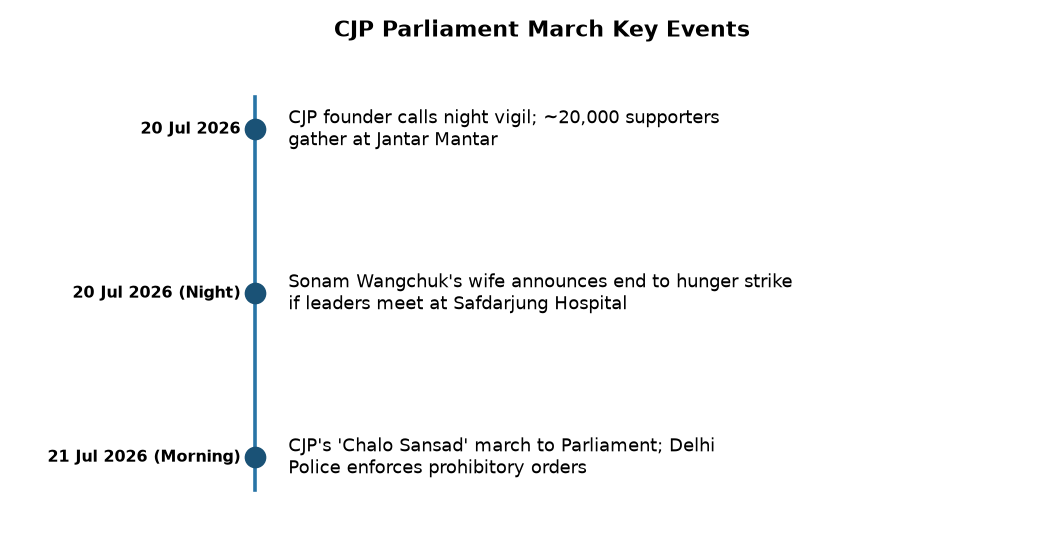
The Cockroach Janata Party (CJP) is organising a ‘Chalo Sansad’ march to the Parliament on the inaugural day of its Monsoon Session, demanding the resignation of the Union Education Minister. This mobilisation, which has seen significant participation at Jantar Mantar, is proceeding despite prohibitory orders under Section 163 of the Bharatiya Nagarik Suraksha Sanhita (BNSS) being in effect around Parliament House, highlighting the ongoing tension between citizens’ right to protest and the state’s prerogative to maintain public order and ensure parliamentary functioning.
Background
- The CJP’s protest centres on demands related to education accountability, specifically calling for the resignation of the Union Education Minister.
- Activist Sonam Wangchuk, a prominent figure associated with the protest, has been on a hunger strike and is currently under medical supervision at Safdarjung Hospital.
- The protest venue at Jantar Mantar has witnessed a substantial gathering, with CJP leaders claiming significant attendance ahead of the planned march.
- The Delhi Police have stated that the CJP has not obtained official clearance for its ‘Chalo Sansad’ march.
- Prohibitory orders under Section 163 of the BNSS are enforced in the New Delhi district, particularly around Parliament House and India Gate, during parliamentary sessions, restricting gatherings of four or more people and unauthorised rallies.
- Sonam Wangchuk’s wife has indicated that he would consider ending his hunger strike if political leaders meet him and assure that education accountability will be a focus during the Monsoon Session of Parliament.
The Right to Protest in India
- The right to protest is a fundamental right enshrined under Article 19(1)(a) and Article 19(1)(b) of the Constitution of India, guaranteeing freedom of speech and expression and the right to assemble peacefully and without arms, respectively.
- These rights are not absolute and are subject to ‘reasonable restrictions’ under Article 19(2) and Article 19(3) in the interest of public order, sovereignty and integrity of India, security of the state, morality, or contempt of court.
- The Supreme Court of India has repeatedly affirmed the right to peaceful protest as an integral part of a democratic society, essential for expressing dissent and holding the government accountable.
- However, the Court has also emphasised that protests must be peaceful and not infringe upon the rights of other citizens or disrupt public life excessively.
- Section 163 of the Bharatiya Nagarik Suraksha Sanhita (BNSS), formerly Section 144 of the Code of Criminal Procedure, 1973, empowers an Executive Magistrate to issue orders in urgent cases of apprehended danger or nuisance, prohibiting assembly of four or more people, carrying weapons, or conducting public meetings.
- Such prohibitory orders are typically imposed in sensitive areas or during periods of heightened security concerns, such as parliamentary sessions, to prevent potential disturbances and ensure law and order.
- Jantar Mantar in Delhi has historically been designated as a primary site for protests and demonstrations, providing a space for citizens to exercise their right to protest while attempting to manage public order.
- The Monsoon Session is one of the three main parliamentary sessions in India, during which legislative business is conducted, and various issues of national importance are debated.
Key Features
| Feature | Significance |
|---|---|
| Right to Protest | A fundamental aspect of democratic societies, allowing citizens to express dissent and demand accountability from the government. |
| Freedom of Speech and Expression | Guaranteed under Article 19(1)(a) of the Constitution, enabling individuals and groups to voice their opinions on public matters. |
| Prohibitory Orders (Section 163 BNSS) | Legal provisions empowering authorities to restrict public gatherings and movement, particularly in sensitive areas like Parliament House, to maintain law and order. |
| Role of Civil Society Organisations (CSOs) | CSOs like CJP play a crucial role in advocating for specific causes, mobilising public opinion, and holding the government accountable. |
| Parliamentary Session Dynamics | The Monsoon Session serves as a platform for legislative business, debates, and addressing public concerns, often coinciding with heightened protest activities. |
| Hunger Strike as a Protest Method | A non-violent form of protest employed by activists to draw attention to their demands and exert moral pressure on authorities. |
Why it Matters
Political Significance
- Highlights the persistent demand for governmental accountability, specifically concerning the education sector, which can influence policy discourse.
- Demonstrates the continued relevance of public protests and civil society mobilisation in shaping the political agenda and pressuring elected representatives.
- Tests the government’s approach to dissent and its capacity to engage with protesting groups while upholding law and order.
Social Significance
- Reflects public sentiment regarding critical issues such as education quality and ministerial responsibility, potentially fostering broader societal debate.
- Underscores the role of prominent activists like Sonam Wangchuk in galvanising public support and bringing specific issues to national attention.
- Illustrates the collective action of citizens in exercising their democratic rights to advocate for social change and improved governance.
Governance Significance
- Presents a challenge to the administration in balancing the right to protest with the imperative of maintaining public order and ensuring the smooth functioning of Parliament.
- Emphasises the importance of effective communication and dialogue between the government and protesting groups to resolve grievances peacefully.
- Highlights the need for transparency and responsiveness from public officials in addressing concerns raised by civil society organisations.
Challenges
1. Balancing Rights and Order
- The inherent tension between citizens’ fundamental right to protest and the state’s responsibility to maintain public order and prevent disruption.
- Determining the appropriate level of force or restriction to apply during protests, ensuring it is proportionate and does not infringe upon legitimate rights.
UPSC Link: GS-II: Fundamental Rights, Law and Order
2. Managing Large-Scale Mobilisation
- The logistical and security challenges associated with managing large gatherings, especially in sensitive areas like the national capital.
- Ensuring the peaceful conduct of protests while preventing potential escalation or infiltration by disruptive elements.
UPSC Link: GS-III: Internal Security, Disaster Management
3. Ensuring Accountability and Responsiveness
- The challenge for the government to be perceived as responsive to public grievances and demands, particularly when they involve ministerial accountability.
- Establishing effective mechanisms for dialogue and resolution with protesting groups to prevent prolonged agitations.
UPSC Link: GS-II: Governance, Accountability
4. Health and Safety of Protesters
- The risks associated with prolonged protest methods like hunger strikes, requiring medical intervention and ethical considerations for authorities.
- Ensuring access to medical care for protesters while respecting their autonomy and the nature of their protest.
UPSC Link: GS-II: Health, Human Rights
5. Information Dissemination and Misinformation
- The challenge of accurate reporting and countering potential misinformation or disinformation surrounding protests, especially through social media.
- Ensuring that the public receives factual information regarding the protest, government actions, and the demands of the protesters.
UPSC Link: GS-III: Media and Social Networking, Internal Security
Challenges — UPSC Perspective
| Issue | Concern |
|---|---|
| Unauthorised March | Potential for violation of prohibitory orders and disruption of parliamentary proceedings. |
| Activist’s Health | The deteriorating health of Sonam Wangchuk due to prolonged hunger strike, requiring continuous medical supervision. |
| Public Order Maintenance | Ensuring peace and preventing any untoward incidents during a large-scale public mobilisation in the capital. |
| Governmental Response | The need for the Centre to address the protesters’ demands effectively while upholding democratic principles. |
| Parliamentary Functioning | Potential for protests to impede the smooth conduct of legislative business during the Monsoon Session. |
| Credibility of Protests | Maintaining the peaceful and disciplined nature of the protest to ensure its message is heard and not overshadowed by disorder. |
Way Forward
- Prioritise constructive dialogue between government representatives and protest leaders to understand and address grievances.
- Ensure strict adherence to legal provisions concerning public assembly while upholding fundamental rights to protest and expression.
- Implement transparent communication strategies to inform the public about the protest’s objectives, government’s stance, and any ongoing negotiations.
- Provide adequate medical and humanitarian support to protesters, especially those undertaking hunger strikes, ensuring their well-being.
- Facilitate peaceful and organised protest activities by designating appropriate venues and establishing clear guidelines for demonstrations.
- Encourage parliamentary discussion on the issues raised by the protesters, allowing for a democratic resolution and policy formulation.
- Strengthen mechanisms for public accountability of ministers and government departments to prevent future grievances from escalating into large-scale protests.
- Utilise technology and social media responsibly to disseminate accurate information and counter misinformation during periods of public unrest.
UPSC Value Addition
Keywords for Mains Answer-Writing
Right to Protest · Freedom of Assembly · Public Order · Prohibitory Orders · Section 163 BNSS · Parliamentary Sessions · Accountability in Governance · Civil Disobedience · Democratic Dissent · Fundamental Rights
Constitutional & Policy Linkages
- {‘article’: ‘Article 19(1)(a)’, ‘note’: ‘Freedom of speech and expression’}
- {‘article’: ‘Article 19(1)(b)’, ‘note’: ‘Right to assemble peacefully’}
- {‘article’: ‘Article 21’, ‘note’: ‘Protection of life and personal liberty’}
Concept Flow
Citizen grievances regarding education accountability. → Formation and mobilisation by Cockroach Janata Party (CJP). → Call for ‘Chalo Sansad’ march during Monsoon Session. → Imposition of prohibitory orders (Section 163 BNSS). → Activist Sonam Wangchuk’s hunger strike and hospitalisation. → Centre’s outreach and potential for dialogue. → Parliamentary discussion on education accountability.
Prelims Practice Questions
Q1. With reference to public order and fundamental rights in India, consider the following statements:
1. The right to protest peacefully is a fundamental right guaranteed under Article 19(1)(b) of the Constitution of India.
2. Prohibitory orders under Section 163 of the Bharatiya Nagarik Suraksha Sanhita (BNSS) can restrict gatherings of four or more people.
3. The imposition of such prohibitory orders is an absolute restriction on the right to assemble and cannot be challenged in a court of law.
- 1 only
- 1 and 2 only
- 2 and 3 only
- 1, 2 and 3
Answer: 1 and 2 only — Statement 1 is correct: The right to assemble peacefully and without arms is a fundamental right under Article 19(1)(b). Statement 2 is correct: Section 163 of the BNSS (formerly Section 144 CrPC) empowers executive magistrates to issue orders prohibiting assemblies of four or more people. Statement 3 is incorrect: While restrictions can be imposed, they must be reasonable and are subject to judicial review, ensuring they do not disproportionately infringe upon fundamental rights.
Q2. Which of the following statements accurately describes the nature of a hunger strike as a form of protest in India?
- A hunger strike is explicitly protected as a fundamental right under Article 21 (Right to Life) of the Constitution.
- The Supreme Court of India has consistently held that a hunger strike is an illegal act and punishable by law.
- While not explicitly a fundamental right, a peaceful hunger strike is generally considered a legitimate form of protest, subject to reasonable restrictions and not amounting to coercion.
- A hunger strike automatically grants immunity from arrest or medical intervention by state authorities.
Answer: While not explicitly a fundamental right, a peaceful hunger strike is generally considered a legitimate form of protest, subject to reasonable restrictions and not amounting to coercion. — A peaceful hunger strike is generally recognized as a form of democratic dissent and a legitimate method of protest, falling within the ambit of freedom of speech and expression and the right to protest, though not explicitly enumerated as a fundamental right. It is subject to reasonable restrictions and cannot be used to coerce the government. The state may intervene on humanitarian grounds if the life of the individual is in danger.
Mains Practice Question
✍ The right to protest is a cornerstone of a vibrant democracy, yet its exercise often intersects with concerns for public order and national security. In light of recent events involving public demonstrations and the imposition of prohibitory orders, critically analyse the balance between the fundamental right to peaceful assembly and the state’s prerogative to maintain law and order. Discuss the constitutional provisions and judicial pronouncements that guide this balance, and suggest measures to ensure that both democratic dissent and public safety are upheld effectively.
Approach: Candidates should begin by defining the right to protest as a fundamental right under Article 19(1)(b) and its significance in a democracy. Subsequently, they should elaborate on the constitutional provisions allowing for reasonable restrictions on this right, specifically Article 19(2) and the powers conferred by laws like the Bharatiya Nagarik Suraksha Sanhita (BNSS). The discussion should then move to judicial interpretations, citing relevant Supreme Court judgments that have sought to balance these competing interests. Finally, candidates should propose constructive measures, such as clear guidelines for imposing restrictions, facilitating peaceful protests, and ensuring accountability, to navigate this complex interplay effectively.
Source: Mint
Generated by AanyaAi for educational purpose.

- केरल उच्च न्यायालय ने 2016 पुट्टिंगल आतिशबाजी दुर्घटना मामले की सुनवाई पर रोक लगाई - September 8, 2026
- Kerala HC Stays Puttingal Fireworks Case Trial: Key UPSC Polity Insights - September 8, 2026
- 11 सितंबर से शुरू होगा पूरे ज़िले में कुष्ठ रोग का घर-घर सर्वेक्षण - September 8, 2026

No Comments