


11 Sep CMPDI & MSME Ranchi Host 2-Day Vendor Development Program for UPSC & State PCS Aspirants
✎ Vendor Development Programmes are strategic platforms that bridge the gap between MSMEs and PSUs, enhancing procurement transparency, fostering indigenous manufacturing, and supporting India’s self-reliance goals through digital…
Subject Relevance — Where This Topic Fits
- GS Paper II — Government Policies and Interventions for Development in various sectors | GS Paper III — Role of Public Sector Undertakings (PSUs) and MSMEs in Economic Development | GS Paper III — Government Procurement and E-Marketplace (GeM) Platforms
- Prelims: MSME Development Office, Government e-Marketplace (GeM), Trade Receivables Discounting System (TReDS), Public Sector Undertakings (PSUs), Coal India Limited (CIL) subsidiaries, Central Mine Planning and Design Institute (CMPDI), Vendor Development Programme, Make in India, Atmanirbhar Bharat
- Essay: The role of MSMEs in India’s economic growth: Challenges and opportunities, Public-private partnerships as catalysts for industrial development
Quick Revision: Vendor Development Programmes are strategic platforms that bridge the gap between MSMEs and PSUs, enhancing procurement transparency, fostering indigenous manufacturing, and supporting India’s self-reliance goals through digital procurement reforms like GeM and TReDS.
Why is this in the news?
The successful conclusion of a two-day Vendor Development Programme-cum-Product Exhibition for Micro, Small, and Medium Enterprises (MSMEs), jointly organised by the Central Mine Planning and Design Institute (CMPDI) and the MSME Development Office, Ranchi, underscores the strategic emphasis on integrating MSMEs into the supply chains of public sector undertakings in the coal and mining sectors. This programme, held on 9–10 September 2026 in Ranchi, aligns with broader national initiatives to promote indigenous manufacturing, enhance procurement transparency, and foster long-term partnerships between corporates and MSMEs, particularly in the context of India’s developmental goals.
Background
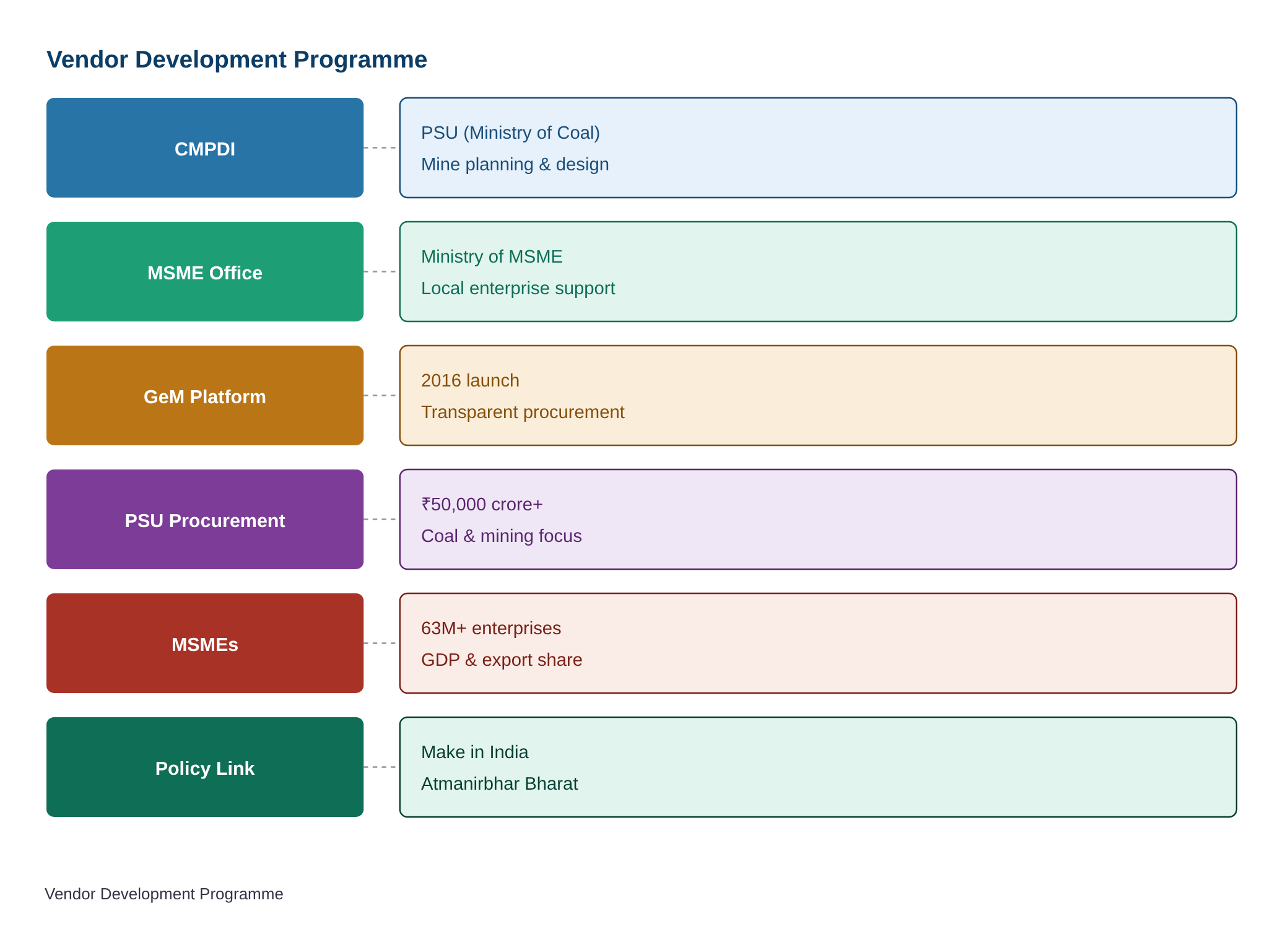
- The MSME sector contributes significantly to India’s GDP, employment generation, and industrial output, with over 63 million enterprises and a substantial share in exports.
- Public Sector Undertakings (PSUs) in the coal and mining sectors, such as Coal India Limited (CIL) and its subsidiaries, play a pivotal role in the national economy, with annual procurement expenditure exceeding ₹50,000 crore.
- The Government of India’s ‘Make in India’ and ‘Atmanirbhar Bharat’ initiatives aim to reduce import dependence and promote local manufacturing, creating opportunities for MSME integration into supply chains.
- The Government e-Marketplace (GeM) platform, launched in 2016, has emerged as a critical digital infrastructure for public procurement, enabling transparent and efficient vendor engagement.
- CMPDI, a Mini-Ratna Category-I PSU under the Ministry of Coal, is responsible for mine planning, design, and environmental services, while the MSME Development Office, Ranchi, functions under the Ministry of MSME to support local enterprises.
What is a Vendor Development Programme (VDP) and its significance in the context of MSMEs and PSUs?
- A Vendor Development Programme (VDP) is a structured initiative designed to strengthen linkages between large corporates or PSUs and MSMEs by facilitating direct engagement, knowledge transfer, and capacity building.
- Such programmes aim to enhance the competitiveness of MSMEs by aligning their capabilities with the procurement requirements of PSUs, thereby fostering sustainable business relationships and reducing supply chain inefficiencies.
- The Ranchi VDP-cum-Product Exhibition 2026 focused on sectors such as mining equipment, environmental services, mine closure technologies, and ancillary supplies, reflecting the operational domains of CMPDI and its stakeholders.
- Key components of the programme included technical sessions on procurement policies, buyer-seller interactions, product exhibitions, and awareness campaigns on schemes like GeM and TReDS.
- The event provided MSMEs with a platform to showcase their products, understand compliance requirements, and explore opportunities for collaboration with PSUs such as CMPDI, CCL, BSL, SAIL, and NTPC Mining Limited.
- The integration of GeM and TReDS in the programme highlights the government’s push for digital procurement reforms, ensuring transparency, efficiency, and timely payments to MSMEs.
- VDPs also serve as a mechanism for promoting indigenous innovation, reducing import dependence, and supporting the ‘Atmanirbhar Bharat’ vision by leveraging local expertise.
- The programme underscored the role of MSMEs in achieving self-reliance, particularly in critical sectors like coal and mining, where domestic manufacturing can enhance supply chain resilience.
Key Features
| Feature | Significance |
|---|---|
| Joint organisation by CMPDI (PSU) and MSME Development Office, Ranchi | Demonstrates inter-institutional collaboration between public-sector mining planning and MSME development arms under the Ministry of MSME. |
| Two-day vendor development programme cum exhibition | Provides a structured platform for MSMEs to showcase products, engage with buyers, and receive technical guidance. |
| Inclusion of GeM, TReDS, and public procurement policy sessions | Equips MSMEs with knowledge of digital procurement platforms and formal procurement frameworks. |
| Focus on indigenous innovation and localisation | Aligns with national objectives of Atmanirbhar Bharat by encouraging domestic manufacturing and technological self-reliance. |
| Participation of multiple PSUs (CMPDI, CCL, BSL, SAIL, HCL, SE Railway, GAIL, NTPC Mining) | Expands market access for MSMEs across diverse sectors such as mining, energy, and infrastructure. |
Why it Matters
Economic Development
- Enhances backward integration in the mining and industrial supply chain by fostering partnerships between MSMEs and large PSUs.
- Promotes entrepreneurship among micro and small enterprises, particularly in resource-rich states like Jharkhand.
- Encourages localisation of inputs, reducing import dependence and strengthening domestic industrial capacity.
Policy Implementation
- Operationalises the Public Procurement (Preference to Make in India) Order, 2017, by facilitating direct engagement between MSMEs and government buyers.
- Demonstrates the role of GeM and TReDS in streamlining procurement and improving MSME access to working capital.
- Supports the MSME Champions Scheme, 2020, by providing capacity-building and market linkage opportunities.
Institutional Synergy
- Bridges the gap between technical institutions (CMPDI) and entrepreneurship development agencies (MSME Development Office).
- Strengthens the role of PSUs as catalysts for MSME growth through structured vendor development initiatives.
- Fosters transparency in procurement processes, aligning with the Prevention of Corruption Act, 1988, and government vigilance frameworks.
Social Inclusion
- Encourages participation of women entrepreneurs and SC/ST-owned MSMEs through targeted outreach and capacity-building sessions.
- Promotes equitable growth by integrating marginalised sections into the formal supply chain of large industries.
Challenges
1. Access to Finance for MSMEs
- Limited collateral and credit history restrict MSMEs’ ability to leverage TReDS for receivables discounting.
- Need for greater awareness among MSMEs about government credit schemes such as the Credit Guarantee Fund Scheme for MSMEs.
UPSC Link: MSMEs and Credit Constraints
2. Technology and Skill Gaps
- MSMEs in traditional sectors often lack advanced manufacturing capabilities to meet PSU quality standards.
- Need for continuous upskilling through programmes like the Scheme of Fund for Regeneration of Traditional Industries (SFURTI).
UPSC Link: Technology Adoption in MSMEs
3. Procurement Barriers
- Complex bid processes and stringent eligibility criteria exclude smaller MSMEs from public procurement opportunities.
- Delays in payment cycles under government contracts strain MSME liquidity.
UPSC Link: Public Procurement and MSMEs
4. Geographical Disparities
- Concentration of MSMEs in urban centres limits rural and tribal entrepreneurs’ access to such programmes.
- Logistical challenges in transporting goods from remote areas to PSU hubs.
UPSC Link: Regional Disparities in MSME Growth
5. Awareness and Outreach
- Many MSMEs remain unaware of government schemes, GeM registration, or procurement policies.
- Need for sustained multi-channel information dissemination, including regional language materials.
UPSC Link: MSME Awareness and Outreach
Challenges — UPSC Perspective
| Issue | Concern |
|---|---|
| Credit Constraints | Inability to meet collateral requirements for loans or TReDS utilisation. |
| Quality Compliance | Difficulty in meeting PSU-specific technical and safety standards. |
| Bid Process Complexity | High documentation and eligibility hurdles deter small vendors. |
| Payment Delays | Extended payment cycles under government contracts affect cash flow. |
| Digital Divide | Limited digital literacy hinders participation in GeM and TReDS platforms. |
| Regional Imbalance | Concentration of programmes in urban areas excludes rural MSMEs. |
Government Initiatives — Must-Memorise for Prelims
- Public Procurement (Preference to Make in India) Order, 2017
- MSME Champions Scheme, 2020
- Government e-Marketplace (GeM) Platform
- Scheme of Fund for Regeneration of Traditional Industries (SFURTI)
Way Forward
- Expand the scope of vendor development programmes to tier-2 and tier-3 cities for inclusive growth.
- Strengthen the role of MSME Development Institutes (MSME-DIs) in post-programme handholding and mentorship.
- Integrate GeM and TReDS training into existing MSME skill development initiatives under the Ministry of MSME.
- Simplify procurement guidelines to lower entry barriers for micro-enterprises, particularly those owned by women and SC/ST.
- Establish a dedicated grievance redressal mechanism for MSMEs facing delays in payment or bid rejections.
- Promote public-private partnerships to set up regional incubation centres for MSMEs in mining and allied sectors.
- Conduct periodic impact assessments to measure the programme’s contribution to MSME turnover and employment generation.
UPSC Value Addition
Keywords for Mains Answer-Writing
MSME Development Programmes · Government e-Marketplace (GeM) · Trade Receivables Discounting System (TReDS) · Public Procurement Policy · Vendor Development Programmes · Public Sector Undertakings (PSUs) · Procurement Transparency · Indigenous Manufacturing · MSME Ecosystem · Corporate-MSME Partnerships · GeM Registration Process · TReDS Mechanism · Public Procurement Reforms · MSME Empowerment · Vendor Registration in PSUs
Constitutional & Policy Linkages
- Article 19(1)(g) – Right to practise any profession, or to carry on any occupation, trade or business (economic freedom).
- Directive Principles of State Policy (Article 43) – Promotion of cottage and small-scale industries.
Concept Flow
Policy Framework: Public Procurement (Preference to Make in India) Order, 2017 → MSME Champions Scheme, 2020 → Institutional Setup: CMPDI (PSU) + MSME Development Office (Ranchi) → Joint vendor development programme → Programme Design: Technical sessions + buyer-seller meets + exhibition → Capacity building and market linkage → Participant Engagement: MSMEs (15 units) + PSUs (5 organisations) → Direct interaction and procurement opportunities → Outcome: Enhanced MSME competitiveness + strengthened supply chains + localisation of inputs → Feedback Loop: Post-programme assessments → Iterative improvement in programme design and outreach
Prelims Practice Questions
Q1. Consider the following statements regarding the Government e-Marketplace (GeM):
1. GeM is an online platform for public procurement in India.
2. GeM enables direct procurement by government agencies from MSMEs.
3. GeM mandates the use of TReDS for all procurement transactions.
4. GeM provides a platform for vendors to register and bid for government tenders.
How many of the above statements are correct?
- Only one
- Only two
- Only three
- All four
Answer: Only three — Statements 1, 2, and 4 are correct. GeM is an online platform for public procurement, enables direct procurement from MSMEs, and provides a platform for vendor registration and bidding. Statement 3 is incorrect as TReDS is a separate mechanism for financing trade receivables and is not mandated for all procurement transactions.
Q2. Assertion (A): The Trade Receivables Discounting System (TReDS) is designed to address the liquidity challenges faced by MSMEs.
Reason (R): TReDS allows MSMEs to discount their trade receivables from buyers, including government agencies, to obtain immediate funds.
Options:
A. Both A and R are true, and R is the correct explanation of A.
B. Both A and R are true, but R is not the correct explanation of A.
C. A is true, but R is false.
D. A is false, but R is true.
Answer: ? — Both the Assertion (A) and Reason (R) are true, and R correctly explains A. TReDS is specifically designed to help MSMEs improve liquidity by discounting their trade receivables, including those from government agencies.
Q3. Match the following public sector undertakings (PSUs) with their respective sectors:
Column I (PSU) Column II (Sector)
A. CMPDI 1. Coal Mining
B. CCL 2. Mining and Metallurgy
C. NTPC 3. Mining and Exploration
D. Hindustan Copper Limited 4. Power Generation
Options:
A – 3, B – 1, C – 4, D – 2
A – 1, B – 3, C – 2, D – 4
A – 2, B – 1, C – 4, D – 3
A – 3, B – 1, C – 2, D – 4
- A – 3, B – 1, C – 4, D – 2
- A – 1, B – 3, C – 2, D – 4
- A – 2, B – 1, C – 4, D – 3
- A – 3, B – 1, C – 4, D – 2
Answer: A – 3, B – 1, C – 4, D – 2 — Correct matching: A. CMPDI (Central Mine Planning and Design Institute) – 3. Mining and Exploration; B. CCL (Central Coalfields Limited) – 1. Coal Mining; C. NTPC – 4. Power Generation; D. Hindustan Copper Limited – 2. Mining and Metallurgy.
Mains Practice Question
✍ The Government of India has been actively promoting vendor development programmes to foster partnerships between Public Sector Undertakings (PSUs) and Micro, Small, and Medium Enterprises (MSMEs). Critically examine the significance of such programmes in achieving the objectives of the Public Procurement Policy and the ‘Atmanirbhar Bharat’ initiative. Also, analyse the role of digital platforms like GeM and TReDS in facilitating these partnerships. (15 Marks)
Approach: MODEL-ANSWER SKELETON:
1. **Introduction (2 Marks)**
– Define vendor development programmes and their purpose in the context of PSU-MSME partnerships.
– Mention the ‘Atmanirbhar Bharat’ initiative and its emphasis on indigenous manufacturing and MSME empowerment.
2. **Significance of Vendor Development Programmes (5 Marks)**
– **Capacity Building**: How these programmes enhance the technical and managerial capabilities of MSMEs to meet PSU standards.
– **Procurement Transparency**: Role in ensuring fair and transparent procurement processes under the Public Procurement Policy (2017).
– **Localisation and Indigenous Manufacturing**: Alignment with ‘Make in India’ and ‘Atmanirbhar Bharat’ to reduce import dependency.
– **Sustainable Partnerships**: Long-term collaborations between PSUs and MSMEs, fostering innovation and economic growth.
– **Inclusivity**: Focus on women and SC/ST entrepreneurs, as highlighted in the programme.
3. **Role of Digital Platforms (5 Marks)**
– **GeM (Government e-Marketplace)**: Explain its role in streamlining procurement, vendor registration, and bidding processes. Mention its impact on reducing delays and improving efficiency.
– **TReDS (Trade Receivables Discounting System)**: Discuss how TReDS addresses liquidity constraints for MSMEs by allowing discounting of trade receivables, including those from government agencies.
– **Data-Driven Decision Making**: How digital platforms enable better tracking of procurement trends and vendor performance.
4. **Challenges and Way Forward (3 Marks)**
– **Awareness and Accessibility**: Barriers faced by MSMEs in participating due to lack of awareness or digital literacy.
– **Quality and Compliance**: Ensuring MSME products meet PSU standards and regulatory requirements.
– **Policy Implementation**: Need for continuous monitoring and evaluation of vendor development programmes.
– **Suggestions**: Strengthening mentorship programmes, simplifying compliance norms, and expanding digital infrastructure in rural areas.
Source: PIB (Press Information Bureau)
Jharkhand PCS (JPSC) — State PCS Practice
Prelims: Which of the following is a key objective of the two-day Vendor Development Program organized jointly by CMPDI and the MSME Development Office, Ranchi?
- To promote tribal entrepreneurship in Jharkhand’s mineral-based industries
- To facilitate skill development for youth in urban Jharkhand
- To enhance agricultural productivity in rural Jharkhand
- To establish new MSME units in non-mineral sectors
Answer: To promote tribal entrepreneurship in Jharkhand’s mineral-based industries — The program aimed at fostering vendor development in Jharkhand’s mineral-based industries, aligning with the state’s industrial growth and tribal entrepreneurship.
Mains: Discuss the significance of the Vendor Development Program organized by CMPDI and the MSME Development Office, Ranchi, for the industrial ecosystem of Jharkhand. Highlight its potential impact on local tribal entrepreneurs and the state’s economy.
Generated by AanyaAi for educational purpose.
Related guides on our sites
- Current affairs for upsc 2026
- How to prepare for GS paper 1 for UPSC CSE mains exam
- Best UPSC coaching for IFOS exam
- Best mentorship programme for upsc

- NAMASTE Scheme: Enhancing Sanitation Workers’ Livelihoods & Safety - November 14, 2026
- एमएसएमई का विशेष अभियान 6.0: स्वच्छता और लंबित मामलों का निपटारा - November 14, 2026
- Sea Vigil-26: Coastal Defence Drills Off Visakhapatnam - November 14, 2026

No Comments