


18 Sep CM’s Western Ghats Visit: Schools Shut in Tirthahalli for Safety
✎ The Kasturirangan Committee Report on the Western Ghats recommends the declaration of Ecologically Sensitive Areas (ESAs) covering 37% of the region to regulate developmental activities, balancing conservation with livelihood…
Subject Relevance — Where This Topic Fits
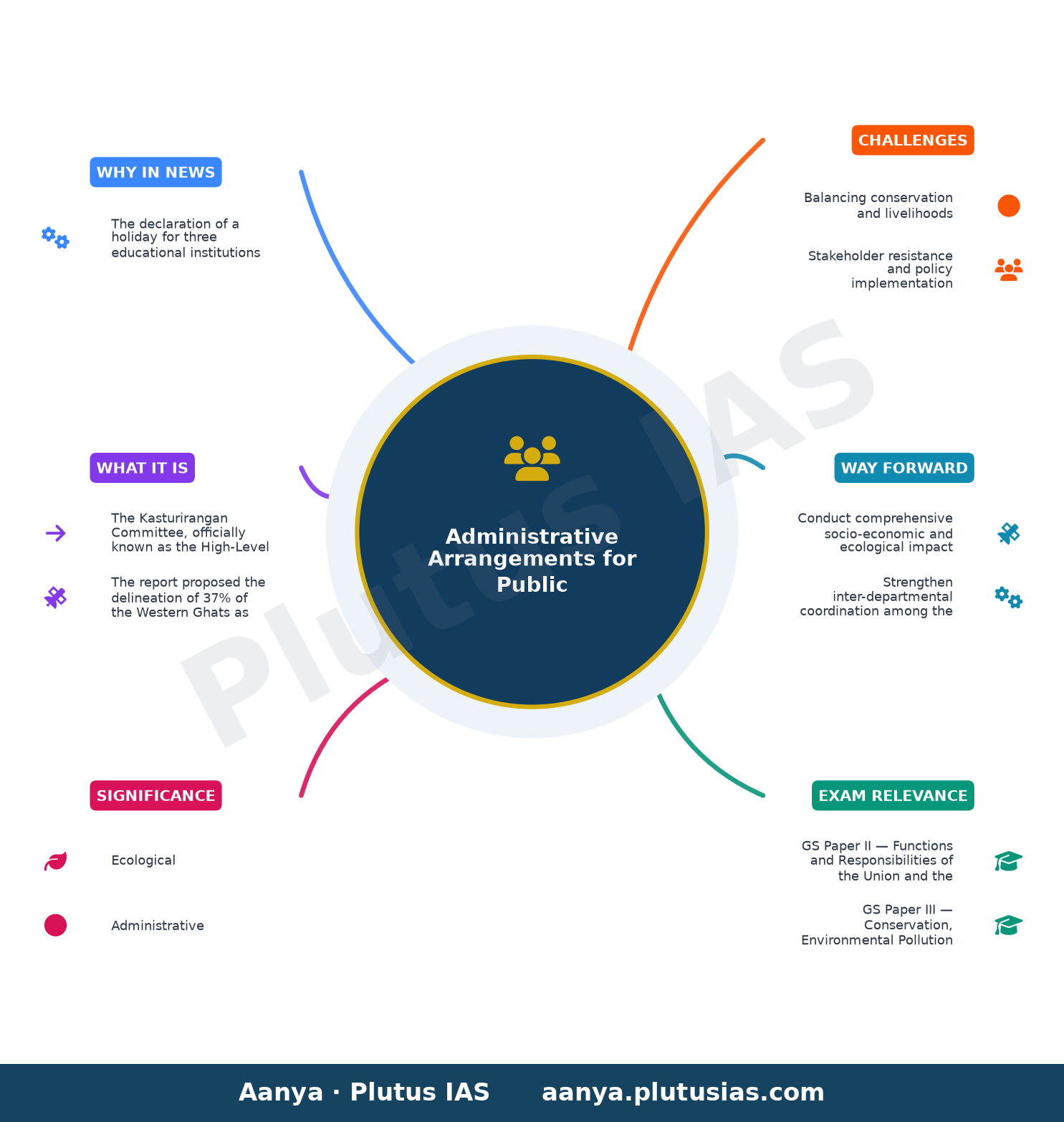
- GS Paper II — Functions and Responsibilities of the Union and the States, Issues and Challenges Pertaining to the Federal Structure | GS Paper III — Conservation, Environmental Pollution and Degradation, Environmental Impact Assessment
- Prelims: Western Ghats Ecology Expert Panel (WGEEP), Kasturirangan Committee Report, Ecologically Sensitive Areas (ESA), Environmental Impact Assessment (EIA), Federalism in environmental governance
- Essay: Environmental Conservation vs. Development: Balancing Act in India’s Western Ghats
Quick Revision: The Kasturirangan Committee Report on the Western Ghats recommends the declaration of Ecologically Sensitive Areas (ESAs) covering 37% of the region to regulate developmental activities, balancing conservation with livelihood concerns through participatory governance and phased regulatory measures.
Why is this in the news?
The declaration of a holiday for three educational institutions in Tirthahalli, Karnataka, on 19 September 2026, to facilitate the Chief Minister’s visit for public consultations on the Kasturirangan Committee Report on the Western Ghats, underscores the administrative and governance dimensions of environmental policy implementation. The visit, part of a broader tour to address stakeholder grievances, highlights the procedural and logistical challenges in balancing ecological conservation with developmental aspirations in ecologically sensitive regions.
Background
- The Western Ghats, a UNESCO World Heritage Site, is recognised as one of the world’s eight ‘hottest hotspots’ of biological diversity, supporting over 5,000 species of flowering plants, 139 mammal species, 508 bird species, and 179 amphibian species.
- The report’s recommendations have been contentious due to perceived conflicts with livelihoods dependent on agriculture, horticulture, and forest-based economies, particularly in states like Karnataka, Kerala, Tamil Nadu, and Goa.
- The Western Ghats Ecology Expert Panel (WGEEP), chaired by Madhav Gadgil (2011), had earlier proposed a more stringent regulatory framework, leading to prolonged debates on the balance between conservation and development.
- Karnataka has been actively engaging with stakeholders through public consultations, ministerial visits, and administrative measures to address concerns arising from the Kasturirangan Committee’s recommendations.
- The declaration of holidays for educational institutions in Tirthahalli is a logistical measure to ensure public order and safety during high-profile administrative visits, reflecting the intersection of governance, public administration, and environmental policy.
What is the Kasturirangan Committee Report on the Western Ghats?
- The Kasturirangan Committee, officially known as the High-Level Working Group on Western Ghats, was constituted in 2012 under the chairmanship of Dr. K. Kasturirangan to review the recommendations of the Gadgil Committee (WGEEP) and suggest a balanced approach to environmental conservation in the Western Ghats.
- The report proposed the delineation of 37% of the Western Ghats as Ecologically Sensitive Areas (ESAs), where developmental activities would be regulated under the Environment (Protection) Act, 1986, to mitigate ecological degradation.
- The report identified 126 talukas across six states (Kerala, Karnataka, Tamil Nadu, Goa, Maharashtra, and Gujarat) for ESA notification, with varying degrees of regulatory restrictions based on ecological sensitivity.
- Key recommendations included the establishment of a Western Ghats Ecology Authority (WGEA) to oversee implementation, phased phasing out of environmentally harmful activities, and promotion of sustainable livelihoods in buffer zones.
- The report emphasised the need for participatory governance, integrating local knowledge systems, and ensuring that conservation measures do not disproportionately impact marginalised communities dependent on forest and agricultural resources.
- The Kasturirangan Committee’s approach was designed to be less restrictive than the Gadgil Committee’s proposals, aiming for a middle path between conservation and development.
- Implementation of the report’s recommendations has been a subject of inter-state coordination, as the Western Ghats span multiple states with divergent socio-economic and ecological priorities.
- The report’s recommendations have been subject to judicial scrutiny, with the Supreme Court of India directing the Union Government to notify ESAs in the Western Ghats while considering state-specific concerns.
Key Features
| Feature | Significance |
|---|---|
| Declaration of holiday for educational institutions | Ensures safety of students and staff during high-traffic public events, demonstrating administrative prudence in managing civic logistics. |
| Chief Minister’s helicopter tour to Tirthahalli and Balehonnur | Facilitates rapid high-level engagement with stakeholders in remote Western Ghats regions, enabling direct assessment of local concerns. |
| Public consultation on K. Kasturirangan report | Provides a formal platform for citizens to voice grievances and suggestions, aligning with principles of participatory governance and decentralised decision-making. |
| Presence of multiple cabinet ministers | Signals inter-departmental coordination on environmental governance, particularly forest and education portfolios, reflecting integrated policy response. |
| Focus on Western Ghats conservation | Highlights the ecological significance of the Western Ghats as a biodiversity hotspot and UNESCO World Heritage Site, necessitating evidence-based policy interventions. |
Why it Matters
Ecological
- The Western Ghats, a globally recognised biodiversity hotspot, is under ecological stress due to anthropogenic pressures such as deforestation, agriculture, and infrastructure development.
- The K. Kasturirangan report proposes a regulatory framework (including the Ecologically Sensitive Area (ESA) notification) to balance conservation with livelihood needs, making it a critical policy instrument for sustainable development.
- Public consultations are essential to reconcile conservation imperatives with the socio-economic realities of local communities, particularly in agrarian and forest-dependent regions.
Administrative
- The Chief Minister’s visit underscores the state government’s commitment to inclusive policymaking, where field-level feedback informs high-level decision-making.
- The declaration of a holiday for educational institutions reflects administrative foresight in mitigating disruptions to civic life during high-profile public engagements.
- The coordination among multiple ministries (Forest, Education, and School Education) exemplifies the need for inter-departmental synergy in addressing complex environmental governance challenges.
Socio-economic
- The Western Ghats region is home to diverse communities, including farmers, tribals, and forest dwellers, whose livelihoods are intricately linked to the ecosystem.
- Policies like the ESA notification aim to regulate land use, which can impact agricultural practices, particularly in areca nut and coffee cultivation, necessitating stakeholder engagement.
- Public consultations serve as a mechanism to address grievances and build consensus, reducing resistance to conservation measures.
Legal
- The K. Kasturirangan report is based on the recommendations of the Western Ghats Ecology Expert Panel (WGEEP), which was constituted under the Environment Protection Act, 1986.
- The ESA notification, if implemented, would be framed under the provisions of the Environment (Protection) Act, 1986, and the Forest Rights Act, 2006, to regulate activities in ecologically sensitive zones.
Challenges
1. Balancing conservation and livelihoods
- The Western Ghats region is a major agricultural hub, with areca nut, coffee, and spices being key crops. Restrictive conservation measures risk alienating local communities.
- Forest-dependent tribes and other marginalised groups rely on non-timber forest products (NTFPs) for their livelihoods, which may be adversely affected by stringent regulations.
- The need to reconcile ecological imperatives with economic development creates a policy dilemma, requiring evidence-based and participatory approaches.
UPSC Link: GS3: Conservation, Environmental Pollution & Degradation
2. Stakeholder resistance and policy implementation
- Local communities, particularly farmers and cooperatives, have expressed concerns over the ESA notification, citing potential curbs on agricultural activities.
- Political and electoral considerations may influence the pace and nature of policy implementation, leading to delays or dilution of conservation measures.
- The multiplicity of governance actors (Centre, State, local bodies) can create coordination challenges, requiring robust institutional mechanisms for effective implementation.
UPSC Link: GS2: Government Policies & Interventions
3. Ecological fragility and climate vulnerability
- The Western Ghats is a critical water source for peninsular India, with its rivers and catchments supporting millions of people. Degradation of the ecosystem threatens water security.
- Climate change exacerbates the fragility of the Western Ghats, increasing the frequency of extreme weather events such as landslides and floods.
- Inadequate enforcement of conservation measures and lack of awareness among local communities further exacerbate ecological degradation.
UPSC Link: GS3: Environmental Impact Assessment
4. Logistical and administrative constraints
- The remoteness of the Western Ghats region poses challenges for effective governance, including limited infrastructure and communication networks.
- High-level visits, while symbolically important, require meticulous planning to ensure meaningful engagement with stakeholders and avoid disruptions to civic life.
- The need for multi-stakeholder consultations demands significant administrative resources, which may be constrained by competing priorities.
UPSC Link: GS2: Role of Civil Services in Policy Implementation
5. Legal and constitutional ambiguities
- The division of powers between the Centre and State governments in matters of environmental governance is often ambiguous, leading to jurisdictional conflicts.
- The Forest Rights Act, 2006, and the Environment Protection Act, 1986, have overlapping provisions, creating legal uncertainties in the implementation of conservation measures.
- The lack of a clear legal framework for compensating communities affected by conservation restrictions can lead to resistance and non-compliance.
UPSC Link: GS2: Federalism & Centre-State Relations
Challenges — UPSC Perspective
| Issue | Concern |
|---|---|
| Stakeholder resistance to ESA notification | Farmers and cooperatives oppose restrictions on agricultural activities, risking policy rollback or dilution. |
| Ecological fragility of Western Ghats | Degradation threatens water security, biodiversity, and climate resilience, necessitating urgent conservation measures. |
| Administrative and logistical constraints | Remoteness and limited infrastructure hinder effective governance and stakeholder engagement. |
| Legal ambiguities in environmental governance | Overlapping laws and jurisdictional conflicts create implementation challenges. |
| Climate change exacerbation | Increased frequency of extreme weather events threatens the stability of the ecosystem and livelihoods. |
| Policy implementation delays | Political and electoral considerations may delay or dilute conservation measures, undermining long-term goals. |
Way Forward
- Conduct comprehensive socio-economic and ecological impact assessments to inform the ESA notification, ensuring that conservation measures are evidence-based and context-specific.
- Strengthen inter-departmental coordination among the Forest Department, Education Department, and local bodies to streamline policy implementation and address logistical challenges.
- Institute mechanisms for compensating communities affected by conservation restrictions, such as payments for ecosystem services (PES) or alternative livelihood programmes.
- Enhance public awareness campaigns to educate local communities about the ecological significance of the Western Ghats and the benefits of conservation measures.
- Establish grievance redressal mechanisms at the district and taluk levels to address stakeholder concerns and build trust in the policy process.
- Promote participatory governance by involving local communities, NGOs, and experts in the design and monitoring of conservation initiatives.
- Integrate climate adaptation strategies into conservation plans to address the growing threats posed by climate change to the Western Ghats ecosystem.
- Leverage technology, such as GIS mapping and remote sensing, to monitor ecological changes and enforce conservation measures effectively.
UPSC Value Addition
Keywords for Mains Answer-Writing
Western Ghats · Kasturirangan Report · Ecologically Sensitive Areas (ESA) · Environmental governance · State-Citizen interface · Public consultation mechanisms · Forest conservation · Regional development · Administrative procedures · Sustainable development · Tirthahalli · Karnataka administration
Concept Flow
Western Ghats as a biodiversity hotspot and UNESCO World Heritage Site → Ecological significance and conservation imperatives → Formulation of K. Kasturirangan report and ESA notification → Public consultations and stakeholder engagement → Administrative response (CM’s visit) → Policy implementation and challenges → Balancing conservation with livelihoods.
Prelims Practice Questions
Q1. Consider the following statements regarding the K. Kasturirangan report on the Western Ghats:
1. The report recommends the declaration of Ecologically Sensitive Areas (ESA) covering 37% of the Western Ghats.
2. The report was submitted to the Ministry of Environment, Forest and Climate Change in 2013.
3. The report classifies the Western Ghats into three zones based on ecological sensitivity.
How many of the above statements are correct?
- Only one
- Only two
- All three
- None
Answer: All three — Statements 1 and 2 are correct. Statement 3 is incorrect as the report classifies the Western Ghats into two zones: ESAs and non-ESAs.
Q2. Which of the following is NOT a function of the Western Ghats Ecology Expert Panel (WGEEP) headed by Dr. K. Kasturirangan?
- To assess the ecological status of the Western Ghats region
- To recommend measures for the conservation of the Western Ghats
- To declare Ecologically Sensitive Areas (ESA) under the Wildlife Protection Act, 1972
- To prepare a comprehensive plan for sustainable development in the Western Ghats
Answer: To declare Ecologically Sensitive Areas (ESA) under the Wildlife Protection Act, 1972 — The WGEEP did not have the authority to declare ESAs under the Wildlife Protection Act, 1972; this is a function of the central government.
Q3. Assertion (A): The Kasturirangan report on the Western Ghats recommends a blanket ban on all developmental activities in the declared Ecologically Sensitive Areas (ESA).
Reason (R): The report aims to prioritise environmental conservation over economic development in the Western Ghats region.
- Both A and R are true, and R is the correct explanation of A
- Both A and R are true, but R is NOT the correct explanation of A
- A is true, but R is false
- A is false, but R is true
Answer: ? — Assertion (A) is false as the report does not recommend a blanket ban but proposes regulated activities in ESAs. Reason (R) is true as the report prioritises conservation.
Mains Practice Question
✍ The State administration’s decision to declare a holiday for educational institutions in Tirthahalli to facilitate the Chief Minister’s public consultation on the Kasturirangan report on the Western Ghats exemplifies the evolving interface between governance and public participation in environmental policymaking. Critically examine the mechanisms of public consultation in environmental governance in India, with reference to the Kasturirangan report and recent judicial pronouncements. (15 Marks)
Approach: MODEL-ANSWER SKELETON:
1. **Introduction** (2 marks): Define environmental governance and public consultation mechanisms in India, citing constitutional provisions (Art. 48A, Art. 51A(g)) and statutory frameworks (Environment Protection Act, 1986; Forest Rights Act, 2006).
2. **Public Consultation Mechanisms** (4 marks):
– Role of State governments in organising public consultations (e.g., public hearings under EIA Notification, 2006).
– Examples of recent consultations (e.g., K. Kasturirangan report public meetings in Karnataka, Kerala, Maharashtra).
– Administrative procedures for ensuring participation (e.g., notifications, grievance redressal mechanisms).
3. **Kasturirangan Report Context** (4 marks):
– Background: WGEEP (2011) and Kasturirangan Committee (2013) reports on Western Ghats conservation.
– Key recommendations: Declaration of ESAs, zoning, regulated activities.
– Public response: Protests, political debates, and demands for modifications.
4. **Judicial Pronouncements** (3 marks):
– Supreme Court’s stance on environmental governance (e.g., T.N. Godavarman Thirumulpad case, 1996; Alembic Pharmaceuticals Ltd. v. Rohit Prajapati, 2020).
– Emphasis on public participation in environmental decision-making (e.g., Vellore Citizens Welfare Forum v. Union of India, 1996).
5. **Critical Analysis** (2 marks):
– Strengths: Enhanced transparency, stakeholder engagement, and democratic legitimacy.
– Challenges: Limited reach, elite capture, and delays in implementation.
– Suggestions for improvement: Use of digital platforms, local language outreach, and post-consultation feedback mechanisms.
Source: The Hindu
Generated by AanyaAi for educational purpose.
Related guides on our sites
- Current affairs for upsc 2026
- Best PSIR optional coaching for upsc
- Best economics optional coaching for upsc
- Best PSIR optional teacher for upsc

- CM’s Western Ghats Visit: Schools Shut in Tirthahalli for Safety - September 18, 2026
- तमिलनाडु की आर्थिक क्षमता बढ़ाने के लिए केर्नी रिपोर्ट के प्रमुख सुझाव - September 18, 2026
- Kearney Report: Tamil Nadu’s Fiscal Gap Can Be Bridged Without New Taxes or Loans - September 18, 2026

No Comments