


09 Aug CPI Warns AP Over Telangana’s Krishna Lift Irrigation Project: UPSC Exam Analysis
✎ The Krishna River Management Board (KRMB) and the Apex Council, as mandated under the Andhra Pradesh Reorganisation Act, 2014, are the primary institutional mechanisms for regulating inter-state water disputes in the Krishna…
Subject Relevance — Where This Topic Fits
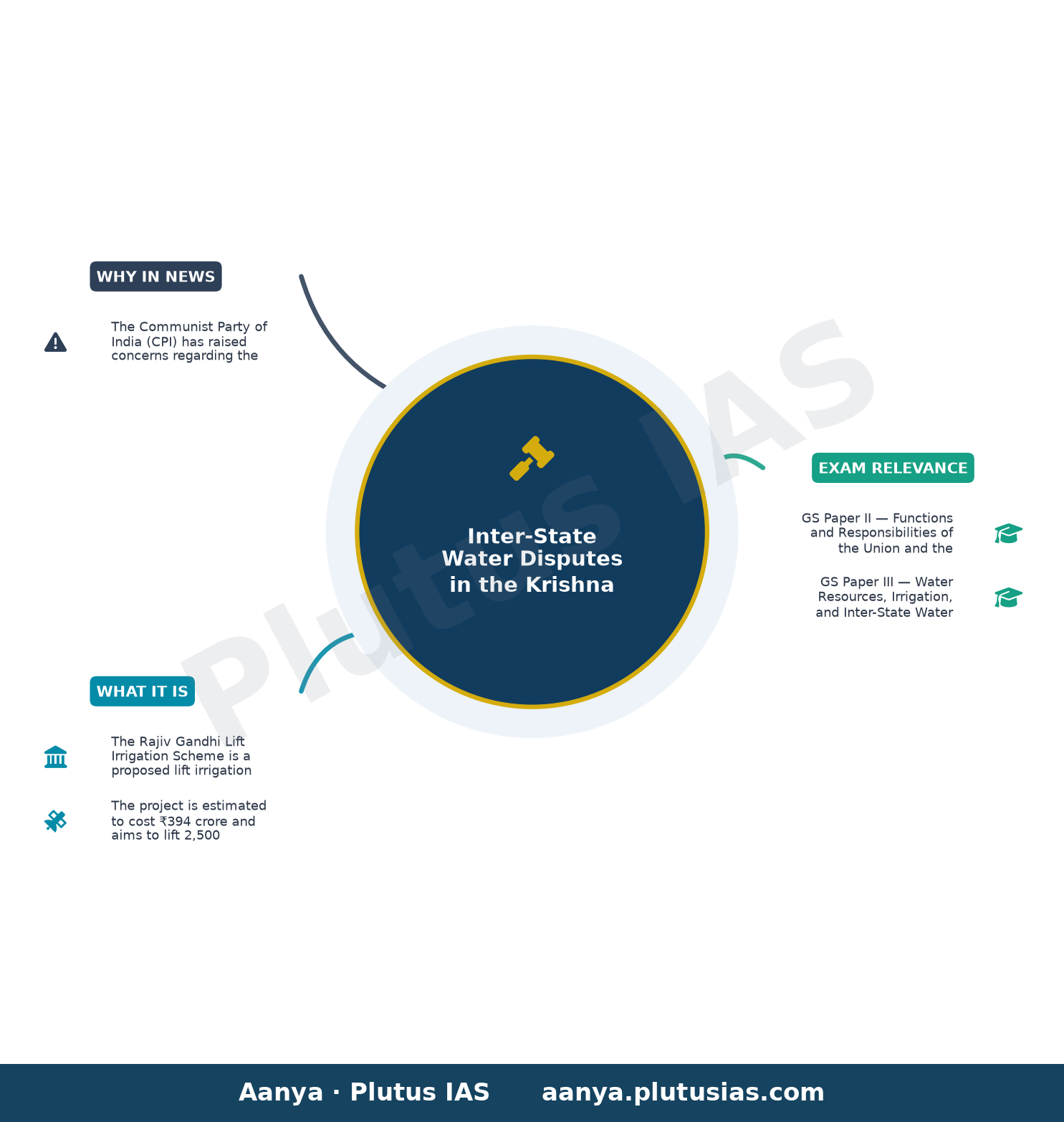
- GS Paper II — Functions and Responsibilities of the Union and the States, Issues and Challenges Pertaining to the Federal Structure | GS Paper III — Water Resources, Irrigation, and Inter-State Water Disputes
- Prelims: Krishna River Management Board (KRMB), Andhra Pradesh Reorganisation Act, 2014, Apex Council under the Inter-State Water Disputes Act, 1956, Pulichintala Project, Lift Irrigation Schemes, Inter-State River Water Disputes (Amendment) Act, 2019, Cauvery Water Disputes Tribunal, National Water Policy, 2012
- Essay: Federalism and Centre-State Relations in Water Governance: Balancing Development and Equity, Sustainable Water Resource Management: Lessons from Inter-State River Basin Conflicts
Quick Revision: The Krishna River Management Board (KRMB) and the Apex Council, as mandated under the Andhra Pradesh Reorganisation Act, 2014, are the primary institutional mechanisms for regulating inter-state water disputes in the Krishna basin, ensuring adherence to legal frameworks before the execution of projects like the Rajiv Gandhi Lift Irrigation Scheme.
Why is this in the news?
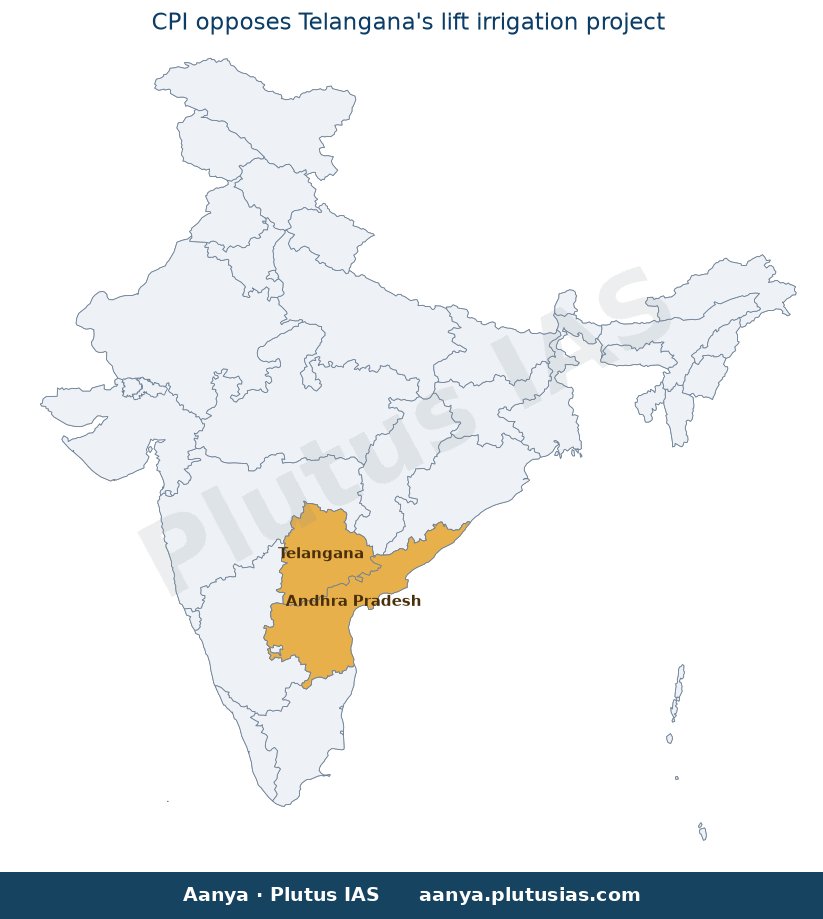
The Communist Party of India (CPI) has raised concerns regarding the construction of the Rajiv Gandhi Lift Irrigation Scheme by Telangana near the Pulichintala reservoir in Andhra Pradesh, alleging potential adverse impacts on existing lift irrigation projects, drinking water supply, and agricultural land in Andhra Pradesh. The controversy highlights the persistent challenges in inter-state water governance within the Krishna basin, particularly the need for adherence to legal and institutional frameworks such as the Andhra Pradesh Reorganisation Act, 2014, and the role of the Krishna River Management Board (KRMB) and the Apex Council.
Background
- The Krishna River, the second-largest east-flowing peninsular river in India, is a critical water resource for the states of Maharashtra, Karnataka, Telangana, and Andhra Pradesh, supporting agriculture, industry, and drinking water supply.
- Post-bifurcation of Andhra Pradesh in 2014, the Andhra Pradesh Reorganisation Act, 2014, was enacted to address the distribution of assets, liabilities, and water resources between Telangana and the residual Andhra Pradesh.
- The Act mandated the establishment of the Krishna River Management Board (KRMB) and the Godavari River Management Board (GRMB) under Section 85 to regulate and manage the Krishna and Godavari river systems, respectively.
- The Pulichintala Project, a multi-purpose irrigation project on the Krishna River, was commissioned to provide irrigation security to 1.3 million acres across seven districts in Andhra Pradesh, including Guntur, Palnadu, Prakasam, Bapatla, Krishna, NTR, and Eluru.
What is the Rajiv Gandhi Lift Irrigation Scheme?
- The Rajiv Gandhi Lift Irrigation Scheme is a proposed lift irrigation project by the Telangana government, located between Bugga Madaram and Dondapadu villages in Chintalapalem mandal of Suryapet district, Telangana.
- The project is estimated to cost ₹394 crore and aims to lift 2,500 cusecs of water daily to stabilise irrigation facilities over 14,000 acres under the Muktyala Major Branch of the Nagarjunasagar Left Canal system.
- Lift irrigation involves pumping water from a lower elevation to a higher elevation to facilitate irrigation, which is critical in regions where gravity-based irrigation is not feasible due to topographical constraints.
- The scheme is intended to enhance agricultural productivity and water security in the designated command area, aligning with Telangana’s broader irrigation and agricultural development goals.
- The project’s proximity to the Pulichintala reservoir has raised concerns in Andhra Pradesh regarding potential disruptions to existing lift irrigation schemes, drinking water supply, and agricultural land.
- The scheme’s construction and operation require prior approvals from the Apex Council and the KRMB as mandated under Sections 84 and 85 of the Andhra Pradesh Reorganisation Act, 2014.
- Lift irrigation schemes are often contentious in inter-state river basins due to their potential to alter downstream water availability, necessitating rigorous technical and legal scrutiny.
UPSC Value Addition
Keywords for Mains Answer-Writing
Krishna River water disputes · Andhra Pradesh-Telangana inter-state water conflicts · Pulichintala project · Rajiv Gandhi Lift Irrigation Scheme · Krishna River Management Board (KRMB) · Andhra Pradesh Reorganisation Act, 2014 · Apex Council for inter-state river disputes · lift irrigation schemes in Krishna basin · inter-state water sharing mechanisms · federalism in water governance · water rights and agricultural impact · constitutional provisions for river disputes · inter-state coordination in water projects · irrigation and drinking water security · federalism and cooperative federalism in water management
Prelims Practice Questions
Q1. Consider the following statements regarding the Pulichintala project and its significance:
1. The Pulichintala project is designed to regulate the flow of the Krishna River and ensure irrigation and drinking water supplies to downstream areas.
2. The project provides irrigation security to nearly 1.3 million acres of Krishna delta ayacut across multiple districts in Andhra Pradesh.
3. The Pulichintala project is a lift irrigation scheme that lifts water from the Krishna River to higher elevations for agricultural use.
How many of the above statements are correct?
- Only one
- Only two
- All
- None
Answer: All — Statements 1 and 2 are correct as they accurately describe the Pulichintala project’s purpose and coverage. Statement 3 is incorrect because the Pulichintala project is a reservoir-based project, not a lift irrigation scheme.
Q2. Assertion (A): The Krishna River Management Board (KRMB) is empowered to approve new lift irrigation schemes in the Krishna basin under the Andhra Pradesh Reorganisation Act, 2014.
Reason (R): The Apex Council, headed by the Union Jal Shakti Minister, is the final authority for resolving inter-state river water disputes in India.
Options:
A. Both A and R are true, and R is the correct explanation of A.
B. Both A and R are true, but R is not the correct explanation of A.
C. A is true, but R is false.
D. A is false, but R is true.
Answer: ? — Both Assertion (A) and Reason (R) are true. The KRMB is indeed empowered under Sections 84 and 85 of the Andhra Pradesh Reorganisation Act, 2014, to approve new lift irrigation schemes. The Apex Council, headed by the Union Jal Shakti Minister, is the final authority for resolving inter-state river water disputes, making R the correct explanation of A.
Q3. Match the following inter-state river water disputes with the relevant constitutional or statutory bodies responsible for their resolution:
Column I:
A. Krishna River dispute between Andhra Pradesh and Telangana
B. Cauvery River dispute between Karnataka and Tamil Nadu
C. Ravi-Beas River dispute between Punjab and Haryana
D. Godavari River dispute between Maharashtra and Telangana
Column II:
1. Cauvery Water Disputes Tribunal
2. Krishna River Management Board (KRMB)
3. Ravi & Beas Waters Tribunal
4. Godavari River Management Board (GRMB)
Options:
A. A-2, B-1, C-3, D-4
B. A-1, B-2, C-3, D-4
C. A-3, B-1, C-2, D-4
D. A-4, B-2, C-1, D-3
Answer: ? — The correct matches are: A (Krishna River dispute) – 2 (KRMB), B (Cauvery River dispute) – 1 (Cauvery Water Disputes Tribunal), C (Ravi-Beas River dispute) – 3 (Ravi & Beas Waters Tribunal), and D (Godavari River dispute) – 4 (GRMB).
Mains Practice Question
✍ The construction of the Rajiv Gandhi Lift Irrigation Scheme by Telangana near the Pulichintala project on the Krishna River raises critical issues of federalism, constitutional compliance, and inter-state water governance. Critically examine the constitutional and statutory framework governing inter-state river water disputes in India, with particular reference to the role of the Krishna River Management Board (KRMB) and the Apex Council. Also, analyse the potential implications of unilateral construction of such projects on cooperative federalism and agricultural security in the Krishna basin. (15 Marks)
Approach: MODEL-ANSWER SKELETON:
1. **Constitutional Framework for Inter-State River Water Disputes**:
– Article 262 of the Constitution empowers Parliament to provide for the adjudication of inter-state river water disputes.
– The Inter-State Water Disputes Act, 1956, provides the legal mechanism for resolving such disputes.
– The 42nd Amendment Act, 1976, inserted Article 262(2), which bars the jurisdiction of the Supreme Court and other courts in inter-state river water disputes.
2. **Statutory Bodies for Krishna River Disputes**:
– **Krishna River Management Board (KRMB)**: Constituted under Section 84 of the Andhra Pradesh Reorganisation Act, 2014, to regulate and supervise the Krishna River basin.
– **Apex Council**: Headed by the Union Jal Shakti Minister, it is the final authority for resolving inter-state river water disputes, including those in the Krishna basin (Section 85 of the Act).
– **Role of KRMB**: Approval of new lift irrigation schemes, regulation of water releases, and monitoring of projects.
3. **Constitutional and Statutory Compliance Issues**:
– Sections 84 and 85 of the Andhra Pradesh Reorganisation Act, 2014, mandate prior approval from the Apex Council and KRMB for new lift irrigation schemes in the Krishna basin.
– Unilateral construction of the Rajiv Gandhi Lift Irrigation Scheme by Telangana violates these provisions, raising legal concerns.
– The absence of such approvals undermines the constitutional framework and cooperative federalism.
4. **Implications for Cooperative Federalism**:
– **Erosion of Trust**: Unilateral actions by states erode trust and undermine the spirit of cooperative federalism.
– **Legal Recourse**: Affected states (e.g., Andhra Pradesh) may seek legal recourse through the Supreme Court or approach the Apex Council for resolution.
– **Precedents**: Similar disputes (e.g., Cauvery, Ravi-Beas) highlight the need for adherence to statutory and constitutional mechanisms.
5. **Agricultural and Water Security Concerns**:
– **Impact on Andhra Pradesh**: The Pulichintala project provides irrigation security to 1.3 million acres in Andhra Pradesh. Unilateral projects by Telangana may disrupt water flows, affecting agriculture and drinking water supplies.
– **Agricultural Impact**: Potential reduction in water availability for 51 lift irrigation schemes in Andhra Pradesh, affecting 50,000 acres and thousands of farmers.
– **Economic Consequences**: Disruptions in irrigation and drinking water supply could lead to economic losses and social unrest.
6. **Balancing Competing Demands**:
– **Equitable Water Sharing**: The need for equitable water sharing mechanisms to balance the demands of riparian states.
– **Sustainable Water Management**: Emphasis on sustainable water management practices to ensure long-term agricultural and ecological security.
7. **Conclusion**:
– The unilateral construction of the Rajiv Gandhi Lift Irrigation Scheme by Telangana violates the constitutional and statutory framework governing inter-state river water disputes.
– It undermines cooperative federalism and poses significant risks to agricultural and water security in the Krishna basin.
– Affected states must pursue legal and diplomatic avenues to resolve the dispute and uphold the principles of federalism and constitutional compliance.
Source: The Hindu
Generated by AanyaAi for educational purpose.

- यूपी में पहली बार तेंदुओं का बधियाकरण: मानव-वन्यजीव संघर्ष रोकेगा अभियान - September 24, 2026
- UP’s Groundbreaking Leopard Sterilization Plan to Curb Human-Wildlife Conflict - September 24, 2026
- महाराष्ट्र में त्योहार जुलूसों पर बॉम्बे हाईकोर्ट का बड़ा फैसला: पटाखे, लेजर और संगीत पर रोक - September 24, 2026

No Comments